
Rhea Ewing
Author of Fine: A Comic About Gender
Series
Works by Rhea Ewing
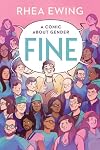
Fine: A Coming About Gender 1 copy
Tagged
Common Knowledge
- Birthdate
- 1988-10-16
- Gender
- non-binary
- Short biography
- Rhea Ewing (they/them) is a comic illustrator and fine artist who graduated from University of Wisconsin-Madison with a BFA in drawing and printmaking. They currently live in California, taking artistic inspiration from the state's diverse landscapes.
- Nationality
- USA
- Birthplace
- Kentucky, USA
- Associated Place (for map)
- Kentucky, USA
Members
Reviews
I really enjoyed this compilation of thoughts on the subject of gender -- not only is it powerful as a documentation of interviews and experience, but it covers a vast array of topics that are both adjacent to and integral to expressing gender identity in the US. There is just so much to think about here -- from personal stories to big topics of privilege and race and housing and poverty to unexpected biases and acceptances that all combine to make gender a complicated topic. I loved that show more Rhea felt comfortable sharing their own story -- it pulls the book together beautifully. They have a compassionate and inclusive heart and it shows in what they choose to share and how they look for hope in the future. I think this is a strong and thought-provoking work. It's also a very well done graphic novel.
Advanced Reader's Copy provided by Edelweiss. show less
Advanced Reader's Copy provided by Edelweiss. show less
I'll admit that I'm still playing catch-up when it comes to understanding the dynamic world of gender identity that exists outside my little heteronormative and cisgender shell, so I welcome the insights and experiences offered up by the author and the dozens of people they interviewed for this very personal look at issues faced by the LGBTQIA+ community. It took me longer to get through than the average graphic novel, but I always found myself reluctant to stop and eager to return.
So many show more problems stem from the constructions of masculinity and femininity we've built as a society over time and the use of a language where the desire to ignore and hurt that which is outside the binary is inherent and only just starting to change.
It's a shame that in addition to all the outside pressures faced, there is internecine strife that can also be damaging, especially since the search for a community where one feels accepted and safe is a recurring theme, one that is pretty universal to humanity regardless of gender.
A picayune observation: In a book where every panel seems to be an original illustration, I noticed that the same drawing of the high-heeled shoe of ultimate femininity repeats on pages 76, 243, and 293. I point this out merely to justify the amount of time I spent compulsively combing the book for its previous appearances to verify I wasn't imagining things once it struck me as familiar on its third showing. show less
So many show more problems stem from the constructions of masculinity and femininity we've built as a society over time and the use of a language where the desire to ignore and hurt that which is outside the binary is inherent and only just starting to change.
It's a shame that in addition to all the outside pressures faced, there is internecine strife that can also be damaging, especially since the search for a community where one feels accepted and safe is a recurring theme, one that is pretty universal to humanity regardless of gender.
A picayune observation: In a book where every panel seems to be an original illustration, I noticed that the same drawing of the high-heeled shoe of ultimate femininity repeats on pages 76, 243, and 293. I point this out merely to justify the amount of time I spent compulsively combing the book for its previous appearances to verify I wasn't imagining things once it struck me as familiar on its third showing. show less
This book started out as a small college project as Rhea struggled to answer the question, "what even is gender anyway?" that eventually spun out over a decade with (often multiple) interviews with fifty-six people from all over the United States (though mostly residing in the Midwest at the time). Rhea talks to people all over and outside of the gender binary, asking questions like: What is the difference between gender and sex? And getting into issues like queer community, public show more restrooms, intersectionality, family reactions, discrimination in the workplace, gender euphoria, etc., along the way.
I LOVED the graphic form of this. For once thing, I tend to have a pretty visual memory when it comes to people, so shifting back and forth between 56 subjects (plus the author and lots of other assorted characters), it was much easier to remember each person from their drawing than if they had just been reintroduced by name. Plus many people are interviewed again over the years, and I enjoyed seeing the changes in their gender presentation without the added layer of remove of someone trying to describe it in words.
Mostly I loved that this was a depiction of a diverse group of people just trying to do their best to be true to themselves under wildly varying circumstances. It is a rejection of cookie cutter solutions and labels. What works incredibly well for one person may not even work for that same person two years later. But that doesn't make the struggle any less important.
There is some terminology here that is a bit outdated, but it is mostly people using it to describe themselves, and a consequence of just how quickly the culture and language is changing around gender.(The book came out in 2022, but the project started in 2010).
LOVED. show less
I LOVED the graphic form of this. For once thing, I tend to have a pretty visual memory when it comes to people, so shifting back and forth between 56 subjects (plus the author and lots of other assorted characters), it was much easier to remember each person from their drawing than if they had just been reintroduced by name. Plus many people are interviewed again over the years, and I enjoyed seeing the changes in their gender presentation without the added layer of remove of someone trying to describe it in words.
Mostly I loved that this was a depiction of a diverse group of people just trying to do their best to be true to themselves under wildly varying circumstances. It is a rejection of cookie cutter solutions and labels. What works incredibly well for one person may not even work for that same person two years later. But that doesn't make the struggle any less important.
There is some terminology here that is a bit outdated, but it is mostly people using it to describe themselves, and a consequence of just how quickly the culture and language is changing around gender.(The book came out in 2022, but the project started in 2010).
LOVED. show less
No matter how many compelling adjectives I use in my review, they will fall short to explain what an illuminative experience reading this book has been!!
From the days when there were (supposedly) only two main genders – male and female – to today when gender is known to be not a binary concept but a spectrum, human thinking and acceptance of gender variations has come a long way. Unfortunately, we have an even longer path to journey ahead. In an age where there are so many gender-related show more terms coming up regularly – genderqueer, nonbinary, genderfluid, androgyne, cisgender, agender,… it is so easy to feel lost and confused, trying to understand who is what, who prefers what, what is what!
This book won’t provide you with a dictionary of definitions but it will certainly help you understand concepts you never looked at or attempted to understand before. Because of its inherent structure, it provides perspectives, not definite solutions or fixed answers. Using the information it provides, you will be at least a little better prepared to understand the nuances of gender in today’s world.
Rhea Ewing is a visual artist based in California. After struggling with their own gender identity for a long time (right term for this: ‘Gender Dysphoria’, which I now know thanks to this book), they decided to take up a social study as their college project. The plan was to ask people their idea of what gender means to them. (Try asking this question to yourself: “what is gender?” It’s not as easy as it sounds.) As the interactions grew, their questions, and thus their project, went on increasing in complexity and span. Rhea ended up spending more than a decade on their project. This book is the end result of all those efforts. As they write in the introduction, “Take the book for what it is: my own attempt to understand and connect with other people. No more, no less.”
The structure of the book can be primarily divided into three categories: a theme/topic introduced through Rhea’s memories or experiences, answers related to that theme/topic taken from Rhea’s interviews with people of various gender identities, and finally Rhea’s own musings on that theme/topic before moving on to the next topic. The themes are as varied as race, language, hormones, healthcare, bathrooms, feelings, and many more.
The content is staggering to comprehend. This is not a book to be read in one go but to be pondered over slowly and discussed often. I would have appreciated a glossary of the various gender identities because not everything comes out clearly through the interviews. At the same time, I can understand the difficult of collating so much information into a sensible and coherent flow and why a glossary would have been difficult to include – the definitions are still evolving and as of now, are more fluid than fixed, just like the idea of ‘gender’ itself. I can't say if I'll remember everything I read in this book but I've definitely learnt a lot and have begun looking with a fresh perspective at many things I’ve always taken for granted.
Though this was a graphic novel, I didn’t really focus much on the artistic style used. This is a book you ought to read for its content, not for its illustrations. But if you are interested in knowing, the sketches are primarily in earth tones – varied shades of blacks, whites and browns. The illustrations don’t jump out of the page, keeping your focus on the text, as should be the case.
A much-needed novel for today’s world where gender definitions change faster than we can stay abreast of. Again, this book is not to understand what is encompassed by each gender identity but to realise that there are many gender identities out there and we need to start thinking beyond just masculine and feminine, and to be an ally to everyone in every way we can.
A must-read for all, no matter what gender you identify as. The book will help you understand why the rainbow flag is in rainbow hues and not in a dichromatic tint.
The book begins with this beautiful dedication, and I’d like to end my review with it:
“This book is dedicated to everyone who wonders if they are enough. You are enough.”
My thanks to W. W. Norton and Edelweiss for the DRC of “Fine: A Comic About Gender”. This review is voluntary and contains my honest opinion about the book.
***********************
Join me on the Facebook group, Readers Forever!, for more reviews, book-related discussions and fun. show less
From the days when there were (supposedly) only two main genders – male and female – to today when gender is known to be not a binary concept but a spectrum, human thinking and acceptance of gender variations has come a long way. Unfortunately, we have an even longer path to journey ahead. In an age where there are so many gender-related show more terms coming up regularly – genderqueer, nonbinary, genderfluid, androgyne, cisgender, agender,… it is so easy to feel lost and confused, trying to understand who is what, who prefers what, what is what!
This book won’t provide you with a dictionary of definitions but it will certainly help you understand concepts you never looked at or attempted to understand before. Because of its inherent structure, it provides perspectives, not definite solutions or fixed answers. Using the information it provides, you will be at least a little better prepared to understand the nuances of gender in today’s world.
Rhea Ewing is a visual artist based in California. After struggling with their own gender identity for a long time (right term for this: ‘Gender Dysphoria’, which I now know thanks to this book), they decided to take up a social study as their college project. The plan was to ask people their idea of what gender means to them. (Try asking this question to yourself: “what is gender?” It’s not as easy as it sounds.) As the interactions grew, their questions, and thus their project, went on increasing in complexity and span. Rhea ended up spending more than a decade on their project. This book is the end result of all those efforts. As they write in the introduction, “Take the book for what it is: my own attempt to understand and connect with other people. No more, no less.”
The structure of the book can be primarily divided into three categories: a theme/topic introduced through Rhea’s memories or experiences, answers related to that theme/topic taken from Rhea’s interviews with people of various gender identities, and finally Rhea’s own musings on that theme/topic before moving on to the next topic. The themes are as varied as race, language, hormones, healthcare, bathrooms, feelings, and many more.
The content is staggering to comprehend. This is not a book to be read in one go but to be pondered over slowly and discussed often. I would have appreciated a glossary of the various gender identities because not everything comes out clearly through the interviews. At the same time, I can understand the difficult of collating so much information into a sensible and coherent flow and why a glossary would have been difficult to include – the definitions are still evolving and as of now, are more fluid than fixed, just like the idea of ‘gender’ itself. I can't say if I'll remember everything I read in this book but I've definitely learnt a lot and have begun looking with a fresh perspective at many things I’ve always taken for granted.
Though this was a graphic novel, I didn’t really focus much on the artistic style used. This is a book you ought to read for its content, not for its illustrations. But if you are interested in knowing, the sketches are primarily in earth tones – varied shades of blacks, whites and browns. The illustrations don’t jump out of the page, keeping your focus on the text, as should be the case.
A much-needed novel for today’s world where gender definitions change faster than we can stay abreast of. Again, this book is not to understand what is encompassed by each gender identity but to realise that there are many gender identities out there and we need to start thinking beyond just masculine and feminine, and to be an ally to everyone in every way we can.
A must-read for all, no matter what gender you identify as. The book will help you understand why the rainbow flag is in rainbow hues and not in a dichromatic tint.
The book begins with this beautiful dedication, and I’d like to end my review with it:
“This book is dedicated to everyone who wonders if they are enough. You are enough.”
My thanks to W. W. Norton and Edelweiss for the DRC of “Fine: A Comic About Gender”. This review is voluntary and contains my honest opinion about the book.
***********************
Join me on the Facebook group, Readers Forever!, for more reviews, book-related discussions and fun. show less
Lists
Awards


Statistics
- Works
- 5
- Members
- 194
- Popularity
- #112,876
- Rating
- 4.2
- Reviews
- 12
- ISBNs
- 5