
Graham Brack
Author of Death in Delft
About the Author
Series
Works by Graham Brack
Associated Works
My Favourite Year: A Collection of New Football Writing (1996) — Contributor — 184 copies, 8 reviews
Tagged
Common Knowledge
- Nationality
- UK
- Associated Place (for map)
- UK
Members
Reviews

Graham Brack writes historical mysteries that are both perceptive and hilarious. He explores serious issues (serious in Reformation-era 17th Century Nemetherlands) of religious conflict, gender, class, and an emerging push for more democratic government. Lest this make his writing sound polemical, let me emphasize the "hilarious" part. This is period detective fiction that will have you reading paragraphs aloud to anyone within earshot.
Exempli gratia—
"[O]n the few occasions that I have show more come across someone who really needed a priest, I have been as much use as a glass mallet."
"He was King before he was five years old and made policy like a five-year-old for the rest of his life."
"There is not much work for a door-to-door moral philosopher."
"To William's [of Orange] way of thinking, compromise meant accepting the other side's abject surrender gracefully."
Master Mercuius, the central character in this series, is a university lecturer, which requires being an ordained minister of the reformed church, but also an ordained Catholic priest—two irreconcilable identities. He's rather cautious and quite naive, not your typical detective/political fixer in any age, but certainly not in 17th Century Netherlands. He's also a somewhat cynical wit (see above). But somehow, Master Mercurius has come to the attention of William of Orange and keeps getting sent out on complicated, dangerous missions.
This time around, Master Mercurius is simultaneously engaged in three tasks:
• convince the four mayors of Amsterdam that the must pay the taxes owed to William
• determine whether there is anything nefarious going on among the English residents of Amsterdam, who fled their home country when the monarchy was restored (cameo appearance by John Locke)
• find a trio of kidnapped Jewish children and return them to their parents.
Just that.
If you haven't begun reading this series yet, do so at once! (Seriously. I almost never use exclamation points in book reviews.) If you have been reading this series, I assume you stopped paying attention to this review several paragraphs ago and are out now trying to hunt down a copy of The Vanishing Children. And if you aren't, why not?
I received a free electronic review copy of this title from the publisher via Net Galley; the opinions are my own. show less
Exempli gratia—
"[O]n the few occasions that I have show more come across someone who really needed a priest, I have been as much use as a glass mallet."
"He was King before he was five years old and made policy like a five-year-old for the rest of his life."
"There is not much work for a door-to-door moral philosopher."
"To William's [of Orange] way of thinking, compromise meant accepting the other side's abject surrender gracefully."
Master Mercuius, the central character in this series, is a university lecturer, which requires being an ordained minister of the reformed church, but also an ordained Catholic priest—two irreconcilable identities. He's rather cautious and quite naive, not your typical detective/political fixer in any age, but certainly not in 17th Century Netherlands. He's also a somewhat cynical wit (see above). But somehow, Master Mercurius has come to the attention of William of Orange and keeps getting sent out on complicated, dangerous missions.
This time around, Master Mercurius is simultaneously engaged in three tasks:
• convince the four mayors of Amsterdam that the must pay the taxes owed to William
• determine whether there is anything nefarious going on among the English residents of Amsterdam, who fled their home country when the monarchy was restored (cameo appearance by John Locke)
• find a trio of kidnapped Jewish children and return them to their parents.
Just that.
If you haven't begun reading this series yet, do so at once! (Seriously. I almost never use exclamation points in book reviews.) If you have been reading this series, I assume you stopped paying attention to this review several paragraphs ago and are out now trying to hunt down a copy of The Vanishing Children. And if you aren't, why not?
I received a free electronic review copy of this title from the publisher via Net Galley; the opinions are my own. show less
Untrue Till Death: Murder in 17th Century Europe (Master Mercurius Mysteries Book 2) by Graham Brack
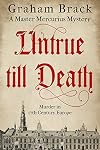
I love Graham Brack's Master Mercurius novels. They offer solid historical fiction, interesting mysteries—and a central character and narrator full of brilliant, tongue-in-cheek humor. This is one of those books that it's dangerous to read when around other people: you'll keep saying "Let me just read you these two sentences" and repeatedly interrupting whatever they're trying to focus on.
A sampling:
"Molenaar was made of caution. I suspect the first word he uttered as a child was show more "perhaps."
"His name, though spelled Brough, was pronounced Bruff, he explained. I find English names very difficult to say sometimes. Why they can't have honest Dutch names like Terhoeven, Van Leeuwenhoek or Gijsbert Voet I have no idea. Anyone can pronounce those names."
"I have heard many worse lute players, but also many more melodious tomcats."
I trust you can see what I mean.
The novels are set in 17th Century Leiden. Mercurius, a secret Catholic priest in this Protestant stronghold, is on the faculty of the university there. He's been charged with finding an incomprehensible way of calculating salaries so that faculty are unable to compare their earnings with one another, but his focus quickly changes following the murder of a despised coworker.
I have only one complaint about this series, which is that it consists of only three novels. I've read two of them and am eagerly anticipating reading the third while simultaneously dreading that moment when there will be no more left to read.
I received a free electronic ARC of this title from the publisher via NetGalley. The opinions are my own. show less
A sampling:
"Molenaar was made of caution. I suspect the first word he uttered as a child was show more "perhaps."
"His name, though spelled Brough, was pronounced Bruff, he explained. I find English names very difficult to say sometimes. Why they can't have honest Dutch names like Terhoeven, Van Leeuwenhoek or Gijsbert Voet I have no idea. Anyone can pronounce those names."
"I have heard many worse lute players, but also many more melodious tomcats."
I trust you can see what I mean.
The novels are set in 17th Century Leiden. Mercurius, a secret Catholic priest in this Protestant stronghold, is on the faculty of the university there. He's been charged with finding an incomprehensible way of calculating salaries so that faculty are unable to compare their earnings with one another, but his focus quickly changes following the murder of a despised coworker.
I have only one complaint about this series, which is that it consists of only three novels. I've read two of them and am eagerly anticipating reading the third while simultaneously dreading that moment when there will be no more left to read.
I received a free electronic ARC of this title from the publisher via NetGalley. The opinions are my own. show less
Death in Delft: A 17th Century historical murder mystery (Master Mercurius Mysteries Book 1) by Graham Brack

I don't often rate books at a full five stars but I had been looking for a good historical series now that there won't be any more Shardlake novels and this seems to be it.
Master Mercurius is a Protestant cleric in the Netherlands in the 17th century, writing his secret memoirs and looking back to his early thirties when he was tasked to travel to Delft and solve the disappearance of three eight year old girls, one of whom has been found buried. There he interacts with various people, show more including the mothers of two of the girls from working class families - one a single parent looked down on for having had her child outside marriage - and the father of the last child abducted, a wealthy and unpopular merchant. He meets and works with a local artist - I was delighted to recognise Vermeer, painter of 'Girl with a Pearl Earring ' - and a draper who is a part time scientist. I looked him up while reading the novel and discovered that he was an early pioneer of microbiology. Both of these real historical characters are vividly portrayed and come across as living people on the page.
Mercurius is aware of the ambiguities of human life and morality, especially because he is also a secret Catholic and, even more dangerous for him, an ordained priest. The Low Countries, as they are known, seem more tolerant than many other lands in that period, because Catholics can worship in their own churches providing they keep everything low key but they are still discriminated against as is made clear through Vermeer, who converted to Catholism in order to marry into a Catholic family. Mercurius has been tasked by his bishop to be a secret pillar of the church in the event of the country one day returning to Catholism, but would be in a lot of trouble if this was found out and I sense that losing his position as a university lecturer would be the least of it. In the meantime, he faces the awkwardness of people trying to pair him off with potential wives when he is obliged to remain celibate.
The landscape of Delft is well pictured, as are the living conditions for the various classes. The narrative is nicely tinged with a humorous self deprecation and wry wit. Altogether I enjoyed the book and have no hesitation in rating it as a five star read. show less
Master Mercurius is a Protestant cleric in the Netherlands in the 17th century, writing his secret memoirs and looking back to his early thirties when he was tasked to travel to Delft and solve the disappearance of three eight year old girls, one of whom has been found buried. There he interacts with various people, show more including the mothers of two of the girls from working class families - one a single parent looked down on for having had her child outside marriage - and the father of the last child abducted, a wealthy and unpopular merchant. He meets and works with a local artist - I was delighted to recognise Vermeer, painter of 'Girl with a Pearl Earring ' - and a draper who is a part time scientist. I looked him up while reading the novel and discovered that he was an early pioneer of microbiology. Both of these real historical characters are vividly portrayed and come across as living people on the page.
Mercurius is aware of the ambiguities of human life and morality, especially because he is also a secret Catholic and, even more dangerous for him, an ordained priest. The Low Countries, as they are known, seem more tolerant than many other lands in that period, because Catholics can worship in their own churches providing they keep everything low key but they are still discriminated against as is made clear through Vermeer, who converted to Catholism in order to marry into a Catholic family. Mercurius has been tasked by his bishop to be a secret pillar of the church in the event of the country one day returning to Catholism, but would be in a lot of trouble if this was found out and I sense that losing his position as a university lecturer would be the least of it. In the meantime, he faces the awkwardness of people trying to pair him off with potential wives when he is obliged to remain celibate.
The landscape of Delft is well pictured, as are the living conditions for the various classes. The narrative is nicely tinged with a humorous self deprecation and wry wit. Altogether I enjoyed the book and have no hesitation in rating it as a five star read. show less
Loved it! Although there is a crime to be solved at the core, the true enjoyment of the book comes from the descriptions of 17th century Delft and, even more so, the characters.
Brack has woven into the story a number of historical figures, great and small. Chief among them are the artist Vermeer and the scientist/inventor Leeuwenhoek, each of whom is presented on the basis of his genius and his personality, and each of whom assists Master Mercurius as he attempts to resolve the show more disappearance/murder of 3 young girls.
Mercurius is a fascinating character in his own right. Nominally a Protestant minister/academic, known to be quite clever, he is secretly also a Catholic priest. This condition creates interesting opportunities in terms of plot development as well as much self-reflection, often quite ironic. One of my favorites:
“I was beginning to wonder whether there were any loopholes in the vow of chastity that a clever bit of casuistry could squeeze me through. I must find a Jesuit, I thought; they are always good at that kind of thing.”
The only downside to reading this for me was that it wasn't available in an audio version and I've been hard pressed to find time to read in print lately. Of course, the flip side of that is that by reading on the Kindle app I was able to quickly research people, places and terms that were new to me.
Rating this compared with other historical mysteries, I give it a solid 5 stars. show less
Brack has woven into the story a number of historical figures, great and small. Chief among them are the artist Vermeer and the scientist/inventor Leeuwenhoek, each of whom is presented on the basis of his genius and his personality, and each of whom assists Master Mercurius as he attempts to resolve the show more disappearance/murder of 3 young girls.
Mercurius is a fascinating character in his own right. Nominally a Protestant minister/academic, known to be quite clever, he is secretly also a Catholic priest. This condition creates interesting opportunities in terms of plot development as well as much self-reflection, often quite ironic. One of my favorites:
“I was beginning to wonder whether there were any loopholes in the vow of chastity that a clever bit of casuistry could squeeze me through. I must find a Jesuit, I thought; they are always good at that kind of thing.”
The only downside to reading this for me was that it wasn't available in an audio version and I've been hard pressed to find time to read in print lately. Of course, the flip side of that is that by reading on the Kindle app I was able to quickly research people, places and terms that were new to me.
Rating this compared with other historical mysteries, I give it a solid 5 stars. show less
Awards

You May Also Like


Associated Authors
Statistics
- Works
- 20
- Also by
- 1
- Members
- 341
- Popularity
- #69,902
- Rating
- 3.8
- Reviews
- 58
- ISBNs
- 28