
Kirsten Lodge
Author of The Dedalus Book of Russian Decadence: Perversity, Despair and Collapse
About the Author
Works by Kirsten Lodge
The Dedalus Book of Russian Decadence: Perversity, Despair and Collapse (2007) — Editor — 112 copies, 1 review
Associated Works
Tagged
Common Knowledge
- Gender
- female
- Education
- Central European University, Prague (MA|History and Philosophy of Art and Architecture|1995)
Columbia University (PhD|Russian and Czech Language and Literature|2006) - Occupations
- Professor of Humanities and English
- Organizations
- Midwestern State University
- Nationality
- USA
- Associated Place (for map)
- USA
Members
Reviews
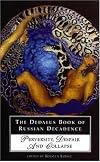
Subtitled "Perversity, Despair and Collapse", this is really for those who want to fill the gap in their knowledge of Russian culture - late nineteenth century Western decadence tended to elide into pessimism, despair and gloom as it got closer to Moscow. It also tended to be very derivative of Western forms and preoccupations.
It might be far too easy to read predictions of Revolution in what is, mostly, a rather predictable melange of adolescent lust, late nineteenth century misogyny and show more bourgeois confusion at the social requirements of a very slowly modernising society.
However, there are two discoveries that make this book worth acquiring. The first is Valery Briusov's imagination.
His "The Diary of a Psychopath" is Poe recast, well before its time, for the world of virtual reality. "The Republic of the Southern Cross" can stand alongside Verne and Wells and offers an interesting cultural precursor to the apocalyptic tradition in Hollywood horror.
"The Last Martyrs" is more classically decadent but less impressive - and it falls into the classic trap of period publication. Like other decadent works, it demands the sort of pornographic detail that can only be implied because of what is permitted socially.
As a result, Briusov, far from appearing truly decadent, seems, at these times, repressed and Victorian - showing his metaphorical willy and running away giggling as a naughty little boy who wants to be chastised. This is a problem with all 'naughty' literature in repressed times - it cannot really say what it means.
The second, more solid discovery, is Leonid Andreyev, already better known in the West in recent years, whose three representative stories take the time to delve into the dark side of adolescent disturbance without the weakness of romanticism.
The final tale by Andreyev in this book, 'The Story of Sergey Petrovich', with its odd mix of inner disturbance, peer pressure and ideas inadequately understood, could be read with profit while watching YouTube for signs of the next teenage gunman.
Andreyev is a not-so-minor master and makes the other tales in the book look mannered (though the woman writer Zinaida Gippius almost reaches Andreyev levels of insight with 'The Moon-Ants'). As for the poetry, well let us just be charitable and say that it might be better read in the Russian.
All in all, a book of a particular time and a place but, if this edition is taken as evidence of Russian culture at the turn of the last century, then the gloom and depression of Russian youth and of the aesthetic wing of its intelligensiya suggests that, while revolutions are never inevitable, the loss of will to go on amongst the Russian bourgeoisie may be a factor in the rise of radical modernism in Russian culture and the initial welcoming of a clean Soviet break. show less
It might be far too easy to read predictions of Revolution in what is, mostly, a rather predictable melange of adolescent lust, late nineteenth century misogyny and show more bourgeois confusion at the social requirements of a very slowly modernising society.
However, there are two discoveries that make this book worth acquiring. The first is Valery Briusov's imagination.
His "The Diary of a Psychopath" is Poe recast, well before its time, for the world of virtual reality. "The Republic of the Southern Cross" can stand alongside Verne and Wells and offers an interesting cultural precursor to the apocalyptic tradition in Hollywood horror.
"The Last Martyrs" is more classically decadent but less impressive - and it falls into the classic trap of period publication. Like other decadent works, it demands the sort of pornographic detail that can only be implied because of what is permitted socially.
As a result, Briusov, far from appearing truly decadent, seems, at these times, repressed and Victorian - showing his metaphorical willy and running away giggling as a naughty little boy who wants to be chastised. This is a problem with all 'naughty' literature in repressed times - it cannot really say what it means.
The second, more solid discovery, is Leonid Andreyev, already better known in the West in recent years, whose three representative stories take the time to delve into the dark side of adolescent disturbance without the weakness of romanticism.
The final tale by Andreyev in this book, 'The Story of Sergey Petrovich', with its odd mix of inner disturbance, peer pressure and ideas inadequately understood, could be read with profit while watching YouTube for signs of the next teenage gunman.
Andreyev is a not-so-minor master and makes the other tales in the book look mannered (though the woman writer Zinaida Gippius almost reaches Andreyev levels of insight with 'The Moon-Ants'). As for the poetry, well let us just be charitable and say that it might be better read in the Russian.
All in all, a book of a particular time and a place but, if this edition is taken as evidence of Russian culture at the turn of the last century, then the gloom and depression of Russian youth and of the aesthetic wing of its intelligensiya suggests that, while revolutions are never inevitable, the loss of will to go on amongst the Russian bourgeoisie may be a factor in the rise of radical modernism in Russian culture and the initial welcoming of a clean Soviet break. show less
Awards

You May Also Like
Associated Authors
Statistics
- Works
- 2
- Also by
- 2
- Members
- 127
- Popularity
- #158,247
- Rating
- 3.8
- Reviews
- 1
- ISBNs
- 4