
Jay Posey
Author of Three
Series
Works by Jay Posey
Associated Works
Tagged
Common Knowledge
- Gender
- male
Members
Reviews

"Three" (is it just me, or that a confusing name for the first book in a trilogy?) is a grim, tense, violent book from the first page to the last.
"Three" is a mood rather than character driven book, heavy on atmosphere and light on introspection.This isn't one of those novels where the reader feels smart for spotting the world-building clues that the author seeds the text with and creating a deeply textured society. This is novel where the world doesn't feel the need to explain itself; you show more have to figure it out as best you can while every character you meet is trying to kill you. This is a world so unforgiving that a child asking "Momma, are we going to die today?" is stoic realism rather than high melodrama.
Part Western, part Samurai-turned-Ronin movie, part survival horror video game, "Three" tells the story of a lone warrior, in a bleak, post-apocalyptic world, who breaks his own survival code and takes a woman and her son under his protection and embarks on a quest to find the boy's father.
The warrior, who is called Three, for reasons that are never clearly explained, is so laconic that he makes The Man With No Name seem intoxicated with the exuberance of his own verbosity.
An intense, dangerous, loner who is constantly vigilant and frequently deadly, Three is a bounty hunter who relentlessly pursues his prey through the Weir-infested wastelands of ruined cities, surviving by the sword, the gun and total personal discipline. Unlike the "soft" civilized folk who live behind city walls and don't go out at night, Three is all hard shell and honed edges and walks where he pleases.
The woman and the boy Three chooses to protect are far from helpless. Helpless doesn't survive past dusk in this world. They are capable of great violence and would be formidable if they were not being hunted by people even scarier than they are.
Although this book is primarily an action adventure vehicle, the kind of thing that would make a summer blockbuster movie or a best-selling combat video game, it is lifted by its willingness to take on some big themes: the true nature of heroism (it's not bravery if you're not scared); the possibility of redemption by doing something for others that will make them carry you in their memory; the importance of a living by a code; the rigour of vigilance born out of the inevitability of betrayal and the leavening effect of compassion.
If there is a message in all of this, it is that love makes you weak by giving you something to lose but the absence of love makes your strength hollow and futile.
Although this book was an engrossing read and I'll definitely be back for the rest of the series, I hope the next novels have more dialogue and less authorial voice. I picked up "Three" after reading Jay Posey's most recent book, "Outriders". In retrospect, I can see that that wasn't the ideal progression. Although "Three" is a remarkable debut novel, the thought that kept going through my mind was: "Wow, Jay Posey has learned a lot about writing dialogue in the three years between these two books." show less
"Three" is a mood rather than character driven book, heavy on atmosphere and light on introspection.This isn't one of those novels where the reader feels smart for spotting the world-building clues that the author seeds the text with and creating a deeply textured society. This is novel where the world doesn't feel the need to explain itself; you show more have to figure it out as best you can while every character you meet is trying to kill you. This is a world so unforgiving that a child asking "Momma, are we going to die today?" is stoic realism rather than high melodrama.
Part Western, part Samurai-turned-Ronin movie, part survival horror video game, "Three" tells the story of a lone warrior, in a bleak, post-apocalyptic world, who breaks his own survival code and takes a woman and her son under his protection and embarks on a quest to find the boy's father.
The warrior, who is called Three, for reasons that are never clearly explained, is so laconic that he makes The Man With No Name seem intoxicated with the exuberance of his own verbosity.
An intense, dangerous, loner who is constantly vigilant and frequently deadly, Three is a bounty hunter who relentlessly pursues his prey through the Weir-infested wastelands of ruined cities, surviving by the sword, the gun and total personal discipline. Unlike the "soft" civilized folk who live behind city walls and don't go out at night, Three is all hard shell and honed edges and walks where he pleases.
The woman and the boy Three chooses to protect are far from helpless. Helpless doesn't survive past dusk in this world. They are capable of great violence and would be formidable if they were not being hunted by people even scarier than they are.
Although this book is primarily an action adventure vehicle, the kind of thing that would make a summer blockbuster movie or a best-selling combat video game, it is lifted by its willingness to take on some big themes: the true nature of heroism (it's not bravery if you're not scared); the possibility of redemption by doing something for others that will make them carry you in their memory; the importance of a living by a code; the rigour of vigilance born out of the inevitability of betrayal and the leavening effect of compassion.
If there is a message in all of this, it is that love makes you weak by giving you something to lose but the absence of love makes your strength hollow and futile.
Although this book was an engrossing read and I'll definitely be back for the rest of the series, I hope the next novels have more dialogue and less authorial voice. I picked up "Three" after reading Jay Posey's most recent book, "Outriders". In retrospect, I can see that that wasn't the ideal progression. Although "Three" is a remarkable debut novel, the thought that kept going through my mind was: "Wow, Jay Posey has learned a lot about writing dialogue in the three years between these two books." show less
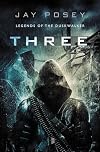
Prepare to be unplugged! This powerhouse of an apocalyptic read cannot and will not be denied!
Visit My Shelf Confessions for an article from Jay Posey on Post-Apocalyptic Bounty Hunting & a giveaway of 2 signed copies of Three
Three is the kind of book you pick up that refuses to be put down until finished. Tension runs high as it rushes you from action scene to action scene with just the right amount of downtime to catch your breath in between.
In this post-apocalyptic future, you must fear show more the Weir, monstrous once humans that roam the night with their sickly pale dead skin, glowing blue orb eyes and electrical screams. They were human…once. I imagined their screeching to sound like a high speed train quickly throwing an emergency brake. The cities are abandoned and it is much the wasteland. What little is left of humanity are locked behind walled towns or small underground fortresses so they can carry on with some semblance of life.
Three is a man apart, but when a woman and her child walk into his life one day in need of help which he originally refuses to give, all of his ways of life start to slowly change…against his better judgement. Now I’m a sucker for a cute kid’s face, so of course this stalwart loner was going to crack, thats what this is all about right? Wren is an adorable kid with some very unique gifts, his mother Cass, well she took some time for me to warm up to. She’s the most “together” junkie I’ve ever read. Though Three is a man of few words he definitely served me up a few chuckles regardless.
True to post-apocalytic fashion, people are scavengers, travel is hard, resources are scarce, and there are no easy modes of transportation. If you are going somewhere…you’re walking.
But the interesting balancing point to all of that, is that technology is still present, and in an advanced state. Everyone is wired in a sense I can’t really explain other than all the data and information you could ever want to know about the past is available for you to access from within yourself because you are wired into all of that data from the time you’re born. It might even be genetically engineered into people such that you are born with it – I was a bit sketchy on the particulars there. It’s a fascinating concept. There are genetically enhanced people, chemical stimulants like you wouldn’t believe, kick ass weapons that give it an almost western feel, and so many other aspects that are at odds with the post-apocalyptic setting and yet fit perfectly.
In Three the details are sparse just like the landscape. If you’re a reader that needs to know everything then be warned going in that this story is awesome but it is about the characters in it not about the world, land, it’s history or how it got to the point it is. Being a completely character driven story, it is so well fleshed out I didn’t feel that it was lacking in any way. I certainly hope that more details are revealed in the next installment. Because I of course want to know all of the nitty gritty details! Ultimately, for many readers, I believe the sheer power of Posey’s prose and storytelling will overwhelm that tiny pick point.
With every page I was sucked in ever deeper such that I am content if I never find out the answers to all my curious little questions. String me along Posey, like a starving wretch after some breadcrumbs, I’ll take every morsel I can get! show less
Visit My Shelf Confessions for an article from Jay Posey on Post-Apocalyptic Bounty Hunting & a giveaway of 2 signed copies of Three
Three is the kind of book you pick up that refuses to be put down until finished. Tension runs high as it rushes you from action scene to action scene with just the right amount of downtime to catch your breath in between.
In this post-apocalyptic future, you must fear show more the Weir, monstrous once humans that roam the night with their sickly pale dead skin, glowing blue orb eyes and electrical screams. They were human…once. I imagined their screeching to sound like a high speed train quickly throwing an emergency brake. The cities are abandoned and it is much the wasteland. What little is left of humanity are locked behind walled towns or small underground fortresses so they can carry on with some semblance of life.
In fact, most of the Vault stretched down underground, below the city, like some kind of human hive bored out of a cement iceberg. – pg 8
Three is a man apart, but when a woman and her child walk into his life one day in need of help which he originally refuses to give, all of his ways of life start to slowly change…against his better judgement. Now I’m a sucker for a cute kid’s face, so of course this stalwart loner was going to crack, thats what this is all about right? Wren is an adorable kid with some very unique gifts, his mother Cass, well she took some time for me to warm up to. She’s the most “together” junkie I’ve ever read. Though Three is a man of few words he definitely served me up a few chuckles regardless.
He chuckled aloud at the thought of his fellow patrons out there drinking his recycled urine. – pg 23
True to post-apocalytic fashion, people are scavengers, travel is hard, resources are scarce, and there are no easy modes of transportation. If you are going somewhere…you’re walking.
“My feet are sad.”
“Mine too baby. Mine too.” – pg 119
But the interesting balancing point to all of that, is that technology is still present, and in an advanced state. Everyone is wired in a sense I can’t really explain other than all the data and information you could ever want to know about the past is available for you to access from within yourself because you are wired into all of that data from the time you’re born. It might even be genetically engineered into people such that you are born with it – I was a bit sketchy on the particulars there. It’s a fascinating concept. There are genetically enhanced people, chemical stimulants like you wouldn’t believe, kick ass weapons that give it an almost western feel, and so many other aspects that are at odds with the post-apocalyptic setting and yet fit perfectly.
In Three the details are sparse just like the landscape. If you’re a reader that needs to know everything then be warned going in that this story is awesome but it is about the characters in it not about the world, land, it’s history or how it got to the point it is. Being a completely character driven story, it is so well fleshed out I didn’t feel that it was lacking in any way. I certainly hope that more details are revealed in the next installment. Because I of course want to know all of the nitty gritty details! Ultimately, for many readers, I believe the sheer power of Posey’s prose and storytelling will overwhelm that tiny pick point.
It was as if some great ocean of destruction had rolled its unyielding tide through the city and then, upon its terrible recession, left behind only a shoreline of concrete sand and crushed humanity. – pg 283
With every page I was sucked in ever deeper such that I am content if I never find out the answers to all my curious little questions. String me along Posey, like a starving wretch after some breadcrumbs, I’ll take every morsel I can get! show less
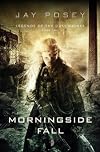
This is the follow-up to the book Three, which was by far one of my best reads of last year, and this one is taking it's spot as my favourite read for this year.
In Three, the child Wren and his drug addicted dying mother Cass are on the run, and find themselves under the wing of the titular Three, a lone gunman who guides them to (relative) safety in Morningside Falls - but at terrible cost.
In Morningside Fall, Wren is now the titular governor of the city of Morningside but not everyone is show more happy about it. Between a city council that expected him to be malleable and play the figurehead, his having allowed the rabble that had been living outside the city walls to come inside to safety, and his uncanny ability to awaken some of the weir, there's a lot of unhappy people around and some of them have the ability to make life very difficult for Wren and his beloved mother Cass.
I was a little apprehensive that without Three around, and with the antagonist Asher apparently defeated and Cass and Wren starting out in a relatively comfortable position, I wouldn't enjoy this book as much, but I was wrong. Wren is in a completely untenable position, a literal child who despite wisdom well beyond his years in a lot of ways, often doesn't understand the politics and motives of those around him as they try to manipulate him. So he is on the run again, this time with a whole team, trying to get back to one of the few places he ever felt truly happy. And everyone knows you can't go home again, so I don't need to tell you how that turns out.
There's all the things I liked from the first book - the sparse but incredibly evocative, almost visceral descriptions, the loveable but deeply flawed, even tragic characters. The way everyone is beaten down, exhausted by their ordeals - nobody here is running for 20 kilometres but still up and ready to party right after. People who are hurt, are hurt, they even die, they feel pain.
There's still no explanation how the world got the way it is, and I like it better for that. We don't need to know, the characters don't know either, and can't answer. Nobody, not even the weir or the awakened know what the weir really are, so how can we the reader? I can see that not sitting well with some readers, but for me, it's as it should be. I'm sure if Wren ever figures it out, we'll find out right along with him.
But mostly, it's just so flat out well-written, I could turn around and read both books start to finish again just to savour them.
The new characters do a fine job standing in for Three, but it's a testament to him that it takes a half dozen of them to achieve what he did alone, and in the end, they still can't quite. The repeat characters remain true to themselves as written in the first book (a pet peeve of mine when they don't!).
Cass is still an interesting character - despite her enormous abilities, she is mostly passive, and when she stands up for herself (or finally goes into action in a fight) everyone is surprised, including Cass herself--but not Wren. As for Wren, while a little fey and full of surprises and as yet untapped power, he could have easily been a miniature Marty Stu, but he's not. Posey manages to write a child who despite being possibly the saviour of the world has a child's reactions to things: He believes what adults tell him, he understands when adults are just being polite to him--but not why, he trusts, he has overwhelming faith in his mother and that "doing the right thing" and being good will fix everything. You can feel his frustration with his small physical size, they way he's upset over something as small as tripping over and grazing his chin. And he's afraid--still enough a child to want to sleep in his mamma's room after the things that go bump in the night turn out to be carrying a knife.
Once again, the ending has everyone in fairly dire circumstances, and there are characters we're probably not going to see again, albeit not as gut-wrenchingly as the first book. And the set-up for the next book is clear.
One final comment: I still can't help see these books as typical westerns. I compared Three to the classic plot elements of the western that Will Wright wrote about. If Three was Shane, the epitome of the classic western plot, this is the transitional western: High Noon. Wren's special status and abilities sets him apart, but keep him alienated and rejected by the society he so dearly wants to help. (I could also argue, it follows some of the narrative structure of the vengeance western plot, but I suspect that one is going to be even clearer in book 3. I predict Stagecoach--let's see if I'm right. And I can't wait.)
ARC from NetGalley in exchange for an honest review. show less
In Three, the child Wren and his drug addicted dying mother Cass are on the run, and find themselves under the wing of the titular Three, a lone gunman who guides them to (relative) safety in Morningside Falls - but at terrible cost.
In Morningside Fall, Wren is now the titular governor of the city of Morningside but not everyone is show more happy about it. Between a city council that expected him to be malleable and play the figurehead, his having allowed the rabble that had been living outside the city walls to come inside to safety, and his uncanny ability to awaken some of the weir, there's a lot of unhappy people around and some of them have the ability to make life very difficult for Wren and his beloved mother Cass.
I was a little apprehensive that without Three around, and with the antagonist Asher apparently defeated and Cass and Wren starting out in a relatively comfortable position, I wouldn't enjoy this book as much, but I was wrong. Wren is in a completely untenable position, a literal child who despite wisdom well beyond his years in a lot of ways, often doesn't understand the politics and motives of those around him as they try to manipulate him. So he is on the run again, this time with a whole team, trying to get back to one of the few places he ever felt truly happy. And everyone knows you can't go home again, so I don't need to tell you how that turns out.
There's all the things I liked from the first book - the sparse but incredibly evocative, almost visceral descriptions, the loveable but deeply flawed, even tragic characters. The way everyone is beaten down, exhausted by their ordeals - nobody here is running for 20 kilometres but still up and ready to party right after. People who are hurt, are hurt, they even die, they feel pain.
There's still no explanation how the world got the way it is, and I like it better for that. We don't need to know, the characters don't know either, and can't answer. Nobody, not even the weir or the awakened know what the weir really are, so how can we the reader? I can see that not sitting well with some readers, but for me, it's as it should be. I'm sure if Wren ever figures it out, we'll find out right along with him.
But mostly, it's just so flat out well-written, I could turn around and read both books start to finish again just to savour them.
The new characters do a fine job standing in for Three, but it's a testament to him that it takes a half dozen of them to achieve what he did alone, and in the end, they still can't quite. The repeat characters remain true to themselves as written in the first book (a pet peeve of mine when they don't!).
Cass is still an interesting character - despite her enormous abilities, she is mostly passive, and when she stands up for herself (or finally goes into action in a fight) everyone is surprised, including Cass herself--but not Wren. As for Wren, while a little fey and full of surprises and as yet untapped power, he could have easily been a miniature Marty Stu, but he's not. Posey manages to write a child who despite being possibly the saviour of the world has a child's reactions to things: He believes what adults tell him, he understands when adults are just being polite to him--but not why, he trusts, he has overwhelming faith in his mother and that "doing the right thing" and being good will fix everything. You can feel his frustration with his small physical size, they way he's upset over something as small as tripping over and grazing his chin. And he's afraid--still enough a child to want to sleep in his mamma's room after the things that go bump in the night turn out to be carrying a knife.
Once again, the ending has everyone in fairly dire circumstances, and there are characters we're probably not going to see again, albeit not as gut-wrenchingly as the first book. And the set-up for the next book is clear.
One final comment: I still can't help see these books as typical westerns. I compared Three to the classic plot elements of the western that Will Wright wrote about. If Three was Shane, the epitome of the classic western plot, this is the transitional western: High Noon. Wren's special status and abilities sets him apart, but keep him alienated and rejected by the society he so dearly wants to help. (I could also argue, it follows some of the narrative structure of the vengeance western plot, but I suspect that one is going to be even clearer in book 3. I predict Stagecoach--let's see if I'm right. And I can't wait.)
ARC from NetGalley in exchange for an honest review. show less

The Outriders of the title are a "death proof", very low profile, very hi-tech, special forces group on a future earth. They are sent to investigate events that may be co-incidence or may be covert attacks that could lead to the first war between Earth and Mars.
"Outriders" has the twisty plot of a good spy novel, lots of shiny futuristic military toys for search and destroy games, a team of cool soldiers who are both likeable and lethal and a story-telling pace that grabs hold of you from show more page one (where the main character, Lincoln Suh, dies) and doesn't let up until the end.
All of that would have been enough for me to read this book with a grin on my face and then set it aside but Jay Posey added a few things that made "Outriders" more than just a good military SF novel.
I found his calm, factual way of telling this tense and violent tale compelling. This high attention, low arousal approach to dealing with a crisis is exactly what I imagine to be necessary to do the kind of work the Outriders do. Lincoln Suh, the new officer trying earn the right to lead and experienced, established team, embodies this killer calm and garnsihes it with an engaging mix of humour and self-deprication.
I also liked the way Posey brought out the similarities between the Outriders and the military/spy team that they are up against. Both teams are driven to achieve goals that they believe in through violence and destruction. Neither wants to cause harm to by-standers. Neither mistreats the people that they capture. Yet either team will shoot the other on sight with no hesitation.
James Lindgren does a great job of the narration, matching the controlled-calm of the text while still being able to keep the tension of the plot.
I've never read Jay Posey before but I'll be hitting his back-catalog soon, while I wait for the next "Outriders" to come out.
Go HERE to read an interview with Jay Posey on how he cam e up with the ideas for "Outriders". show less
"Outriders" has the twisty plot of a good spy novel, lots of shiny futuristic military toys for search and destroy games, a team of cool soldiers who are both likeable and lethal and a story-telling pace that grabs hold of you from show more page one (where the main character, Lincoln Suh, dies) and doesn't let up until the end.
All of that would have been enough for me to read this book with a grin on my face and then set it aside but Jay Posey added a few things that made "Outriders" more than just a good military SF novel.
I found his calm, factual way of telling this tense and violent tale compelling. This high attention, low arousal approach to dealing with a crisis is exactly what I imagine to be necessary to do the kind of work the Outriders do. Lincoln Suh, the new officer trying earn the right to lead and experienced, established team, embodies this killer calm and garnsihes it with an engaging mix of humour and self-deprication.
I also liked the way Posey brought out the similarities between the Outriders and the military/spy team that they are up against. Both teams are driven to achieve goals that they believe in through violence and destruction. Neither wants to cause harm to by-standers. Neither mistreats the people that they capture. Yet either team will shoot the other on sight with no hesitation.
James Lindgren does a great job of the narration, matching the controlled-calm of the text while still being able to keep the tension of the plot.
I've never read Jay Posey before but I'll be hitting his back-catalog soon, while I wait for the next "Outriders" to come out.
Go HERE to read an interview with Jay Posey on how he cam e up with the ideas for "Outriders". show less
Awards

You May Also Like


Associated Authors
Statistics
- Works
- 8
- Also by
- 2
- Members
- 848
- Popularity
- #30,160
- Rating
- 3.7
- Reviews
- 33
- ISBNs
- 45