
Jacqueline Koyanagi
Author of Ascension
Series
Works by Jacqueline Koyanagi
The Blackout Killer 1 copy
The Clawed Limb 1 copy
Associated Works
Phantasm Japan: Fantasies Light and Dark, From and About Japan (2014) — Contributor — 50 copies, 1 review
Ctrl-Alt-Destroy — some editions; some editions — 4 copies
Tagged
Common Knowledge
- Other names
- Koyanagi, Jae
- Birthdate
- 20th century
- Gender
- female
- Agent
- Rachel Kory
Russell Galen (Scovil Galen Ghosh Literary Agency) - Nationality
- USA
- Places of residence
- Colorado, USA
- Associated Place (for map)
- Colorado, USA
Members
Reviews
Alana Quick is a sky surgeon. That's engineer to you and I. And she's that in a world where that career is coming to an end and it's rare a sky surgeon ever gets off the ground. She lives with her Aunt Lai, both of them struggling to make ends meet, and also struggling with a neurological, chronic pain disorder. One day a ship lands at their shipyard looking for Alana's sister Nova, a spirit guide, and, encouraged by the ship's doctor, Alana stows away. The captain and her crew are not happy show more about it but gradually they realize Alana can help them find Nova which will, in turn, help them save their pilot's life.
Now let me tell you why you want to read this book. All the things we look for in genre movies, tv, and fiction that aren't there? They're here, at least many of them are. Alana is a woman of color. She's queer. She's chronically ill. There are other people in this book who are queer, who are ill, who are in poly relationships, who believe they are something other than what their body tells them, who run the gamut of what real people are. There's found family, sisters with all the love and conflict sisters can have, and women who get to be people, not just "women." There are strong themes of identity, love, and acceptance.
Read this book, y'all. You will not regret it.
ARC provided by publisher. show less
Now let me tell you why you want to read this book. All the things we look for in genre movies, tv, and fiction that aren't there? They're here, at least many of them are. Alana is a woman of color. She's queer. She's chronically ill. There are other people in this book who are queer, who are ill, who are in poly relationships, who believe they are something other than what their body tells them, who run the gamut of what real people are. There's found family, sisters with all the love and conflict sisters can have, and women who get to be people, not just "women." There are strong themes of identity, love, and acceptance.
Read this book, y'all. You will not regret it.
ARC provided by publisher. show less

Taken from my booklog:
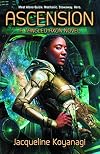
It was the woman on the cover which drew me to this novel and the subtitle which almost scared me off again. The woman attracted me because it’s not often you actually do see a woman of colour on the cover of a science fiction novel, sometimes not even when the heroine is indeed a black woman. Seeing that got me to pull Ascension off the shelves, but reading the subtitle A Tangled Axon Novel almost made me put it back because it made it sound as if this was a novel in show more an established series, rather than a first novel. Luckily the inside cover blurb mentioned that this was Jacqueline Koyanagi’s first novel, so I took a punt. Not having heard of her or her novel before, in the end the cover as well as reading the first few pages were enough to make me want to read this.
And I’m so glad I did, because this was a glorious, wonderful mess of a book. Reading it, especially in the first couple of chapters, you get the idea that the author is only showing you glimpses of a much larger universe she’s been carrying around in her head for a long time, therefore occasionally making oblique references to things she knows and which are completely clear to her, but doesn’t quite explain to the reader. That’s the messy part of the book. The glorious and wonderful parts are its characters, its protagonist especially. Alana Quick is a sky surgeon, a starship engineer in the midst of a depression when nobody needs starship engineers because starships are obsolete. Her ex-wife left her for a career with Transliminal Solutions, the company that made them obsolete, her sister Nova has a flourishing career as a spirit guide, relieving rich clients from their anxieties, while her own obsession with space, with the Big Quiet, makes her unsuitable for anything but repairing spaceships even if the hard physical labour does her chronic nerve disease no favours. Having to deal with a debilitating disease while barely making ends meet, is it any wonder she stows away when the Tangled Axon comes looking for her sister? Or that she falls in love with the ship’s glamorous captain Tev — “all blond hair, boots and confidence”?
A love that may seem hopelessly misguided at first, as neither crew nor captain take kindly to a stowaway, though they have no qualms in using her as a hostage to get through to her sister. As to why they’re so desparate to resort to such measures, it’s because the ship’s pilot, Marre is slowly disappearing, dying little by little and only Transliminal could cure her. But you need something to trade to get anything from Transliminal and luckily Birke, the mysterious woman who’s the — boss? CEO? Leader? — of Transliminal in this universe is obsessed with Nova, so they’re gambling that if they can get Nova to agree to work for Birke, her gratitude will give them a cure for Marre. There may even be a possibility of a real cure for the Mel’s disorder Alana suffers from.
As the external threats mount up for the Tangled Axon and crew, it’s the internal tensions that ratchet up. With her sister on board, Alana, who grew up in her shadow, has to deal with her feelings of inadequacy, jealousy and love towards her. At the same time her growning attraction to Tev is complicated by the fact that she’s in a relation with the ship’s doctor, Slip, also the first person in the crew to treat Alana half decently. Then there’s Marre, losing cohesion, with parts of her body dissappearing and reappearing at random, who fascinates Alana; she keeps hearing her in her head. Perhaps the least complicated person on board the ship is the other engineer, Ovie, who just looks like a big wolf occassionally but at least isn’t emotionally complicated like the rest of them. And of course there’s the ship itself, with which Alana from the first feels at home and talks to.
Ascension then is space opera, but one with a love story at the heart of it. It’s not just Alana falling in lust and then in love with Tev, moving beyond Alana’s initial attraction to her as a symbol of everything she ever wanted to wanting her as a person, but also Alana’s re-evaluation of her relationship with her sister, relationships with the other members of the crew, Slip, Marre and Ovie and as always, the ship itself.
And that brings us again to the messy part. Because we see everything through Alana’s eyes and Alana is confused, blinded by her emotions, occassionally lying to herself and like so many people, often worst at recognising her own blindspots, there’s a lot that she tells us that turns out not to be true, or not quite as she thinks it is. This is the core of the novel. Alana is not an unreliable narrator in the traditional sense, but like most of us, she’s build up stories about herself that colour her perceptions. This is most clear when we finally meet and get to know her sister, who isn’t quite the shallow airhead Alana makes her out to be and whose calling as a spirit guide can do more than just massage the egos of rich clients. Alana’s prejudices and assumptions make her (and by extention, us as readers) miss plot developments that might’ve been blindingly obvious with another narrator.
What stuck the most with me in reading Ascension was the underlying theme of disability and chronic illness. It’s not just Alana having to deal with her Mel’s Disorder or Marre very sfnal illness, slowly disappearing from the universe. Tev only becomes a real person, rather than somebody to admire or fuck, when it turns out she lost one of her legs in an industrial accident. She does have an artificial leg indistinguishable from a real one, but only when she’s clothed and she’s still paying it off. For both Alana and Tev their respective disabilities are things they have to live with, not things that define them, but they’re not a DND style kind of weakness either, something to offset their strengths. Alana has to keep her illness into account when working, to make sure she doesn’t make it worse and if she can’t take her mediciation, it will fuck her up; she’s learned how to minimise the impact her disease has on her life, but doesn’t always succeed or have that luxury. It’s a very mature, realistic portrayal of what being chronically ill means and for me personally it worked.
What I also found realistic is how Alana’s health is part of her soured relationship with her sister Nova, who’s perfectly healthy but who as a spirit guide disdains her body. This is the first sf novel ever that I’ve read that could and did talk about health privilege. Science fiction over the years hasn’t done well in showing people with disabilities or chronic illnesses, other than providing a bit of extra glamour perhaps to dark and brooding antiheroes, so to see it handled so well here is appreciated.
In the end, Ascension is a love story as much as a space opera and it worked for me. The relationships between Alana, her sister Nova, Tev and Marre, Ovie and Slip were just a delight to see established and grow. If you like science fiction about strong, queer women of colour dealing with their disabilities, this is the book for you. If you don’t, what’s wrong with you? show less
It was the woman on the cover which drew me to this novel and the subtitle which almost scared me off again. The woman attracted me because it’s not often you actually do see a woman of colour on the cover of a science fiction novel, sometimes not even when the heroine is indeed a black woman. Seeing that got me to pull Ascension off the shelves, but reading the subtitle A Tangled Axon Novel almost made me put it back because it made it sound as if this was a novel in show more an established series, rather than a first novel. Luckily the inside cover blurb mentioned that this was Jacqueline Koyanagi’s first novel, so I took a punt. Not having heard of her or her novel before, in the end the cover as well as reading the first few pages were enough to make me want to read this.
And I’m so glad I did, because this was a glorious, wonderful mess of a book. Reading it, especially in the first couple of chapters, you get the idea that the author is only showing you glimpses of a much larger universe she’s been carrying around in her head for a long time, therefore occasionally making oblique references to things she knows and which are completely clear to her, but doesn’t quite explain to the reader. That’s the messy part of the book. The glorious and wonderful parts are its characters, its protagonist especially. Alana Quick is a sky surgeon, a starship engineer in the midst of a depression when nobody needs starship engineers because starships are obsolete. Her ex-wife left her for a career with Transliminal Solutions, the company that made them obsolete, her sister Nova has a flourishing career as a spirit guide, relieving rich clients from their anxieties, while her own obsession with space, with the Big Quiet, makes her unsuitable for anything but repairing spaceships even if the hard physical labour does her chronic nerve disease no favours. Having to deal with a debilitating disease while barely making ends meet, is it any wonder she stows away when the Tangled Axon comes looking for her sister? Or that she falls in love with the ship’s glamorous captain Tev — “all blond hair, boots and confidence”?
A love that may seem hopelessly misguided at first, as neither crew nor captain take kindly to a stowaway, though they have no qualms in using her as a hostage to get through to her sister. As to why they’re so desparate to resort to such measures, it’s because the ship’s pilot, Marre is slowly disappearing, dying little by little and only Transliminal could cure her. But you need something to trade to get anything from Transliminal and luckily Birke, the mysterious woman who’s the — boss? CEO? Leader? — of Transliminal in this universe is obsessed with Nova, so they’re gambling that if they can get Nova to agree to work for Birke, her gratitude will give them a cure for Marre. There may even be a possibility of a real cure for the Mel’s disorder Alana suffers from.
As the external threats mount up for the Tangled Axon and crew, it’s the internal tensions that ratchet up. With her sister on board, Alana, who grew up in her shadow, has to deal with her feelings of inadequacy, jealousy and love towards her. At the same time her growning attraction to Tev is complicated by the fact that she’s in a relation with the ship’s doctor, Slip, also the first person in the crew to treat Alana half decently. Then there’s Marre, losing cohesion, with parts of her body dissappearing and reappearing at random, who fascinates Alana; she keeps hearing her in her head. Perhaps the least complicated person on board the ship is the other engineer, Ovie, who just looks like a big wolf occassionally but at least isn’t emotionally complicated like the rest of them. And of course there’s the ship itself, with which Alana from the first feels at home and talks to.
Ascension then is space opera, but one with a love story at the heart of it. It’s not just Alana falling in lust and then in love with Tev, moving beyond Alana’s initial attraction to her as a symbol of everything she ever wanted to wanting her as a person, but also Alana’s re-evaluation of her relationship with her sister, relationships with the other members of the crew, Slip, Marre and Ovie and as always, the ship itself.
And that brings us again to the messy part. Because we see everything through Alana’s eyes and Alana is confused, blinded by her emotions, occassionally lying to herself and like so many people, often worst at recognising her own blindspots, there’s a lot that she tells us that turns out not to be true, or not quite as she thinks it is. This is the core of the novel. Alana is not an unreliable narrator in the traditional sense, but like most of us, she’s build up stories about herself that colour her perceptions. This is most clear when we finally meet and get to know her sister, who isn’t quite the shallow airhead Alana makes her out to be and whose calling as a spirit guide can do more than just massage the egos of rich clients. Alana’s prejudices and assumptions make her (and by extention, us as readers) miss plot developments that might’ve been blindingly obvious with another narrator.
What stuck the most with me in reading Ascension was the underlying theme of disability and chronic illness. It’s not just Alana having to deal with her Mel’s Disorder or Marre very sfnal illness, slowly disappearing from the universe. Tev only becomes a real person, rather than somebody to admire or fuck, when it turns out she lost one of her legs in an industrial accident. She does have an artificial leg indistinguishable from a real one, but only when she’s clothed and she’s still paying it off. For both Alana and Tev their respective disabilities are things they have to live with, not things that define them, but they’re not a DND style kind of weakness either, something to offset their strengths. Alana has to keep her illness into account when working, to make sure she doesn’t make it worse and if she can’t take her mediciation, it will fuck her up; she’s learned how to minimise the impact her disease has on her life, but doesn’t always succeed or have that luxury. It’s a very mature, realistic portrayal of what being chronically ill means and for me personally it worked.
What I also found realistic is how Alana’s health is part of her soured relationship with her sister Nova, who’s perfectly healthy but who as a spirit guide disdains her body. This is the first sf novel ever that I’ve read that could and did talk about health privilege. Science fiction over the years hasn’t done well in showing people with disabilities or chronic illnesses, other than providing a bit of extra glamour perhaps to dark and brooding antiheroes, so to see it handled so well here is appreciated.
In the end, Ascension is a love story as much as a space opera and it worked for me. The relationships between Alana, her sister Nova, Tev and Marre, Ovie and Slip were just a delight to see established and grow. If you like science fiction about strong, queer women of colour dealing with their disabilities, this is the book for you. If you don’t, what’s wrong with you? show less
I had put this book on my to-read list YEARS ago, so when I realized it fit the chronically ill protagonist prompt for the Queer Your Year challenge, I put a library hold on it immediately.
Honestly, part of why I hesitated picking it up before was that I thought it was the first book in a series. But whether this was intended to be a series or not, this thankfully works as a standalone novel.
Things I liked about this book: the portrayal of chronic illness: the tradeoffs Alana makes with her show more meds and her needs for activity in the moment that will have consequences later. The entangled critique of the accessibility of better health care options.
The queer longing. Alana is THIRSTY for someone she isn't even sure she likes at first, and who seems to be spoken for as well, and the distraction of her attraction and how she fights against it is well done.
The polyamory slow reveal. I was worried it was going to end up that "everybody screws everyone and we are all one big happy family!" trope, but it turned out to be more nuanced and well motivated.
I also enjoyed the humor/friction/reversal of the idea that Alana, a ship's mechanic, is judged for not getting more serious/prestigious job like her sister the spirit guide.
Things that fell a little short for me: The captain, object of Alana's desire, just never felt fully fleshed out to me. I did not get her, and her actions often baffled me.
Listen. I will not sugar coat this. There is a whole fucking genocide in this book, with near-instantaneous destruction of an entire planet, and I almost threw the book across the room right there. It was too much stakes, too fast, felt out of proportion with everything else, and what's worse, when they confront the person responsible near the end, THE MOTIVATION DOESN'T EVEN MAKE SENSE, AND NO ONE SEEMS TO NOTICE. IT'S LIKE, WORSE THAN MCU THANOS'S MOTIVATION, AND THAT'S RIDICULOUS.
There were enough interesting elements that I would say I enjoyed this overall, but definitely rough in places. show less
Honestly, part of why I hesitated picking it up before was that I thought it was the first book in a series. But whether this was intended to be a series or not, this thankfully works as a standalone novel.
Things I liked about this book: the portrayal of chronic illness: the tradeoffs Alana makes with her show more meds and her needs for activity in the moment that will have consequences later. The entangled critique of the accessibility of better health care options.
The queer longing. Alana is THIRSTY for someone she isn't even sure she likes at first, and who seems to be spoken for as well, and the distraction of her attraction and how she fights against it is well done.
The polyamory slow reveal. I was worried it was going to end up that "everybody screws everyone and we are all one big happy family!" trope, but it turned out to be more nuanced and well motivated.
I also enjoyed the humor/friction/reversal of the idea that Alana, a ship's mechanic, is judged for not getting more serious/prestigious job like her sister the spirit guide.
Things that fell a little short for me: The captain, object of Alana's desire, just never felt fully fleshed out to me. I did not get her, and her actions often baffled me.
Listen. I will not sugar coat this. There is a whole fucking genocide in this book, with near-instantaneous destruction of an entire planet, and I almost threw the book across the room right there. It was too much stakes, too fast, felt out of proportion with everything else, and what's worse, when they confront the person responsible near the end, THE MOTIVATION DOESN'T EVEN MAKE SENSE, AND NO ONE SEEMS TO NOTICE. IT'S LIKE, WORSE THAN MCU THANOS'S MOTIVATION, AND THAT'S RIDICULOUS.
There were enough interesting elements that I would say I enjoyed this overall, but definitely rough in places. show less
Oh man, this book disappointed me so hard. When I first heard of it, I thought, "Lesbian POC as a main character? Hell yeah." Then someone referred to it as a lesbian Firefly and I ordered it the same day. Man, what a let down.
★Let's start with the writing, it's obscured, full of phrases like this: "His voice eventually tore in half, and he was quiet." What the hell does that mean? It meanders. It repeats itself. It's too flowery to be functional.
★Then there is the sex, which relates show more to the obscure writing. It was (I think purposefully) vague about what went where, such that phrases like "she slipped into her" felt very P-in-V. Surely, in that example it was meant to be a finger or some such, but lacking that information it resulted in the most hetero-feeling lesbian sex scene I've ever read.
★Then there is the romantic angst. My god, it drug out FOREVER because the MC would neither ask for clarification nor allow anyone to explain it to her. It was drawn out far beyond what could feel natural.
★Then there is the main character. I simply didn't like her. She was reckless and a little TSTL. She created problems everywhere she went doing stupid things. And no one ever called her on it.
★There is almost no world building. Info bombs are dropped and never explained. For example, ships are referred to as alive but it's never explained what that means or in what manner (and that's far before the final reveal). There is no known political system. The science is basically hand waving.
★Outside the main character, there is no character development (and only a little for the MC). You don't get to know anyone in any depth.
★The finale came out of left field and didn't feel tied to the rest of the plot at all. And true, even considering the book basically just wonders around almost aimlessly in general.
★But worst of all, the book was bloody boring. There is so much internal angst and philosophical nonsense that my attention started to drift. This is the only book I have ever read that managed to make the genocidal destruction of an entire planet and research station, including people important to the characters, dull. Honestly, there was nothing.
So basically this book was a fail for me, made even more strongly so by my having such high hopes for it, going in. show less
★Let's start with the writing, it's obscured, full of phrases like this: "His voice eventually tore in half, and he was quiet." What the hell does that mean? It meanders. It repeats itself. It's too flowery to be functional.
★Then there is the sex, which relates show more to the obscure writing. It was (I think purposefully) vague about what went where, such that phrases like "she slipped into her" felt very P-in-V. Surely, in that example it was meant to be a finger or some such, but lacking that information it resulted in the most hetero-feeling lesbian sex scene I've ever read.
★Then there is the romantic angst. My god, it drug out FOREVER because the MC would neither ask for clarification nor allow anyone to explain it to her. It was drawn out far beyond what could feel natural.
★Then there is the main character. I simply didn't like her. She was reckless and a little TSTL. She created problems everywhere she went doing stupid things. And no one ever called her on it.
★There is almost no world building. Info bombs are dropped and never explained. For example, ships are referred to as alive but it's never explained what that means or in what manner (and that's far before the final reveal). There is no known political system. The science is basically hand waving.
★Outside the main character, there is no character development (and only a little for the MC). You don't get to know anyone in any depth.
★The finale came out of left field and didn't feel tied to the rest of the plot at all. And true, even considering the book basically just wonders around almost aimlessly in general.
★But worst of all, the book was bloody boring. There is so much internal angst and philosophical nonsense that my attention started to drift. This is the only book I have ever read that managed to make the genocidal destruction of an entire planet and research station, including people important to the characters, dull. Honestly, there was nothing.
So basically this book was a fail for me, made even more strongly so by my having such high hopes for it, going in. show less
Lists
Awards


You May Also Like


Associated Authors
Statistics
- Works
- 5
- Also by
- 3
- Members
- 411
- Popularity
- #59,240
- Rating
- 3.5
- Reviews
- 24
- ISBNs
- 7
- Favorited
- 1