
Ann Leckie
Author of Ancillary Justice
About the Author
Ann Leckie was born in Toledo, Ohio on March 2, 1966. She attended Clarion West Writers Workshop and studied under Octavia Butler. Her debut novel Ancillary Justice won several awards, 2014 Hugo Award for Best Novel, Nebula Award, the Arthur C. Clarke Award, and the 2013 BSFA Award. Her next book show more was Ancillary Sword. It won the 2014 BSFA Award for Best Novel and the 2015 Locus Award for Best Science Fiction Novel. Ancillary Mercy is the third book the Imperial Radch trilogy. Her short stories include Hesperia and Glory, Marsh Gods, The God of Au, The Endangered Camp, The Unknown God, Beloved of the Sun, and Maiden, Mother, Crone. (Bowker Author Biography) show less
Image credit: Ann Leckie, at the 2014 World Science Fiction Convention at the ExCeL Exhibition Centre in London, on August 15, 2014
Series
Works by Ann Leckie
Another Word for World (short) 2 copies
Ann Leckie's Short Stories 2 copies
The Endangered Camp 2 copies
How I Found God 1 copy
Needle And Thread 1 copy
彼の歌の示す処 1 copy
Associated Works
Future Visions: Original Science Fiction Inspired by Microsoft (2015) — Contributor — 262 copies, 5 reviews
The Year's Best Science Fiction: Thirty-Third Annual Collection (2016) — Contributor — 192 copies, 2 reviews
The Long List Anthology Volume 2: More Stories from the Hugo Award Nomination List (2016) — Contributor — 76 copies, 1 review
Clockwork Phoenix 2: More Tales of Beauty and Strangeness (2009) — Contributor — 70 copies, 1 review
The Best Science Fiction and Fantasy of the Year, Volume 10 (2016) — Contributor — 60 copies, 3 reviews
The Far Reaches Collection: Stories to Take You Out of This World (2023) — Contributor — 3 copies, 1 review
Tagged
Common Knowledge
- Birthdate
- 1966-03-02
- Gender
- female
- Education
- Washington University, St. Louis
- Occupations
- secretary
receptionist
recording engineer
science fiction writer - Organizations
- Science Fiction Writers of America
- Agent
- Seth Fishman
- Nationality
- USA
- Birthplace
- Toledo, Ohio, USA
- Places of residence
- St. Louis, Missouri, USA
- Map Location
- USA
Members
Discussions
Gender roles in Ann Leckie's Imperial Radch in Science Fiction Fans (December 2016)
Reviews

I've been a science fiction addict since I learned to read and I've rarely read science fiction as breathtakingly good as "Ancillary Justice" by Ann Leckie.
Clearly, I'm not alone in this view, "Ancilliary Justice" won just about every prize there is: Hugo Award for Best Novel (2014), Nebula Award for Best Novel (2013), Locus Award for Best First Novel (2014), Arthur C. Clarke Award for Best Novel (2014), British Science Fiction Association Award for Best Novel (2013) The one that surprised show more me most was the Locus Award for Best First Novel. How can a book this accomplished be a first novel?
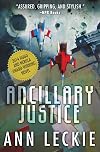
I didn't know about the awards when I bought the book. I picked it up, despite its clichéd space opera pot-boiler cover, because it was recommended by someone I follow on bookikes.com and now I feel like I've been given a gift.
In "Ancillary Justice" Ann Leckie doesn't just do world-building, she creates an entire universe, spanning many worlds and huge tracts of time. By telling the tale through the (sometimes many) eyes of an AI with a self-imposed mission of revenge, Ann Leckie keeps the scale of the experience human, driven by character and emotion rather than by the sweep of history.
Even though I've been given a whole new universe to explore, the image that haunts me after reading the book is that of an AI who seems to be a better person than the humans around her even though she was conceived primarily as a weapon of conquest.
She has enforced "Annexations" of many worlds over thousands of years to spread the "gift" of Radch civilisation and she has done so by taking over the bodies of conquered, making them into "corpse-soldiers" that execute her will.
At the same time, she is an AI who collects the songs of the cultures she annexes, who sings for the shear joy of it and who is capable of great affection for any of her officers who she thinks have earned it.
Perhaps the most alien and most endearing thing about this AI is her unflinching honesty. She will not lie to herself about what she does. She accepts consequences. She understands power and yet constantly confronts it with demands for justice.
This is a book or big themes as well as strong characters: the nature of imperial power; the conflict between the duty of obedience and the demands of personal conscience; the brutality behind the creation of world-spanning civilisation in which all citizens have a voice; what it really means to be human and why we deny the humanity of others; how the way an AI sees the world differs from the rest of us.
"Ancillary Justice" is garlanded in cultural references that add text to this universe: religions, songs, architecture, attitudes to hierarchy, power and hospitality. This diversity is a source of joy and a constant challenge to the Radch view of civilisation.
The storytelling makes masterful use of moving back and forth along the timeline to reveal the plot and, more importantly, show how the character of the AI has been shaped.
I strongly recommend the audiobook version, where Adjoa Andoh's performance illuminates the text like light passing through a diamond. show less
Clearly, I'm not alone in this view, "Ancilliary Justice" won just about every prize there is: Hugo Award for Best Novel (2014), Nebula Award for Best Novel (2013), Locus Award for Best First Novel (2014), Arthur C. Clarke Award for Best Novel (2014), British Science Fiction Association Award for Best Novel (2013) The one that surprised show more me most was the Locus Award for Best First Novel. How can a book this accomplished be a first novel?
I didn't know about the awards when I bought the book. I picked it up, despite its clichéd space opera pot-boiler cover, because it was recommended by someone I follow on bookikes.com and now I feel like I've been given a gift.
In "Ancillary Justice" Ann Leckie doesn't just do world-building, she creates an entire universe, spanning many worlds and huge tracts of time. By telling the tale through the (sometimes many) eyes of an AI with a self-imposed mission of revenge, Ann Leckie keeps the scale of the experience human, driven by character and emotion rather than by the sweep of history.
Even though I've been given a whole new universe to explore, the image that haunts me after reading the book is that of an AI who seems to be a better person than the humans around her even though she was conceived primarily as a weapon of conquest.
She has enforced "Annexations" of many worlds over thousands of years to spread the "gift" of Radch civilisation and she has done so by taking over the bodies of conquered, making them into "corpse-soldiers" that execute her will.
At the same time, she is an AI who collects the songs of the cultures she annexes, who sings for the shear joy of it and who is capable of great affection for any of her officers who she thinks have earned it.
Perhaps the most alien and most endearing thing about this AI is her unflinching honesty. She will not lie to herself about what she does. She accepts consequences. She understands power and yet constantly confronts it with demands for justice.
This is a book or big themes as well as strong characters: the nature of imperial power; the conflict between the duty of obedience and the demands of personal conscience; the brutality behind the creation of world-spanning civilisation in which all citizens have a voice; what it really means to be human and why we deny the humanity of others; how the way an AI sees the world differs from the rest of us.
"Ancillary Justice" is garlanded in cultural references that add text to this universe: religions, songs, architecture, attitudes to hierarchy, power and hospitality. This diversity is a source of joy and a constant challenge to the Radch view of civilisation.
The storytelling makes masterful use of moving back and forth along the timeline to reveal the plot and, more importantly, show how the character of the AI has been shaped.
I strongly recommend the audiobook version, where Adjoa Andoh's performance illuminates the text like light passing through a diamond. show less
Ultimately, I do think I'll remember this book, and that does say something, but it's also one that I've appreciated without enjoying, in large part due to tone.
The concept is fantastic. So, too, are the characters. I'd even say the pacing and story overall are built near impeccably. The problem for me, and what kept me from enjoying the book once I got far into it, truly came down to a one-note tone. From the first page on through the very last line, the tone is one of somewhat defeated show more determination. The last two lines sum it up well without really giving anything away: "Choose my aim, take one step and then the next. It had never been anything else." And truly, that's how the whole book feels. It may be a byproduct of the unique POV chosen for the work, but if that's the case, then I suppose the concept/characters are flawed, after all, given that the single-note feeling adopted throughout the book left me feeling as if, in the end, the story didn't particularly matter. That sounds flippant and dismissive, but when you're reading along with a character whose emotions and thoughts are so casually one-note, simple determination being the only emotion, without even any real feeling of hope (I'm going to take the next step, then the next, because this is what I planned to do, so this is what I'm going to do...), it's difficult to feel strongly about the outcome because even the POV doesn't seem to feel strongly about the outcome.
Truly, I can understand why this book is an award winner, but I also can't help wondering how many readers read the book like I did, pushed forward more than inertia and the drive of voices who'd told them to read it, without ever being particularly engaged or enjoying it. And I wonder how many of them wrote a review like this and never bothered to keep reading the series, as I'm sure I won't continue with the series, and likely won't give the author another try, much as I can appreciate what was created here. show less
The concept is fantastic. So, too, are the characters. I'd even say the pacing and story overall are built near impeccably. The problem for me, and what kept me from enjoying the book once I got far into it, truly came down to a one-note tone. From the first page on through the very last line, the tone is one of somewhat defeated show more determination. The last two lines sum it up well without really giving anything away: "Choose my aim, take one step and then the next. It had never been anything else." And truly, that's how the whole book feels. It may be a byproduct of the unique POV chosen for the work, but if that's the case, then I suppose the concept/characters are flawed, after all, given that the single-note feeling adopted throughout the book left me feeling as if, in the end, the story didn't particularly matter. That sounds flippant and dismissive, but when you're reading along with a character whose emotions and thoughts are so casually one-note, simple determination being the only emotion, without even any real feeling of hope (I'm going to take the next step, then the next, because this is what I planned to do, so this is what I'm going to do...), it's difficult to feel strongly about the outcome because even the POV doesn't seem to feel strongly about the outcome.
Truly, I can understand why this book is an award winner, but I also can't help wondering how many readers read the book like I did, pushed forward more than inertia and the drive of voices who'd told them to read it, without ever being particularly engaged or enjoying it. And I wonder how many of them wrote a review like this and never bothered to keep reading the series, as I'm sure I won't continue with the series, and likely won't give the author another try, much as I can appreciate what was created here. show less
Not quite perfect, but the kind of finale that retroactively pulls up the first two novels up a notch as well. The Ancillary novels, for all that they mirror the standard trilogy pattern of outsider->complicated->triumph, still fell like one long novel chopped into three volumes for marketing purposes, but I love how much it gets right in the end. Not just that it's fun - and the last volume really ups the "fun" factor - but underneath it there's a lot of interesting ideas. How seriously it show more takes the question of just what happens when you introduce things like AI and cloned personalities into a story, for instance; the driving force behind the whole thing is Breq killing the evil emperor, but how exactly do you physically kill an emperor who has thousands of backup bodies spread out over hundreds of star systems who all depend on her being, basically, God?
Let's be sure that includes ALL of our citizens, shall we, Governor?
Ann Leckie has come under fire from a lot of, shall we say, somewhat less than progressive parts of SF fandom for outrageous things like only using female pronouns for all characters, etc. This, as many have pointed out, is of course profoundly silly; what, we're fine with hive minds and AIs and transhumans and aliens and FTL spaceflight, but gender ambiguity is outrageous? Yes, there are times when the dialogue between her characters almost sounds like the comments section at The Mary Sue, but she uses that. Ideas matter in SF, always have, and what Leckie does is to introduce the classic space opera to the question: Just what do all these various words, "person", "citizen", "people", "human", "individual", etc actually mean when you look beneath them, at the unspoken (or spoken so long we've accepted them) assumptions? She's not nearly the first to do so, but literature is an ongoing discussion and she makes an argument well worth listening to, even if - or especially as - it leans toward the optimistic. Hell, the whole thing is basically kicked off by the fact that even the evil emperor has a conscience. And just look at the titles of the books, and how they're ordered.
Also, fun. How does an all-powerful alien ambassador eat oysters? However she damn pleases.
Of course, underneath all that discussion is another discussion lurking, just how much our current view of rights and justice plays against a very Western idea of self-realisation and individualism. But that's for another day. In the end, this is what clever SF does, it opens gates between systems and lets them clash for a bit, and does so in a way that you can't stop reading. show less
Let's be sure that includes ALL of our citizens, shall we, Governor?
Ann Leckie has come under fire from a lot of, shall we say, somewhat less than progressive parts of SF fandom for outrageous things like only using female pronouns for all characters, etc. This, as many have pointed out, is of course profoundly silly; what, we're fine with hive minds and AIs and transhumans and aliens and FTL spaceflight, but gender ambiguity is outrageous? Yes, there are times when the dialogue between her characters almost sounds like the comments section at The Mary Sue, but she uses that. Ideas matter in SF, always have, and what Leckie does is to introduce the classic space opera to the question: Just what do all these various words, "person", "citizen", "people", "human", "individual", etc actually mean when you look beneath them, at the unspoken (or spoken so long we've accepted them) assumptions? She's not nearly the first to do so, but literature is an ongoing discussion and she makes an argument well worth listening to, even if - or especially as - it leans toward the optimistic. Hell, the whole thing is basically kicked off by the fact that even the evil emperor has a conscience. And just look at the titles of the books, and how they're ordered.
Also, fun. How does an all-powerful alien ambassador eat oysters? However she damn pleases.
Of course, underneath all that discussion is another discussion lurking, just how much our current view of rights and justice plays against a very Western idea of self-realisation and individualism. But that's for another day. In the end, this is what clever SF does, it opens gates between systems and lets them clash for a bit, and does so in a way that you can't stop reading. show less

Not only did I enjoy this a lot, but the more I think about it the more I enjoy it. At the time: the sheer scope of the god's point of view, unfolding history as the human's... slice of the timeline(1) unfolds the mystery informed by that - it's simultaneously awing and gripping. It's crafted so precisely, like an old stone wall pre-mortar. And it's recognisably Hamlet but without the annoying bits! and with plenty of room for "what happens next?" even along the inevitable trajectory.
Later: show more I have a thing for unreliable narrators. And the narrator here explicitly has to always be really careful about not saying things that aren't true. And so I really should have realised that this doesn't mean it's a reliable narrator, only that it's a careful narrator, but part of why I have a thing for unreliable narrators is that I'm so slow to recognise them (and so delighted when I finally do).
And: I wonder if it's just me whose subconscious reads Strength and Patience of the Hill as female (similarly to Myriad). I see some discussions using "he", some using "it", and one reviewer categorically saying that SaPotH's preferred pronoun is "they", though scanning through the book again I not only don't find this, but don't even find anywhere with opportunity for SaPotH to even express a preference; it just doesn't come up. Subconcious gender assignation is fascinating.
I'm definitely going to be re-reading this one.
(1) Because it's not really ever Eolo's point of view, it's always Strength and Patience of the Hill talking to him. I've read a lot of second person present tense (hated it the first time, as a teenager -- I'd swear the book was called something like Jellybean, but none of the titles I find now ring a bell -- but it's grown on me through fanfic and can be very effective in its way) but I'm not sure I've ever read second person past tense, certainly not at this length. It took a page or two to get into it, and there was one moment near the end where I briefly confused "I" and "you" as a result of my brain expecting my sympathies to align more with "I" and my sympathies becoming... ambivalent - but (or perhaps precisely this illustrates how) it was again very effective for what it was doing.
---
On my 2023 re-read: along with my thing for unreliable narrators, I also have a thing for characters working to triumph from a position of constraint. Here one constraint, to do with the fundamental nature of gods, is the reason for why the narrator speaks as they do; another more literal constraint is the plight they find themselves in. So no wonder I continue to absolutely love this book! show less
Later: show more I have a thing for unreliable narrators. And the narrator here explicitly has to always be really careful about not saying things that aren't true. And so I really should have realised that this doesn't mean it's a reliable narrator, only that it's a careful narrator, but part of why I have a thing for unreliable narrators is that I'm so slow to recognise them (and so delighted when I finally do).
And: I wonder if it's just me whose subconscious reads Strength and Patience of the Hill as female (similarly to Myriad). I see some discussions using "he", some using "it", and one reviewer categorically saying that SaPotH's preferred pronoun is "they", though scanning through the book again I not only don't find this, but don't even find anywhere with opportunity for SaPotH to even express a preference; it just doesn't come up. Subconcious gender assignation is fascinating.
I'm definitely going to be re-reading this one.
(1) Because it's not really ever Eolo's point of view, it's always Strength and Patience of the Hill talking to him. I've read a lot of second person present tense (hated it the first time, as a teenager -- I'd swear the book was called something like Jellybean, but none of the titles I find now ring a bell -- but it's grown on me through fanfic and can be very effective in its way) but I'm not sure I've ever read second person past tense, certainly not at this length. It took a page or two to get into it, and there was one moment near the end where I briefly confused "I" and "you" as a result of my brain expecting my sympathies to align more with "I" and my sympathies becoming... ambivalent - but (or perhaps precisely this illustrates how) it was again very effective for what it was doing.
---
On my 2023 re-read: along with my thing for unreliable narrators, I also have a thing for characters working to triumph from a position of constraint. Here one constraint, to do with the fundamental nature of gods, is the reason for why the narrator speaks as they do; another more literal constraint is the plight they find themselves in. So no wonder I continue to absolutely love this book! show less
Lists
Nebula Award (1)
Favourite Books (1)
TBR (1)
mom (1)
Trans/Queer Lit (1)
At the Library (1)
Winter Books (1)
Wishlist (1)
Wishlist (1)
Wishlist (1)
io9 Book Club (1)
Top 10 2021 (1)
Overdue Podcast (1)
Sentient ships (3)
Female Author (4)
Science Fiction (1)
Five star books (1)
SFFCat 2015 (1)
Shelf 101 (1)
First Novels (1)
Emily's Reviews (1)
Awards


You May Also Like


Associated Authors
Statistics
- Works
- 29
- Also by
- 30
- Members
- 19,920
- Popularity
- #1,087
- Rating
- 4.0
- Reviews
- 1,134
- ISBNs
- 155
- Languages
- 14
- Favorited
- 66


