

Michael Kuhn (1) (1955–)
Author of Marcellus - Der Merowinger
For other authors named Michael Kuhn, see the disambiguation page.
Series
Works by Michael Kuhn
Tagged
Common Knowledge
- Other names
- KUHN, Michael
- Birthdate
- 1955
- Education
- Universität Aachen
- Occupations
- Historiker, Autor, Verleger
- Nationality
- Deutschland
- Birthplace
- Wuppertal, Nordrhein-Westfalen, Deutschland
Members
Reviews
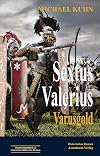
Exciting story of a young optio, Sextus Valerius, who, along with others, survives the Battle of Teutoberg, 9 AD. The signifier, Kaeso, is greedy and steals the "Varusgold", which I interpreted as the intended salary for Varus' legions. "Why should the natives have it?" is his defense. This money overshadows the whole novel and is a motivation for much of the action and emotions of the characters: the three officers who wish to use the gold for their own nefarious purposes, including an show more illegal trade scheme: buying weapons and selling them to tribesmen beyond the Rhine, in exchange for pelts, amber, and blond girls they can sell as slaves. One, an evil centurion, Fabricius, falsifies the personnel roster of Sextus' old unit, even writing he's gone over to the enemy, attempting to bar his entrance into another legion. This plot is foiled and the personnel roll completely destroyed. With the help of other officers and a young legionary, Quintus, who wish to ferret out the truth, Sextus searches for convincing evidence of those three officers' guilt. One is his former friend, Lucius. It's also the story of two women with whom Sextus becomes involved; he finds he has been blinded by a selfish one, Lucilla, and falls for the better one, the tribeswoman, Hildiko, who has fallen in love with him for himself. The story ends on a cliffhanger: will Kaeso convince the tribesmen he can lead them to the gold before they kill him? It sounds like there will be a sequel.
An interesting angle to the Teutoberg aftermath. We root for Sextus as he tries to overcome any obstacles in his way. A few of the characters are two-dimensional, for instance the villains and Lucilla, the tavernkeeper and Sextus' mistress. But Lucius is torn: he still has a core of goodness, now covered by greed. A bit disconcerting was the layout: Sextus' first-person narration in regular type, AND third-person action of other characters, in italics. I wish instead of italics, those parts of the book could have been bolded or even a different color. A well-drawn map on each of the endpapers traces Sextus' journey. A section after the novel, with pictures and text, gives us information about museums in the areas that figure in the story. On the cover, the man in the fore-and-aft black feather crest might be the author's son, costumed in a reenactment group uniform of an optio.
Highly recommended. show less
An interesting angle to the Teutoberg aftermath. We root for Sextus as he tries to overcome any obstacles in his way. A few of the characters are two-dimensional, for instance the villains and Lucilla, the tavernkeeper and Sextus' mistress. But Lucius is torn: he still has a core of goodness, now covered by greed. A bit disconcerting was the layout: Sextus' first-person narration in regular type, AND third-person action of other characters, in italics. I wish instead of italics, those parts of the book could have been bolded or even a different color. A well-drawn map on each of the endpapers traces Sextus' journey. A section after the novel, with pictures and text, gives us information about museums in the areas that figure in the story. On the cover, the man in the fore-and-aft black feather crest might be the author's son, costumed in a reenactment group uniform of an optio.
Highly recommended. show less
Marcus - Maximus Alamannicus: Schicksal an Mosel und Rhein Band 3 (Marcus-Trilogie) (German Edition) by Michael Kuhn

A fitting conclusion to Marcus' memoirs. The possessor of the serpent brooch, serpent bracelet and serpent belt buckle is supposedly destined to be King of the Franks. The evil Frank Ulf obtains all three and most of the story concerns Marcus' 18 year search for Ulf and the final reckoning after the Battle of Argentoratum, in which Marcus saves Caesar Julian's life. There is a long description of plans for the battle and details of its being fought. That DID get tiresome after awhile. Ulf's show more fate was not the usual: losing end of a duel between the hero and villain but much more unusual and gruesome. I liked the Epilog in which Marcus tells the reader what happened subsequently to each of the characters and to Marcus' family, even slipping in a little Roman history of a few years following events of the story. The whole trilogy was very satisfying. I just wish there were an English translation. I liked the device the author used all through the trilogy; he gave us the first person Marcus writing in regular print, then actions involving other characters, in italics, in third person.
Recommended. show less
Recommended. show less
Set in the latter half of 4th century during the Roman Tetrarchy, an old soldier is writing his memoirs. Exciting and most engrossing, they describe Germania and wars against various tribes, most importantly, the Franks. Most of the story takes place in or near the Ardennes Forest. The fort Gelduba, in which Marcus, a centurion, serves, is overrun by Franks and he, with a few others, escapes. The story is mainly his flight south, to his family home and to Treveris,to deliver a message to a show more high official there. Marcus has many adventures along the way, meets an Alemannian girl, Bissula, who travels with him partway then leaves to join relatives. A priest tells him they will be separated but meet again. He meets and makes a new loyal friend, Galerius, who travels with him. At his home, his dying mother had wished him to have a broken brooch with the same serpent shape and emerald eyes, as a bracelet he always wears. The steward gives it to him and tells him his grandfather was a Frank and a Frank, Ulf, keeps appearing, to get the bracelet. What is its importance and why is it so important? A note of fantasy: it does warn Marcus of imminent danger by sudden pain in his wrist and reddening of the skin beneath the bracelet. At Treveris, because of his bold defense of a neighboring senator's villa, he is promoted to tribune and posted to a fort where he will aid Caesar Julian in retaking a fortress captured by Franks.
The ending left me wanting more of Marcus' story, which he tells us he will continue.
Highly recommended. show less
The ending left me wanting more of Marcus' story, which he tells us he will continue.
Highly recommended. show less
Exciting and gripping conclusion to the story of Sextus Valerius, the optio [now centurion] and what happens to him in the years that follow the debacle of the Teutoberg battle. There are three main strains to the story: in first person, Sextus himself; the second and third are told in third person. One concerns the villains of the piece, Kaeso, the army deserter and ex-signifier and Lucius, Sextus' former friend, the other concerns the Marsi tribespeople, both good--the smith Gernot and his show more sister Hildiko--and bad, Marbod, who lusts for gold and for power. Overarching the action as a whole is the "Varusgold" and greed for its possession. We follow the campaigns of Germanicus, to finally overcome the Germanic tribes east of the Rhine and how his campaigns turn out. Several battles are described; they seem to be stalemates but Germanicus portrays them as victories. Finally, all the main characters are brought together in a shipwreck, marooned on an island. Will they be found before the onset of winter?
I enjoyed the flow of the story and was satisfied at the ending. The characters were black-and-white; I didn't see much nuance to their personalities, although I was sympathetic to some of them. I thought the maps on the end papers and the author's explanation of the Roman army and other facts interesting touches.
Highly recommended. show less
I enjoyed the flow of the story and was satisfied at the ending. The characters were black-and-white; I didn't see much nuance to their personalities, although I was sympathetic to some of them. I thought the maps on the end papers and the author's explanation of the Roman army and other facts interesting touches.
Highly recommended. show less
Statistics
- Works
- 8
- Members
- 23
- Popularity
- #537,597
- Rating
- 4.1
- Reviews
- 4
- ISBNs
- 52
- Languages
- 2
- Favorited
- 1