
Elsa Okon Rael
Author of What Zeesie Saw on Delancey Street
About the Author
Works by Elsa Okon Rael
Tagged
Common Knowledge
There is no Common Knowledge data for this author yet. You can help.
Members
Reviews

When Rivka, a little Jewish girl living in New York City's Lower East Side in the early twentieth century, learns about Thanksgiving at school, she longs for her own family to join the celebration. Much like the Pilgrims in the story she has been taught, her people came to America for religious freedom and for safety. Having found those things, she reasons, they too should be thankful. Her Bubbe takes the issue to the Rabbi Yoshe Preminger, who declares that Jews do not celebrate show more Thanksgiving. Rivka knows the rabbi is wrong, but what can one little girl do in the face of such authority...?
In Rivka's First Thanksgiving, author Elsa Okon Rael answers that question by demonstrating how sometimes a child, by questioning and even criticizing her elders, by questioning and criticizing religious authority, can be the one to effect change, leading her community in the right direction. The story reminded me a bit of Barbara Cohen's Molly's Pilgrim, which also features a young Jewish girl finding meaning through the Thanksgiving story, although here the conflict is internal to the Jewish community, whereas there the conflict is external. The text here is quite long for a picture-book, and discusses the history of Rivka's family and community in Poland, where they experienced persecution and violence. For these reasons, this isn't a book I would recommend to very young children, although older picture-book audiences (six and up, I would say) will probably be the right target group. There is a glossary at the rear, explaining the meanings of some of the names and words used in the story, from Rivka (a variant of Rebecca, meaning "Bound") to Bubbe (grandmother). The artwork by Maryann Kovalski is cute, although sometimes I found her human faces a little too cartoonish, in odd ways. Leaving that last aside, all in all this is an engaging Thanksgiving story, one which illuminates the fact that the Thanksgiving story, whatever one thinks of it, has given comfort and meaning to a diverse range of Americans. show less
In Rivka's First Thanksgiving, author Elsa Okon Rael answers that question by demonstrating how sometimes a child, by questioning and even criticizing her elders, by questioning and criticizing religious authority, can be the one to effect change, leading her community in the right direction. The story reminded me a bit of Barbara Cohen's Molly's Pilgrim, which also features a young Jewish girl finding meaning through the Thanksgiving story, although here the conflict is internal to the Jewish community, whereas there the conflict is external. The text here is quite long for a picture-book, and discusses the history of Rivka's family and community in Poland, where they experienced persecution and violence. For these reasons, this isn't a book I would recommend to very young children, although older picture-book audiences (six and up, I would say) will probably be the right target group. There is a glossary at the rear, explaining the meanings of some of the names and words used in the story, from Rivka (a variant of Rebecca, meaning "Bound") to Bubbe (grandmother). The artwork by Maryann Kovalski is cute, although sometimes I found her human faces a little too cartoonish, in odd ways. Leaving that last aside, all in all this is an engaging Thanksgiving story, one which illuminates the fact that the Thanksgiving story, whatever one thinks of it, has given comfort and meaning to a diverse range of Americans. show less

"Zeesie wasn't really happy about the visit to her grandparents," begins this engaging family story from Elsa Okon Rael, which won the 1997 Sydney Taylor Book Award (given by the Association of Jewish Libraries, in order to recognize "quality Judaic literature") in the 'Younger Readers' category. Dispatched to Bubbeh Ruchel and Zayde Avrum's apartment, when her mother must go to the hospital to have a baby, Zeesie is at first as intimidated as always by her stern Zayde (grandfather), show more accepting his invitation to join him at shul only with great reluctance. Imagine her surprise when, having arrived at the beautiful Eldridge Street Synagogue, she sees the normally scowling Zayde smiling and dancing, and enjoying the celebration of Simchas Torah! Equally surprising is his positive reaction, when she questions him about to the meaning of the celebration...
An excellent introduction to the celebration of Simchas Torah - the day in the Jewish calendar on which the year-long public reading of the Torah is concluded, and which marks the beginning of another year's cycle of reading - which I have not seen extensively discussed in children's books (actually, I haven't seen it discussed at all, but then, I haven't been looking for it either), When Zaydeh Danced on Eldridge Street is also a sensitive family story, one which explores the sometimes difficult relationship between the generations. Anyone who has had a formidable grandparent will recognize and identify with Zeesie's anxiety, and will rejoice in the rapport that she builds with Zaydeh, by showing an interest in Jewish traditions. I really appreciated the fact that, although heartwarming, this is not an unrealistically 'sweet' story - Zaydeh is a genuinely grouchy old man, with little patience for young people, and that doesn't seem likely to change. On the other hand, despite Zeesie's fears, he's clearly not an ogre, and it's very satisfying to see this reality becoming apparent to her. Highly recommended, to anyone looking for Simchas Torah stories for younger readers, or for stories involving the grandparent-grandchild relationship. show less
An excellent introduction to the celebration of Simchas Torah - the day in the Jewish calendar on which the year-long public reading of the Torah is concluded, and which marks the beginning of another year's cycle of reading - which I have not seen extensively discussed in children's books (actually, I haven't seen it discussed at all, but then, I haven't been looking for it either), When Zaydeh Danced on Eldridge Street is also a sensitive family story, one which explores the sometimes difficult relationship between the generations. Anyone who has had a formidable grandparent will recognize and identify with Zeesie's anxiety, and will rejoice in the rapport that she builds with Zaydeh, by showing an interest in Jewish traditions. I really appreciated the fact that, although heartwarming, this is not an unrealistically 'sweet' story - Zaydeh is a genuinely grouchy old man, with little patience for young people, and that doesn't seem likely to change. On the other hand, despite Zeesie's fears, he's clearly not an ogre, and it's very satisfying to see this reality becoming apparent to her. Highly recommended, to anyone looking for Simchas Torah stories for younger readers, or for stories involving the grandparent-grandchild relationship. show less
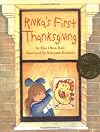
Having learned about it in school, Rivka wants to celebrate Thanksgiving more than anything. The only problem is trying to persuade her family and Rabbi. Rivka’s parents are Jewish immigrants from Poland and never celebrated the holiday, let alone heard of it. They don’t believe Pilgrims and Indians have anything to do with Jews and are wary to participate. Rivka makes the argument to the Rabbi that Thanksgiving is a holiday for all Americans to give thanks for what they have, regardless show more of religion or culture.
I love how it gently touches on the treatment of Jews during the early twentieth century. This could help children better understand why Rivka was so thankful to live in America and wanted to celebrate Thanksgiving. It could also be a great discussion with students to figure out what they are thankful for.
This book seamlessly blends Jewish traditions into American culture and portrays the rich cultural diversity that makes America what it is: a melting pot. This is a sweet story of family, blending new traditions with old, and always being thankful for what we have. show less
I love how it gently touches on the treatment of Jews during the early twentieth century. This could help children better understand why Rivka was so thankful to live in America and wanted to celebrate Thanksgiving. It could also be a great discussion with students to figure out what they are thankful for.
This book seamlessly blends Jewish traditions into American culture and portrays the rich cultural diversity that makes America what it is: a melting pot. This is a sweet story of family, blending new traditions with old, and always being thankful for what we have. show less

When Marushka's mother sends her to the market to buy a "perfect" egg for their Easter bread, the young girl finds herself tricked and imprisoned by the evil witch Baba Yaga, who offers her a beautifully decorated blue egg lit up by a mysterious inner light. Sucked into the world inside the egg, Marushka becomes Baba Yaga's servant, cleaning her scaled house, Izbushka, and caring for Katya the cat, Kronus the crow, and Ilya the bear. Determined to escape, clever Marushka asks her captor a show more series of questions, eventually freeing both herself and her animal companions...
Although it incorporates some well-known themes and characters from Russian folklore, from the three animal companions to Baba Yaga the witch, I'm not entirely sure that Marushka's Egg is a traditional folktale so much as a creative adaptation. Whatever the case may be, it is a lovely picture-book with an engaging heroine. The beautiful tempera and watercolor illustrations by Joanna Wezyk are lushly colorful, and give the book an admirably whimsical quality. This is an Easter tale that young readers will enjoy, and I thank my friend Kathryn for recommending it! show less
Although it incorporates some well-known themes and characters from Russian folklore, from the three animal companions to Baba Yaga the witch, I'm not entirely sure that Marushka's Egg is a traditional folktale so much as a creative adaptation. Whatever the case may be, it is a lovely picture-book with an engaging heroine. The beautiful tempera and watercolor illustrations by Joanna Wezyk are lushly colorful, and give the book an admirably whimsical quality. This is an Easter tale that young readers will enjoy, and I thank my friend Kathryn for recommending it! show less
Awards


You May Also Like


Associated Authors
Statistics
- Works
- 4
- Members
- 512
- Popularity
- #48,443
- Rating
- 3.9
- Reviews
- 24
- ISBNs
- 13