
Bob Moore (2)
Author of Don't Call Me a Crook!: A Scotsman's Tale of World Travel, Whisky and Crime
For other authors named Bob Moore, see the disambiguation page.
Works by Bob Moore
Don't Call Me a Crook!: A Scotsman's Tale of World Travel, Whisky and Crime (2009) 23 copies, 8 reviews
Tagged
Common Knowledge
Members
Reviews
Don't Call Me a Crook! is a memoir by the most unreliable of narrators. Despite not wanting to be called a crook, Bob Moore most certainly is one. An engineer by trade, his adventures take him all over the world where he finds himself "swiping" anything from diamonds to cash to a Shriner's sword. Moore's twenties really roared, and his experiences paint a picture of an era when lawlessness was a way of life. Bob's adventures take him to New York where he rips off a smuggler's diamonds, to show more Chicago where he cons a gullible woman out of her diamond ring, to a party yacht on the Long Island Sound, to South America where he makes off with funds given him for a supposed business start up, and even to China where the lawlessness seems to shock even him. There is no doubt that Bob Moore was a product of his time and had the experiences to prove it, but well, actually, there is some doubt, at least in my mind, about whether the stories he tells are true. After all, the very life he chronicles gives us reason to question everything he says. How can you trust the storytelling of a guy who gets by on lies and dishonest gain?
Whether it's true or not, though, Don't Call Me a Crook! is a rollicking adventure. While Moore's style of writing is a little stilted and hard to read, his tale is full of action and what seems like a particularly honest and unflinching view at the 20s. Few pages go by where Moore isn't getting into or getting out of some trouble. Admittedly, Moore's routine of getting "oiled" (drunk) and making trouble can get redundant, but at other times his experiences are laugh out loud funny. It's a bit like listening to your crazy old uncle tell stories after he's had a few, that is, if you have a crazy old uncle or someone of that sort. I found the middle section about his time on a party yacht with some stingy millionaires and their wild sons to be particularly enjoyable. The pages in this section flew by, but his time in China was a bit more of struggle to read given the daily atrocities and disregard for human life he witnessed and occasionally even perpetrated himself.
All in all I found Don't Call Me a Crook! to be an interesting and amusing memoir. Reading Moore's memoir certainly gives us a hardy sampling of what life could be like in 1920s in a variety of locations. Moore is unapologetic about his thoughts and actions, and so emerges a memoir that, even if not entirely true, still offers an unvarnished and often surprisingly honest-seeming look at life during quite a wild time in our history. show less
Whether it's true or not, though, Don't Call Me a Crook! is a rollicking adventure. While Moore's style of writing is a little stilted and hard to read, his tale is full of action and what seems like a particularly honest and unflinching view at the 20s. Few pages go by where Moore isn't getting into or getting out of some trouble. Admittedly, Moore's routine of getting "oiled" (drunk) and making trouble can get redundant, but at other times his experiences are laugh out loud funny. It's a bit like listening to your crazy old uncle tell stories after he's had a few, that is, if you have a crazy old uncle or someone of that sort. I found the middle section about his time on a party yacht with some stingy millionaires and their wild sons to be particularly enjoyable. The pages in this section flew by, but his time in China was a bit more of struggle to read given the daily atrocities and disregard for human life he witnessed and occasionally even perpetrated himself.
All in all I found Don't Call Me a Crook! to be an interesting and amusing memoir. Reading Moore's memoir certainly gives us a hardy sampling of what life could be like in 1920s in a variety of locations. Moore is unapologetic about his thoughts and actions, and so emerges a memoir that, even if not entirely true, still offers an unvarnished and often surprisingly honest-seeming look at life during quite a wild time in our history. show less
In this memoir’s foreword the editor mentions he stumbled upon DON’T CALL ME A CROOK by Robert Moore (this edition is a re-issue) by searching for the term “Tramp” at the New York Public library’s database. Tramp is a particularly apt descriptive for Moore, who usually has a roof over his head, but never the same roof for any given period of time. He argues that he isn’t a crook, but upon reading his “reminisces”; one finds he’s as opportunistic a criminal as they come. show more Moore (probably a pseudonym), an affable Scotsman, launches an international campaign to find a good time while working the least amount as possible. He lives from one adventure to another escapade all the while taking everything he can get and issuing no apologies.
This book is an effective cocktail of social commentary, travel memoir and holy confession. This edition is annotated to easily acclimate the reader to Moore-speak, though many misspellings and word misuses are left in for colloquial charm. It’s also been editorially sequenced into its natural story arc. Though book didn’t make much of a debut in its day, and one can only speculate as to why that was, as it certainly is not for lack of appeal. Moore’s stories range from absolutely ridiculous to deliciously over the top. His style is conversational and his antidotes and the recounts of his capers are always entertaining. Despite his sins, Moore manages to retain his bad boy charisma. His story more above all things--is undeniably cool. show less
This book is an effective cocktail of social commentary, travel memoir and holy confession. This edition is annotated to easily acclimate the reader to Moore-speak, though many misspellings and word misuses are left in for colloquial charm. It’s also been editorially sequenced into its natural story arc. Though book didn’t make much of a debut in its day, and one can only speculate as to why that was, as it certainly is not for lack of appeal. Moore’s stories range from absolutely ridiculous to deliciously over the top. His style is conversational and his antidotes and the recounts of his capers are always entertaining. Despite his sins, Moore manages to retain his bad boy charisma. His story more above all things--is undeniably cool. show less
I really wanted to like this book. After all, “A Scotsman’s Tale of World Travel, Whiskey and Crime” sounds right up my alley. I love colorful memoirs, adventure stories, all that, and I thought I would really enjoy this one.
I didn’t even make it through 100 pages.
There are a lot of reasons I was disappointed in the book. First off, the writing is clunky. It sounds much like you would expect a Scotsman to sound, sitting in a pub, telling you a story after a couple of pints. I show more didn’t, in this case, find that charming.
Second, I don’t care what the title says, he’s a crook. Here’s his explanation, given very early on:
“Though really, I am not a crook at all, because a crook is a man who steals things from people, but I have only swiped things when I needed them or when it would be wasteful to let slip an opportunity. Because I think it is very wrong for a man to waste his opportunities.”
So, he’s not a crook because he “swiped” things, instead of stealing them. That’s perfectly logical, right? And what about his train trip to Chicago? He started drinking with a married woman, got her drunk, seduced her, asked her to spend a week in Chicago with him. When they arrived, he didn’t want his friends to see her, so he convinced her to wait at the station while he went to pawn her engagement ring. He did come back for her – a week later. I suppose she was just an “opportunity” that he didn’t want to “let slip.” That’s a load of crap, if you ask me.
Now, I don’t require that every book be a morality play, but maybe I’ve just had enough corruption and rationalization lately. I just didn’t find this charming; I found it insulting. Someone who was perfectly willing to take advantage of you if he got the chance, so as not to let an opportunity slip, is not an adventurer, he’s a criminal. The rationalization just makes it worse.
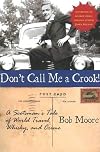
There were a couple of things about this edition of the book that bothered me. First off, the cover. Looks like a dashing fellow, right? Well, it’s not Bob Moore, the author. I don’t know who it is – it’s just some guy that the publisher and cover designer thought “conveyed the book’s cheekiness and rougishness.” What? I honestly can’t say why that bothered me as much as it did. I was also unhapy with the editing. I understand adding footnotes to clarify certain points, but editor Pat Spry apparently thinks readers are unfamiliar with modern language, as well as Moore’s more antiquated expressions. I do not need footnote definitions of fathoms, galley, fortnight, winch, squall or subway. Come on! There may be expressions that are less common today – such as “on the floor,” which mean impoverished – but defining what should be basic vocabulary words was just annoying.
I think I am more annoyed by this book because I wanted so much to enjoy it. If I had no expectations, I still don’t think I would have finished it, but I certainly wouldn’t have been angry about it. show less
I didn’t even make it through 100 pages.
There are a lot of reasons I was disappointed in the book. First off, the writing is clunky. It sounds much like you would expect a Scotsman to sound, sitting in a pub, telling you a story after a couple of pints. I show more didn’t, in this case, find that charming.
Second, I don’t care what the title says, he’s a crook. Here’s his explanation, given very early on:
“Though really, I am not a crook at all, because a crook is a man who steals things from people, but I have only swiped things when I needed them or when it would be wasteful to let slip an opportunity. Because I think it is very wrong for a man to waste his opportunities.”
So, he’s not a crook because he “swiped” things, instead of stealing them. That’s perfectly logical, right? And what about his train trip to Chicago? He started drinking with a married woman, got her drunk, seduced her, asked her to spend a week in Chicago with him. When they arrived, he didn’t want his friends to see her, so he convinced her to wait at the station while he went to pawn her engagement ring. He did come back for her – a week later. I suppose she was just an “opportunity” that he didn’t want to “let slip.” That’s a load of crap, if you ask me.
Now, I don’t require that every book be a morality play, but maybe I’ve just had enough corruption and rationalization lately. I just didn’t find this charming; I found it insulting. Someone who was perfectly willing to take advantage of you if he got the chance, so as not to let an opportunity slip, is not an adventurer, he’s a criminal. The rationalization just makes it worse.
There were a couple of things about this edition of the book that bothered me. First off, the cover. Looks like a dashing fellow, right? Well, it’s not Bob Moore, the author. I don’t know who it is – it’s just some guy that the publisher and cover designer thought “conveyed the book’s cheekiness and rougishness.” What? I honestly can’t say why that bothered me as much as it did. I was also unhapy with the editing. I understand adding footnotes to clarify certain points, but editor Pat Spry apparently thinks readers are unfamiliar with modern language, as well as Moore’s more antiquated expressions. I do not need footnote definitions of fathoms, galley, fortnight, winch, squall or subway. Come on! There may be expressions that are less common today – such as “on the floor,” which mean impoverished – but defining what should be basic vocabulary words was just annoying.
I think I am more annoyed by this book because I wanted so much to enjoy it. If I had no expectations, I still don’t think I would have finished it, but I certainly wouldn’t have been angry about it. show less
Bob Moore, obviously a pseudonym, was a rapscallion who traveled the world, often as an engineer on ships but always causing trouble, constantly running to avoid getting caught for his crimes. He was a womanizer, a drunk, a thief and a murderer. But, his memoir is a hoot. You have to be mentally prepared to swallow his trail of crime and, fortunately, I was forewarned that he was really a rotten guy. If you just go in expecting him to be a horror, the book is fascinating for the peek into show more the time period and -- at times -- even becomes a little bit slapstick.
Originally published in 1935, the new publisher has no idea who Bob Moore really was, although there are notes verifying some of the historical facts the author mentioned. Moore comments that it's rough being "famous" and a preface indicates that the publisher couldn't figure out in what way fame figured into the story. I think it was a misuse of terms. He probably meant "infamous". Having said that, note that the cover is not a photo of the author. It's just a photo the publisher thought fit the time period and which showed a suitably cheeky-looking fellow. show less
Originally published in 1935, the new publisher has no idea who Bob Moore really was, although there are notes verifying some of the historical facts the author mentioned. Moore comments that it's rough being "famous" and a preface indicates that the publisher couldn't figure out in what way fame figured into the story. I think it was a misuse of terms. He probably meant "infamous". Having said that, note that the cover is not a photo of the author. It's just a photo the publisher thought fit the time period and which showed a suitably cheeky-looking fellow. show less
You May Also Like
Associated Authors
Statistics
- Works
- 1
- Members
- 23
- Popularity
- #537,597
- Rating
- 3.7
- Reviews
- 8
- ISBNs
- 44
- Languages
- 1