
Einhard (–840)
Author of Two Lives of Charlemagne
About the Author
Image credit: Einhard memorial in the German city of Eschweiler. Photo by Grunpfnul / Sascha Faber.
Works by Einhard
Associated Works
Readings and Exercises in Latin Prose Composition: From Antiquity to the Renaissance (2005) — Contributor — 48 copies
Antiikin viimeinen keisari : Kaarle Suuri ja läntisen Euroopan muotoutuminen antiikista keskiajalle (2023) 13 copies, 1 review
Tagged
Common Knowledge
- Other names
- Eginhard
Einhart - Birthdate
- c. 770
- Date of death
- 840-03-14
- Gender
- male
- Education
- educated at Benedictine monastery of Fulda
- Occupations
- courtier
construction manager
private secretary to Emperor Louis the Pious - Nationality
- Francia (Frankish Kingdom)
- Birthplace
- Maingau, Francia (Present-day Germany)
- Places of residence
- Seligenstadt, Germany
- Place of death
- Seligenstadt, Francia (Present-day Germany)
- Map Location
- Germany
Members
Reviews
I read an excerpt in The Medieval Reader that so interested me that I sought the full text. Of the ones I found, this was easy to read (well-translated for modern readers) and has over fifty elucidating footnotes. As a math teacher, I often get the "When I am going to use this?" question. My answer is generally around the "When you use your brain" type of response as I believe studying math makes for better thinking. In this recreational reading by an author also called Einhard I came across show more this observation of the famous Emperor of the Franks:
I think it is interesting that he learned to calculate motions of the planets without ever becoming truly literate we are told. (Footnotes here also doubt complete illiteracy.) Why would he even invest so much time as "with deep thought and skill most carefully calculated the courses of the planets"? I think he felt it improved his mind, if only to impress visitors to court with this acumen. (How else would we know? Did he show of his calculated orbits and periods with pride?)
It is interesting to see the apotheosis of this expansionist and politically astute rule who became a "Holy Roman Emperor" and nearly deified in retrospect even by Otto III who strongly aspired to be the successor of Charlemagne. In 1000, he visited Charlemagne's tomb in Aachen, removing relics from it and basically worshipping the corpse, as detailed in the final footnote here. show less
He was ready and fluent in speaking, and able to express himself with great clearness. He did not confine himself to his native tongue, but took pains to learn foreign languages, acquiring such knowledge of Latin that he could make an address in that language as well as in his own. Greek he could better understand than speak. Indeed, he was so polished in speech that he might have passed for a learned man.
He was an ardent admirer of the liberal arts, and greatly revered their professors, whom he promoted to high honors. In order to learn grammar, he attended the lectures of the aged Peter of Pisa, a deacon; and for other branches he chose as his preceptor Albinus, otherwise called Alcuin, also a deacon, - a Saxon by race, from Britain, the most learned man of the day, with whom the king spent much time in leaving rhetoric and logic, and more especially astronomy. He learned the art of determining the dates upon which the movable festivals of the Church fall, and with deep thought and skill most carefully calculated the courses of the planets. Charles also tried to learn to write, and used to keep his tablets and writing book under the pillow of his couch, that when he had leisure he might practice his hand in forming letters; but he made little progress in this task, too long deferred and begun too late in life.
I think it is interesting that he learned to calculate motions of the planets without ever becoming truly literate we are told. (Footnotes here also doubt complete illiteracy.) Why would he even invest so much time as "with deep thought and skill most carefully calculated the courses of the planets"? I think he felt it improved his mind, if only to impress visitors to court with this acumen. (How else would we know? Did he show of his calculated orbits and periods with pride?)
It is interesting to see the apotheosis of this expansionist and politically astute rule who became a "Holy Roman Emperor" and nearly deified in retrospect even by Otto III who strongly aspired to be the successor of Charlemagne. In 1000, he visited Charlemagne's tomb in Aachen, removing relics from it and basically worshipping the corpse, as detailed in the final footnote here. show less
This small volume,written in the 9th century by a member of Charlemagne's court, provides a glimpse of the leader's life. While it lacks the sophistication of modern biographies, its importance lies in revealing how his inner circle viewed him. I found the map of "Europe According to Einhard" fascinating.
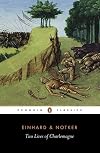
Sure, I could have googled and learned the 'facts' about Charlemagne in about 5 minutes; but then I wouldn't have found the pleasure in reading about greedy monks or stupid nobles being embarrassed in front of the court, ha ha; nor would I have learned how Charlemagne chastized his soldiers for wearing wimpy Gallic cloaks in favor of the superior Frankish sort ("What is the use of these little napkins?.... When I go off to empty my bowels, I catch cold because my backside is frozen!"). Did show more you know that Charlemagne had a pet elephant named Abu-l-Abbas, received as a gift from the king of Persia?
Read the rest of my review of Two Lives of Charlemagne on my blog, The Nerd is the Word.
http://nerdword.blogspot.com/2006/07/26-two-lives-of-charlemagne.html show less
Read the rest of my review of Two Lives of Charlemagne on my blog, The Nerd is the Word.
http://nerdword.blogspot.com/2006/07/26-two-lives-of-charlemagne.html show less

This small volume contains two biographies of Charlemagne, one by a man who knew him, the other written within 100 years of his death. The translated biographies are interesting for their style, attitudes and anecdotes. The commentary points out when the biographies make factual errors or omissions and the sources of some of the references to sources like the Bible or the Aeneid. The personalities of both writers and of the translator come through, which I sometimes found amusing and show more sometimes found annoying. show less
Lists
Western Canon (1)
You May Also Like


Associated Authors
Statistics
- Works
- 13
- Also by
- 3
- Members
- 2,266
- Popularity
- #11,329
- Rating
- 3.6
- Reviews
- 15
- ISBNs
- 57
- Languages
- 8
- Favorited
- 3
