
Michael Roberts (18)
Author of The Long Depression: Marxism and the Global Crisis of Capitalism
For other authors named Michael Roberts, see the disambiguation page.
About the Author
Image credit: Michael Roberts
Works by Michael Roberts
World in Crisis: A Global Analysis of Marx's Law of Profitability (2018) — Editor; Contributor — 21 copies, 1 review
Tagged
Common Knowledge
Members
Reviews

In this excellent book, Michael Roberts very convincingly applies Marxist economic theory to the concrete realities of the world capitalist economy.
In particular, he shows the central importance of Marx’s “law of the tendency of the rate of profit to fall” in explaining the recurring crises of the capitalist system. Although there are countertendencies to this law, Roberts shows that the tendency will prevail over time.
He also shows that, although each crisis has its own specific show more peculiarities (such as the “credit crunch” of 2007), the tendency of the rate of profit to fall is the constant underlying cause of capitalism’s problems.
Roberts explains the difference between a run-of-the-mill recession and a depression. He says that we are currently enduring “The Long Depression”, which began in 2008, and that this depression is only the third in the last 150 years. (The first was from 1873-1897, and the second was from 1929-1939.)
Roberts also shows us in great detail how today’s crisis is playing out in all the different parts of the world, and ends up discussing the prospects for the future.
Capitalism is exploitative, wasteful and destructive; it causes wars and is destroying our environment. It has to be replaced by a democratically planned world economy. But, as Roberts says, “Capitalism can only be replaced by a new system of social organization through conscious action of human beings, in particular by the majority of people (the working class globally).”
I’m ninety per cent positive about this book, but I’ll just mention a few points of criticism.
Firstly, when explaining Marx’s law of the tendency of the rate of profit to fall, Roberts does not give a full enough explanation of why labour is the only source of value and of surplus value, and hence of the profits grabbed by the capitalist class. In particular, he does not even mention Marx’s crucial distinction between labour and labour power.
For anyone new to Marxist economics, it would therefore be best to read an introduction to Marxist economics before tackling this book. (I would recommend “Unravelling Capitalism” by Joseph Choonara and/or “Zombie Capitalism” by Chris Harman.)
Secondly, Roberts makes no mention of the theory of the permanent arms economy, which was developed by some Marxists to explain the long post-war boom of the 1950s and 1960s. (Again, this theory is covered in the books by Choonara and Harman.)
Thirdly, there is something lacking in Roberts’ description of the regime in China. He is quite rightly critical of China’s Stalinist rulers. He correctly points out that the system there “is not socialism by any Marxist definition or by any benchmark of democratic workers’ control.” But he describes the system in China as a “weird beast”, and thus in my view fails to see it for what it actually is: a system of bureaucratic state capitalism.
Fourthly, I have my doubts about Roberts’ attempt to incorporate Kondratiev’s “long waves” into his analysis. He acknowledges that critics have said that “there is no convincing theory or model to explain these long cycles, if they do exist”, but he nevertheless thinks that there is something in the idea.
Fifthly and finally, there is the minor criticism that there has been some sloppy proofreading for the book. So, for example, we have the phrase “…much useful things…”, and the following sentence: “Capital-reducing investments could also more productive.”
But overall, I strongly recommend this book. As I said, I’m ninety per cent positive about it, so I’ll go for five stars. show less
In particular, he shows the central importance of Marx’s “law of the tendency of the rate of profit to fall” in explaining the recurring crises of the capitalist system. Although there are countertendencies to this law, Roberts shows that the tendency will prevail over time.
He also shows that, although each crisis has its own specific show more peculiarities (such as the “credit crunch” of 2007), the tendency of the rate of profit to fall is the constant underlying cause of capitalism’s problems.
Roberts explains the difference between a run-of-the-mill recession and a depression. He says that we are currently enduring “The Long Depression”, which began in 2008, and that this depression is only the third in the last 150 years. (The first was from 1873-1897, and the second was from 1929-1939.)
Roberts also shows us in great detail how today’s crisis is playing out in all the different parts of the world, and ends up discussing the prospects for the future.
Capitalism is exploitative, wasteful and destructive; it causes wars and is destroying our environment. It has to be replaced by a democratically planned world economy. But, as Roberts says, “Capitalism can only be replaced by a new system of social organization through conscious action of human beings, in particular by the majority of people (the working class globally).”
I’m ninety per cent positive about this book, but I’ll just mention a few points of criticism.
Firstly, when explaining Marx’s law of the tendency of the rate of profit to fall, Roberts does not give a full enough explanation of why labour is the only source of value and of surplus value, and hence of the profits grabbed by the capitalist class. In particular, he does not even mention Marx’s crucial distinction between labour and labour power.
For anyone new to Marxist economics, it would therefore be best to read an introduction to Marxist economics before tackling this book. (I would recommend “Unravelling Capitalism” by Joseph Choonara and/or “Zombie Capitalism” by Chris Harman.)
Secondly, Roberts makes no mention of the theory of the permanent arms economy, which was developed by some Marxists to explain the long post-war boom of the 1950s and 1960s. (Again, this theory is covered in the books by Choonara and Harman.)
Thirdly, there is something lacking in Roberts’ description of the regime in China. He is quite rightly critical of China’s Stalinist rulers. He correctly points out that the system there “is not socialism by any Marxist definition or by any benchmark of democratic workers’ control.” But he describes the system in China as a “weird beast”, and thus in my view fails to see it for what it actually is: a system of bureaucratic state capitalism.
Fourthly, I have my doubts about Roberts’ attempt to incorporate Kondratiev’s “long waves” into his analysis. He acknowledges that critics have said that “there is no convincing theory or model to explain these long cycles, if they do exist”, but he nevertheless thinks that there is something in the idea.
Fifthly and finally, there is the minor criticism that there has been some sloppy proofreading for the book. So, for example, we have the phrase “…much useful things…”, and the following sentence: “Capital-reducing investments could also more productive.”
But overall, I strongly recommend this book. As I said, I’m ninety per cent positive about it, so I’ll go for five stars. show less

Comprehensive review with a robust defence of "the falling rate of profit" as the ultimate cause of crisis formation. The concluding chapter is surprisingly flat but is the only bum note in a remarkably readable survey.
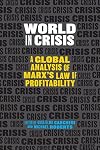
Focusing on the Marxist law of profitability. A heavy read, certainly if you're not a trained economist. Some chapters/contributions are better than others. But does offer interesting insights into evolution of profit rate and capitalist development in the 20th century.
Reviewed in the September 2017 issue of the Socialist Standard:
http://socialiststandardmyspace.blogspot.com/2017/09/the-slump-2017.html
http://socialiststandardmyspace.blogspot.com/2017/09/the-slump-2017.html
You May Also Like
Associated Authors
Statistics
- Works
- 5
- Members
- 102
- Popularity
- #187,250
- Rating
- 4.0
- Reviews
- 4
- ISBNs
- 185
- Languages
- 7