
Dave Kindred
Author of Morning Miracle: Inside the Washington Post A Great Newspaper Fights for Its Life
About the Author
Dave Kindred has been a columnist for 32 years, writing sports, politics and news in Louisville, Washington and Atlanta. He has been a columnist for The Sporting News since 1991. Kindred is the recipient of the 1991 "Red Smith Award" chosen by the Associated Press Sports Editors Association for show more lifetime achievement in sports journalism, and the 1997 "National Sportswriter of The Year" award chosen by the National Sportscasters and Sportswriters Association. Kindred is currently president of the National Sportscasters and Sportswriters Association show less
Image credit: (Photo by Bob Leverone/Sporting News)
Works by Dave Kindred
Morning Miracle: Inside the Washington Post A Great Newspaper Fights for Its Life (2010) 75 copies, 19 reviews
Leave Out the Tragic Parts: A Grandfather's Search for a Boy Lost to Addiction (2021) 30 copies, 1 review
My Home Team: A Sportswriter's Life and the Redemptive Power of Small-Town Girls Basketball (2023) 13 copies, 1 review
Associated Works
Tagged
Common Knowledge
- Gender
- male
- Awards and honors
- Red Smith Award (1991)
- Nationality
- USA
- Associated Place (for map)
- USA
Members
Reviews
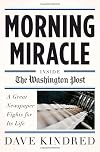
There was a time when the city newspaper was delivered to my front yard every morning, and I was actually pretty good about reading it every day. Then the kids got older and our schedules got more hectic, and I started to notice that days and days would go by when I never took the morning paper out of its plastic sleeve. Eventually, we stopped our subscription, promising ourselves that we would still buy the Sunday paper. And then even that came to an end.
And at the same time in an almost show more perfect negative correlation, my use of the Internet began to rise.
In his book Morning Madness, Dave Kindred tells the same story from the backside. What happens when readership at one of the largest and most well respected newspapers in the country, The Washington Post, drops off precipitously. Let the soul searching begin!
Kindred’s book begins with a quick, but interesting history of the Post, beginning with the fire sale of the newspaper to Eugene Meyer in 1933, after the previous owner got caught up in the Teapot Dome scandal. The next pages are filled with stories of how the Post grew into the powerhouse that people of my age remember in the early 1970s when Woodward and Bernstein broke the Watergate story. At its zenith Ben Bradlee and Katharine Graham, daughter of Meyer, ruled over 900 journalists as they labored to bring the news to Washington and beyond.
Kindred follows that up with a section highlighting the work done by some of the stars at the paper. He follows them as they do investigative stories, crouch in a battle zone, respond to national tragedy, exploring not only the stories they tell but why they tell them.
But stuff happens. And so does technology. And 40 years after Watergate, The Washington Post is losing readers and money at alarming rates. Kindred details the uneasy dance that ensues between the paper and the washingtonpost.com website, as they try to learn how to work with each other and how to woo a new generation of readers (or non-readers as the case may be).
The story was engaging, although the use of Dan Brown-like chapter endings got a little trite after a while. Throughout I also couldn’t shake the feeling that I was complicit in the fatalism captured in the interviews of Post employees as they faced yet another round of layoffs. I am definitely the problem here. I am a big believer in the Fourth Estate and its responsibilities in a democracy, but for some reason I don’t seem willing to pay for that very important service.
Morning Miracle is a book without a real ending. As Kindred sent it to press the struggles of the Post and washingtonpost.com continue, with no clear vision of what this collision of news and new technology would bring. It is easy to be pessimistic.
A couple of weeks ago I read that researchers had determined that although the possible sources of news being forwarded through Twitter were in the millions, in truth, most news stories had their beginnings at one of 15 or so mainstream media outlets like CNN and the New York Times. Maybe there is reason for me –and the Washington Post – to be optimistic after all. show less
And at the same time in an almost show more perfect negative correlation, my use of the Internet began to rise.
In his book Morning Madness, Dave Kindred tells the same story from the backside. What happens when readership at one of the largest and most well respected newspapers in the country, The Washington Post, drops off precipitously. Let the soul searching begin!
Kindred’s book begins with a quick, but interesting history of the Post, beginning with the fire sale of the newspaper to Eugene Meyer in 1933, after the previous owner got caught up in the Teapot Dome scandal. The next pages are filled with stories of how the Post grew into the powerhouse that people of my age remember in the early 1970s when Woodward and Bernstein broke the Watergate story. At its zenith Ben Bradlee and Katharine Graham, daughter of Meyer, ruled over 900 journalists as they labored to bring the news to Washington and beyond.
Kindred follows that up with a section highlighting the work done by some of the stars at the paper. He follows them as they do investigative stories, crouch in a battle zone, respond to national tragedy, exploring not only the stories they tell but why they tell them.
But stuff happens. And so does technology. And 40 years after Watergate, The Washington Post is losing readers and money at alarming rates. Kindred details the uneasy dance that ensues between the paper and the washingtonpost.com website, as they try to learn how to work with each other and how to woo a new generation of readers (or non-readers as the case may be).
The story was engaging, although the use of Dan Brown-like chapter endings got a little trite after a while. Throughout I also couldn’t shake the feeling that I was complicit in the fatalism captured in the interviews of Post employees as they faced yet another round of layoffs. I am definitely the problem here. I am a big believer in the Fourth Estate and its responsibilities in a democracy, but for some reason I don’t seem willing to pay for that very important service.
Morning Miracle is a book without a real ending. As Kindred sent it to press the struggles of the Post and washingtonpost.com continue, with no clear vision of what this collision of news and new technology would bring. It is easy to be pessimistic.
A couple of weeks ago I read that researchers had determined that although the possible sources of news being forwarded through Twitter were in the millions, in truth, most news stories had their beginnings at one of 15 or so mainstream media outlets like CNN and the New York Times. Maybe there is reason for me –and the Washington Post – to be optimistic after all. show less
 This review was written for LibraryThing Early Reviewers.
I thought this book was a compelling read. It leads one through the vaunted history of a great American newspaper, the Washingon Post, from its purchase at auction in 1934 by Eugene Meyer to the present print-news nightmare - the instant, albeit shallow, gratification of the digital age. It is obvious the author, Dave Kindred, loved everything about the Post - the history, the "ink-stained wretches", even the long hours and little recognition (unless one happened to be a Pulitzer Prize show more winner).
I'd recommend it to anyone interested in the world of journalism, digital or hard copy. It provides some fascinating insights into why the mainstream media is struggling these days, working without a road map into the realm of successful multimedia . show less
I'd recommend it to anyone interested in the world of journalism, digital or hard copy. It provides some fascinating insights into why the mainstream media is struggling these days, working without a road map into the realm of successful multimedia . show less
This review was written for LibraryThing Early Reviewers.I won this book from LibraryThing and just couldn't wait to read it when it finally arrived. I've been a news junkie all my life; came by it naturally since my mother was too. Our political leanings were totally opposite, leading to countless debates, er, arguments about politics. I grew up in the state capitol of Illinois so there was plenty to argue about, and every Sunday we went downtown to get the Chicago Tribune which only added fuel to the fire.
As an adult I was a journalist myself at show more several newspapers through the years, only leaving the profession for better pay in another field. You can imagine then how I feel watching newspapers across the country being sold and/or dying. Some respected newspapers have actually become online-only news outlets. I read an autobiography of Katherine Graham some time ago so I already knew a lot about The Washington Post from an owner's point of view. This, however, is the Post's fight for life from a reporter's point of view.
Dave Kindred started out as a sportswriter which may be why I love his writing style. In sports a reporter has to learn quickly how to sum up an athlete in one telling story. Kindred takes that ability to the news room and the owner's office and to Bob Woodward and gets great interviews on the topic of the Post and news reporting in general.
I've wondered why so few people read a daily newspaper these days. Young people are so electronically wired in that they just naturally turn to the internet, their phones and so on, but I don't even see that many older people reading a paper anymore. Last night when we stopped for a slice on our way to a basketball game, I saw a middle-aged man reading The New York Times. I could hardly believe my eyes. The Post has an amazing number of Pulitzer prize winning reporters and feature writers, yet its subscription numbers have consistently fallen and revenues along with them.
Kindred gets the background on some of the Pulitzer winning stories (the mistreatment of veterans at Walter Reed Hospital, the McChrystal report on Afghanistan, the Virginia Tech shootings, and more) with emphasis on how reporters got those stories. Those reporters didn't just waltz in, take a few notes, and write the piece. In the Walter Reed story, for instance, the two reporters spent time in Building 18 talking to patients and employees. They got to know the patients and their families, secured confirmation of all information, got a photographer in to take the damning photos, and were allowed to take all the time they needed. Then they wrote the story and as we all know, all Hell broke loose. Anyone who saw the movie or read the book about Bernstein, Woodward, and Watergate will recognize the work involved.
While these dedicated reporters were doing their job though, everyone knew their careers might be limited by the bottom line. A poignant part of the book is employee buyouts, retirement packages offered to them which eventually resulted in the 800 person newsroom being reduced to under 400. Katherine Graham's son Don moved himself up out of day-to-day operation in favor of the only family member at the paper, his niece Katherine Weymouth. Len Downie, long the managing editor and beloved by his reporters, was "advised" to take the buyout. The whole masthead was in upheaval.
This book is a tragedy of Shakespearean proportions to a newsie like me even though I suppose younger people wouldn't see it as such. Kindred makes it all readable, a story of a mighty giant fallen, and although the Post survives, it is no longer that powerful force it once was. Congratulations to Kindred on a book well written, one that began as "a valentine" to the paper and ended as an elegy to a great newspaper. show less
As an adult I was a journalist myself at show more several newspapers through the years, only leaving the profession for better pay in another field. You can imagine then how I feel watching newspapers across the country being sold and/or dying. Some respected newspapers have actually become online-only news outlets. I read an autobiography of Katherine Graham some time ago so I already knew a lot about The Washington Post from an owner's point of view. This, however, is the Post's fight for life from a reporter's point of view.
Dave Kindred started out as a sportswriter which may be why I love his writing style. In sports a reporter has to learn quickly how to sum up an athlete in one telling story. Kindred takes that ability to the news room and the owner's office and to Bob Woodward and gets great interviews on the topic of the Post and news reporting in general.
I've wondered why so few people read a daily newspaper these days. Young people are so electronically wired in that they just naturally turn to the internet, their phones and so on, but I don't even see that many older people reading a paper anymore. Last night when we stopped for a slice on our way to a basketball game, I saw a middle-aged man reading The New York Times. I could hardly believe my eyes. The Post has an amazing number of Pulitzer prize winning reporters and feature writers, yet its subscription numbers have consistently fallen and revenues along with them.
Kindred gets the background on some of the Pulitzer winning stories (the mistreatment of veterans at Walter Reed Hospital, the McChrystal report on Afghanistan, the Virginia Tech shootings, and more) with emphasis on how reporters got those stories. Those reporters didn't just waltz in, take a few notes, and write the piece. In the Walter Reed story, for instance, the two reporters spent time in Building 18 talking to patients and employees. They got to know the patients and their families, secured confirmation of all information, got a photographer in to take the damning photos, and were allowed to take all the time they needed. Then they wrote the story and as we all know, all Hell broke loose. Anyone who saw the movie or read the book about Bernstein, Woodward, and Watergate will recognize the work involved.
While these dedicated reporters were doing their job though, everyone knew their careers might be limited by the bottom line. A poignant part of the book is employee buyouts, retirement packages offered to them which eventually resulted in the 800 person newsroom being reduced to under 400. Katherine Graham's son Don moved himself up out of day-to-day operation in favor of the only family member at the paper, his niece Katherine Weymouth. Len Downie, long the managing editor and beloved by his reporters, was "advised" to take the buyout. The whole masthead was in upheaval.
This book is a tragedy of Shakespearean proportions to a newsie like me even though I suppose younger people wouldn't see it as such. Kindred makes it all readable, a story of a mighty giant fallen, and although the Post survives, it is no longer that powerful force it once was. Congratulations to Kindred on a book well written, one that began as "a valentine" to the paper and ended as an elegy to a great newspaper. show less
This review was written for LibraryThing Early Reviewers.In true journalistic style, I must disclose my gross conflict of interest in reviewing this book: I worked at the Post for 10 years. In fact, I worked there for the 10 years that make up the bulk of this book's narrative. Furthermore, I worked on many of the stories Kindred mentions, and with all of the reporters he interviews (more with some and less with others, but they'd all have at least said hello to me in the elevator). I can personally vouch for nearly every sentence in this show more book.
Except for one thing: I have no idea who Dave Kindred is. I had never heard the name until this book came out. Though I can vouch for my own presence in each of this book's group scenes, like the marathon two-hour clapping-and-speechmaking spree after the Post won six Pulitzers one year that left us all perspiring from the exertion, I don't actually remember seeing him there, or anywhere else! I'm sure he'd say the same about me.
But here's proof of how true to life the book is: even though he doesn't know me, he mentioned me twice. In passing. Just by my job title, never by my name, but I'm in there. That's about right, I think. I gave the paper the best of everything I had, but I was no legend like Pincus or Anne Hull. I experienced my own Morning Miracle every day I got to walk past the guard and take my seat on the newsroom floor. I never got over the awe of just being there. if I warrant two passing mentions in a book about the years that belonged to Len Downie, Don Graham, Dana Priest, and Bob Woodward, that's enough for me.
So I am not impartial about Kindred's book or the Washington Post. But neither is he. Though we aren't in cahoots together (because, it bears repeating, we somehow managed not to meet for TEN WHOLE YEARS), we both have the same conflict of interest: we love the place dearly. We love the people. We are awed to have worked there, amongst those giants of journalism, during the Last Great Years of Newspapers.
I think Kindred did a fantastic job describing the staff, the stories, the policy and the decisions made since Don Graham took over the paper. He certainly manages to find every sweet, funny, meaningful and poignant story about Post staff and include it here. But he doesn't dish much dirt at all beyond K-Wey's salon debacle, which he handles robustly. Though the Post isn't all that controversial, and there isn't much dirt to be slung, he leaves out what pass for Big Ones at the Post. He gives us some new (but still snoringly circumspect) remarks from Steve Coll about why he left, but he left out a major upheaval caused by Susan Glasser's arbitrary reign as national editor. Her forced departure led to the loss of one of the Post's best political reporters, Glasser's husband Peter Baker. He never mentions it, even though in terms of internal news stories, I'd say that's one of the biggest from the past 5 years. He also doesn't mention the departure of Jim Harris (another great political star at the Post) and Jim VandeHei to create Politico, the Post's biggest local threat (IMHO). He barely mentions Phil Bennet, but I think Bennet would have made for an interesting study. While Downie soaked up the love from his adoring and well-fed staff during the mid-2000s after Coll left, it seems to me Bennet was the one who had to notify staffers of all the hard and unpopular personnel decisions. He was the Heavy, Downie was the Don. And then he was passed over for Executive Editor, which I always assumed was a bitter blow, but never knew for sure. I still don't know anything for sure after reading this book, because Kindred doesn't touch it.
As for old business, he compresses the Janet Cooke scandal so tightly (I think it got 2 pages) that it actually loses too much nuance. I hope no teacher uses this book to teach the Cooke scandal to students. The definitive account of the Cooke scandal is ombudsman Bill Green's 14,000 word reconstruction of what went wrong; in it, he lays part of the blame on editors who pressured Cooke to chase down rumors of an 8-year-old heroin addict in Southeast. In Kindred's telling, Cooke faked her resume and lied her way onto the staff so she could launch this fake story on her own. The Post wasn't quite that gaslighted by her, though she certainly is responsible for her actions. He also made it too short to tell the one redeeming part of the story - Courtland Milloy's heroic role uncovering the lie.
Oh, one other thing: it should have had more of me in there.
Other than that, this book is true to life, fun, sentimental, passionate, dramatic, and filled with living legends. Which describes every day I spent on the fifth floor. Even though Dave is a stranger to me, I think I speak for both of us when I say we were so lucky to work there. show less
Except for one thing: I have no idea who Dave Kindred is. I had never heard the name until this book came out. Though I can vouch for my own presence in each of this book's group scenes, like the marathon two-hour clapping-and-speechmaking spree after the Post won six Pulitzers one year that left us all perspiring from the exertion, I don't actually remember seeing him there, or anywhere else! I'm sure he'd say the same about me.
But here's proof of how true to life the book is: even though he doesn't know me, he mentioned me twice. In passing. Just by my job title, never by my name, but I'm in there. That's about right, I think. I gave the paper the best of everything I had, but I was no legend like Pincus or Anne Hull. I experienced my own Morning Miracle every day I got to walk past the guard and take my seat on the newsroom floor. I never got over the awe of just being there. if I warrant two passing mentions in a book about the years that belonged to Len Downie, Don Graham, Dana Priest, and Bob Woodward, that's enough for me.
So I am not impartial about Kindred's book or the Washington Post. But neither is he. Though we aren't in cahoots together (because, it bears repeating, we somehow managed not to meet for TEN WHOLE YEARS), we both have the same conflict of interest: we love the place dearly. We love the people. We are awed to have worked there, amongst those giants of journalism, during the Last Great Years of Newspapers.
I think Kindred did a fantastic job describing the staff, the stories, the policy and the decisions made since Don Graham took over the paper. He certainly manages to find every sweet, funny, meaningful and poignant story about Post staff and include it here. But he doesn't dish much dirt at all beyond K-Wey's salon debacle, which he handles robustly. Though the Post isn't all that controversial, and there isn't much dirt to be slung, he leaves out what pass for Big Ones at the Post. He gives us some new (but still snoringly circumspect) remarks from Steve Coll about why he left, but he left out a major upheaval caused by Susan Glasser's arbitrary reign as national editor. Her forced departure led to the loss of one of the Post's best political reporters, Glasser's husband Peter Baker. He never mentions it, even though in terms of internal news stories, I'd say that's one of the biggest from the past 5 years. He also doesn't mention the departure of Jim Harris (another great political star at the Post) and Jim VandeHei to create Politico, the Post's biggest local threat (IMHO). He barely mentions Phil Bennet, but I think Bennet would have made for an interesting study. While Downie soaked up the love from his adoring and well-fed staff during the mid-2000s after Coll left, it seems to me Bennet was the one who had to notify staffers of all the hard and unpopular personnel decisions. He was the Heavy, Downie was the Don. And then he was passed over for Executive Editor, which I always assumed was a bitter blow, but never knew for sure. I still don't know anything for sure after reading this book, because Kindred doesn't touch it.
As for old business, he compresses the Janet Cooke scandal so tightly (I think it got 2 pages) that it actually loses too much nuance. I hope no teacher uses this book to teach the Cooke scandal to students. The definitive account of the Cooke scandal is ombudsman Bill Green's 14,000 word reconstruction of what went wrong; in it, he lays part of the blame on editors who pressured Cooke to chase down rumors of an 8-year-old heroin addict in Southeast. In Kindred's telling, Cooke faked her resume and lied her way onto the staff so she could launch this fake story on her own. The Post wasn't quite that gaslighted by her, though she certainly is responsible for her actions. He also made it too short to tell the one redeeming part of the story - Courtland Milloy's heroic role uncovering the lie.
Oh, one other thing: it should have had more of me in there.
Other than that, this book is true to life, fun, sentimental, passionate, dramatic, and filled with living legends. Which describes every day I spent on the fifth floor. Even though Dave is a stranger to me, I think I speak for both of us when I say we were so lucky to work there. show less
This review was written for LibraryThing Early Reviewers.Awards

You May Also Like


Associated Authors
Statistics
- Works
- 9
- Also by
- 1
- Members
- 217
- Popularity
- #102,845
- Rating
- 3.6
- Reviews
- 25
- ISBNs
- 28
