
McKenzie Funk
Author of Windfall: The Booming Business of Global Warming
About the Author
McKenzie Funk has spent six years reporting around the world on how we are preparing for a warmer planet, and he shows us that the best way to understand the catastrophe of global warming is to see it through the eyes of those who see it most clearly-as a market opportunity. Global warming's show more physical impacts can be separated into three broad categories: melt, drought, and deluge. Funk travels to two dozen countries to profile entrepreneurial people who see in each of these forces a potential windfall. By letting climate change continue unchecked, we are choosing to adapt to a warming world. Containing the resulting surge will be big business; some will benefit, but much of the planet will suffer. McKenzie Funk has investigated both sides, and what he has found will shock us all. To understand how the world is preparing to warm, Windfall follows the money. show less
Works by McKenzie Funk
The Hank Show: How a House-Painting, Drug-Running DEA Informant Built the Machine That Rules Our Lives (2023) 61 copies, 3 reviews
Associated Works
Tagged
Common Knowledge
- Gender
- male
- Occupations
- investigative journalist
author
Members
Reviews
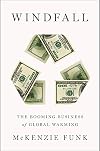
In Windfall: The Booming Business of Global Warming, journalist McKenzie Funk travels the world to personally visit the companies and people who are making a business from global warming, directly or indirectly. He avoids the obvious green energy windmills and solar panels and looks at others less obvious but no less important. For example Greenlanders who are discovering mineral deposits underneath melted glaciers; artificial snow makers (see the 2014 Olympics); genetically modified show more mosquitoes to ward off diseases spreading northward; sea-wall makers; deserts tree planting projects; and so on. In the end he lays out his vision of what will probably happen: the northern countries will have no choice but to implement Geo-engineering which will help the north but devastate the poorer countries since GE has regional differences and isn't a uniform solution. This is an extension of what has been happening for 200+ years as richer countries pour CO2 into the atmosphere for their own benefit and the loss of others, so it is a reasonable prediction, the patterns have long been in place, tragedy of the commons predates civilization.
I believe this book would be an excellent rejoinder to climate denialists. How do you deny the existence of real businesses operated by free market libertarians who have embraced the "opportunity" of global warming? It's impossible to be both a global warming denialist and a supporter of private businesses profiting from global warming. Is it ethical to profit from disaster? It doesn't matter because people have, and are, and will. show less
I believe this book would be an excellent rejoinder to climate denialists. How do you deny the existence of real businesses operated by free market libertarians who have embraced the "opportunity" of global warming? It's impossible to be both a global warming denialist and a supporter of private businesses profiting from global warming. Is it ethical to profit from disaster? It doesn't matter because people have, and are, and will. show less
The Hank Show: How a House-Painting, Drug-Running DEA Informant Built the Machine That Rules Our Lives by McKenzie Funk

Hank Asher is the most important tech genius you’ve never heard of. That, at least, is what McKenzie Funk would have us believe as he starts his new book The Hank Show. And by the time you finish this captivating book you’ll understand why.
Funk’s nonfiction account reads like a novel. We follow Hank Asher from his early days as a drug runner who then reformed himself into the driven owner of the most successful condo painting company in Florida, only to top that by veering into a new show more career as a data broker.
Hank was in the right place at the right time. It was the late 80s, and personal computers were firmly established and growing more powerful with every passing year. Asher became a self-taught programmer, like so many others at that time. He became proficient in R:Base, one of the earliest relational databases for PCs.
He was in Florida, not Silicon Valley - where his unconventional ideas about computing would probably have seemed crazy and likely would have been discouraged. Out of the mainstream in Florida he was able to develop his genius for pushing both software and hardware forward unhindered. He pioneered some of the earliest and fastest parallel processing machines for databases.
Parallel processing is when you break computing tasks into multiple streams and feed those streams to multiple central processing units (in the case of Asher’s first attempt to multiple PCs networked together). If done right, this can enormously speed up the time it takes to go from question to result. Asher had the knack for doing it right.
When applied to large databases of information, parallel processing can lead to impressive results. So, in 1992 Asher and a partner founded Database Technologies in Pompano Beach, Florida. It was there that Asher first heard about the data broker business. Data brokers take public data and organize it on computers in a way that it can be easily searched. DBT focused early on Florida’s Department of Motor Vehicles records. The resulting product (the algorithms in the software, the data, and the parallel processing machine it ran on) was called AutoTrack and it was an instant hit with law enforcement.
By 1994 DBT had 2 TB of data, a huge amount for the time. They sourced data from multiple public and private entities, including lists of federal liens and bankruptcies, telephone directories, change of address info from the US Postal Service, corporate ownership records and more. In 1997 DBT struck “the motherlode” by obtaining name, address, previous addresses, phone numbers, dates of birth, social security numbers and other “header” information from the big three credit reporting agencies - Equifax, Experian and Transunion.
AutoTrack now was one of the largest “people” databases in the US, indeed in the world. And every law enforcement agency, every lender, every insurer suddenly wanted access to their data. Not only their data but their computing power, which thanks to Asher’s genius in parallel processing and his creation of innovative algorithms, was far ahead of DBT’s rivals.
One of the key themes of the book is the paranoia that Asher brought to his work. The former drug runner turned informant was never looked at favorably by the money men who could help turn his ideas into solid businesses. He abused alcohol and drugs, likely self-medicating for his troubled mental state and mercurial personality. As a result, Asher was forced out of DBT after it went public “for the good of the company”.
Asher went on to found two more companies, continuing to perfect his ideas and his products in the people data space. In the time between Asher’s leaving DBT in 1999 and his death in 2012, his paranoia, and his tech products, made their way into the national data infrastructure. The stories that follow his time at DBT find him and his “machine” at the heart of the nation’s business - in the controversial Florida 2000 election results, in the hunt for the identities of the 9/11 terrorists and those who might come after them, and in the welfare reforms of the Clinton era. All of these would rely in one way or another on the products that Hank Asher built. And his legacy is still with us, still tracking us all today.
Even if you’ve never heard of him. show less
Funk’s nonfiction account reads like a novel. We follow Hank Asher from his early days as a drug runner who then reformed himself into the driven owner of the most successful condo painting company in Florida, only to top that by veering into a new show more career as a data broker.
Hank was in the right place at the right time. It was the late 80s, and personal computers were firmly established and growing more powerful with every passing year. Asher became a self-taught programmer, like so many others at that time. He became proficient in R:Base, one of the earliest relational databases for PCs.
He was in Florida, not Silicon Valley - where his unconventional ideas about computing would probably have seemed crazy and likely would have been discouraged. Out of the mainstream in Florida he was able to develop his genius for pushing both software and hardware forward unhindered. He pioneered some of the earliest and fastest parallel processing machines for databases.
Parallel processing is when you break computing tasks into multiple streams and feed those streams to multiple central processing units (in the case of Asher’s first attempt to multiple PCs networked together). If done right, this can enormously speed up the time it takes to go from question to result. Asher had the knack for doing it right.
When applied to large databases of information, parallel processing can lead to impressive results. So, in 1992 Asher and a partner founded Database Technologies in Pompano Beach, Florida. It was there that Asher first heard about the data broker business. Data brokers take public data and organize it on computers in a way that it can be easily searched. DBT focused early on Florida’s Department of Motor Vehicles records. The resulting product (the algorithms in the software, the data, and the parallel processing machine it ran on) was called AutoTrack and it was an instant hit with law enforcement.
By 1994 DBT had 2 TB of data, a huge amount for the time. They sourced data from multiple public and private entities, including lists of federal liens and bankruptcies, telephone directories, change of address info from the US Postal Service, corporate ownership records and more. In 1997 DBT struck “the motherlode” by obtaining name, address, previous addresses, phone numbers, dates of birth, social security numbers and other “header” information from the big three credit reporting agencies - Equifax, Experian and Transunion.
AutoTrack now was one of the largest “people” databases in the US, indeed in the world. And every law enforcement agency, every lender, every insurer suddenly wanted access to their data. Not only their data but their computing power, which thanks to Asher’s genius in parallel processing and his creation of innovative algorithms, was far ahead of DBT’s rivals.
One of the key themes of the book is the paranoia that Asher brought to his work. The former drug runner turned informant was never looked at favorably by the money men who could help turn his ideas into solid businesses. He abused alcohol and drugs, likely self-medicating for his troubled mental state and mercurial personality. As a result, Asher was forced out of DBT after it went public “for the good of the company”.
Asher went on to found two more companies, continuing to perfect his ideas and his products in the people data space. In the time between Asher’s leaving DBT in 1999 and his death in 2012, his paranoia, and his tech products, made their way into the national data infrastructure. The stories that follow his time at DBT find him and his “machine” at the heart of the nation’s business - in the controversial Florida 2000 election results, in the hunt for the identities of the 9/11 terrorists and those who might come after them, and in the welfare reforms of the Clinton era. All of these would rely in one way or another on the products that Hank Asher built. And his legacy is still with us, still tracking us all today.
Even if you’ve never heard of him. show less
The Hank Show: How a House-Painting, Drug-Running DEA Informant Built the Machine That Rules Our Lives by McKenzie Funk

The life of titular Hank Asher reads like a movie anti-hero with a story arc like a Shakespearean tragedy. Flashy drug runner turns successful data entrepreneur largely serving law enforcement agencies while setting up our effective surveillance state. Isn't that interesting that unlike the threat of Big Brother from 1984 etc., private enterprises like Asher's have used the data we have provided under basically our own laws and agreements to surveil ourselves? Adding to this tragic arc, the show more manic behavior borne of the same energy and drive is the basis for self-destructive behavior and unprofessional antics. For some of the time, Asher is on the sideline with non-compete restrictions, but the story continues as competitors like LexisNexis, TransUnion, etc. keep the trend going of uniquely identifying citizens in data bases with ways make connections between them and track them. Some concerning even unsettling cases of individuals having their lives upended by misidentification are explored. Usage of the same techniques during the COVID pandemic appears to have had a positive impact allow ventilator need to be predicted and also, sadly, giving proof to the systemic racism and classism in the US as the the most egregious outcomes are analyzed in the context of effective segregation. show less

"Windfall", by McKenzie Funk, provides an interesting insight into Climate Change. It would appear, from surveys taken, that the most significant factor behind acceptance or rejection of global warming / climate change belief isn’t an individual's education or profession, but has more to do with their political leanings and favorite cable TV commentators. This book won't really educate you on the science of global warming, and may not move you from the believer to the denier camp, or vice show more versa. Rather, through extensive travel and research into how global warming may be impacting people around the world right now, the author looks at what choices people (and Countries)may face, and what opportunities there may be in addressing climate change. Especially interesting was the latter chapter on geoengineering concepts and possibilities, such as cloud seeding, ocean cooling devices, and albedo (e.g., sun reflectivity) modifications. It’s a very interesting look into what the future could look like, and well worth reading. show less
Awards


You May Also Like
Associated Authors
Statistics
- Works
- 5
- Also by
- 1
- Members
- 181
- Popularity
- #119,335
- Rating
- 4.0
- Reviews
- 10
- ISBNs
- 10
- Languages
- 1