
Papa Giovanni XXIII (1881–1963)
Author of Journal of a Soul: The Autobiography of Pope John XXIII
About the Author
Born Angelo Giuseppe Roncalli, the son of peasants who rented land as sharecroppers, Pope John XXIII early demonstrated intellectual abilities that saw him through seminary studies in Bergamo, near his home, and on to his ordination in 1904. For a number of years he worked with Catholic women's and show more youth organizations under the bishop of Bergamo. In World War I he served as a medical sergeant and as a chaplain and after the war was active in the Society for the Propagation of the Faith, with its headquarters in Rome. In 1925 he was appointed to the first of several diplomatic missions, first among the Catholic minority in Bulgaria, then in Turkey, where he set the precedent of introducing Turkish into the Mass, and in Greece, where during World War II military operations destroyed any opportunity he might have had to work with the Orthodox majority and confronted him with a hatred of Italians fueled by the Italian army's occupation of the country. As the war began to heat up on French soil, he was appointed papal nuncio to France and arrived in Paris at the very end of 1944. There, for almost a decade, he worked with first the Germans and then the French government to heal the wounds of warfare, to keep the church intact through rapid changes of government, to keep Catholic schools alive, and to deal with the French bishops who saw the increasing secularization of the nation and the failing religious allegiance of the people as signs pointing to the need for radical new measures to propagate the faith. Nevertheless, it is true that the worker-priest movement, which he watched at first with approval, received its deathblow during his pontificate. After serving as patriarch of Venice and being made cardinal (1953), he was elected by the College of Cardinals in 1958 to succeed Pius XII. The major accomplishment of his pontificate was the calling of the Second Vatican Council, whose arguments and decrees seemed revolutionary in their time (1962--65) and whose ripples continue to move the barque of Rome to this day. Thirty-nine non-Catholic observers attended with his blessing, special provision being made for translation from Latin documents and speeches, and it is perhaps not surprising that one of the first conciliar decrees was to allow the vernacular to replace Latin in the liturgy. He died of a gastric ulcer on June 3, 1963. (Bowker Author Biography) show less
Image credit: Photo © ÖNB/Wien
Series
Works by Papa Giovanni XXIII
Aeterna Dei Sapientia: On Commemorating the Fifteenth Centennial of the Death of Pope St. Leo I: The See of Peter as the Centre of Christian Unity (1961) 10 copies
The Liturgy Documents. Volume Three, Foundational Documents on the Origins and Implementation of Sacrosanctum Concilium. (2013) 7 copies
The teachings of Pope John XXIII 3 copies
IL GIORNALE DELL'ANIMA 3 copies
Mission To France, 1944-1953 3 copies
MESSAGE OF PEACE: A Special Appeal to World Leaders to Settle Grave International Situations by Peaceful Means (1961) 3 copies
Mater et Magistra / Pacem in Terris — Author — 3 copies
Figlioli vi parlo di me. Ricordi di papa Giovanni — Author — 2 copies
Pensieri spirituali di Giovanni 23. — Author — 2 copies
Geistliches Tagebuch 2 copies
La paz en la tierra. 2 copies
Fred På Jorden 1 copy
Geestelijke nalatenschap 1 copy
Pensieri dal diario 1 copy
La sapienza nel cuore 1 copy
Documentos de João XXIII 1 copy
Pope John XXIII - Pamphlets 1 copy
Fiducia e obbedienza: Lettere ai rettori del Seminario romano : 1901-1959 (Storia della Chiesa) (Italian Edition) (1997) — Author — 1 copy
Le costituzioni del Sinodo di Roma: discorso di Giovanni 23. e costituzione apostolica "Sollicitudo omnium ecclesiarum" — Author — 1 copy
Lettere 1958-1963 1 copy
La parroquia 1 copy
℗4: ℗De Sacerdotio: Sacerdotii nostri primordia, Sacerdotalis Caelibatus — Author — 1 copy
1962 Christmas Message 1 copy
John XXIII Peace on Earth 1 copy
Il-Gurnal Tar-Ruh 1 copy
Towards Christian unity : the inaugural address of the second Vaticn Council delivered on October 11, 1962 (1962) 1 copy
Days of Devotion 1 copy
On Catholic Action 1 copy
Appropinquante Concilio 1 copy
Seven Great Encyclicals 1 copy
The Holy Father speaks to teachers — Author — 1 copy
Il papa alle ACLI 1 copy
1960 Christmas Message 1 copy
1961 Christmas Message 1 copy
Ioannis XXIII Pont. max., Epistula ad singulos catholicae ecclesiae episcopos ceterosque patres Concilii Oecumenici Vaticani II in Epiphania Domini — Author — 1 copy
Pope John: daily readings 1 copy
Associated Works
The Divine Office, Volume 1: Daily Prayer for Advent, Christmastide and Weeks 1-9 (1974) — Contributor — 197 copies, 1 review
The Liturgy of the Hours According to the Roman Rite (Volume II Lenten Season and Easter Season) (1974) — Contributor — 189 copies
The Liturgy of the Hours According to the Roman Rite (Volume III: The Weeks of the Year 6 - 34) (1974) — Contributor — 72 copies
Witness of the Saints: Patristic Readings in the Liturgy of the Hours (2012) — Contributor — 29 copies, 1 review
Breviarium romanum : ex decreto sacrosancti Concilii tridentini restitutum. - Tomus prior (1961) — Introduction, some editions — 10 copies
Tagged
Common Knowledge
- Other names
- Roncalli, Angelo Giuseppe
Johannes XXIII - Birthdate
- 1881-11-25
- Date of death
- 1963-06-03
- Gender
- male
- Occupations
- priest
bishop
pope - Organizations
- Roman Catholic Church
- Awards and honors
- Presidential Medal of Freedom (1963)
Time Magazine, Man of the Year (1962) - Nationality
- Italy
Vatican City - Birthplace
- Sotto il Monte, Bergamo, Italy
- Places of residence
- Rome, Italy
- Place of death
- Rome, Italy
- Burial location
- St. Peter's Basilica, Vatican City
- Associated Place (for map)
- Italy
Members
Discussions
50th anniversary of Pacem in Terris in Catholic Tradition (May 2013)
Reviews
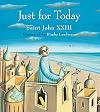
I received a copy of this book from Eerdmans via the Early Reviewers program. It is a beautifully illustrated book. The paintings are dreamlike and evocative. Upon reading it myself I thought "This is a picture book for adults, it only looks like a children's book". I appreciate the message of wisdom, which as another reviewer has pointed out, is universal enough to appeal to non-Catholics or even non-Christians, and combined with the gorgeous Mediterranean illustrations, it was a reading show more experience I could enjoy again and again. I then snagged a passing five-year-old to test the not-a-children's-book hypothesis. (Full disclosure: said five-year-old liked having Robert McCloskey's "Time of Wonder" read to her, and may have a penchant for evocative paintings and peaceful text.) She liked the book a great deal, although most of her comments and questions seemed to deal with the small blue deer that the child in the book carries around with him on every page -- there is enough visual interest in each illustration to keep a child captivated through multiple readings. It was a good enough book that I am considering preserving it for future reading by hand-binding the sheaf of loose pages that Eerdmans mails out for their ER books. show less
 This review was written for LibraryThing Early Reviewers.
I am always on the lookout for good Catholic books for my school library. This book definitely fits the bill. Beautifully illustrated, this book brings Saint John XXIII's philosophy to life. This great man, had a wonderful, attainable philosophy, which still is useful to today's busy life. Every page provided a different gem and word of wisdom from the beloved pontiff.
The illustrations are a true gem here. Everywhere I look there are symbols and hidden things to explore and ponder the show more meaning about. What is their symbolism? Is it the illustrator's signature or are they symbolic to Catholicism or Saint John XXIII? The applications with students are endless. While stylistically Bimba Landmann's illustrations are not my favorite (mainly due to the yellow pallor of the subjects), there is so much to look at that I can't help but be intrigued by the narrative the illustrator has created. Landmann created almost a mythical world - a mix between the middle Eastern roots of Catholicism with the Italian world of Rome. I'm not quite sure what this world is, but I know I like it. show less
The illustrations are a true gem here. Everywhere I look there are symbols and hidden things to explore and ponder the show more meaning about. What is their symbolism? Is it the illustrator's signature or are they symbolic to Catholicism or Saint John XXIII? The applications with students are endless. While stylistically Bimba Landmann's illustrations are not my favorite (mainly due to the yellow pallor of the subjects), there is so much to look at that I can't help but be intrigued by the narrative the illustrator has created. Landmann created almost a mythical world - a mix between the middle Eastern roots of Catholicism with the Italian world of Rome. I'm not quite sure what this world is, but I know I like it. show less
This review was written for LibraryThing Early Reviewers.I received this lovely small unbound book via the early review program. The opening page states that when Angelo Roncalli, later Saint John XXIII, received his first communion, he noted "I want always to be good to everyone." Throughout his life he continued to hold steadfast to his original thought/feeling.
This book is a wonderfully illustrated book of his life-long intentions. The illustrations are quite lovely.
The text is eloquently written and serves as a reminder to life simply, love show more often and enjoy each precious day.
The papers were not bound, thus it was difficult to follow the pattern of the writing. This very much took away from the joy of the book. However, I liked the illustrations enough to follow more of the unique artistry. show less
This book is a wonderfully illustrated book of his life-long intentions. The illustrations are quite lovely.
The text is eloquently written and serves as a reminder to life simply, love show more often and enjoy each precious day.
The papers were not bound, thus it was difficult to follow the pattern of the writing. This very much took away from the joy of the book. However, I liked the illustrations enough to follow more of the unique artistry. show less
This review was written for LibraryThing Early Reviewers.This is an excellent example of a picture book for the whole family! It consists of ten resolutions, repetitively introduced "Just for today, I will..." and beautifully illustrated by Bimba Landmann. I have enjoyed Landmann's work since first finding "Clare and Francis." Her depictions of the ten daily goals reflect a modern take on a highly stylized approach heavily influenced by medieval art and illumination, including a touch of whimsy and suggesting a Mediterranean setting. Though penned show more by St. John XXIII, the Pope associated with Vatican II, these brief reflections are general enough to hold interest for non-Catholic and even non-Christian families, and the enchanting pictoral settings offer extensive re-reading and reflection opportunities. show less
This review was written for LibraryThing Early Reviewers.Lists
Awards


You May Also Like


Associated Authors
Statistics
- Works
- 127
- Also by
- 7
- Members
- 1,831
- Popularity
- #14,053
- Rating
- 4.3
- Reviews
- 35
- ISBNs
- 74
- Languages
- 7

