
About the Author
Works by D. R. Oldroyd
The Arch of Knowledge: An Introductory Study of the History of the Philosophy and Methodology of Science (1986) 64 copies
Thinking about the Earth: A History of Ideas in Geology (Studies in the History and Philosophy of the Earth Sciences) (1996) 27 copies, 1 review
The Highlands controversy : constructing geological knowledge through fieldwork in nineteenth-century Britain (1990) 18 copies
The Wider Domain of Evolutionary Thought (Studies in History and Philosophy of Science) (1983) 7 copies
Sciences of the Earth: Studies in the History of Mineralogy and Geology (Collected Studies, Cs628) (1998) 3 copies
Tagged
Common Knowledge
- Legal name
- Oldroyd, David Roger
- Birthdate
- 1936-01-20
- Gender
- male
Members
Reviews
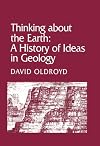
31. Thinking about the Earth : A History of Ideas in Geology by David R. Oldroyd
published: 1996
format: 348 page hardcover (entire book with glossary, bibliography, index, etc is 440 pages)
acquired: 1996
read: May 1-28
rating: 4
The book for those who were wondering what a geosyncline is or was, or a miogeosyncline, or eugeosyncline, and for those wondering what the heck a Wernerian was, or what the big deal was between uniformitarianism and catastrophism. Geology, for all that it goes back to show more mythology, is a surprisingly young science, and not always well-given to empirical research. You collect data and then make a story. So Descartes could send out crazy ideas, and they remained influential for years, while Leibniz could write up some very creative ideas, and see them disappear and never get published until the 20th century. Because who knew what was true, and maybe the earth really had an outer crustal layer lying on a molten ocean of convection. Hooke threw projectiles at plaster balls to try to determine whether the moon's craters were impact craters or volcanoes. Someone else tried to cook limestone to see if he could generate marble. Unknowns make fascinating people.
Of course James Hutton was giving us deep time in 18th century, but Lyell wasn't providing plainly reasonable observations until the the 19th century, and he never bought into ice ages, despite the evidence all around him, covering and confusing all the other geology. Darwin waited till mid century. It's kind of amazing that geologic maps didn't exist until the 19th century, and the real intense mapping didn't get under way until well into that century (many areas weren't mapped at all until the 20th century). That plate tectonics, an earth science fundamental, wasn't worked out in any sensible and defensible way until the 1960's. Ideas that appear crazy to us today aren't very old, leaving one to wonder how fundamentally sound earth and geologic concepts are today.
The writing was maybe rough, the geological terms not exactly user friendly, but Oldroyd has put together quite a story, covering the history of science from the geologic perspective. Lovers of geology and this obscure history of science will really enjoy this. Thanks to Kevin (aka stretch) for pointing me here.
2018
https://www.librarything.com/topic/288371#6494072 show less
published: 1996
format: 348 page hardcover (entire book with glossary, bibliography, index, etc is 440 pages)
acquired: 1996
read: May 1-28
rating: 4
The book for those who were wondering what a geosyncline is or was, or a miogeosyncline, or eugeosyncline, and for those wondering what the heck a Wernerian was, or what the big deal was between uniformitarianism and catastrophism. Geology, for all that it goes back to show more mythology, is a surprisingly young science, and not always well-given to empirical research. You collect data and then make a story. So Descartes could send out crazy ideas, and they remained influential for years, while Leibniz could write up some very creative ideas, and see them disappear and never get published until the 20th century. Because who knew what was true, and maybe the earth really had an outer crustal layer lying on a molten ocean of convection. Hooke threw projectiles at plaster balls to try to determine whether the moon's craters were impact craters or volcanoes. Someone else tried to cook limestone to see if he could generate marble. Unknowns make fascinating people.
Of course James Hutton was giving us deep time in 18th century, but Lyell wasn't providing plainly reasonable observations until the the 19th century, and he never bought into ice ages, despite the evidence all around him, covering and confusing all the other geology. Darwin waited till mid century. It's kind of amazing that geologic maps didn't exist until the 19th century, and the real intense mapping didn't get under way until well into that century (many areas weren't mapped at all until the 20th century). That plate tectonics, an earth science fundamental, wasn't worked out in any sensible and defensible way until the 1960's. Ideas that appear crazy to us today aren't very old, leaving one to wonder how fundamentally sound earth and geologic concepts are today.
The writing was maybe rough, the geological terms not exactly user friendly, but Oldroyd has put together quite a story, covering the history of science from the geologic perspective. Lovers of geology and this obscure history of science will really enjoy this. Thanks to Kevin (aka stretch) for pointing me here.
2018
https://www.librarything.com/topic/288371#6494072 show less

An interesting summary of impact of Darwin's theory on diverse areas.
Read in samoa Nov 2002
Read in samoa Nov 2002
Lists
Statistics
- Works
- 12
- Members
- 155
- Popularity
- #135,096
- Rating
- 3.6
- Reviews
- 2
- ISBNs
- 31
- Languages
- 4