
Thomas Parnell (1679–1718)
Author of Memoirs of the Extraordinary Life, Works, and Discoveries of Martinus Scriblerus
About the Author
Image credit: Image © ÖNB/Wien
Works by Thomas Parnell
Memoirs of the Extraordinary Life, Works, and Discoveries of Martinus Scriblerus (1741) 202 copies, 6 reviews
Poetical works 1 copy
Associated Works
Tagged
Common Knowledge
- Birthdate
- 1679
- Date of death
- 1718
- Gender
- male
- Occupations
- poet
essayist - Organizations
- Scriblerus Club
- Nationality
- Ireland
- Birthplace
- Dublin, Ireland
- Place of death
- Chester, Cheshire, England, UK
- Associated Place (for map)
- Ireland
Members
Reviews
A charming Rabelasian squib, which also looks forward to Tristram Shandy, only written by a bunch of fabulous people instead of one fabulous person. The first few chapters (very proto-Shandyan) are satires on The Learned Man who has no idea what he's doing, and could be of interest to those who dislike mansplaining; Cornelius Scriblerus' advice to his wife and wet-nurse on the art of breast-feeding is particularly hilarious. We all know that guy, although our version of 'that guy' is show more probably less well read. There then follow the Rabelasian chapters on Scriblerus' education, in which he and his punning friend Crambe raise hell (the bad, and some very good, puns are combined with corpse humor) and pronounce on themes anatomical ("Ocular demonstration... seems to be on your side, yet I shall not give it up") with some asides against the eighteenth century editor/critics and on themes metaphysical (with rips on both Descartes and materialists). Finally, and less easy to get through, parodies on popular romance (in which Scriblerus discovers the love of his life, one of conjoined twins who share one set of sexual organs), then a parody of the legal profession (is Scriblerus a bigamist? an adulterer?) and finally some Swiftian nonsense, not as funny as Swift's own works, which ends the book on a down note. But wildly entertaining otherwise. show less
Scriblerus: Memoirs of the Extraordinary Life, Works and Discoveries of Martinus Scriblerus/Pope, Alexander by Alexander Pope

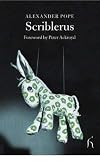
The authorship of this book is somewhat confused, as it came out of an early 17th century literary club. The cover of my copy has the author as Alexander Pope, the title page has Pope and John Arbuthnot as joint authors, and Peter Ackroyd's Foreward says "A great part of this work may confidently be ascribed to Arbuthnot, but the voices of Pope and of Swift are also to be found here".
It is a satire on the pretentiousness of higly-educated people whose learning seems to have made them foolish show more rather than wise. Cornelius Scriblerus is so enamoured of the Ancient Greeks that he endeavours to raise his son Martinus like an Ancient Greek, to the despair of his wife. He even forbids Martinus from playing any children's games that weren't also played in Ancient Greece.
Martinus grows up as foolish as his father, but there is one piece of foolishness that does not seem so foolish in the early 21st century, his method of investigating latent distempers by the sagacious qulity of setting-dogs and pointers, as it has been found that dogs can smell some types of illness and predict epilectic seizures.
It was amusing enough to read once, but I won't be keeping it to re-read. show less
It is a satire on the pretentiousness of higly-educated people whose learning seems to have made them foolish show more rather than wise. Cornelius Scriblerus is so enamoured of the Ancient Greeks that he endeavours to raise his son Martinus like an Ancient Greek, to the despair of his wife. He even forbids Martinus from playing any children's games that weren't also played in Ancient Greece.
Martinus grows up as foolish as his father, but there is one piece of foolishness that does not seem so foolish in the early 21st century, his method of investigating latent distempers by the sagacious qulity of setting-dogs and pointers, as it has been found that dogs can smell some types of illness and predict epilectic seizures.
It was amusing enough to read once, but I won't be keeping it to re-read. show less
Pope's Scriblerus is not Pope's and not titled Scriblerus. As Peter Ackroyd explains in the book's forward back in 1714 Alexander Pope and Jonathan Swift established a literary club under the Scriblerus name. The group wanted to create a satirical periodical, but ended up only with one work. That was published as Pope's work for the first time in 1741 under the title "Memoirs of the Extraordinary life, works and discoveries of Martinus Scriblerus." It was a joint effort though each chapter show more written by somebody else and often together. Wikipedia suggests that it was mostly written though by John Arbuthnot, in whose home the club met.
I have to admit the exquisite language and some of the content proved to be a minor obstacle for understanding the work. But they didn't stop me from enjoying it. I don't usually read early 18th century literature thus quite a bit of the words used here were either unfamiliar for me or had a different meaning than for the authors' contemporaries. This proved a double challenge as they were parodying something they were familiar with and was part of their literary and scholastic culture, but I only have vague notions of.
The focus of the book is satirizing the view that the older knowledge is the more valuable it is. The longer the author of a work has been dead the higher authority it has. It is a mindset that is getting increasingly difficult to occupy in our age, when the pace of information fold is so fast. We have to fight the opposite fallacy: the newer some information is the more reliable it is. Twitter, constant personal and professional updates may make us think that we are missing something if we are not up to speed.
However Pope and his colleagues were trying to bring Enlightenment and modern reason into fashion and show how antiquated knowledge was outdated. In this work they did it by creating a character who was the exact opposite of their ideal scholar. Through seventeen short chapters we learn about the life of Martinus Scriblerus, starting from before his birth and ending with posthumous appraisal of his life and works. Once you get into the style of the prose you will find it as hilarious as I did. The protagonist's (and his father's) notion of science not just borders with superstition but enters deep into its territory.
I laughed out lots of times their actions were so ridiculous and not just against logical reasoning but ordinary common sense too. I just wish I had got more of the context. If I'd known the literature and the popular people of the era I am sure I would have gotten even more out of the book, by understanding the specific references. But even without that it was a terrific reminder how far we came in terms of understanding the powers working in our surroundings, but also how far we could still go. show less
I have to admit the exquisite language and some of the content proved to be a minor obstacle for understanding the work. But they didn't stop me from enjoying it. I don't usually read early 18th century literature thus quite a bit of the words used here were either unfamiliar for me or had a different meaning than for the authors' contemporaries. This proved a double challenge as they were parodying something they were familiar with and was part of their literary and scholastic culture, but I only have vague notions of.
The focus of the book is satirizing the view that the older knowledge is the more valuable it is. The longer the author of a work has been dead the higher authority it has. It is a mindset that is getting increasingly difficult to occupy in our age, when the pace of information fold is so fast. We have to fight the opposite fallacy: the newer some information is the more reliable it is. Twitter, constant personal and professional updates may make us think that we are missing something if we are not up to speed.
However Pope and his colleagues were trying to bring Enlightenment and modern reason into fashion and show how antiquated knowledge was outdated. In this work they did it by creating a character who was the exact opposite of their ideal scholar. Through seventeen short chapters we learn about the life of Martinus Scriblerus, starting from before his birth and ending with posthumous appraisal of his life and works. Once you get into the style of the prose you will find it as hilarious as I did. The protagonist's (and his father's) notion of science not just borders with superstition but enters deep into its territory.
I laughed out lots of times their actions were so ridiculous and not just against logical reasoning but ordinary common sense too. I just wish I had got more of the context. If I'd known the literature and the popular people of the era I am sure I would have gotten even more out of the book, by understanding the specific references. But even without that it was a terrific reminder how far we came in terms of understanding the powers working in our surroundings, but also how far we could still go. show less
Not terribly unreadable, and not altogether boring and trying, and quite Rabelaisian, and quite a surprise enjoyment on the 1,001 Books to Read list. I suppose it's to be expected, considering satire to be an acquired taste, but in the hands of many masters, it's actually not untriumphant a piece of literature.
Lists
My TBR (1)
Awards


You May Also Like
Associated Authors
Statistics
- Works
- 6
- Also by
- 3
- Members
- 236
- Popularity
- #95,934
- Rating
- 4.0
- Reviews
- 6
- ISBNs
- 14
- Languages
- 2