
Joshua Matz
Author of Uncertain Justice: The Roberts Court and the Constitution
Works by Joshua Matz
Tagged
Common Knowledge
- Gender
- male
- Education
- Harvard Law School, J.D.
- Places of residence
- Los Angeles, California, USA
- Associated Place (for map)
- California, USA
Members
Reviews
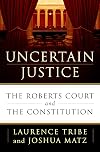
Uncertain Justice: The Roberts Court and the Constitution
By Laurence Tribe and Joshua Matz
Picador
Reviewed by Karl Wolff
The Supreme Court of the United States is the least understood branch of the government. Like the Federal Reserve, it is an elusive institution the general public either knows nothing about or knows only what could charitably be described as misinformation. If people knew more about how the Supreme Court works (and the Federal Reserve, for that matter), it would be less show more likely to pop up in conspiracy theories or partisan bloviations.
Uncertain Justice: The Roberts Court and the Constitution, by Laurence Tribe and Joshua Matz helps illuminate the inner workings of the Court. Tribe and Matz also give succinct portraits of all nine justices, their histories, personalities, and individual interpretation of how justice works. Tribe, a constitutional law professor at Harvard, and Matz, a Harvard Law School graduate and SCOTUSblog writer, team up to offer a sober assessment of the Roberts Court and its major rulings. (It should be noted that Uncertain Justice came out in July 2014. Certain cases, including Sibelius, popularly known as "The Hobby Lobby case" had yet to be decided. This does nothing to detract from the material in the book though.)* The great thing about this book is one doesn't have to be a legal scholar, attorney, or political junkie to appreciate it. The law effects all of us.
Laurence Tribe's students included Barack Obama, John Roberts, Elena Kagan. This adds a fascinating relevancy to the book. Tribe has also argued in front of the Supreme Court, avoiding the caricature of a professor sequestered in the Ivory Tower, isolated from society-at-large. As a Harvard Law Professor, Tribe offers the reader not only the historical background of major cases, but the specific legal, ideological, and cultural baggage each case carries. All the greatest hits are here: gun control, abortion, free speech, healthcare, privacy, and presidential power.
Uncertain Justice is an early assessment of the Roberts Court. Chief Justice John Roberts is the 17th Chief Justice of the United States, nominated by President George W. Bush in 2005. He took over as Chief Justice after the death of Chief Justice William Rehnquist. Like Rehnquist, Roberts is a conservative jurist. While the general public's attitude towards the law has moved slowly to the left, the Supreme Court remains a conservative bulwark.
President Obama has nominated two justices to the Court, but Republican presidents have had the opportunity to nominate four Chief Justices (Earl Warren, Warren Burger, William Rehnquist, and John Roberts). I bring this up not to provoke partisan squabbling, but for readers to take the long view. Despite the imperious title, the Chief Justice is more of an administrative role in the Court. He - until history proves otherwise - assigns cases to specific justices. Although the Chief Justice lacks the authority to write decisions, unless he assigns the case to himself, it is his name in the history books. The Warren Court is now known as a time of liberal change and increased rights. The Taney Court (of Dred Scott v. Stanford) is remembered as the most detested in United States history. Ten years in, where does the Roberts Court stack up?
While characterized as a liberal law professor, Tribe doesn't let his personal ideology overshadow the proceedings. One of the wonderful things about reading Uncertain Justice was how Tribe and Matz articulated arguments from both sides. In some cases it was a challenge to bring myself to make a judgment call. Not because of personal ambivalence, but because each side presented valid arguments. And unlike trial law, an arena of emotions and lurid details, when one argues in front of the Supreme Court, one is intellectually parsing language and wrestling with abstract concepts. Then one applies these to the case at hand. The stakes are huge and the consequences are either revolutionary or devastating, depending what side you are on. Luckily law operates in a more complex yet simple fashion than basic partisan divisiveness. Upon reaching this plateau of jurisprudence, at least ideally, one hopes it doesn't get reduced to "the Republican side" versus "the Democratic side." The questions argued before the Court shouldn't boil down to knee-jerk party tribalism. Leave that for the campaign trail.
In the book, Tribe and Matz discuss a test used by elite law firms: "if you had to eliminate half of the amendments in the Constitution, would you eliminate the odd- or even-numbered rights?" A knee-jerk response would include saying odd, because of the First Amendment, or even, because of the Second Amendment. The authors go on to explain how this is actually a trick question, but use it as a thought experiment. While each amendment is important, the Constitution, Bill of Rights, and additional amendments is a living "machine" with interrelated parts. Amendments are dependent on each other and cannot function alone. While freedom of expression is very important, so is equal protection. But how they interrelate becomes dependent on the individual justice's interpretation of the Constitution itself as it applies to the case at hand.
Tribe and Matz examine each case through two perspectives. The first is the narrative. The story of the individual and their claim. The second perspective is case genealogy. Supreme Court cases, like constitutional amendments, are interrelated. Brown v. Board can be traced back to Plessy v. Ferguson and Dred Scott v. Sanford. Though not immediately apparent, Brown also has roots in Korematsu v. United States, a case involving the wartime internment of Japanese-Americans. The Court upheld the racial segregation of Korematsu in 1944 on the grounds of "national security." Since racial segregation of "separate but equal" had no national security component, it weakened the justifications for the practice. When it comes to matters of free expression, privacy, gun control, and abortion, a working knowledge of case genealogy is very important. Both to understand what is being argued and to observe the trends occurring in American jurisprudence. In the case of abortion, the Right has abandoned the fight for the wholesale repeal of Roe v. Wade. Instead the fight has evolved into creating legislation that limits access.
Nine people make up the Supreme Court, but unlike the other branches, the arguments are ideological not partisan, a crucial distinction. The Court is very small and its important decisions are not televised. In today's hyper-mediated, image-saturated culture, one would think this means they are secretive. Tribe argues to the contrary, noting that there are no cameras because of what the justices write, not what they say. While some justices have been notorious for their public appearances (Justice Scalia most notably), during their session on the Court, they keep away from the public eye. It would be devastating to the process of American democracy if we had Supreme Court justices show-boating to the camera. Some cases involve incredibly pivotal decision-making. This would be ruined if they had to act like a lowly member of Congress or the President.
The "balance of powers" works because each branch has different strengths and weaknesses. The Supreme Court, unlike the President and Congress, is notable as a deliberative body and issuing decisions based on interpretation. Ideally, Congress and the President represent the nation's popular opinion, the Supreme Court should not. The challenge becomes issuing decisions whose time have come, but not making rash decisions based on the whims of public opinion. In the end, Supreme Court is about rendering a judgment, making a decision that will effect everyone.
Right now the Court is challenged by "political gridlock, cultural change, and technological progress." Just as the Federal Reserve is the lender of last resort, the Supreme Court is final arbiter of justice. The Roberts Court continues the conservative interpretation of jurisprudence, but making that interpretation effective relies on a majority of justices. Unfortunately the present Court, like our other branches, is divided. Supreme Court reporting has devolved into answering one question, "What will Justice Anthony Kennedy say?" Kennedy has become the reliable centrist between the Court's conservative and liberal wings. Hence the abundance of 5-4 rulings.
What has typified this Court is its disdain for "judicial overreach" and its preference for "legislative redress." If the Court has ruled against you, talk to your Senator or Representative about drafting a law to counter it. (Cue hysterical outbreak of words like inequality, oligarchy, and Citizens United references.) This is a cautious Court, one that doesn't seek to create new sweeping new law. It is the antithesis of the Warren Court. With that in mind, there are other ways to seek redress besides the Supreme Court. Protests, boycotts, awareness campaigns, lobbying, and elections are all means to an end. The end being: a law that changes things. Whether that law is constitutional? Well ...
Why am I including a Supreme Court book on a literary website? Because judicial decisions are like book reviews, judgment is rendered through interpretation and this can be controversial and divisive. Unlike book reviews, Supreme Court decisions should not be about "personal taste." Deeming a statute constitutional or not depends on the interpretive framework of the nine justices. Things get more tricky when ideology enters the fray.
For those interested in the Supreme Court (its history, personalities, major decisions, etc.) I would highly recommend Jeffrey Toobin's The Nine: Inside the Secret World of the Supreme Court, Scorpions: The Battles and Triumphs of FDR's Great Supreme Court Justices by Noah Feldman, and The Brethren: Inside the Supreme Court by Bob Woodward and Scott Armstrong.
*While Uncertain Justice could easily fall into the category of Current Affairs, it possesses the academic rigor and easy readability that pushes it above the Current Affairs category. Current Affairs is a motley mongrel category, embracing everything from cogent analyses of topical subject matter to the latest ghostwritten swill written by a morning political talk show host. Current Affairs usually means Immediately Obsolete. In the case of Uncertain Justice, it is legal commentary aimed for a popular, non-specialist audience.
http://www.cclapcenter.com/2015/06/book_review_uncertain_justice_.html show less
By Laurence Tribe and Joshua Matz
Picador
Reviewed by Karl Wolff
The Supreme Court of the United States is the least understood branch of the government. Like the Federal Reserve, it is an elusive institution the general public either knows nothing about or knows only what could charitably be described as misinformation. If people knew more about how the Supreme Court works (and the Federal Reserve, for that matter), it would be less show more likely to pop up in conspiracy theories or partisan bloviations.
Uncertain Justice: The Roberts Court and the Constitution, by Laurence Tribe and Joshua Matz helps illuminate the inner workings of the Court. Tribe and Matz also give succinct portraits of all nine justices, their histories, personalities, and individual interpretation of how justice works. Tribe, a constitutional law professor at Harvard, and Matz, a Harvard Law School graduate and SCOTUSblog writer, team up to offer a sober assessment of the Roberts Court and its major rulings. (It should be noted that Uncertain Justice came out in July 2014. Certain cases, including Sibelius, popularly known as "The Hobby Lobby case" had yet to be decided. This does nothing to detract from the material in the book though.)* The great thing about this book is one doesn't have to be a legal scholar, attorney, or political junkie to appreciate it. The law effects all of us.
Laurence Tribe's students included Barack Obama, John Roberts, Elena Kagan. This adds a fascinating relevancy to the book. Tribe has also argued in front of the Supreme Court, avoiding the caricature of a professor sequestered in the Ivory Tower, isolated from society-at-large. As a Harvard Law Professor, Tribe offers the reader not only the historical background of major cases, but the specific legal, ideological, and cultural baggage each case carries. All the greatest hits are here: gun control, abortion, free speech, healthcare, privacy, and presidential power.
Uncertain Justice is an early assessment of the Roberts Court. Chief Justice John Roberts is the 17th Chief Justice of the United States, nominated by President George W. Bush in 2005. He took over as Chief Justice after the death of Chief Justice William Rehnquist. Like Rehnquist, Roberts is a conservative jurist. While the general public's attitude towards the law has moved slowly to the left, the Supreme Court remains a conservative bulwark.
President Obama has nominated two justices to the Court, but Republican presidents have had the opportunity to nominate four Chief Justices (Earl Warren, Warren Burger, William Rehnquist, and John Roberts). I bring this up not to provoke partisan squabbling, but for readers to take the long view. Despite the imperious title, the Chief Justice is more of an administrative role in the Court. He - until history proves otherwise - assigns cases to specific justices. Although the Chief Justice lacks the authority to write decisions, unless he assigns the case to himself, it is his name in the history books. The Warren Court is now known as a time of liberal change and increased rights. The Taney Court (of Dred Scott v. Stanford) is remembered as the most detested in United States history. Ten years in, where does the Roberts Court stack up?
While characterized as a liberal law professor, Tribe doesn't let his personal ideology overshadow the proceedings. One of the wonderful things about reading Uncertain Justice was how Tribe and Matz articulated arguments from both sides. In some cases it was a challenge to bring myself to make a judgment call. Not because of personal ambivalence, but because each side presented valid arguments. And unlike trial law, an arena of emotions and lurid details, when one argues in front of the Supreme Court, one is intellectually parsing language and wrestling with abstract concepts. Then one applies these to the case at hand. The stakes are huge and the consequences are either revolutionary or devastating, depending what side you are on. Luckily law operates in a more complex yet simple fashion than basic partisan divisiveness. Upon reaching this plateau of jurisprudence, at least ideally, one hopes it doesn't get reduced to "the Republican side" versus "the Democratic side." The questions argued before the Court shouldn't boil down to knee-jerk party tribalism. Leave that for the campaign trail.
In the book, Tribe and Matz discuss a test used by elite law firms: "if you had to eliminate half of the amendments in the Constitution, would you eliminate the odd- or even-numbered rights?" A knee-jerk response would include saying odd, because of the First Amendment, or even, because of the Second Amendment. The authors go on to explain how this is actually a trick question, but use it as a thought experiment. While each amendment is important, the Constitution, Bill of Rights, and additional amendments is a living "machine" with interrelated parts. Amendments are dependent on each other and cannot function alone. While freedom of expression is very important, so is equal protection. But how they interrelate becomes dependent on the individual justice's interpretation of the Constitution itself as it applies to the case at hand.
Tribe and Matz examine each case through two perspectives. The first is the narrative. The story of the individual and their claim. The second perspective is case genealogy. Supreme Court cases, like constitutional amendments, are interrelated. Brown v. Board can be traced back to Plessy v. Ferguson and Dred Scott v. Sanford. Though not immediately apparent, Brown also has roots in Korematsu v. United States, a case involving the wartime internment of Japanese-Americans. The Court upheld the racial segregation of Korematsu in 1944 on the grounds of "national security." Since racial segregation of "separate but equal" had no national security component, it weakened the justifications for the practice. When it comes to matters of free expression, privacy, gun control, and abortion, a working knowledge of case genealogy is very important. Both to understand what is being argued and to observe the trends occurring in American jurisprudence. In the case of abortion, the Right has abandoned the fight for the wholesale repeal of Roe v. Wade. Instead the fight has evolved into creating legislation that limits access.
Nine people make up the Supreme Court, but unlike the other branches, the arguments are ideological not partisan, a crucial distinction. The Court is very small and its important decisions are not televised. In today's hyper-mediated, image-saturated culture, one would think this means they are secretive. Tribe argues to the contrary, noting that there are no cameras because of what the justices write, not what they say. While some justices have been notorious for their public appearances (Justice Scalia most notably), during their session on the Court, they keep away from the public eye. It would be devastating to the process of American democracy if we had Supreme Court justices show-boating to the camera. Some cases involve incredibly pivotal decision-making. This would be ruined if they had to act like a lowly member of Congress or the President.
The "balance of powers" works because each branch has different strengths and weaknesses. The Supreme Court, unlike the President and Congress, is notable as a deliberative body and issuing decisions based on interpretation. Ideally, Congress and the President represent the nation's popular opinion, the Supreme Court should not. The challenge becomes issuing decisions whose time have come, but not making rash decisions based on the whims of public opinion. In the end, Supreme Court is about rendering a judgment, making a decision that will effect everyone.
Right now the Court is challenged by "political gridlock, cultural change, and technological progress." Just as the Federal Reserve is the lender of last resort, the Supreme Court is final arbiter of justice. The Roberts Court continues the conservative interpretation of jurisprudence, but making that interpretation effective relies on a majority of justices. Unfortunately the present Court, like our other branches, is divided. Supreme Court reporting has devolved into answering one question, "What will Justice Anthony Kennedy say?" Kennedy has become the reliable centrist between the Court's conservative and liberal wings. Hence the abundance of 5-4 rulings.
What has typified this Court is its disdain for "judicial overreach" and its preference for "legislative redress." If the Court has ruled against you, talk to your Senator or Representative about drafting a law to counter it. (Cue hysterical outbreak of words like inequality, oligarchy, and Citizens United references.) This is a cautious Court, one that doesn't seek to create new sweeping new law. It is the antithesis of the Warren Court. With that in mind, there are other ways to seek redress besides the Supreme Court. Protests, boycotts, awareness campaigns, lobbying, and elections are all means to an end. The end being: a law that changes things. Whether that law is constitutional? Well ...
Why am I including a Supreme Court book on a literary website? Because judicial decisions are like book reviews, judgment is rendered through interpretation and this can be controversial and divisive. Unlike book reviews, Supreme Court decisions should not be about "personal taste." Deeming a statute constitutional or not depends on the interpretive framework of the nine justices. Things get more tricky when ideology enters the fray.
For those interested in the Supreme Court (its history, personalities, major decisions, etc.) I would highly recommend Jeffrey Toobin's The Nine: Inside the Secret World of the Supreme Court, Scorpions: The Battles and Triumphs of FDR's Great Supreme Court Justices by Noah Feldman, and The Brethren: Inside the Supreme Court by Bob Woodward and Scott Armstrong.
*While Uncertain Justice could easily fall into the category of Current Affairs, it possesses the academic rigor and easy readability that pushes it above the Current Affairs category. Current Affairs is a motley mongrel category, embracing everything from cogent analyses of topical subject matter to the latest ghostwritten swill written by a morning political talk show host. Current Affairs usually means Immediately Obsolete. In the case of Uncertain Justice, it is legal commentary aimed for a popular, non-specialist audience.
http://www.cclapcenter.com/2015/06/book_review_uncertain_justice_.html show less
 This review was written for LibraryThing Early Reviewers.
Let me begin by noting that I received an Advanced Reader's Copy of this from the publisher. The following are my own thoughts and rating.
I'm also writing this review as a huge Supreme Court nerd. I count The Brethren: Inside the Supreme Court by Bob Woodward and Scott Armstrong amongst my favourite non-fiction titles. So I enjoyed reading this very much, but I can only speak as someone who already counts the goings-on of the Court as an interest.
Unlike most other books about the U.S. show more Supreme Court aimed at the general public--which tend to capitalize on personal and ideological strife amongst the members--Uncertain Justice focuses on the important legal decisions made by the Court under Chief Justice John Roberts, on what legal grounds the opinions were developed, and how these decisions affect the arc of certain areas of law overall. The book also seeks to explain whether some common perceptions of the Court are indeed accurate (for example, that it is pro-business, or that they are purposefully rolling back Civil Rights protections).
Uncertain Justice's authors struggle mightily to present a well-rounded, unbiased account of the U.S. Supreme Court's justices and their landmark decisions, and more often than not succeed. I really enjoyed their account of how the legal minds of the justices appear to work, and thought every case covered was outlined in an easy-to-understand way for those not accustomed to the jargon. Most importantly, to me, is that (although it can become slow at times) Tribe and Matz are clearly taken with their subject. I mean, you can totally tell that they are fascinated by the machinations of the Supreme Court; it comes across clearly on every page. If there is one thing that I think is important in non-fiction, it's a passion for what you're writing about. Where there is passion, there creates interest for the reader, and the authors have it in spades. show less
I'm also writing this review as a huge Supreme Court nerd. I count The Brethren: Inside the Supreme Court by Bob Woodward and Scott Armstrong amongst my favourite non-fiction titles. So I enjoyed reading this very much, but I can only speak as someone who already counts the goings-on of the Court as an interest.
Unlike most other books about the U.S. show more Supreme Court aimed at the general public--which tend to capitalize on personal and ideological strife amongst the members--Uncertain Justice focuses on the important legal decisions made by the Court under Chief Justice John Roberts, on what legal grounds the opinions were developed, and how these decisions affect the arc of certain areas of law overall. The book also seeks to explain whether some common perceptions of the Court are indeed accurate (for example, that it is pro-business, or that they are purposefully rolling back Civil Rights protections).
Uncertain Justice's authors struggle mightily to present a well-rounded, unbiased account of the U.S. Supreme Court's justices and their landmark decisions, and more often than not succeed. I really enjoyed their account of how the legal minds of the justices appear to work, and thought every case covered was outlined in an easy-to-understand way for those not accustomed to the jargon. Most importantly, to me, is that (although it can become slow at times) Tribe and Matz are clearly taken with their subject. I mean, you can totally tell that they are fascinated by the machinations of the Supreme Court; it comes across clearly on every page. If there is one thing that I think is important in non-fiction, it's a passion for what you're writing about. Where there is passion, there creates interest for the reader, and the authors have it in spades. show less
Before reading UNCERTAIN JUSTICE, by Laurence Tribe and Joshua Matz I knew little about Tribe, but what I had read convinced me that he is a "wild-eyed" liberal. So, when I got the book from early reviewers I was prepared for a very slanted book. That didn't turn out to be the case. Though Tribe's liberal bent is evident, it's clear that he tried to be even-handed. (I'm assuming that Matz wrote much of the book with Tribe's oversight.)
UNCERTAIN JUSTICE deals with how decisions by the Roberts show more court have affected such things as: equality, healthcare, campaign finance, freedom of speech, gun rights, presidential power, privacy, and access to justice. For a long time I've been pleased with a supreme court that has more conservative justices than liberal justices. After reading this book, I'm not so sure that's been a such a good thing.
As a layperson, I've often thought "what a bunch of idiots," when reading a new ruling by the supreme court. With a new understanding of how decisions are arrived at and how specific rulings were arrived at, I'm less likely to think that without learning more about each decision as it comes out.
This book is very detailed, but is surprisingly clear and understandable for anyone who isn't in the legal profession. show less
UNCERTAIN JUSTICE deals with how decisions by the Roberts show more court have affected such things as: equality, healthcare, campaign finance, freedom of speech, gun rights, presidential power, privacy, and access to justice. For a long time I've been pleased with a supreme court that has more conservative justices than liberal justices. After reading this book, I'm not so sure that's been a such a good thing.
As a layperson, I've often thought "what a bunch of idiots," when reading a new ruling by the supreme court. With a new understanding of how decisions are arrived at and how specific rulings were arrived at, I'm less likely to think that without learning more about each decision as it comes out.
This book is very detailed, but is surprisingly clear and understandable for anyone who isn't in the legal profession. show less
This review was written for LibraryThing Early Reviewers.This review is based on an advance reader’s edition, which included numbered end-notes (making them easy to follow) but no acknowledgements or index.
Uncertain Justice is an extremely detailed examination of the Roberts Court, with special emphasis on the more current decisions involving the current court members. However, it also gives background history of the topics including decisions made by earlier courts and their impact on the country. In the Prologue, the nine individual justices show more are briefly described particularly in regard with what they qualities they bring to the court.
The main part of the book is divided into nine chapters on specific topics: (1) Equality which includes racial equality in such things as education and voting rights, and gay rights, but very little on gender rights; (2) health care; (3) campaign finance; (4) freedom of speech (first amendment); (5) gun rights (second amendment and its relation to the first amendment); (6) presidential power; (7) privacy including the impact of security and of modern technology such as DNA databases, role of cellphones and text messaging; (8) giving up rights such criminal rights and rights of states versus the federal government; and (9) access to justice including the court’s favoritism of big business; and procedures favoring the police and prosecutors over defendants, and making it difficult for the powerless including lower and even middle class people to receive justice.
The discussion is so detailed that it can be hard to follow; the details tend to obscure the bigger picture. One of the main views a reader sees is that the justices can disagree wholeheartedly when viewing the same information. Even when they make decisions there can be great disagreements between members of the majority or of the minority among themselves. The book discusses in great detail some of their reasoning, which can be difficult to follow unless one is a scholar in the field.
The main point appears to be that with the makeup of the current court, we as the people can expect to have more of our individual rights taken away although nothing is certain about how the court will rule on any case. Their rulings often are not what they seem to be at first glance; they are often very narrow but have a wider impact. However, unfortunately, the Epilogue is brief and does not contain an overall review of the main points made in the book. show less
Uncertain Justice is an extremely detailed examination of the Roberts Court, with special emphasis on the more current decisions involving the current court members. However, it also gives background history of the topics including decisions made by earlier courts and their impact on the country. In the Prologue, the nine individual justices show more are briefly described particularly in regard with what they qualities they bring to the court.
The main part of the book is divided into nine chapters on specific topics: (1) Equality which includes racial equality in such things as education and voting rights, and gay rights, but very little on gender rights; (2) health care; (3) campaign finance; (4) freedom of speech (first amendment); (5) gun rights (second amendment and its relation to the first amendment); (6) presidential power; (7) privacy including the impact of security and of modern technology such as DNA databases, role of cellphones and text messaging; (8) giving up rights such criminal rights and rights of states versus the federal government; and (9) access to justice including the court’s favoritism of big business; and procedures favoring the police and prosecutors over defendants, and making it difficult for the powerless including lower and even middle class people to receive justice.
The discussion is so detailed that it can be hard to follow; the details tend to obscure the bigger picture. One of the main views a reader sees is that the justices can disagree wholeheartedly when viewing the same information. Even when they make decisions there can be great disagreements between members of the majority or of the minority among themselves. The book discusses in great detail some of their reasoning, which can be difficult to follow unless one is a scholar in the field.
The main point appears to be that with the makeup of the current court, we as the people can expect to have more of our individual rights taken away although nothing is certain about how the court will rule on any case. Their rulings often are not what they seem to be at first glance; they are often very narrow but have a wider impact. However, unfortunately, the Epilogue is brief and does not contain an overall review of the main points made in the book. show less
This review was written for LibraryThing Early Reviewers.Awards


You May Also Like
Associated Authors
Statistics
- Works
- 3
- Members
- 124
- Popularity
- #161,164
- Rating
- 4.3
- Reviews
- 8
- ISBNs
- 6
