
Chris Ferrie
Author of Quantum Physics for Babies
About the Author
Image credit: Headshot
Series
Works by Chris Ferrie
8 Little Planets: A Solar System Book for Kids with Unique Planet Cutouts (2018) 429 copies, 6 reviews
ABCs of Science: The Essential ABC Board Book of First STEM Words from the #1 Science Author for Kids (Science Gifts for Kids) (Baby University) (2017) 231 copies, 2 reviews
ABCs of Space: Explore Astronomy, Space, and our Solar System with this Essential STEM Board Book for Kids (Science Gifts for Kids) (Baby University) (2018) 230 copies, 5 reviews
ABCs of Mathematics: Learn About Addition, Equations, and More in this Perfect Primer for Preschool Math (Baby Board Books, Science Gifts for Kids) (Baby University) (2017) 229 copies, 3 reviews
Goodnight Lab: A Scientific Parody Bedtime Book for Toddlers (Funny Gift Book for Science Lovers, Teachers, and Nerds) (Baby University) (2017) 190 copies
There Was a Black Hole that Swallowed the Universe: A Funny Rhyming Space Book from the #1 Science Author for Kids (2019) 129 copies, 2 reviews
ABCs of Biology: An ABC Board Book of First Biology Words from the #1 Science Author for Kids (STEM and Science Gifts for Kids) (Baby University) (2018) 118 copies, 1 review
ABCs of Engineering: The Essential STEM Board Book of First Engineering Words for Kids (Science Gifts for Kids) (Baby University) (2019) 108 copies
Robotics for Babies: An Engineering Baby Learning Book from the #1 Science Author for Kids (Science and STEM Gift for Engineers) (Baby University) (2019) 93 copies
Bayesian Probability for Babies: A STEM and Math Gift for Toddlers, Babies, and Math Lovers from the #1 Science Author for Kids (Baby University) (2019) 68 copies, 1 review
Scientist, Scientist, Who Do You See?: A Rhyming Book about Famous Scientists for Kids (Learn about Marie Curie, George Washington Carver, Albert Einstein, and More!) (2018) 67 copies, 4 reviews
Quantum Bullsh*t: How to Ruin Your Life with Advice from Quantum Physics (2023) 55 copies, 2 reviews
My First 100 Engineering Words: Essential STEAM Learning for Babies and Toddlers from the #1 Science Author for Kids (My First STEAM Words) (2020) 46 copies
Climate Change for Babies: Teach Global Warming and Empower Kids to Help Keep Our Planet Healthy with this STEM Board Book from the #1 Science Author for Kids (Baby University) (2020) 40 copies, 1 review
I Heart Pluto: A Rhyming Solar System Board Book with Unique Planet Cutouts - From the #1 Science Author for Kids (2020) 36 copies, 2 reviews
My First 100 Technology Words: Essential STEM Learning for Toddlers from the #1 Science Author for Kids (My First STEAM Words) (2020) 29 copies
ABCs of Economics: Simple Explanations of Complex Concepts Like Supply, Demand, Capital, and More for Toddlers and Kids (ABC Board Books, Basic Economics for Kids) (Baby… (2020) 29 copies, 1 review
ABCs of Oceanography: Learn about Sea Creatures, Marine Biology, and More with this Essential Ocean Board Book from the #1 Science Author for Kids (Baby University) (2020) 26 copies, 1 review
Let's Ride a Wave!: Diving into the Science of Light and Sound Waves with Physics (2020) 15 copies, 1 review
Pythagorean Theorem for Babies: A Simple and Colorful Introduction to Math and Geometry Concepts (Baby University) (2022) 14 copies
Pranklab: 25 Hilarious Scientific Practical Jokes for Kids (Fun STEM Activities, Prank Book for Kids) (2021) 14 copies, 1 review
Let's Fly a Plane!: Launching into the Science of Flight with Aerospace Engineering (2020) 14 copies, 3 reviews
Let's Power Up!: Charging into the Science of Electric Currents with Electrical Engineering (2020) 5 copies
Where Did We Come From?: A simple exploration of the universe, evolution, and physics (2022) 4 copies, 1 review
Let's Get Tiny!: Jumping into the Science of the Smallest Part of Matter with Quantum Physics (2020) 4 copies
Great Quotes from Great Scientists: Quotes, Lessons, and Universal Truths from the World's Greatest Scientific Minds (2024) 2 copies
You Can't Open The Door 1 copy
Cosmic Bullsh*t 1 copy
Tagged
Common Knowledge
- Canonical name
- Chris Ferrie
- Legal name
- Christopher Ferrie
- Birthdate
- 1982-01-30
- Gender
- male
- Education
- University of Waterloo, Canada (PhD|Applied Mathematics)
University of Waterloo, Canada (MM|Applied Mathematics)
University of Waterloo, Canada (BSc|Math in Mathematical Physics) - Occupations
- Senior Lecturer, Centre for Quantum Software and Information, University of Technology Sydney
- Organizations
- University of Technology, Sydney
- Awards and honors
- Australian Research Council Discovery Early Career Researcher Award (2017)
UTS Chancellor's Postdoctoral Research Fellowship (2017)
Natural Sciences and Engineering Research Postdoctoral Fellowship (2013) - Nationality
- Canada
- Birthplace
- Ontario, Canada
- Places of residence
- Waterloo, Ontario, Canada
Albuquerque, New Mexico, USA
Sydney, New South Wales, Australia - Associated Place (for map)
- Canada
Members
Reviews
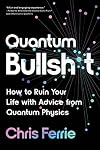
Chris Ferrie discusses quantum physics in a way I’ve not seen, read or heard any type of physics before. It’s immediately engaging, funny and what’s more, you actually learn stuff. (Although if you really hate f-bombs, this might not be your kind of book).
I’ve not done any physics since a previous postgrad, and for school I chose biology because it was easier to get a super high mark / allowed me to study less in first year undergrad. However, I understand now that my reluctance to show more learn any more physics than necessary for the exam was because I didn’t have the teacher who could make physics interesting, fun and swear a lot. Enter Quantum Bullsh*t and Chris Ferrie. This is a book for the angry, annoyed and those sick of stupidity. Those sick of mislabelling everything as quantum when frankly, it has nothing to do with quantum physics. Quantum is but a buzzword and Dr Ferrie is here to shred that to pieces. I am all for a good takedown, especially when it involves stupidity on the internet and swearing. I saw this on the science shelf on the bookshop (thankfully it wasn’t mistakenly put in the self help section), picked it up and started reading and laughing. (I did end up buying it – that much laughter doesn’t usually come from the science section).
The tone of the book is cynical, but not towards the reader. It uses simple terms to describe the basics of quantum physics, although I did wonder why it took so long to get to the multiverse (possibly the only thing besides Dr Strange that interests me in the never-ending Marvel movie series). It’s really fun, explaining things simply and giving some great examples. (Like on ongoing joke of famous physicists being in a car, then having Schrödinger’s cat in the boot…) It’s more about quantum physics than an in-depth takedown of quantum everything else that’s not really quantum, which was fine by me. (I can look up quackery on the internet any time, thanks quantum physics!) Overall, I found the book much more engaging than a dry lecture series and I think I learned more too. It’s funny, and way more entertaining than any textbook.
http://samstillreading.wordpress.com show less
I’ve not done any physics since a previous postgrad, and for school I chose biology because it was easier to get a super high mark / allowed me to study less in first year undergrad. However, I understand now that my reluctance to show more learn any more physics than necessary for the exam was because I didn’t have the teacher who could make physics interesting, fun and swear a lot. Enter Quantum Bullsh*t and Chris Ferrie. This is a book for the angry, annoyed and those sick of stupidity. Those sick of mislabelling everything as quantum when frankly, it has nothing to do with quantum physics. Quantum is but a buzzword and Dr Ferrie is here to shred that to pieces. I am all for a good takedown, especially when it involves stupidity on the internet and swearing. I saw this on the science shelf on the bookshop (thankfully it wasn’t mistakenly put in the self help section), picked it up and started reading and laughing. (I did end up buying it – that much laughter doesn’t usually come from the science section).
The tone of the book is cynical, but not towards the reader. It uses simple terms to describe the basics of quantum physics, although I did wonder why it took so long to get to the multiverse (possibly the only thing besides Dr Strange that interests me in the never-ending Marvel movie series). It’s really fun, explaining things simply and giving some great examples. (Like on ongoing joke of famous physicists being in a car, then having Schrödinger’s cat in the boot…) It’s more about quantum physics than an in-depth takedown of quantum everything else that’s not really quantum, which was fine by me. (I can look up quackery on the internet any time, thanks quantum physics!) Overall, I found the book much more engaging than a dry lecture series and I think I learned more too. It’s funny, and way more entertaining than any textbook.
http://samstillreading.wordpress.com show less
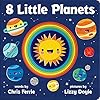
A board book with concentric cutouts takes readers from Neptune at the outer edge of the solar system into the Sun, with cute-faced planets, moons, and stars. Each page has two couplets about each planet. The first couplet states a worry the planet feels about its uniqueness — is Uranus’ side tilt weird? Is Mars too dusty? But the second couplet resolves the tension, stating a quality that the planet is proud of: “It’s pretty cool to be the most cold!” for Uranus and “It has the show more tallest mountain of any planet here!” for Mars. Being able to shift the vocal tone from worry to pride on each page makes it fun to read aloud. show less
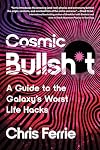
I finally found humor along with a pearl of wisdom in a humor book. For decades, I have agreed to review supposed humor books believing they would at least be funny, if not intelligent. Until now, I have consistently struck out in three pitches straight. But Chris Ferrie’s Cosmic Bullsh*t hits lots of laughs, while getting more and more serious all the way through. An accomplishment. A worthwhile read in humor!
As a scientist, Ferrie is rightly appalled by all the crap that circulates as show more fact, when science has proven and provable answers. “My task is to hype up scientific inquiry because, sadly, it needs it. Though you’d think revealing a universe far more intricate and stunning than any ancient script could conjure would be appealing enough.” Because, we have actually learned a thing or two in the past 50,000 years that differs from the accepted knowledge of that time, though some days you wouldn’t know it from the headlines. That he does it with humor, mostly sarcasm, makes the medicine go down even more readily.
He criticizes the trivialization of science, referencing things like Star Trek: “the adventures of the USS Enterprise as its crew explore new worlds and meet diverse alien species, all in the service of the copyright theft of memorable catchphrases like ‘live long and prosper,’ ‘resistance is futile,’ and ‘That’s not where that goes, Captain Kirk.’”
Ferrie takes a quick trip through all the nonsense Man has built around himself, from early religion to space ignorance, and ends with the real existential threats we face today: disease, nuclear war, and climate, with a side trip to artificial intelligence.
He got my vote early on, with a fill-in-the-blank description of pretty much any religion you know or would like to make up:
Once upon a time, in the vast expanse of ________ (noun), there existed a Primordial ________ (noun). Driven by a cosmic ________ (noun), it began to weave the fabric of ________ (noun). From its essence emerged divine ________ (plural noun), each embodying a unique aspect of ________ (noun). They danced to the tune of ________ (plural noun), shaping ________ (noun), ________ (noun), and ________ (noun).
Among the realms they forged was ________ (noun), a realm destined to harbor ________ (plural noun). The first beings were molded from the ________ (plural noun), gifted with the spark of ________ (noun). They were entrusted with the legacy of the ________ (noun), a reflection of the divine in a ________ (adjective) coil. As time ________ (verb (past tense)), civilizations ________ (verb (past tense)) and ________ (verb (past tense)), each striving to unravel the mysteries of their ________ (noun), reaching for the ________ (plural noun) from whence they came. Yet, amid the quest for ________ (noun), the whimsy of ________ (noun) entwined their destinies, an eternal dance of ________ (noun) and ________ (noun).
…and he then gives an example by filling in the blanks with words like toaster, accordion, cheese, crayons and spaghetti. Works.
Christianity has changed over the years: “Nowadays, Christianity seems more concerned with church attendance, tithing schedules, and gendered toilets. It’s like heaven got its own homeowners’ association with gates guarded by a clipboard-wielding angel named Karen.”
Of Taoism he says: “Writing referencing Taoism is often nuanced and poetic (read that as ‘vague and convoluted’).”
Astrology is always a fat target. It was originally weather forecasting, based on phases of the moon and seasons of the year, giving leaders a clue as to plantings, crop yields, and pitched battles. Somewhere along the line, it morphed into personal forecasts, with no basis whatsoever. These, of necessity, had to be as vague and generalized as possible. Yet after millennia of debunking, astrology still thrives. Doesn’t matter that new planets have been discovered, and some, like Pluto, have been demoted. The science of astrology can take anything in its stride, because it is entirely made up. It has become a religion to billions. Ferrie gives the example of President Ronald Reagan, who would not make a move unless his astrologist back in San Francisco blessed it. And you wonder why the USA is the way it is today?
He then begins the arduous task of tackling the universe and all the lies and nonsense it has attracted. We’ve come a very long way in a very short time. Just in my lifetime, we’ve come from “knowing” the Milky Way was the entire extent of the universe, to understanding the Milky Way doesn’t even register as significant in our local, gigantic cluster of galaxies, that itself is only a fraction of the known universe. Insignificance doesn’t even begin to describe planet Earth.
Ferrie explains the impossibility of space travel, and how other life forms hearing from us would face the same impossibility of traveling here as we would finding them. It would take us hundreds of thousands of years traveling as near the speed of light as we could, just to reach a star where we think a planet might harbor life. For aliens, they would have had to evolve so much farther that they could launch a mission 50,000 years ago, which would be nowhere near reaching us by now. So no, we are not being scouted by aliens, and it is doubtful we (in person) will ever visit them at home, either. In fact, despite all our careful listening, we have yet to hear the slightest indication there is anything out there at all capable of making noise like we do. And that includes visual noise.
He goes on to explain black holes, the expansion of the universe, and how it will likely end. He explains the second law of thermodynamics in terms of everything tending toward the same dull temperature, foreshadowing the end of everything as everything falls apart. Gravity fails, planets fly out of their orbits, and activity ceases. Maybe everything collapses back into a compressed spec again, and the whole process repeats. We won’t be around to find out.
The Earth has several endings to choose from, from that collapse, to being consumed by the enlarged sun on its way to flameout, to collision with the Andromeda galaxy, or to a hit by an outsized asteroid. On a local level, a disease plague, or a supervolcano explosion could take down all life on Earth by poisoning the air for all life that survived the fires, earthquakes and floods.
About the only scenario he does not consider is my own favorite, wherein the nuclear powerplant at the center of the Earth consumes the last of the uranium it can find, and dies out. That’s when the Earth’s magnetic shield shuts down and the sun bakes the Earth, sterilizing it with solar radiation for good measure. With nothing protecting the biosphere, the Earth turns into another Mars, just a lot of stones and dust, but hotter. With no furnace, volcanic activity ceases, water disappears, and Earth becomes a zombie planet.
I did not like that he considers life in the universe to be only carbon-based. All the current searches for other life in the universe assume carbon-based life will leave the same trail of evidence that Earth does. But there is nothing to indicate some other form of life, one that say, does not need a breathing mechanism, or needs to processes our kind of sunlight, or that employs a regulated blood stream - is absolutely required for any kind of life to exist at all. That is pure, arrogant chauvinism, and there is no science to back it. Oxygen is an unnatural freak happenstance on Earth, and maybe on Earth alone.
These quibbles aside, Cosmic Bullsh*t is quite extraordinarily entertaining while providing clarity and insight that only systematic science can.
This is hardly Chris Ferrie’s first attempt. He has published books like Quantum Bullsh*t as well as children’s books (with fewer f-bombs, he promises), all while teaching physics at the University of Technology Sydney.
While the bottom line must ultimately be worrisome, he manages to twist the knife one last time at the very end: “(So) raise a glass, not to forgotten gods or hollow hopes, but to the fierce, flickering flame of being itself, burning a path to oblivion.” Cheers.
David Wineberg show less
As a scientist, Ferrie is rightly appalled by all the crap that circulates as show more fact, when science has proven and provable answers. “My task is to hype up scientific inquiry because, sadly, it needs it. Though you’d think revealing a universe far more intricate and stunning than any ancient script could conjure would be appealing enough.” Because, we have actually learned a thing or two in the past 50,000 years that differs from the accepted knowledge of that time, though some days you wouldn’t know it from the headlines. That he does it with humor, mostly sarcasm, makes the medicine go down even more readily.
He criticizes the trivialization of science, referencing things like Star Trek: “the adventures of the USS Enterprise as its crew explore new worlds and meet diverse alien species, all in the service of the copyright theft of memorable catchphrases like ‘live long and prosper,’ ‘resistance is futile,’ and ‘That’s not where that goes, Captain Kirk.’”
Ferrie takes a quick trip through all the nonsense Man has built around himself, from early religion to space ignorance, and ends with the real existential threats we face today: disease, nuclear war, and climate, with a side trip to artificial intelligence.
He got my vote early on, with a fill-in-the-blank description of pretty much any religion you know or would like to make up:
Once upon a time, in the vast expanse of ________ (noun), there existed a Primordial ________ (noun). Driven by a cosmic ________ (noun), it began to weave the fabric of ________ (noun). From its essence emerged divine ________ (plural noun), each embodying a unique aspect of ________ (noun). They danced to the tune of ________ (plural noun), shaping ________ (noun), ________ (noun), and ________ (noun).
Among the realms they forged was ________ (noun), a realm destined to harbor ________ (plural noun). The first beings were molded from the ________ (plural noun), gifted with the spark of ________ (noun). They were entrusted with the legacy of the ________ (noun), a reflection of the divine in a ________ (adjective) coil. As time ________ (verb (past tense)), civilizations ________ (verb (past tense)) and ________ (verb (past tense)), each striving to unravel the mysteries of their ________ (noun), reaching for the ________ (plural noun) from whence they came. Yet, amid the quest for ________ (noun), the whimsy of ________ (noun) entwined their destinies, an eternal dance of ________ (noun) and ________ (noun).
…and he then gives an example by filling in the blanks with words like toaster, accordion, cheese, crayons and spaghetti. Works.
Christianity has changed over the years: “Nowadays, Christianity seems more concerned with church attendance, tithing schedules, and gendered toilets. It’s like heaven got its own homeowners’ association with gates guarded by a clipboard-wielding angel named Karen.”
Of Taoism he says: “Writing referencing Taoism is often nuanced and poetic (read that as ‘vague and convoluted’).”
Astrology is always a fat target. It was originally weather forecasting, based on phases of the moon and seasons of the year, giving leaders a clue as to plantings, crop yields, and pitched battles. Somewhere along the line, it morphed into personal forecasts, with no basis whatsoever. These, of necessity, had to be as vague and generalized as possible. Yet after millennia of debunking, astrology still thrives. Doesn’t matter that new planets have been discovered, and some, like Pluto, have been demoted. The science of astrology can take anything in its stride, because it is entirely made up. It has become a religion to billions. Ferrie gives the example of President Ronald Reagan, who would not make a move unless his astrologist back in San Francisco blessed it. And you wonder why the USA is the way it is today?
He then begins the arduous task of tackling the universe and all the lies and nonsense it has attracted. We’ve come a very long way in a very short time. Just in my lifetime, we’ve come from “knowing” the Milky Way was the entire extent of the universe, to understanding the Milky Way doesn’t even register as significant in our local, gigantic cluster of galaxies, that itself is only a fraction of the known universe. Insignificance doesn’t even begin to describe planet Earth.
Ferrie explains the impossibility of space travel, and how other life forms hearing from us would face the same impossibility of traveling here as we would finding them. It would take us hundreds of thousands of years traveling as near the speed of light as we could, just to reach a star where we think a planet might harbor life. For aliens, they would have had to evolve so much farther that they could launch a mission 50,000 years ago, which would be nowhere near reaching us by now. So no, we are not being scouted by aliens, and it is doubtful we (in person) will ever visit them at home, either. In fact, despite all our careful listening, we have yet to hear the slightest indication there is anything out there at all capable of making noise like we do. And that includes visual noise.
He goes on to explain black holes, the expansion of the universe, and how it will likely end. He explains the second law of thermodynamics in terms of everything tending toward the same dull temperature, foreshadowing the end of everything as everything falls apart. Gravity fails, planets fly out of their orbits, and activity ceases. Maybe everything collapses back into a compressed spec again, and the whole process repeats. We won’t be around to find out.
The Earth has several endings to choose from, from that collapse, to being consumed by the enlarged sun on its way to flameout, to collision with the Andromeda galaxy, or to a hit by an outsized asteroid. On a local level, a disease plague, or a supervolcano explosion could take down all life on Earth by poisoning the air for all life that survived the fires, earthquakes and floods.
About the only scenario he does not consider is my own favorite, wherein the nuclear powerplant at the center of the Earth consumes the last of the uranium it can find, and dies out. That’s when the Earth’s magnetic shield shuts down and the sun bakes the Earth, sterilizing it with solar radiation for good measure. With nothing protecting the biosphere, the Earth turns into another Mars, just a lot of stones and dust, but hotter. With no furnace, volcanic activity ceases, water disappears, and Earth becomes a zombie planet.
I did not like that he considers life in the universe to be only carbon-based. All the current searches for other life in the universe assume carbon-based life will leave the same trail of evidence that Earth does. But there is nothing to indicate some other form of life, one that say, does not need a breathing mechanism, or needs to processes our kind of sunlight, or that employs a regulated blood stream - is absolutely required for any kind of life to exist at all. That is pure, arrogant chauvinism, and there is no science to back it. Oxygen is an unnatural freak happenstance on Earth, and maybe on Earth alone.
These quibbles aside, Cosmic Bullsh*t is quite extraordinarily entertaining while providing clarity and insight that only systematic science can.
This is hardly Chris Ferrie’s first attempt. He has published books like Quantum Bullsh*t as well as children’s books (with fewer f-bombs, he promises), all while teaching physics at the University of Technology Sydney.
While the bottom line must ultimately be worrisome, he manages to twist the knife one last time at the very end: “(So) raise a glass, not to forgotten gods or hollow hopes, but to the fierce, flickering flame of being itself, burning a path to oblivion.” Cheers.
David Wineberg show less
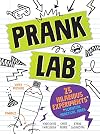
As a kid, I would have devoured this book. Packed with fun...yes, not boring...science to understand and play with.
Packed with 25 experiments, science is made fun and brought down to a level middle graders can understand and enjoy. Each experiment creates a chapter, which starts with an list of items required as well as an immediate run down of what to expect—whether it's 'messy', how to have fun with it without getting into trouble, and what items might be required for clean-up or what to show more watch out for. Then, the experiment is presented in a clear step-by-step manner. The reasons behind the desired effects are explained (the science), and even the main historical figure behind the theory or cause is shown in a small, basic illustration along with a sentence or two about them. So, this book definitely teaches as it goes along.
With four kids of my own, the danger of pranks was in the back of my mind when I picked this one up, but after reading it, I'm a total fan of this book. The authors take care to point out the problems each prank could produce (mess, loudness, and such), remind readers that ignoring certain aspects could cause trouble, and offering hints of how to avoid causing real issues...and all of this without coming across as preachy but keeping it humorous and fun. But these experiments are nothing over the top or something most of us adults haven't seen at one time or another. They are actually awesome, easy experiments to show several basics of science.
I really appreciated the explanations behind the fun. The reasons why things happen the way they do and what each experiment shows are also included. And these aren't boring, either. Fun is kept front and center...and isn't science exciting anyway? (At least, I think so.) I was also impressed that the historical figures behind the theories or discoveries aren't forgotten. and none of this takes up much time to bring across, but really sticks to the details and goes on.
This is a great book for hands-on kids who love to do things while learning about them too. I can really recommend this one and would definitely pick it up for my own kids. show less
Packed with 25 experiments, science is made fun and brought down to a level middle graders can understand and enjoy. Each experiment creates a chapter, which starts with an list of items required as well as an immediate run down of what to expect—whether it's 'messy', how to have fun with it without getting into trouble, and what items might be required for clean-up or what to show more watch out for. Then, the experiment is presented in a clear step-by-step manner. The reasons behind the desired effects are explained (the science), and even the main historical figure behind the theory or cause is shown in a small, basic illustration along with a sentence or two about them. So, this book definitely teaches as it goes along.
With four kids of my own, the danger of pranks was in the back of my mind when I picked this one up, but after reading it, I'm a total fan of this book. The authors take care to point out the problems each prank could produce (mess, loudness, and such), remind readers that ignoring certain aspects could cause trouble, and offering hints of how to avoid causing real issues...and all of this without coming across as preachy but keeping it humorous and fun. But these experiments are nothing over the top or something most of us adults haven't seen at one time or another. They are actually awesome, easy experiments to show several basics of science.
I really appreciated the explanations behind the fun. The reasons why things happen the way they do and what each experiment shows are also included. And these aren't boring, either. Fun is kept front and center...and isn't science exciting anyway? (At least, I think so.) I was also impressed that the historical figures behind the theories or discoveries aren't forgotten. and none of this takes up much time to bring across, but really sticks to the details and goes on.
This is a great book for hands-on kids who love to do things while learning about them too. I can really recommend this one and would definitely pick it up for my own kids. show less
Lists
Awards


You May Also Like


Associated Authors
Statistics
- Works
- 98
- Members
- 6,290
- Popularity
- #3,902
- Rating
- 3.7
- Reviews
- 63
- ISBNs
- 325
- Languages
- 7
- Favorited
- 1
