
Joanne Dobson
Author of Quieter Than Sleep
About the Author
Joanne Dobson is an associate professeor of English at Fordham University.
Series
Works by Joanne Dobson
Associated Works
A Taste of Murder: Diabolically Delicious Recipes from Contemporary Mystery Writers (1999) — Contributor — 48 copies, 1 review
Tagged
Common Knowledge
- Birthdate
- 1942-03-27
- Gender
- female
- Occupations
- English professor
- Organizations
- Fordham University
- Short biography
- Joanne Dobson teaches English at Fordham University. Her first Professor Karen Pelletier academic mystery, Quieter Than Sleep (1997), was an Agatha nominee, of which Publisher's Weekly said: "Deftly balancing its literary and mystery elements, Dobson's debut sparkles with wit and insight." It was followed by The Northbury Papers (1998), The Raven and the Nightingale (1999), and Cold and Pure and Very Dead (2000).
In her scholarly work, Professor Dobson has concentrated on the recovery of the neglected literature of nineteenth-century American women writers. Professor Dobson is a founding editor of Legacy: A Journal of American Women Writers and a general editor of the Rutgers American Women Writers reprint series.
She and her husband live in the New York City area and have three grown children. - Nationality
- USA
- Places of residence
- New York, New York, USA
- Associated Place (for map)
- New York, USA
Members
Reviews
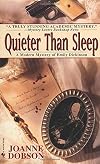
Hindsight is 20/20. If she had only known that Professor Randy Astin-Berger wasn't going to leave the Enfield College faculty Christmas party alive, Dr. Karen Pelletier might have paid attention to his endless monologue when he had her cornered. Lieutenant Piotrowski is a skilled crime investigator, but he doesn't have the specialist knowledge of 19th century American literature that may hold the key to the solution of Randy's murder. Can Karen and the Lieutenant work together to catch a show more murderer?
I've spent most of my life in academic circles, so I always enjoy a good mystery in an academic setting. This book has all the right ingredients -- a small private liberal arts college, just the right mix of collegiality and professional jealousy, and a scholarly puzzle. The momentum wavered in the middle third of the book, but the beginning and ending sections were page turners. There are several more books in this series, and I look forward to future visits in the world Dobson has created. show less
I've spent most of my life in academic circles, so I always enjoy a good mystery in an academic setting. This book has all the right ingredients -- a small private liberal arts college, just the right mix of collegiality and professional jealousy, and a scholarly puzzle. The momentum wavered in the middle third of the book, but the beginning and ending sections were page turners. There are several more books in this series, and I look forward to future visits in the world Dobson has created. show less
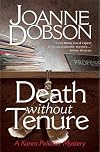
Reader beware: this book made me angry. I am not a kind reviewer when I am angry. This may indeed be a good book, but it really, really pushed some of my buttons and I am currently unapologetic for the forthcoming tirade.
Death without Tenure is, as one might expect from the title, a murder mystery that takes place in academia with a professorial protagonist. Karen is a professor of English in a New England liberal arts college. She is currently fighting against a fellow professor, the Native show more American Joe Lone Wolf, for tenure. For some odd and improbable reason, this insane school decided to give tenure to only one of the two. (That's not how tenure works, folks.) Even more improbably, Joe Lone Wolf was somehow hired with no publications, no finished PhD, and no qualifications. He hasn't attended a conference for six years, no one has even checked on what he is teaching, and he isn't producing academic work. But despite this, the (insane) school decides to put him up for tenure because of affirmative action. People, this isn't how the system works. There is no way in the deep abysses of Hell that any professor could get away with the above. The system is also not so corrupt that ethnicity trumps everything else.
Well, of course, Joe gets murdered, and our protagonist is a primary suspect. We have some ridiculously improbable police interrogation and even more ridiculous and offensive characterization of Native Americans and other ethnicities. The book finally terminates with the obvious suspect and an improbable methodology.
As a relatively engaging, light, and not particularly enthralling murder mystery, this is fine. I've read plenty of books that were more poorly written. So why all the ire?
Well, the entire plot centres around racism, ethnicity, and affirmative action, and I have never before encountered someone who combines such self-satisfied politically correct smugness with such disgustingly racist perspectives. We have a lot of different characters with different nationalities: Indian Joe (just in case the fact that his freaking name is "Joe" happened to escape you...), the protagonist's African-American friend, and her Muslim student. Again, the entire story is superficially about racism, with facile characterizations of affirmative action, entitlement, prejudice, and racism, and the oh-so-easy answers. We have various characterizations of various types of racism, from general hate speech to the more insidious "over-affirmative action" and the tendency to view a minority as an exemplar of said minority. The author repeatedly pontificates about white entitlement and appropriation...and then goes on to commit those same crimes. The hypocrisy of all of this infuriates me.
Let's talk about the basics: the characterization of minority characters. First, this book suffers from one of the worst (and yet smuggest) cases of default whiteness I've ever encountered. All characters are (obviously, right?) white unless otherwise specified. Any time any character of any ethnicity is mentioned, you can be sure that some description of "exotic eyes" or "dark skin," etc, will be mentioned. It doesn't matter if it's the hundredth time or the thousandth time that the character has spoken; exotic eyes or dark skin or braided hair are sure to be mentioned, just in case we started thinking of the character as a character rather than an instance of an ethnic group. Any character with any nonwhite ethnicity are seen as of that nationality first, human being second (or never.) And along with that, we get a single "exemplar" character per culture. Each exemplar has all the stereotypes of their culture, and obviously since all are the same, having one character of each nationality is sufficient, right? Our Native American exemplar is an arrogant, entitled, uneducated Native American who dresses in feathers, smokes marijuana, takes peyote, does native war dances, collects tomahawks...tomahawks, for heaven's sake. Kill me now. hover for spoiler One of the worst cases of this, other than the almost abusive portrayal of Native Americans in the story, is that of Khalida, Karen's Muslim student. Every time she is mentioned, her religion, her face veil, etc are mentioned. She is smart, quiet...and Muslim. That apparently suffices to create a personality, right? One of the instances that infuriated me with the book was when Joe touches Khalida's arm and Karen decides to "rescue" her by yelling at Joe and saying that it is a "Muslim crime," etc for him to touch her. Really, Karen is using Khalida as a pawn in her own argument with Joe, but since she is "defending" Khalida, this is apparently laudable. In my own personal view, however, by pushing her own assumptions and preconceptions of Islam on Khalida, Karen silences her just as effectively as Joe's pressure.
Yes, there are a multitude of self-conscious and self-satisfied stereotype reversals; for example, Khalida's family are fine with her gaining an education and don't want to kill her for transgressing sharia law (shocker!). But the creation of the stereotype, the self-satisfied-aren't-we-PC reversal, and above all the use of an exemplar, is just as bad. It's like the TV shows where the token minority is placed in a position of power rather than as the token minority goof-off sidekick or subordinate, or the tech-savvy girl being incredibly beautiful and articulate. It's an attempt to reverse an ethnicity/socioeconomic/power stereotype, but it ends up looking smug, self-conscious, and forced. It actually enforces the stereotype as it creates a separation between "good" __'s and "bad" __'s because it basically suggests that if you don't totally renounce everything typically attributed to your minority, you don't deserve to be represented as a character. It's patronizing: rather than letting a character be an individual, it's almost like the author is trying to correct the "flaws" of the minority and erase anyone with a subset of these "flaws".
The entire basis of the plot is that, given the right ethnicity, you can get away with anything because obviously, affirmative action goes on to shove totally unsuitable candidates far above their "proper station". This attitude is disgusting. It reminds me of certain rather insane leaders and their belief that white middle-class men are "oppressed." Yeah, right. I'm white and know that, since I grew up in suburban America, my outlook is tainted by racism and I can never fully understand the perspectives of those who have encountered the casual, everyday prejudice that is such a part of American life. As a woman in CS, which is
Honestly, I don't know how to approach sensitive topics like race. I am white; I can never actually fully understand the precise problem. But whatever approach is right, I think this one is indubitably wrong. It effectively pushes minority viewpoints into handy pidgeonholes and easy solutions, minimizes and appropriates the pains and problems of prejudice, and, by simplifying and stereotyping, effectively silences those who actually understand the subtleties of the problem of prejudice. Ah, well, back to smug self-satisfaction at our own PC-ness, I suppose. show less
Death without Tenure is, as one might expect from the title, a murder mystery that takes place in academia with a professorial protagonist. Karen is a professor of English in a New England liberal arts college. She is currently fighting against a fellow professor, the Native show more American Joe Lone Wolf, for tenure. For some odd and improbable reason, this insane school decided to give tenure to only one of the two. (That's not how tenure works, folks.) Even more improbably, Joe Lone Wolf was somehow hired with no publications, no finished PhD, and no qualifications. He hasn't attended a conference for six years, no one has even checked on what he is teaching, and he isn't producing academic work. But despite this, the (insane) school decides to put him up for tenure because of affirmative action. People, this isn't how the system works. There is no way in the deep abysses of Hell that any professor could get away with the above. The system is also not so corrupt that ethnicity trumps everything else.
Well, of course, Joe gets murdered, and our protagonist is a primary suspect. We have some ridiculously improbable police interrogation and even more ridiculous and offensive characterization of Native Americans and other ethnicities. The book finally terminates with the obvious suspect and an improbable methodology.
As a relatively engaging, light, and not particularly enthralling murder mystery, this is fine. I've read plenty of books that were more poorly written. So why all the ire?
Well, the entire plot centres around racism, ethnicity, and affirmative action, and I have never before encountered someone who combines such self-satisfied politically correct smugness with such disgustingly racist perspectives. We have a lot of different characters with different nationalities: Indian Joe (just in case the fact that his freaking name is "Joe" happened to escape you...), the protagonist's African-American friend, and her Muslim student. Again, the entire story is superficially about racism, with facile characterizations of affirmative action, entitlement, prejudice, and racism, and the oh-so-easy answers. We have various characterizations of various types of racism, from general hate speech to the more insidious "over-affirmative action" and the tendency to view a minority as an exemplar of said minority. The author repeatedly pontificates about white entitlement and appropriation...and then goes on to commit those same crimes. The hypocrisy of all of this infuriates me.
Let's talk about the basics: the characterization of minority characters. First, this book suffers from one of the worst (and yet smuggest) cases of default whiteness I've ever encountered. All characters are (obviously, right?) white unless otherwise specified. Any time any character of any ethnicity is mentioned, you can be sure that some description of "exotic eyes" or "dark skin," etc, will be mentioned. It doesn't matter if it's the hundredth time or the thousandth time that the character has spoken; exotic eyes or dark skin or braided hair are sure to be mentioned, just in case we started thinking of the character as a character rather than an instance of an ethnic group. Any character with any nonwhite ethnicity are seen as of that nationality first, human being second (or never.) And along with that, we get a single "exemplar" character per culture. Each exemplar has all the stereotypes of their culture, and obviously since all are the same, having one character of each nationality is sufficient, right? Our Native American exemplar is an arrogant, entitled, uneducated Native American who dresses in feathers, smokes marijuana, takes peyote, does native war dances, collects tomahawks...tomahawks, for heaven's sake. Kill me now. hover for spoiler One of the worst cases of this, other than the almost abusive portrayal of Native Americans in the story, is that of Khalida, Karen's Muslim student. Every time she is mentioned, her religion, her face veil, etc are mentioned. She is smart, quiet...and Muslim. That apparently suffices to create a personality, right? One of the instances that infuriated me with the book was when Joe touches Khalida's arm and Karen decides to "rescue" her by yelling at Joe and saying that it is a "Muslim crime," etc for him to touch her. Really, Karen is using Khalida as a pawn in her own argument with Joe, but since she is "defending" Khalida, this is apparently laudable. In my own personal view, however, by pushing her own assumptions and preconceptions of Islam on Khalida, Karen silences her just as effectively as Joe's pressure.
Yes, there are a multitude of self-conscious and self-satisfied stereotype reversals; for example, Khalida's family are fine with her gaining an education and don't want to kill her for transgressing sharia law (shocker!). But the creation of the stereotype, the self-satisfied-aren't-we-PC reversal, and above all the use of an exemplar, is just as bad. It's like the TV shows where the token minority is placed in a position of power rather than as the token minority goof-off sidekick or subordinate, or the tech-savvy girl being incredibly beautiful and articulate. It's an attempt to reverse an ethnicity/socioeconomic/power stereotype, but it ends up looking smug, self-conscious, and forced. It actually enforces the stereotype as it creates a separation between "good" __'s and "bad" __'s because it basically suggests that if you don't totally renounce everything typically attributed to your minority, you don't deserve to be represented as a character. It's patronizing: rather than letting a character be an individual, it's almost like the author is trying to correct the "flaws" of the minority and erase anyone with a subset of these "flaws".
The entire basis of the plot is that, given the right ethnicity, you can get away with anything because obviously, affirmative action goes on to shove totally unsuitable candidates far above their "proper station". This attitude is disgusting. It reminds me of certain rather insane leaders and their belief that white middle-class men are "oppressed." Yeah, right. I'm white and know that, since I grew up in suburban America, my outlook is tainted by racism and I can never fully understand the perspectives of those who have encountered the casual, everyday prejudice that is such a part of American life. As a woman in CS, which is
Honestly, I don't know how to approach sensitive topics like race. I am white; I can never actually fully understand the precise problem. But whatever approach is right, I think this one is indubitably wrong. It effectively pushes minority viewpoints into handy pidgeonholes and easy solutions, minimizes and appropriates the pains and problems of prejudice, and, by simplifying and stereotyping, effectively silences those who actually understand the subtleties of the problem of prejudice. Ah, well, back to smug self-satisfaction at our own PC-ness, I suppose. show less
"Karen Pelletier abandoned her life in New York for a professorship at Massachusetts's elite Enfield College. But she quickly learns that New England is not the peaceful enclave she had imagined -- and that not even the privileged world of academia is immune to murder.
"Professor Karen Pelletier's prime literary passion is poet Emily Dickinson -- a passion she shares with her hotshot colooleague Randy Astin-Berger. Heir apparent to the head of Enfield's English Department, the pompous Randy show more is the campus Casanova. That is, he was -- until he was found strangled with his own flashy necktie. The last peson to see Randy alive -- and the first to find him dead -- Karen knows she must solove the case before she becomes the prime suspect. But to do that, she must first discovewr the truth behind Randy's final Dickinsoni8an discovery -- a literary bombshell that may well have been to die for ..."
~~back cover
I was amazed to find I was really enjoying this book. Ordinarily I'd rather read English cozies, set in England and bloodless. But this mystery was so skillfully done that I couldn't help adding it to my favorites.
For one thing, it's not formulaic, and Professor Pelletier doesn't decide she can out think the police and attempt to solve the mystery herself. Instead, she finds herself pulled into "assisting the police" by the detective on the case, who also seems to be very attracted to her ... or is he?
Karen is also a very likeable, realistic human being -- besit by worries and doubts. She's a single mother of a remarkable young woman, who's pulled herself up by her bootstraps by grit, determination and a lot of hard work. She doesn't take herself too seriously either. Very realistic and chilling subplots just add spice to the mix.
I can't wait to read the second book in the series, to see what happens to Karen's love life, and to see if the writing continues at a very professional level. show less
"Professor Karen Pelletier's prime literary passion is poet Emily Dickinson -- a passion she shares with her hotshot colooleague Randy Astin-Berger. Heir apparent to the head of Enfield's English Department, the pompous Randy show more is the campus Casanova. That is, he was -- until he was found strangled with his own flashy necktie. The last peson to see Randy alive -- and the first to find him dead -- Karen knows she must solove the case before she becomes the prime suspect. But to do that, she must first discovewr the truth behind Randy's final Dickinsoni8an discovery -- a literary bombshell that may well have been to die for ..."
~~back cover
I was amazed to find I was really enjoying this book. Ordinarily I'd rather read English cozies, set in England and bloodless. But this mystery was so skillfully done that I couldn't help adding it to my favorites.
For one thing, it's not formulaic, and Professor Pelletier doesn't decide she can out think the police and attempt to solve the mystery herself. Instead, she finds herself pulled into "assisting the police" by the detective on the case, who also seems to be very attracted to her ... or is he?
Karen is also a very likeable, realistic human being -- besit by worries and doubts. She's a single mother of a remarkable young woman, who's pulled herself up by her bootstraps by grit, determination and a lot of hard work. She doesn't take herself too seriously either. Very realistic and chilling subplots just add spice to the mix.
I can't wait to read the second book in the series, to see what happens to Karen's love life, and to see if the writing continues at a very professional level. show less
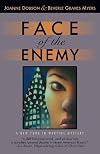
"2:33. 2:33 on a sunny Sunday afternoon, and nothing will ever be the same."
This is the second Netgalley offering I've read this year which featured an interracial (Japanese immigrant and white American) couple in 1941 who were directly affected by the bombing of Pearl Harbor. The two books were utterly different in all other ways, though, apart from both being very good.
Here, the couple is Robert and Masako Oakley, respectively a professor and an artist living in Manhattan. At Masako's show more show, which by terrible coincidence opens on just before Pearl Harbor. Much more happens than just the sale of paintings: protesters picket outside, two racist society dissenters invade the show and deface one of the paintings, and Robert – refusing to spoil his beloved wife's big night by giving in to illness – is literally brought down by the illness he's been ignoring. Events gallop on from there: Pearl Harbor is attacked, and the FBI round up anyone of Japanese origins for internment. And when the body is found in the gallery, placed under one of Masako's paintings, the police join in the hounding, pretty darn sure that – tiny and non-violent as she is – she must be the killer.
I've been a fan of Joanne Dobson's Professor Karen Pelletier books for ages, and so I was delighted to get my hands on this through Netgalley (to whom go my thanks). Dobson (along with her coauthor Beverle Graves Myers, of course) does every bit as lovely a job on 1941 New York as she does with present-day academic Massachusetts. The setting is true-to-life, the emotions of even minor characters adding to the entirety of a shocked and angry city changing its mind about war. And the situation Masako is dropped into is horrific. Bureaucratic red tape mixed with a vengeful attitude, righteousness and anger combined with "just doing my job, ma'am" – all swirling around a character who quickly becomes someone the reader does not want dropped into a hideous situation: it's powerful.
Fortunately, detective Michael McKenna – who reminded me of Riker from the Kathy Mallory novels – is not blinded by the surge of racial hatred; he just wants to find and put away the actual murderer. Whether he wants it or not he has assistance from the nurse brought in to look after Robert, Louise – and also Louise's roommate at a boarding house that reminded me in ways of Stage Door (and the similar house in the Rosie Winter novels). The latter is Intrepid Girl Reporter Cabby Ward, Louise's roommate, who is finding out just how hard it is to be a girl in a men's world – but she's tough, and determined, and willing to do just about anything for her story. It's only a little later that she has the realization I wish all reporters would have – that the people in the case, victim and suspect(s) and cops, are people, not just subjects for an article, and that the ethics of a story might just be as important as the sensation.
I like these characters. I like the use of the immigrant ethos of New York to bring the moment in time to life: Masako's plight, along with that of Louise's landlady, German-born Helda, and her son. The American homefront of WWII is one of my favorite settings, surprisingly underused in my experience (though See Also Rosie Winter); it makes me very happy to know this is the beginning of a series. show less
This is the second Netgalley offering I've read this year which featured an interracial (Japanese immigrant and white American) couple in 1941 who were directly affected by the bombing of Pearl Harbor. The two books were utterly different in all other ways, though, apart from both being very good.
Here, the couple is Robert and Masako Oakley, respectively a professor and an artist living in Manhattan. At Masako's show more show, which by terrible coincidence opens on just before Pearl Harbor. Much more happens than just the sale of paintings: protesters picket outside, two racist society dissenters invade the show and deface one of the paintings, and Robert – refusing to spoil his beloved wife's big night by giving in to illness – is literally brought down by the illness he's been ignoring. Events gallop on from there: Pearl Harbor is attacked, and the FBI round up anyone of Japanese origins for internment. And when the body is found in the gallery, placed under one of Masako's paintings, the police join in the hounding, pretty darn sure that – tiny and non-violent as she is – she must be the killer.
I've been a fan of Joanne Dobson's Professor Karen Pelletier books for ages, and so I was delighted to get my hands on this through Netgalley (to whom go my thanks). Dobson (along with her coauthor Beverle Graves Myers, of course) does every bit as lovely a job on 1941 New York as she does with present-day academic Massachusetts. The setting is true-to-life, the emotions of even minor characters adding to the entirety of a shocked and angry city changing its mind about war. And the situation Masako is dropped into is horrific. Bureaucratic red tape mixed with a vengeful attitude, righteousness and anger combined with "just doing my job, ma'am" – all swirling around a character who quickly becomes someone the reader does not want dropped into a hideous situation: it's powerful.
Fortunately, detective Michael McKenna – who reminded me of Riker from the Kathy Mallory novels – is not blinded by the surge of racial hatred; he just wants to find and put away the actual murderer. Whether he wants it or not he has assistance from the nurse brought in to look after Robert, Louise – and also Louise's roommate at a boarding house that reminded me in ways of Stage Door (and the similar house in the Rosie Winter novels). The latter is Intrepid Girl Reporter Cabby Ward, Louise's roommate, who is finding out just how hard it is to be a girl in a men's world – but she's tough, and determined, and willing to do just about anything for her story. It's only a little later that she has the realization I wish all reporters would have – that the people in the case, victim and suspect(s) and cops, are people, not just subjects for an article, and that the ethics of a story might just be as important as the sensation.
I like these characters. I like the use of the immigrant ethos of New York to bring the moment in time to life: Masako's plight, along with that of Louise's landlady, German-born Helda, and her son. The American homefront of WWII is one of my favorite settings, surprisingly underused in my experience (though See Also Rosie Winter); it makes me very happy to know this is the beginning of a series. show less
Awards

You May Also Like


Associated Authors
Statistics
- Works
- 14
- Also by
- 4
- Members
- 1,103
- Popularity
- #23,300
- Rating
- 3.5
- Reviews
- 22
- ISBNs
- 50
- Languages
- 1
- Favorited
- 5