

Walter J. Harrelson (1919–2012)
Author of The New Interpreter's Study Bible: New Revised Standard Version With the Apocrypha
About the Author
Walter J. Harrelson is University Professor of Hebrew Bible at Wake Forest Divinity School and Distinguished Professor of Old Testament Emeritus at Vanderbilt Divinity School
Works by Walter J. Harrelson
Associated Works
The Ten Commandments: The Reciprocity of Faithfulness (Library of Theological Ethics) (2004) — Contributor — 56 copies
Translating & Understanding the Old Testament: Essays in Honor of Herbert Gordon May (1970) — Contributor — 23 copies
Worship and the Hebrew Bible Essays in H: Essays in Honor of John T. Willis (JSOT Supplement) (1999) — Contributor — 18 copies
Religions in Antiquity: Essays in Memory of Erwin Ramsdell Goodenough (1970) — Contributor — 6 copies
Tagged
Common Knowledge
- Birthdate
- 1919-11-28
- Date of death
- 2012-09-05
- Gender
- male
- Birthplace
- Winnabow, North Carolina, USA
- Associated Place (for map)
- North Carolina, USA
Members
Reviews
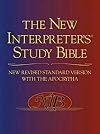
The NISB stands, undoubtedly, as a landmark achievement amongst the ever-growing plethora of so-called “study Bibles.” While many of the offerings lack substance or have a bizarre focus (thinking here particularly of the “American Patriot’s Study Bible”), this study Bible provides deep engagement with the text, commitment to theological understanding, and is careful to make appropriate application. The contributors to this volume are a veritable “who’s who” of biblical show more scholarship. Many of the contributors have written widely-recognized commentaries on the books for which they contributed notes. Some have even written for the “New Interpreter’s Bible,” a massive multi-volume commentary edited by Leander Keck that is another landmark publication.
So far, so good; however, the NISB is written from within what is generally described as the “mainline Protestant” tradition and represents many of the commitments common to that stream. There is a deep-rooted suspicion of an overly “historical” or “literal” or “supernatural” interpretation of any text (particularly evident in the handling of the Pentateuchal narratives, the authorship of the epistles, and the Gospels’ miracles stories, including the Virgin Birth and Resurrection). Also prevalent is a consistent concern with the Bible’s “patriarchal” and “anti-Semitic” overtones. For those from my background (Oneness Pentecostal), then, this study Bible has a decidedly “liberal” slant.
Personally, I found that feature to be part of its value because it provided, in nice summary form, an overview of the mainline Protestant view of Scripture. In fact, included at the end are several articles on the authority and proper interpretation of Scripture that are very helpful in understanding this overall approach, which often appears so foreign and even offensive to Pentecostal interpretive sensibilities. Even if one disagrees (vehemently, perhaps) with any number of the claims made and conclusions reached, one still receives the benefit of seeing those propositions in context which helps those who disagree to craft more effective responses.
One thing that I appreciated was the deep commitment to illuminating the original context. I gleaned numerous insights on the ANE or Greco-Roman background of the text that wouldn’t be made available to the reader in, say, the “Life Application Study Bible.” Of course, this was often presented as a way to RESTRICT the meaning of the text, but the insights themselves were nonetheless valid.
Now, when I began this reading project about three years ago (with the now-ridiculous-sounding hope of completing my read-through in a single year), I was aware of the particular “bias.” Thus, I was pleasantly surprised to find that several notably conservative scholars had contributed at significant points (e.g., Joel Green on Luke, James R. Edwards on Romans, and Donald Hagner on Hebrews). I was further pleased to note the many places where more conservative views were acknowledged without disdain. On the whole, though decidedly “liberal,” there were a fair number of attempts at presenting an overall-balanced perspective. Enough, at least, to keep me from getting disgusted and giving up the book altogether!
There is a good bit of repetition but, of course, that is to be expected, I suppose. Study Bibles are reference works not really designed to be read “cover-to-cover”; therefore, each contributor tried to address all the relevant issues within the text rather than simply assuming they had been covered by earlier contributors. On the whole, I am glad that I took the time to work my way slowly through this book; the amount of information contained requires a slow pace. Also, I am glad that I read the work “cover-to-cover” because it gave me a sense of the mainline Protestant approach to the entire Bible…rather than just to this or that particular book.
Obviously, this is not, at least from my perspective, a “new convert’s” study Bible…one would be MUCH better served to begin with the “Apostolic Study Bible.” However, for more mature Christians, this work serves as a kind of broad introduction to the mainline Protestant way of thinking. If not ultimately convincing (at least, for me it wasn’t), it was at least enlightening. show less
So far, so good; however, the NISB is written from within what is generally described as the “mainline Protestant” tradition and represents many of the commitments common to that stream. There is a deep-rooted suspicion of an overly “historical” or “literal” or “supernatural” interpretation of any text (particularly evident in the handling of the Pentateuchal narratives, the authorship of the epistles, and the Gospels’ miracles stories, including the Virgin Birth and Resurrection). Also prevalent is a consistent concern with the Bible’s “patriarchal” and “anti-Semitic” overtones. For those from my background (Oneness Pentecostal), then, this study Bible has a decidedly “liberal” slant.
Personally, I found that feature to be part of its value because it provided, in nice summary form, an overview of the mainline Protestant view of Scripture. In fact, included at the end are several articles on the authority and proper interpretation of Scripture that are very helpful in understanding this overall approach, which often appears so foreign and even offensive to Pentecostal interpretive sensibilities. Even if one disagrees (vehemently, perhaps) with any number of the claims made and conclusions reached, one still receives the benefit of seeing those propositions in context which helps those who disagree to craft more effective responses.
One thing that I appreciated was the deep commitment to illuminating the original context. I gleaned numerous insights on the ANE or Greco-Roman background of the text that wouldn’t be made available to the reader in, say, the “Life Application Study Bible.” Of course, this was often presented as a way to RESTRICT the meaning of the text, but the insights themselves were nonetheless valid.
Now, when I began this reading project about three years ago (with the now-ridiculous-sounding hope of completing my read-through in a single year), I was aware of the particular “bias.” Thus, I was pleasantly surprised to find that several notably conservative scholars had contributed at significant points (e.g., Joel Green on Luke, James R. Edwards on Romans, and Donald Hagner on Hebrews). I was further pleased to note the many places where more conservative views were acknowledged without disdain. On the whole, though decidedly “liberal,” there were a fair number of attempts at presenting an overall-balanced perspective. Enough, at least, to keep me from getting disgusted and giving up the book altogether!
There is a good bit of repetition but, of course, that is to be expected, I suppose. Study Bibles are reference works not really designed to be read “cover-to-cover”; therefore, each contributor tried to address all the relevant issues within the text rather than simply assuming they had been covered by earlier contributors. On the whole, I am glad that I took the time to work my way slowly through this book; the amount of information contained requires a slow pace. Also, I am glad that I read the work “cover-to-cover” because it gave me a sense of the mainline Protestant approach to the entire Bible…rather than just to this or that particular book.
Obviously, this is not, at least from my perspective, a “new convert’s” study Bible…one would be MUCH better served to begin with the “Apostolic Study Bible.” However, for more mature Christians, this work serves as a kind of broad introduction to the mainline Protestant way of thinking. If not ultimately convincing (at least, for me it wasn’t), it was at least enlightening. show less

An interesting look at the work of revising the RSV (1952) in order to bring the Bible forward, and staying near the present state of the English language, as of 1989. At times the tone is a little defensive, but it's less boastful than a similar book on the NIV (1978-1984-2011). No real rationale given for the places where gender-inclusive or "non male" wording is deployed. It is basically assumed to be the correct thing. Book carefully notes, and this IS important, they do not ever adjust show more the language when used of God: the NRSV uses Father, Son and Holy Spirit with respect to the Trinity. Overall, enjoyed this and would recommend it. The irony is that 2025 saw the end of life of the NRSV. The National Council of Churches, holding RSV, NSRSV and now the NRSVue copyrights, has pulled the plug (production/publishing) of the NRSV, since they have updated it: NRSVue = NRSV updated edition> show less
The publication of the New Revised Standard Version (NRSV) in September 1990 marked yet another milestone in the history of Bible translation. How the NRSV—a new synthesis of scholarly accuracy and expressive power—came to be is the subject of this book.
Written by three members of the translation committee responsible for producing the New Revised Standard Version, this book is addressed to the general public “with the aim of helping the reader of the Bible to understand the main show more principles that guided the work of the Standard Bible Committee.”
Robert Dentan begins by recounting both the historical background and the actual production of the NRSV. Walter Harrelson then discusses how the discoveries of the Dead Sea Scrolls and other manuscript finds have affected Bible translation. Bruce Metzger proceeds to write about some of the many problems facing Bible translators—and about how the NRSV Committee worked together for seventeen years to meet those challenges. Walter Harrelson concludes the book by discussing how masculine-biased language in English distorts the message of the biblical writers, and he details the evolution of the Committee’s inclusive-language policy. Throughout the book the three authors describe the NRSV Committee in its work as seeking to be “as literal as possible, as free as necessary.”
An inside account of how one of the premier Bible translations of our time was produced, The Making of the New Revised Standard Version will interest a wide variety of ministers, scholars, and church members—indeed, all those who are serious students of the Bible.
Top Highlights
“The program was, therefore, this: to update grammatical forms, to eliminate sex-biased vocabulary” (Page 8)
“What finally made this movement irresistible was the decision of the Roman Catholic Church to translate its Latin liturgy into English, and into current English rather than into an artificial liturgical style.” (Page 5)
“fragments of all of the books of the Hebrew Bible except Esther and of many of the Apocrypha” (Page 23)
“use in the Old Testament of the proper name ‘Jehovah,’ instead of ‘the Lord,’ to translate the Tetragrammaton” (Page 2) show less
Written by three members of the translation committee responsible for producing the New Revised Standard Version, this book is addressed to the general public “with the aim of helping the reader of the Bible to understand the main show more principles that guided the work of the Standard Bible Committee.”
Robert Dentan begins by recounting both the historical background and the actual production of the NRSV. Walter Harrelson then discusses how the discoveries of the Dead Sea Scrolls and other manuscript finds have affected Bible translation. Bruce Metzger proceeds to write about some of the many problems facing Bible translators—and about how the NRSV Committee worked together for seventeen years to meet those challenges. Walter Harrelson concludes the book by discussing how masculine-biased language in English distorts the message of the biblical writers, and he details the evolution of the Committee’s inclusive-language policy. Throughout the book the three authors describe the NRSV Committee in its work as seeking to be “as literal as possible, as free as necessary.”
An inside account of how one of the premier Bible translations of our time was produced, The Making of the New Revised Standard Version will interest a wide variety of ministers, scholars, and church members—indeed, all those who are serious students of the Bible.
Top Highlights
“The program was, therefore, this: to update grammatical forms, to eliminate sex-biased vocabulary” (Page 8)
“What finally made this movement irresistible was the decision of the Roman Catholic Church to translate its Latin liturgy into English, and into current English rather than into an artificial liturgical style.” (Page 5)
“fragments of all of the books of the Hebrew Bible except Esther and of many of the Apocrypha” (Page 23)
“use in the Old Testament of the proper name ‘Jehovah,’ instead of ‘the Lord,’ to translate the Tetragrammaton” (Page 2) show less

Lists
You May Also Like


Associated Authors
Statistics
- Works
- 16
- Also by
- 4
- Members
- 1,125
- Popularity
- #22,838
- Rating
- 4.4
- Reviews
- 5
- ISBNs
- 23