
Edwin Balmer (1883–1959)
Author of When Worlds Collide
About the Author
Disambiguation Notice:
Philip Wylie is not Edwin Balmer. Please do not combine the entry for Balmer and Wylie with the entry for Balmer alone.
Series
Works by Edwin Balmer
Waylaid by wireless;: A suspicion, a warning, a sporting proposition, and a transatlantic pursuit, (1909) 4 copies
The breath of scandal 2 copies
The candle of the wicked, a novel 2 copies
That Royle girl 1 copy
The shield of silence 1 copy
A wild goose chase 1 copy
Dangerous business 1 copy
Associated Works
Tagged
Common Knowledge
- Canonical name
- Balmer, Edwin
- Birthdate
- 1883-07-26
- Date of death
- 1959-03-21
- Gender
- male
- Occupations
- science fiction writer
mystery writer
editor - Organizations
- Chicago Tribune
Redbook - Relationships
- Philip Wylie and Edwin Balmer
MacHarg, William (brother-in-law) - Nationality
- USA
- Birthplace
- Chicago, Illinois, USA
- Disambiguation notice
- Philip Wylie is not Edwin Balmer. Please do not combine the entry for Balmer and Wylie with the entry for Balmer alone.
- Associated Place (for map)
- Illinois, USA
Members
Reviews
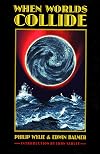
I probably should have written this review three weeks ago when I actually finished this When Worlds Collide/After Worlds Collide omnibus. But I went on tvtropes.org to see how influential the Worlds Collide series actually was, and I've only just managed to escape.
The summary of my findings is… oh God, I don't remember. I ended up somewhere between an Eldritch Abomination and a face full of alien wing-wong and completely lost track of whatever I read at the start. Oh well, I'll just blag show more it and hope no one notices.
When Worlds Collide is one of those stories that it's easy to feel like you've read before. The basic plot is that Earth is doomed and the best solution seems to be hopping in a spaceship and fleeing. Echoes of this can be found everywhere from Superman through to much more recent science fiction, like Stephen Baxter's [b:Flood|2111634|Flood (Flood, #1)|Stephen Baxter|http://d.gr-assets.com/books/1347366300s/2111634.jpg|2117042]/[b:Ark|2111628|Ark (Flood, #2)|Stephen Baxter|http://d.gr-assets.com/books/1347369559s/2111628.jpg|2117036] series. But tropes and clichés have to start somewhere, and many of these disaster story ones started here.
The novels' age may shield them from accusations of clichédom, but it raises another inevitable problem. They were written in the early 1930s, and they often show their age. Both stories edge uncomfortably close to if not racism then at least lazy stereotypes of non-American nationalities. Moreover, depending on how much you read into it, the attitude to women in the stories is either occasionally cringeworthy or downright sexist. But as with all stories from the past it's worth remembering that they simply reflect the cultural norms of the time. Those norms may be unpalatable these days, but as George Santayana famously put it: “Those who cannot remember the past should pick up and old book now and then and be jolly thankful that the world has moved on.”
Once you've adjusted your mental blinkers to deal with the dated elements of the story, it's quite the romp. Sure, the characters have a disarming tendency to launch into page- if not chapter-long soliloquies about this, that, or the other. But so what? Shakespeare did that all the time and nobody says “Gosh, that Shakespeare! His plays are okay, I guess, but there's just so much talking.” The first of the two stories is definitely the stronger, dealing as it does with the worryingly realistic reaction of mankind to news of its impending doom, and the tale of some heroic scientists who struggle to survive. Obviously at least some of them do survive, otherwise there wouldn't be a sequel.
I found the second story, After Worlds Collide, more interesting for what it sets out to do than the story itself, which is somewhat more lacklustre that its antecedent, and hasn't aged nearly as well (some long dead aliens are deduced to be super-advanced because they had… really smooth roads. And steam powered cars that could do 200mph. Wow.). Think back to your favourite disaster novel or film, be it one where Earth and Earthmen survive the disaster (say [b:Lucifer's Hammer|10431656|Lucifer's Hammer|Larry Niven|http://d.gr-assets.com/books/1297373905s/10431656.jpg|1842237] or 2012) or one where the species has to flee (say [b:Moonseed|1866449|Moonseed|Stephen Baxter|http://d.gr-assets.com/books/1348796298s/1866449.jpg|2117020], where the Moon represents our ultimate sanctuary). And then ask the question that my nephew would ask, if he was born yet and could talk: What happens next? This question is usually either glossed over or given a few pages/minutes in the denouement. A vague feeling of “Hey, we survived! Now let's rebuild society and make it better!” is generally given, and that's your lot. Wylie and Balmer do do this at the end of When Worlds Collide, but they also drop enough tantalising questions to warrant a second part to the adventure. Unfortunately the second adventure feels a whole lot more directionless than the obviously very focussed first one. The characters essentially amble around for a hundred and eighty pages finding out a few things here and there. And then its like the authors got bored so, with a couple of pages to go, they wrap up the book's conflict and everyone lives happily ever after the end.
The blink-and-you-miss-it ending to the duology is a bit of an anti-climax given the enormity of some of the ideas present. But if you want to read tales of cataclysm on a planetary scale then you really shouldn't be starting anywhere else.
--
As a side note, When Worlds Collide features a rather lovely gaffe about half way through. Two planets are heading towards Earth, a huge gas giant called Bronson Alpha and a small rocky planet called Bronson Beta. As they approach they become visible in the night sky. At one point, trying to convey a sense of scale, it is said that the gas giant Alpha is as large in the sky as the sun is during the day, while the smaller one, Beta, is only as big as a full moon. My brain accepted this for a few lines then suddenly caught up with the absurdity of it. I'll let you figure it out too. show less
The summary of my findings is… oh God, I don't remember. I ended up somewhere between an Eldritch Abomination and a face full of alien wing-wong and completely lost track of whatever I read at the start. Oh well, I'll just blag show more it and hope no one notices.
When Worlds Collide is one of those stories that it's easy to feel like you've read before. The basic plot is that Earth is doomed and the best solution seems to be hopping in a spaceship and fleeing. Echoes of this can be found everywhere from Superman through to much more recent science fiction, like Stephen Baxter's [b:Flood|2111634|Flood (Flood, #1)|Stephen Baxter|http://d.gr-assets.com/books/1347366300s/2111634.jpg|2117042]/[b:Ark|2111628|Ark (Flood, #2)|Stephen Baxter|http://d.gr-assets.com/books/1347369559s/2111628.jpg|2117036] series. But tropes and clichés have to start somewhere, and many of these disaster story ones started here.
The novels' age may shield them from accusations of clichédom, but it raises another inevitable problem. They were written in the early 1930s, and they often show their age. Both stories edge uncomfortably close to if not racism then at least lazy stereotypes of non-American nationalities. Moreover, depending on how much you read into it, the attitude to women in the stories is either occasionally cringeworthy or downright sexist. But as with all stories from the past it's worth remembering that they simply reflect the cultural norms of the time. Those norms may be unpalatable these days, but as George Santayana famously put it: “Those who cannot remember the past should pick up and old book now and then and be jolly thankful that the world has moved on.”
Once you've adjusted your mental blinkers to deal with the dated elements of the story, it's quite the romp. Sure, the characters have a disarming tendency to launch into page- if not chapter-long soliloquies about this, that, or the other. But so what? Shakespeare did that all the time and nobody says “Gosh, that Shakespeare! His plays are okay, I guess, but there's just so much talking.” The first of the two stories is definitely the stronger, dealing as it does with the worryingly realistic reaction of mankind to news of its impending doom, and the tale of some heroic scientists who struggle to survive. Obviously at least some of them do survive, otherwise there wouldn't be a sequel.
I found the second story, After Worlds Collide, more interesting for what it sets out to do than the story itself, which is somewhat more lacklustre that its antecedent, and hasn't aged nearly as well (some long dead aliens are deduced to be super-advanced because they had… really smooth roads. And steam powered cars that could do 200mph. Wow.). Think back to your favourite disaster novel or film, be it one where Earth and Earthmen survive the disaster (say [b:Lucifer's Hammer|10431656|Lucifer's Hammer|Larry Niven|http://d.gr-assets.com/books/1297373905s/10431656.jpg|1842237] or 2012) or one where the species has to flee (say [b:Moonseed|1866449|Moonseed|Stephen Baxter|http://d.gr-assets.com/books/1348796298s/1866449.jpg|2117020], where the Moon represents our ultimate sanctuary). And then ask the question that my nephew would ask, if he was born yet and could talk: What happens next? This question is usually either glossed over or given a few pages/minutes in the denouement. A vague feeling of “Hey, we survived! Now let's rebuild society and make it better!” is generally given, and that's your lot. Wylie and Balmer do do this at the end of When Worlds Collide, but they also drop enough tantalising questions to warrant a second part to the adventure. Unfortunately the second adventure feels a whole lot more directionless than the obviously very focussed first one. The characters essentially amble around for a hundred and eighty pages finding out a few things here and there. And then its like the authors got bored so, with a couple of pages to go, they wrap up the book's conflict and everyone lives happily ever after the end.
The blink-and-you-miss-it ending to the duology is a bit of an anti-climax given the enormity of some of the ideas present. But if you want to read tales of cataclysm on a planetary scale then you really shouldn't be starting anywhere else.
--
As a side note, When Worlds Collide features a rather lovely gaffe about half way through. Two planets are heading towards Earth, a huge gas giant called Bronson Alpha and a small rocky planet called Bronson Beta. As they approach they become visible in the night sky. At one point, trying to convey a sense of scale, it is said that the gas giant Alpha is as large in the sky as the sun is during the day, while the smaller one, Beta, is only as big as a full moon. My brain accepted this for a few lines then suddenly caught up with the absurdity of it. I'll let you figure it out too. show less
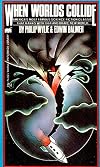
This is classic 1930's science fiction. When Worlds Collide is a ripping yarn in which two wayward planets (Bronson Alpha and Bronson Beta: one a destroyer, one a savior) approach us from deep space: one on a path to destroy Earth, the other a potential haven for the survival of the human race if The League of The Last Days can build a nuclear powered Space Ship, stave off a mob of attacking marauders, and successfully navigate the ship to this "new" earth. As usual, the book is far superior show more to the 1951 film version whose plot is completely stripped down and simplified.
If you can wade through some stilted oratory dialogue and some painful expository dialogue, there's much to enjoy here in both the fast-paced story and in Philip Wylie's writing style. Some cool, evocative phrases like "The Bronson Bodies rose in frightful majesty."... The jaw-dropping descriptions of the horrific cataclysms that befall earth ... And the awe-inspiring description of the sky and celestial beauty of Bronson Beta. show less
If you can wade through some stilted oratory dialogue and some painful expository dialogue, there's much to enjoy here in both the fast-paced story and in Philip Wylie's writing style. Some cool, evocative phrases like "The Bronson Bodies rose in frightful majesty."... The jaw-dropping descriptions of the horrific cataclysms that befall earth ... And the awe-inspiring description of the sky and celestial beauty of Bronson Beta. show less

Number 4 in the list of 50 essential science fiction books and the first American entry, which turns out to be a cracker. We are in the world of pulp fiction, where the story line carries all before it. It is co authored and I suspect that Edwin Balmer was the ideas man and if so he certainly came up with a good one here.
Two rogue planets: Bronson alpha and Bronson Beta are hurtling towards the solar system; they have been tracked by the scientific community, who have formed a league of the show more last days. When news is released to the public it is predicted that Bronson Alpha will collide with the earth, so causing it's destruction, however as a twist to this end of world scenario, 7 months before the collision the two planets will pass so close to the earth that there will be cataclysmic changes to the surface of our world and most of the population will not survive this first "passing." The League of the last days have formed their own community of brilliant scientists who under the leadership of Dr Hendron plan a daring venture to build a space ship to leave earth and settle on Bronson Beta The community must first survive the initial passing of the planets, must get a nuclear powered spaceship built and fight of the marauding groups of fellow survivors before any attempt is made to land on Bronson Alpha. Many of the classic elements of sci-fi are here: scientific discoveries, space travel, dystopia, end of this world and a new beginning,
Written in 1932 this novel is very much of it's time; it is the scientists who will save humanity and they are all white Caucasian males, Some women will assist the scientists, but their main function is domestic arrangements and later breeding stock, A couple of alpha males are in respectful competition for the prettiest most intelligent woman and it is America who will lead the way. The prose can be a bit stilted at times and some of the conversations seem to come from 1930's Hollywood movies, but if you can read past the dated feel to the text then there is much to enjoy here. There is genuine suspense, there is also a brilliant description of a closed community fighting for survival. The dystopia after the first passing has a certain realism but also a sense of wonder that you find in the very best science fiction. The psychology of a group fighting to keep a civilization in the face of savagery is a key theme as is thoughts on a new community and new beginnings.
For me the book had the feel of an exciting science fiction yarn, something that I would certainly have enjoyed as a teenager and reading it today it still had much to offer. At times it had the power to stir the imagination and it was certainly a page turner, although I had to be careful turning the pages of my 1975 paperback copy lest the book might disintegrate. I can understand why the book has it's classic (Sci-fi classic that is) status. I am tempted to dip into other books by Philip Wylie and I rate this novel at 4 stars. show less
Two rogue planets: Bronson alpha and Bronson Beta are hurtling towards the solar system; they have been tracked by the scientific community, who have formed a league of the show more last days. When news is released to the public it is predicted that Bronson Alpha will collide with the earth, so causing it's destruction, however as a twist to this end of world scenario, 7 months before the collision the two planets will pass so close to the earth that there will be cataclysmic changes to the surface of our world and most of the population will not survive this first "passing." The League of the last days have formed their own community of brilliant scientists who under the leadership of Dr Hendron plan a daring venture to build a space ship to leave earth and settle on Bronson Beta The community must first survive the initial passing of the planets, must get a nuclear powered spaceship built and fight of the marauding groups of fellow survivors before any attempt is made to land on Bronson Alpha. Many of the classic elements of sci-fi are here: scientific discoveries, space travel, dystopia, end of this world and a new beginning,
Written in 1932 this novel is very much of it's time; it is the scientists who will save humanity and they are all white Caucasian males, Some women will assist the scientists, but their main function is domestic arrangements and later breeding stock, A couple of alpha males are in respectful competition for the prettiest most intelligent woman and it is America who will lead the way. The prose can be a bit stilted at times and some of the conversations seem to come from 1930's Hollywood movies, but if you can read past the dated feel to the text then there is much to enjoy here. There is genuine suspense, there is also a brilliant description of a closed community fighting for survival. The dystopia after the first passing has a certain realism but also a sense of wonder that you find in the very best science fiction. The psychology of a group fighting to keep a civilization in the face of savagery is a key theme as is thoughts on a new community and new beginnings.
For me the book had the feel of an exciting science fiction yarn, something that I would certainly have enjoyed as a teenager and reading it today it still had much to offer. At times it had the power to stir the imagination and it was certainly a page turner, although I had to be careful turning the pages of my 1975 paperback copy lest the book might disintegrate. I can understand why the book has it's classic (Sci-fi classic that is) status. I am tempted to dip into other books by Philip Wylie and I rate this novel at 4 stars. show less
I probably should have written this review three weeks ago when I actually finished this When Worlds Collide/After Worlds Collide omnibus. But I went on tvtropes.org to see how influential the Worlds Collide series actually was, and I've only just managed to escape.
The summary of my findings is… oh God, I don't remember. I ended up somewhere between an Eldritch Abomination and a face full of alien wing-wong and completely lost track of whatever I read at the start. Oh well, I'll just blag show more it and hope no one notices.
When Worlds Collide is one of those stories that it's easy to feel like you've read before. The basic plot is that Earth is doomed and the best solution seems to be hopping in a spaceship and fleeing. Echoes of this can be found everywhere from Superman through to much more recent science fiction, like Stephen Baxter's [b:Flood|2111634|Flood (Flood, #1)|Stephen Baxter|http://d.gr-assets.com/books/1347366300s/2111634.jpg|2117042]/[b:Ark|2111628|Ark (Flood, #2)|Stephen Baxter|http://d.gr-assets.com/books/1347369559s/2111628.jpg|2117036] series. But tropes and clichés have to start somewhere, and many of these disaster story ones started here.
The novels' age may shield them from accusations of clichédom, but it raises another inevitable problem. They were written in the early 1930s, and they often show their age. Both stories edge uncomfortably close to if not racism then at least lazy stereotypes of non-American nationalities. Moreover, depending on how much you read into it, the attitude to women in the stories is either occasionally cringeworthy or downright sexist. But as with all stories from the past it's worth remembering that they simply reflect the cultural norms of the time. Those norms may be unpalatable these days, but as George Santayana famously put it: “Those who cannot remember the past should pick up and old book now and then and be jolly thankful that the world has moved on.”
Once you've adjusted your mental blinkers to deal with the dated elements of the story, it's quite the romp. Sure, the characters have a disarming tendency to launch into page- if not chapter-long soliloquies about this, that, or the other. But so what? Shakespeare did that all the time and nobody says “Gosh, that Shakespeare! His plays are okay, I guess, but there's just so much talking.” The first of the two stories is definitely the stronger, dealing as it does with the worryingly realistic reaction of mankind to news of its impending doom, and the tale of some heroic scientists who struggle to survive. Obviously at least some of them do survive, otherwise there wouldn't be a sequel.
I found the second story, After Worlds Collide, more interesting for what it sets out to do than the story itself, which is somewhat more lacklustre that its antecedent, and hasn't aged nearly as well (some long dead aliens are deduced to be super-advanced because they had… really smooth roads. And steam powered cars that could do 200mph. Wow.). Think back to your favourite disaster novel or film, be it one where Earth and Earthmen survive the disaster (say [b:Lucifer's Hammer|10431656|Lucifer's Hammer|Larry Niven|http://d.gr-assets.com/books/1297373905s/10431656.jpg|1842237] or 2012) or one where the species has to flee (say [b:Moonseed|1866449|Moonseed|Stephen Baxter|http://d.gr-assets.com/books/1348796298s/1866449.jpg|2117020], where the Moon represents our ultimate sanctuary). And then ask the question that my nephew would ask, if he was born yet and could talk: What happens next? This question is usually either glossed over or given a few pages/minutes in the denouement. A vague feeling of “Hey, we survived! Now let's rebuild society and make it better!” is generally given, and that's your lot. Wylie and Balmer do do this at the end of When Worlds Collide, but they also drop enough tantalising questions to warrant a second part to the adventure. Unfortunately the second adventure feels a whole lot more directionless than the obviously very focussed first one. The characters essentially amble around for a hundred and eighty pages finding out a few things here and there. And then its like the authors got bored so, with a couple of pages to go, they wrap up the book's conflict and everyone lives happily ever after the end.
The blink-and-you-miss-it ending to the duology is a bit of an anti-climax given the enormity of some of the ideas present. But if you want to read tales of cataclysm on a planetary scale then you really shouldn't be starting anywhere else.
--
As a side note, When Worlds Collide features a rather lovely gaffe about half way through. Two planets are heading towards Earth, a huge gas giant called Bronson Alpha and a small rocky planet called Bronson Beta. As they approach they become visible in the night sky. At one point, trying to convey a sense of scale, it is said that the gas giant Alpha is as large in the sky as the sun is during the day, while the smaller one, Beta, is only as big as a full moon. My brain accepted this for a few lines then suddenly caught up with the absurdity of it. I'll let you figure it out too. show less
The summary of my findings is… oh God, I don't remember. I ended up somewhere between an Eldritch Abomination and a face full of alien wing-wong and completely lost track of whatever I read at the start. Oh well, I'll just blag show more it and hope no one notices.
When Worlds Collide is one of those stories that it's easy to feel like you've read before. The basic plot is that Earth is doomed and the best solution seems to be hopping in a spaceship and fleeing. Echoes of this can be found everywhere from Superman through to much more recent science fiction, like Stephen Baxter's [b:Flood|2111634|Flood (Flood, #1)|Stephen Baxter|http://d.gr-assets.com/books/1347366300s/2111634.jpg|2117042]/[b:Ark|2111628|Ark (Flood, #2)|Stephen Baxter|http://d.gr-assets.com/books/1347369559s/2111628.jpg|2117036] series. But tropes and clichés have to start somewhere, and many of these disaster story ones started here.
The novels' age may shield them from accusations of clichédom, but it raises another inevitable problem. They were written in the early 1930s, and they often show their age. Both stories edge uncomfortably close to if not racism then at least lazy stereotypes of non-American nationalities. Moreover, depending on how much you read into it, the attitude to women in the stories is either occasionally cringeworthy or downright sexist. But as with all stories from the past it's worth remembering that they simply reflect the cultural norms of the time. Those norms may be unpalatable these days, but as George Santayana famously put it: “Those who cannot remember the past should pick up and old book now and then and be jolly thankful that the world has moved on.”
Once you've adjusted your mental blinkers to deal with the dated elements of the story, it's quite the romp. Sure, the characters have a disarming tendency to launch into page- if not chapter-long soliloquies about this, that, or the other. But so what? Shakespeare did that all the time and nobody says “Gosh, that Shakespeare! His plays are okay, I guess, but there's just so much talking.” The first of the two stories is definitely the stronger, dealing as it does with the worryingly realistic reaction of mankind to news of its impending doom, and the tale of some heroic scientists who struggle to survive. Obviously at least some of them do survive, otherwise there wouldn't be a sequel.
I found the second story, After Worlds Collide, more interesting for what it sets out to do than the story itself, which is somewhat more lacklustre that its antecedent, and hasn't aged nearly as well (some long dead aliens are deduced to be super-advanced because they had… really smooth roads. And steam powered cars that could do 200mph. Wow.). Think back to your favourite disaster novel or film, be it one where Earth and Earthmen survive the disaster (say [b:Lucifer's Hammer|10431656|Lucifer's Hammer|Larry Niven|http://d.gr-assets.com/books/1297373905s/10431656.jpg|1842237] or 2012) or one where the species has to flee (say [b:Moonseed|1866449|Moonseed|Stephen Baxter|http://d.gr-assets.com/books/1348796298s/1866449.jpg|2117020], where the Moon represents our ultimate sanctuary). And then ask the question that my nephew would ask, if he was born yet and could talk: What happens next? This question is usually either glossed over or given a few pages/minutes in the denouement. A vague feeling of “Hey, we survived! Now let's rebuild society and make it better!” is generally given, and that's your lot. Wylie and Balmer do do this at the end of When Worlds Collide, but they also drop enough tantalising questions to warrant a second part to the adventure. Unfortunately the second adventure feels a whole lot more directionless than the obviously very focussed first one. The characters essentially amble around for a hundred and eighty pages finding out a few things here and there. And then its like the authors got bored so, with a couple of pages to go, they wrap up the book's conflict and everyone lives happily ever after the end.
The blink-and-you-miss-it ending to the duology is a bit of an anti-climax given the enormity of some of the ideas present. But if you want to read tales of cataclysm on a planetary scale then you really shouldn't be starting anywhere else.
--
As a side note, When Worlds Collide features a rather lovely gaffe about half way through. Two planets are heading towards Earth, a huge gas giant called Bronson Alpha and a small rocky planet called Bronson Beta. As they approach they become visible in the night sky. At one point, trying to convey a sense of scale, it is said that the gas giant Alpha is as large in the sky as the sun is during the day, while the smaller one, Beta, is only as big as a full moon. My brain accepted this for a few lines then suddenly caught up with the absurdity of it. I'll let you figure it out too. show less
Lists
Awards


You May Also Like
Associated Authors
Statistics
- Works
- 24
- Also by
- 5
- Members
- 1,318
- Popularity
- #19,501
- Rating
- 3.7
- Reviews
- 37
- ISBNs
- 51
- Languages
- 2