

James Lipton (1926–2020)
Author of An Exaltation of Larks
About the Author
Image credit: Photo by David Shankbone, 2007 (Wikimedia Commons)
Works by James Lipton
Associated Works
Tagged
Common Knowledge
- Legal name
- Lipton, Louis James (birth)
- Birthdate
- 1926-09-19
- Date of death
- 2020-03-02
- Gender
- male
- Relationships
- Lipton, Lawrence (father)
Foch, Nina (first wife) - Nationality
- USA
- Birthplace
- Detroit, Michigan, USA
- Place of death
- Manhattan, New York, USA
- Associated Place (for map)
- USA
Members
Reviews
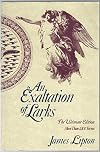
The premise of “An Exaltation of Larks” is simple: in the 1960s,James Lipton researched (among other books) Dame Juliana’s 1486 treatise “The Book of St. Albans,” which listed medieval “terms of venery,” meaning the imaginative way to which various hunted creatures were referred: a murmuration of starlings, for example, or a paddling of ducks. He then proceeded to find or create distinctive terms for other categories, particularly of humans, such as a failing of students, a show more glaze of tourists, a scoop of reporters and my personal favourite, a trip of hippies (which he labels as “archaic” in this 1991 edition). This game of naming goes way back (he cites “a cloud of witnesses” in the bible), and he invites readers to play the game themselves, even devoting a few pages to “rules” for various such games. What makes this book so very delightful, however, are the illustrations by Kedakai Lipton, based on the work of a 19th Century French lithographer named Grandville; they just soar off the page. An excellent book for browsing, and admiring the endless poetic possibilities of the English language; highly recommended! show less

An exaltation of larks, or, The venereal game by James Lipton is presented as a book of poetry, which is really a bit of a misnomer. The book is much more like a poorly executed dictionary.
Language itself is poetic, and the author introduces the reader to a class of nouns known as "collective nouns", also referred to as "nouns of assembly" or "terms of venery", hence the title, The venereal game. The "nouns of assembly" are words for groups of animals originating from the English hunting show more tradition of the Late Middle Ages. The Book of Saint Albans compiled in 1486, lists 165 of such collective nouns.
James Lipton has divided An exaltation of larks, or, The venereal game into four parts: Part 1, collective nouns commonly known and still regularly used, Part 2, collective nouns known by well-educated people, but occasionally used, Part 3, collective nouns now rarely used and generally not known, and Part 4, new collective nouns invented by the author. In the introduction the author explains that his choice of terms in all three first parts of the book that his choices are fairly random, taken from the known sources. The very few terms of the author's own invention are not very imaginative or creative. They apply to animals and have been extended to "nouns of assembly" of groups of people, of which many examples can already be found in Book of Saint Albans.
Examples of "terms of venery" are:
A congregation of alligators.
A herd of asses.
A swarm of bees.
A troop of apes.
A flock of birds.
A pack of dogs.
A team of horses.
A pride of lions
A shoal of mackerel.
or less well known
A sounder of boars (12 or more !)
A bellowing of bullfinches.
A clowder of cats.
A drunkenship of cobblers.
A convocation of eagles.
A gaggle of geese. (on land)
A gaggle of geese. (in flight)
A charm of goldfinches.
An array of hedgehogs.
A bloat of hippopotamuses.
A fluther of jellyfish.
An exaltation of larks.
A superfluity of nuns.
A parliament of owls.
An ostentation of peacocks.
A bouquet of pheasants.
A bevy of quail.
A crash of rhinoceroses.
A bank of swans (on land)
A wedge of swans (in flight)
A lamentation of swans (fanciful)
Regarding the author's selection in the first three parts, he claims never to have aimed to present a complete collection, which given the limited scope of the total number of words would actually have been a more logical choice. The book is illustrated with wood cuts.
It seems An exaltation of larks, or, The venereal game could potentially be a very interesting book, more likely as a work of reference with poetical quality. However, the author did not realize that potential, and his creative contribution is limp and minimal. A missed chance, but still a very interesting book for lexicographers, albeit incomplete. show less
Language itself is poetic, and the author introduces the reader to a class of nouns known as "collective nouns", also referred to as "nouns of assembly" or "terms of venery", hence the title, The venereal game. The "nouns of assembly" are words for groups of animals originating from the English hunting show more tradition of the Late Middle Ages. The Book of Saint Albans compiled in 1486, lists 165 of such collective nouns.
James Lipton has divided An exaltation of larks, or, The venereal game into four parts: Part 1, collective nouns commonly known and still regularly used, Part 2, collective nouns known by well-educated people, but occasionally used, Part 3, collective nouns now rarely used and generally not known, and Part 4, new collective nouns invented by the author. In the introduction the author explains that his choice of terms in all three first parts of the book that his choices are fairly random, taken from the known sources. The very few terms of the author's own invention are not very imaginative or creative. They apply to animals and have been extended to "nouns of assembly" of groups of people, of which many examples can already be found in Book of Saint Albans.
Examples of "terms of venery" are:
A congregation of alligators.
A herd of asses.
A swarm of bees.
A troop of apes.
A flock of birds.
A pack of dogs.
A team of horses.
A pride of lions
A shoal of mackerel.
or less well known
A sounder of boars (12 or more !)
A bellowing of bullfinches.
A clowder of cats.
A drunkenship of cobblers.
A convocation of eagles.
A gaggle of geese. (on land)
A gaggle of geese. (in flight)
A charm of goldfinches.
An array of hedgehogs.
A bloat of hippopotamuses.
A fluther of jellyfish.
An exaltation of larks.
A superfluity of nuns.
A parliament of owls.
An ostentation of peacocks.
A bouquet of pheasants.
A bevy of quail.
A crash of rhinoceroses.
A bank of swans (on land)
A wedge of swans (in flight)
A lamentation of swans (fanciful)
Regarding the author's selection in the first three parts, he claims never to have aimed to present a complete collection, which given the limited scope of the total number of words would actually have been a more logical choice. The book is illustrated with wood cuts.
It seems An exaltation of larks, or, The venereal game could potentially be a very interesting book, more likely as a work of reference with poetical quality. However, the author did not realize that potential, and his creative contribution is limp and minimal. A missed chance, but still a very interesting book for lexicographers, albeit incomplete. show less

An Exaltation of Larks is “the ultimate edition” as it claims, of terms of venery, or as perhaps more commonly known, collective nouns. Many people know a “pride of lions” or a “murder of crows” but there are hundreds of such terms, and most of them have been used since the fifteenth century. Unfortunately, they are not used so much anymore, which is a shame, because they are such fun. And while many of them refer to groups of animals, that is not their only use. Clever show more descriptions of groups of people include “a wince of dentists,” “a pack of smokers” and “a stud of poker players.” As Lipton points out, origins of terms of venery can be divided into six “families” which he lists as:
Onomatopoeia (example: a gaggle of geese)
Characteristic (example: a leap of leopards)
Appearance (example: a knot of toads)
Habitat (example: a shoal of bass)
Comment (example: a richness of martens)
Error (i.e., an incorrect transcription preserved in corrupted form) (example: a school of fish, originally “shoal”)
It is an endlessly entertaining subject (to me, at any rate), and Lipton has done an admirable job not only listing the terms, but reporting on the derivation when he knows it, and including humorous illustrations and a detailed index. His chapters are divided into subject matters such as “Sports,” “Music” “Religion” “Politics & Law” and so on.
Evaluation: This delightful book is a wonderful reference to have on hand. If you’re looking for a wonderful and memorable holiday gift, I highly recommend this book. show less
Onomatopoeia (example: a gaggle of geese)
Characteristic (example: a leap of leopards)
Appearance (example: a knot of toads)
Habitat (example: a shoal of bass)
Comment (example: a richness of martens)
Error (i.e., an incorrect transcription preserved in corrupted form) (example: a school of fish, originally “shoal”)
It is an endlessly entertaining subject (to me, at any rate), and Lipton has done an admirable job not only listing the terms, but reporting on the derivation when he knows it, and including humorous illustrations and a detailed index. His chapters are divided into subject matters such as “Sports,” “Music” “Religion” “Politics & Law” and so on.
Evaluation: This delightful book is a wonderful reference to have on hand. If you’re looking for a wonderful and memorable holiday gift, I highly recommend this book. show less
Grabbed this book because years ago I had a couple of excellent books on the origin of phrases. I believe one was called "Horsefeathers". It was fascinating because it was filled with historical phrases I'd always wondered about.
This is not such a book. Interesting, but filled with neologisms that are the author's own and therefore cast the collection into doubt. If it were EITHER fish or fowl, it would be fine, but mixing historical phrases with newly made up ones just confuses me and makes show more me cranky.
Funny by turns but wish I'd got it out of the library. show less
This is not such a book. Interesting, but filled with neologisms that are the author's own and therefore cast the collection into doubt. If it were EITHER fish or fowl, it would be fine, but mixing historical phrases with newly made up ones just confuses me and makes show more me cranky.
Funny by turns but wish I'd got it out of the library. show less
You May Also Like


Associated Authors
Statistics
- Works
- 17
- Also by
- 2
- Members
- 1,407
- Popularity
- #18,263
- Rating
- 3.7
- Reviews
- 21
- ISBNs
- 18
- Favorited
- 1