
About the Author
Works by Duo Dickinson
The House You Build: Making Real-World Choices to Get the Home You Want (American Institute Architects) (2004) 50 copies, 1 review
House on a Budget: Making Smart Choices to Build the Home You Want (American Institute Architects) (2007) 19 copies
Tagged
Common Knowledge
- Places of residence
- Madison, Connecticut, USA
- Associated Place (for map)
- Connecticut, USA
Members
Reviews

This book looked me dead in the eyes and tried to convince me that a 5000 square foot estate with a pool and 4 bedrooms is a small house. Might as well be titled What Rich People Think Are Small Houses for the Next Century
Sorry to Duo Dickinson if you're reading this, but maybe try to be a little more like Lester Walker
Sorry to Duo Dickinson if you're reading this, but maybe try to be a little more like Lester Walker

adult nonfiction; home renovations. Unlike other books I've seen, this one provides a hefty amount of perspective when considering how your vision will hold up over time (as trends come and go) and lots of helpful advice on a wide variety of topics. It stresses using what you've got (existing walls and structures, and especially in preserving the style of the home) for the least costly renovation work, but also provides lots of inspiration if you want more. I'm not about to rip into any show more walls or anything, but I found it all extremely interesting. show less
The House You Build: Making Real-World Choices to Get the Home You Want (American Institute Architects) by Duo Dickinson
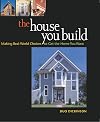
Dickenson wants to teach the reader how to get a high quality custom built home at an affordable price (affordable != cheap). Dickenson dicussed the principles behind 19 affordable custom homes. I list a lot of the tips below, but the thing to remember while reading the specifics is that the houses that used these tips were still great houses. The owners were saving money without giving up the dream of a high quality, custom home.
Although I had read most of the tips before (e.g., stack show more rooms with plumbing and put them back to back and the same floor, curves are expensive), it was refreshing having a book which made a point of focusing on reasonable homes rather than the high end magazine spread homes that so many books seem to feature.
Overall, this was a good refreshing book but not revolutionary given the background I already had.
-----
More notes from the Dickenson book: ('Light and line' and 'Art in the woods' chapters have some inspiring pictures.) Some principles Dickenson gives for building a custom house on a budget:
- Use standard materials creatively: Mass-produced materials are cheaper than custom materials (e.g., dimensional lumber, plywood, drywall). Standard usage of these materials can produce bland homes, but creatively used they can give an effect that defies their cost (e.g., artful grouping of stock windows). You may also be able to save money with standard commercial materials.
- Shrink to fit: A custom built home can be smaller than a spec home because its spaces are tailored to your means (this point is essentially Susanka's book in a nutshell).
- Don't fight the site: Adapt your house plan to the site rather than trying to impose a plan on a site where it may not fit comfortably. This will save money and result in a home that looks more like it belongs on the site.
- Defer and save, build in phases: Instead of building all at once, plan for later expansions. It is much cheaper to set up plumbing and electrical for future hookups, leave space for future doorways in the initial frame, and do other prep work for expansion than it is to try to put those things in later. Leaving some spaces unbuilt or unfinished can save money while building, and you can make it easy to expand later.
- Keep your floor plan simple: Straight lines, 90 degree angles, and rectangular foundations are easier to build.
- Celebrate raw structure: instead of hiding it under drywall or trim. Obviously, there is a trade-off here between the savings and aesthetics of exposed structure and things like insulation for heat retention and sound damping.
- Change the house if changing the site is expensive: E.g., if orienting the house square to the street would require expensive work like rock blasting, try angling it to avoid that expense.
- Spend money where the eye goes: E.g., instead of a curved staircase, make it so that the bottom few stairs flairs out in a curve. Spend extra for expensive materials at the entry. You can get a lot of the effect without the full cost. As a corollary, you can use cheaper when they aren't as visible (e.g., higher off the ground).
- Prioritize: What do you need? What can you leave out? What can you add later?
- Take time: Take the time to plan. Look for ways to reduce space, arrange the house in a more efficient way, and make cost/benefit trade-offs in choices like materials. Once construction starts, time is money, but spending more time in the planning stage can save money.
- Stack up: The foundation is one of the most expensive parts of the home. It's much cheaper to build up than out.
- Take charge, spending time to save money: This is a risky strategy, but if you have the time and expertise, you can take on the role of the general contractor for you home.
Self explanatory hints
- Stock fireplaces in custom cladding can make a dramatic statement.
- Closed stairs are cheaper than open stairs.
- Stack and group plumbing.
- If you have curved walls, don't make them load bearing.
- Keep your styling simple. show less
Although I had read most of the tips before (e.g., stack show more rooms with plumbing and put them back to back and the same floor, curves are expensive), it was refreshing having a book which made a point of focusing on reasonable homes rather than the high end magazine spread homes that so many books seem to feature.
Overall, this was a good refreshing book but not revolutionary given the background I already had.
-----
More notes from the Dickenson book: ('Light and line' and 'Art in the woods' chapters have some inspiring pictures.) Some principles Dickenson gives for building a custom house on a budget:
- Use standard materials creatively: Mass-produced materials are cheaper than custom materials (e.g., dimensional lumber, plywood, drywall). Standard usage of these materials can produce bland homes, but creatively used they can give an effect that defies their cost (e.g., artful grouping of stock windows). You may also be able to save money with standard commercial materials.
- Shrink to fit: A custom built home can be smaller than a spec home because its spaces are tailored to your means (this point is essentially Susanka's book in a nutshell).
- Don't fight the site: Adapt your house plan to the site rather than trying to impose a plan on a site where it may not fit comfortably. This will save money and result in a home that looks more like it belongs on the site.
- Defer and save, build in phases: Instead of building all at once, plan for later expansions. It is much cheaper to set up plumbing and electrical for future hookups, leave space for future doorways in the initial frame, and do other prep work for expansion than it is to try to put those things in later. Leaving some spaces unbuilt or unfinished can save money while building, and you can make it easy to expand later.
- Keep your floor plan simple: Straight lines, 90 degree angles, and rectangular foundations are easier to build.
- Celebrate raw structure: instead of hiding it under drywall or trim. Obviously, there is a trade-off here between the savings and aesthetics of exposed structure and things like insulation for heat retention and sound damping.
- Change the house if changing the site is expensive: E.g., if orienting the house square to the street would require expensive work like rock blasting, try angling it to avoid that expense.
- Spend money where the eye goes: E.g., instead of a curved staircase, make it so that the bottom few stairs flairs out in a curve. Spend extra for expensive materials at the entry. You can get a lot of the effect without the full cost. As a corollary, you can use cheaper when they aren't as visible (e.g., higher off the ground).
- Prioritize: What do you need? What can you leave out? What can you add later?
- Take time: Take the time to plan. Look for ways to reduce space, arrange the house in a more efficient way, and make cost/benefit trade-offs in choices like materials. Once construction starts, time is money, but spending more time in the planning stage can save money.
- Stack up: The foundation is one of the most expensive parts of the home. It's much cheaper to build up than out.
- Take charge, spending time to save money: This is a risky strategy, but if you have the time and expertise, you can take on the role of the general contractor for you home.
Self explanatory hints
- Stock fireplaces in custom cladding can make a dramatic statement.
- Closed stairs are cheaper than open stairs.
- Stack and group plumbing.
- If you have curved walls, don't make them load bearing.
- Keep your styling simple. show less
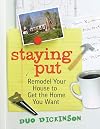
4 stars/Non-Fiction; Home Improvement
This new book by Architect-Author Duo Dickinson called Staying Put could not have been released at a better time. In the current economy, fewer people seem to be relocating than in years past. This book is a great resource for do-it-yourself homeowners everywhere.
Packed with creative ideas and full color before and after photos, Staying Put introduces homeowners to a variety of options for re-creating their space to better fit their current need rather show more than the expense of moving to a new home. Divided into sections that concentrate on different rooms, Dickinson asks specific questions to help the reader better identify not only what they want, but exactly what they need.
Looking at this book, I would categorize it as inspirational home improvement. Simply because while there many great ideas presented and the imagery inspiring, there is no actual building plans or measurements given for any of the projects featured. If you are looking to re-do a space in your home or are just seeking fresh ideas, Staying Put is a great place to start.
Recommended. show less
This new book by Architect-Author Duo Dickinson called Staying Put could not have been released at a better time. In the current economy, fewer people seem to be relocating than in years past. This book is a great resource for do-it-yourself homeowners everywhere.
Packed with creative ideas and full color before and after photos, Staying Put introduces homeowners to a variety of options for re-creating their space to better fit their current need rather show more than the expense of moving to a new home. Divided into sections that concentrate on different rooms, Dickinson asks specific questions to help the reader better identify not only what they want, but exactly what they need.
Looking at this book, I would categorize it as inspirational home improvement. Simply because while there many great ideas presented and the imagery inspiring, there is no actual building plans or measurements given for any of the projects featured. If you are looking to re-do a space in your home or are just seeking fresh ideas, Staying Put is a great place to start.
Recommended. show less
Awards

You May Also Like
Associated Authors
Statistics
- Works
- 9
- Members
- 171
- Popularity
- #124,898
- Rating
- 3.2
- Reviews
- 4
- ISBNs
- 11