
Ann McCallum
Author of Rabbits Rabbits Everywhere: A Fibonacci Tale
About the Author
Works by Ann McCallum
The Secret Life of Math: Discover How (and Why) Numbers Have Survived from the Cave Dwellers to Us! (2000) 45 copies, 2 reviews
Eat Your U.S. History Homework: Recipes for Revolutionary Minds (Eat Your Homework) (2015) 29 copies, 1 review
Eat Your Science Homework: Recipes for Inquiring Minds (Eat Your Homework) (2014) 27 copies, 4 reviews
A kid's multicultural math adventure : amazing activities to explore math's global roots! (2003) 1 copy
Language Arts 1 copy
Tagged
Common Knowledge
- Gender
- female
Members
Reviews
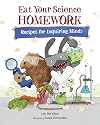
I have a whole bunch of little people around me who are opposed to science but not at all opposed to eating. This adorable book offers a remedy for that problem.
The author combines recipes with basic science information that explains science associated with making the food, in ways I certainly never anticipated. For example, take “Sedimentary Pizza Lasagna.” First the author defines the three basic categories of rocks, one of which is sedimentary. She explains that when the Sedimentary show more Pizza Lasagna bakes, the ingredients meld together to create a sediment. Then she illustrates how to rate the sediment using the Mohs Scale of Hardness. (Thank heavens I’m not cooking here; I’m sure I would earn a “ten” for some of my baking, and not as in “best” but in “hardest.” The first time I tried pecan pie comes to mind….)
Then there are the very exciting “Invisible Ink Snack Pockets.” You not only learn about how to make invisible ink, but you get to write secret messages on the top of each snack that will become visible at it bakes!
Ingredients are simple, the cooking instructions are very clear, and they indicate which parts might require the help of an adult (such as for lighting the oven).
At the end there is a “Science Review” and a glossary.
The adorable illustrations by Leeza Hernandez use animals for cooks, scientists, and tasters. There are fun details hidden in most pictures for those who play close attention.
Evaluation: This combo primer for both cooking and science should appeal to a wide range of ages. show less
The author combines recipes with basic science information that explains science associated with making the food, in ways I certainly never anticipated. For example, take “Sedimentary Pizza Lasagna.” First the author defines the three basic categories of rocks, one of which is sedimentary. She explains that when the Sedimentary show more Pizza Lasagna bakes, the ingredients meld together to create a sediment. Then she illustrates how to rate the sediment using the Mohs Scale of Hardness. (Thank heavens I’m not cooking here; I’m sure I would earn a “ten” for some of my baking, and not as in “best” but in “hardest.” The first time I tried pecan pie comes to mind….)
Then there are the very exciting “Invisible Ink Snack Pockets.” You not only learn about how to make invisible ink, but you get to write secret messages on the top of each snack that will become visible at it bakes!
Ingredients are simple, the cooking instructions are very clear, and they indicate which parts might require the help of an adult (such as for lighting the oven).
At the end there is a “Science Review” and a glossary.
The adorable illustrations by Leeza Hernandez use animals for cooks, scientists, and tasters. There are fun details hidden in most pictures for those who play close attention.
Evaluation: This combo primer for both cooking and science should appeal to a wide range of ages. show less
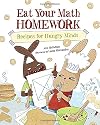
Oh I do like this series. After all, to start with, an algorithm and a recipe are the same thing! Even those folks who don't think they like math or numbers, even if they're all grown-up, would be able to have a lot of fun with this (assuming they carefully work through one chapter at a time, doing all the exercises).
The secret life of math : Discover how (and why) numbers have survived from the cave dwellers to us! by Ann McCallum
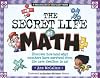
Retelling: The author takes you on a hands-on journey through time and place to solve the mystery of how math developed so similarly in civilizations with very little contact, from quipus in the middle east to the rapid calculating machines called abacus in ancient China. The writing has a very conversational, playful style. Activities and problems are scattered throughout the book.
Thoughts and Feelings: This book made me eager to try calculating in different ways. I wonder how many methods show more from ancient civilizations I could use to represent the same problem. I wonder if some of these methods gave practitioners a better conceptual understanding of mathematical problems than our calculator-driven community has today. I wonder if using the method the Egyptians used would make you think about a number's relationship to 60 and if the Inca method would make you think about their relationship to 40 and 400. show less
Thoughts and Feelings: This book made me eager to try calculating in different ways. I wonder how many methods show more from ancient civilizations I could use to represent the same problem. I wonder if some of these methods gave practitioners a better conceptual understanding of mathematical problems than our calculator-driven community has today. I wonder if using the method the Egyptians used would make you think about a number's relationship to 60 and if the Inca method would make you think about their relationship to 40 and 400. show less
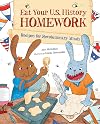
Oh my goodness this is surprisingly wonderful! The recipes are wholesome and straightforward, the details and themes of history engagingly presented and relevant.
I'm definitely going to do my next "grunt" (cobbler) on the stovetop. And I'm very tempted to make a close version of the succotash, and maybe the hoe cakes to use the cornmeal I have on hand.
My only complaints? No bibliography, and not enough recipes. I will look for Staats' other 'eat your homework' books for sure!
Highly show more recommended, especially to homeschooling families with children age 6 to 16. show less
I'm definitely going to do my next "grunt" (cobbler) on the stovetop. And I'm very tempted to make a close version of the succotash, and maybe the hoe cakes to use the cornmeal I have on hand.
My only complaints? No bibliography, and not enough recipes. I will look for Staats' other 'eat your homework' books for sure!
Highly show more recommended, especially to homeschooling families with children age 6 to 16. show less
Awards


You May Also Like


Associated Authors
Statistics
- Works
- 20
- Members
- 355
- Popularity
- #67,467
- Rating
- 3.9
- Reviews
- 14
- ISBNs
- 53