
Stan Gibilisco (1953–2020)
Author of Teach Yourself Electricity and Electronics
About the Author
Stan Gibilisco is the author of several important scientific books, including Understanding Einstein's Theory of Relativity and Teach Yourself Electricity and Electronics. While his primary interests are in technical and scientific fields, his passion has always been writing. He has worked as vice show more president of an electronic company and explains the exciting field of electronics in clear and complete terms. Gibilisco was born on September 26, 1953 in Birmingham, Ala. and educated at the University of Minnesota. (Bowker Author Biography) show less
Image credit: via YouTube
Series
Works by Stan Gibilisco
Tagged
Common Knowledge
- Canonical name
- Gibilisco, Stan
- Birthdate
- 1953-09-26
- Date of death
- 2020-05-03
- Gender
- male
- Nationality
- USA
- Birthplace
- Birmingham, Alabama, USA
- Associated Place (for map)
- Alabama, USA
Members
Reviews

I will read anything that gives me ideas for how to better help my students get acquainted with reading schematics. In the days of the Arduino and relatively cheap breadboard kits, I'm surprised at the author's decision to focus on power supply and radio circuits, and old techniques like wire-wrapping.
The initial circuits diagrams were nice in that they showed a pictorial view of circuit elements followed by a schematic, something I encourage my intro physics students to do. But the book show more seemed like "here's how you connect a light bulb to a battery" followed by, "here's a transformer, full wave rectifier, and noise-suppression circuit. Have fun!" (I would also not recommend that a newbie work with 120 VAC signals...) show less
The initial circuits diagrams were nice in that they showed a pictorial view of circuit elements followed by a schematic, something I encourage my intro physics students to do. But the book show more seemed like "here's how you connect a light bulb to a battery" followed by, "here's a transformer, full wave rectifier, and noise-suppression circuit. Have fun!" (I would also not recommend that a newbie work with 120 VAC signals...) show less
Teach Yourself Electricity and Electronics, 5th Edition (Teach Yourself Electricity & Electronics) by Stan Gibilisco
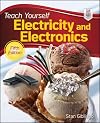
Teach Yourself Electricity and Electronics by Stan Gibilisco is a self-teaching guide that covers a great deal of material. The author suggests taking it in at about a chapter every week or so. A lot of this material is a review to me, so I can go through it slightly faster. However, once it got to things I am not as familiar with I did have to slow down a bit.
First off though, this book does contain stuff that might be dangerous if you mess with it. Electricity is deadly if misused. It only show more takes about 200 milliamps of current across your heart to kill you, so keep that in mind.
The book starts out with the basics of electricity. What is it? Where does it come from? What are atoms? Other questions of this nature are covered pretty heavily. It builds on itself as most educational books do. All of the drawings and illustrations are quite illuminating and easy to understand. Moreover, the book contains quiz questions at the end of each chapter to test your understanding of the subject covered.
The book gets into the more exciting parts pretty quickly, but it does have to cover meters and other methods to measure electrical and electronic phenomena. The book really takes off when it gets into Ohm’s Law and Circuit Schematics. Ohm’s Law hardly needs any introduction to the initiated. It’s such a fundamental equation to circuit analysis that to do anything without it would be like running a marathon without legs or typing without hands. It looks a bit different to me since it uses an “E” for the voltage rather than a “V” but that isn’t a significant difference. So it comes across as E = I * R. Anything you want to know about the circuit can be figured out from this equation. So, the section on Circuit Analysis uses Ohm’s Law and tells us how to combine resistances. For resistances in series you just add. For resistances in parallel, you add the reciprocals. It is as simple as that. Finally, it adds in Kirchhoff’s Laws into the mix of tools and you can do a lot of things.
Anyway, the book starts out with Direct Current Circuits and Components. It moves on to Alternating Current and Components. Electronics is covered in the third part with Semiconductors and Transformers and stuff. The final part is focused on Specialized Devices and Systems.
So once you get into Alternating Current, it introduces Imaginary Numbers and other mathematical things that didn’t have applications at first. Of course, there is also the application of trigonometry and pi and those things are pretty useful. So there’s a ton of new ideas in AC that isn’t covered in DC. Phases, Root Mean Square, Amplitude, and frequency; all of that is covered. It even talks about something I never knew, namely that DC travels more efficiently at extremely high voltages. I just thought it was favored because it was safer on Edison’s end.
On another note, it also talks about computers and the internet. It isn’t the main focus of the book, so I am fine with it being put into one chapter, but I don’t really know why this stuff was put in at all. I mean, if I wanted to know about that I would have gotten a book focused on that in particular.
Aside from the book being really awesome, the cover just strikes me as unusual. Why is there ice cream on the cover? I don’t really understand that particular detail. It also has the electronic components on it as well, so I suppose that is fine, but I just can’t wrap my head around that. All in all, this book is really good for a refresher or if you are learning on your own. show less
First off though, this book does contain stuff that might be dangerous if you mess with it. Electricity is deadly if misused. It only show more takes about 200 milliamps of current across your heart to kill you, so keep that in mind.
The book starts out with the basics of electricity. What is it? Where does it come from? What are atoms? Other questions of this nature are covered pretty heavily. It builds on itself as most educational books do. All of the drawings and illustrations are quite illuminating and easy to understand. Moreover, the book contains quiz questions at the end of each chapter to test your understanding of the subject covered.
The book gets into the more exciting parts pretty quickly, but it does have to cover meters and other methods to measure electrical and electronic phenomena. The book really takes off when it gets into Ohm’s Law and Circuit Schematics. Ohm’s Law hardly needs any introduction to the initiated. It’s such a fundamental equation to circuit analysis that to do anything without it would be like running a marathon without legs or typing without hands. It looks a bit different to me since it uses an “E” for the voltage rather than a “V” but that isn’t a significant difference. So it comes across as E = I * R. Anything you want to know about the circuit can be figured out from this equation. So, the section on Circuit Analysis uses Ohm’s Law and tells us how to combine resistances. For resistances in series you just add. For resistances in parallel, you add the reciprocals. It is as simple as that. Finally, it adds in Kirchhoff’s Laws into the mix of tools and you can do a lot of things.
Anyway, the book starts out with Direct Current Circuits and Components. It moves on to Alternating Current and Components. Electronics is covered in the third part with Semiconductors and Transformers and stuff. The final part is focused on Specialized Devices and Systems.
So once you get into Alternating Current, it introduces Imaginary Numbers and other mathematical things that didn’t have applications at first. Of course, there is also the application of trigonometry and pi and those things are pretty useful. So there’s a ton of new ideas in AC that isn’t covered in DC. Phases, Root Mean Square, Amplitude, and frequency; all of that is covered. It even talks about something I never knew, namely that DC travels more efficiently at extremely high voltages. I just thought it was favored because it was safer on Edison’s end.
On another note, it also talks about computers and the internet. It isn’t the main focus of the book, so I am fine with it being put into one chapter, but I don’t really know why this stuff was put in at all. I mean, if I wanted to know about that I would have gotten a book focused on that in particular.
Aside from the book being really awesome, the cover just strikes me as unusual. Why is there ice cream on the cover? I don’t really understand that particular detail. It also has the electronic components on it as well, so I suppose that is fine, but I just can’t wrap my head around that. All in all, this book is really good for a refresher or if you are learning on your own. show less
The book is a good start but it could have been better if more explanation were given to the choice of component values in the example circuits. The author probably avoided this level of detail because it would probably involve some mathematics. The book as it is requires no math. I just felt I wanted more insight into the thought process of the designers of the circuits. Maybe a sequel to the book is in order.
The book is relatively simple and easy to understand. While that might be an effective strength, it is also its greatest weakness. The book isn't that advanced. Many people won't feel like trudging through this text just to read about Complex Numbers and other things. If you are teaching yourself then this book might be useful to you, but if not then I wouldn't spend the time on it.
Lists
McGraw-Hill (1)
Awards


You May Also Like


Statistics
- Works
- 52
- Members
- 2,127
- Popularity
- #12,104
- Rating
- 3.2
- Reviews
- 14
- ISBNs
- 161
- Languages
- 6