
Stephen Hawking (1942–2018)
Author of A Brief History of Time: From the Big Bang to Black Holes
About the Author
Stephen William Hawking was born in Oxford, England on January 8, 1942. He received a first class honors degree in natural science from Oxford University and a Ph.D. from Cambridge University. He was a theoretical physicist and has held the post of Lucasian Professor of Mathematics at Cambridge show more University from 1982 until his death. In 1974, he was elected a Fellow of the Royal Society, the world's oldest scientific organization. In 1963, he learned he had amyotrophic lateral sclerosis, a neuromuscular wasting disease also known as Lou Gehrig's disease. The disease confined him to a wheelchair and reduced his bodily control to the flexing of a finger and voluntary eye movements, but left his mental faculties untouched. He became a leader in exploring gravity and the properties of black holes. He wrote numerous books including A Brief History of Time: From the Big Bang to Black Holes, Black Holes and Baby Universes, On the Shoulders of Giants, A Briefer History of Time, The Universe in a Nutshell, The Grand Design, and Brief Answers to the Big Questions. In 1982, he was named a commander of the British Empire. A film about his life, The Theory of Everything, was released in 2014 and was based on his first wife Jane Hawking's book Traveling to Infinity: My Life with Stephen. He died on March 14, 2018 at the age of 76. (Bowker Author Biography) show less
Series
Works by Stephen Hawking
The Illustrated A Brief History of Time / The Universe in a Nutshell - Two Books in One (2002) 1,910 copies, 7 reviews
On the Shoulders of Giants: The Great Works of Physics and Astronomy (2002) — Editor; Contributor — 1,329 copies, 7 reviews
God Created the Integers: The Mathematical Breakthroughs That Changed History (2005) 1,037 copies, 4 reviews
A Stubbornly Persistent Illusion: The Essential Scientific Works of Albert Einstein (2007) — Editor — 252 copies, 3 reviews
The Dreams That Stuff Is Made Of: The Most Astounding Papers of Quantum Physics--and How They Shook the Scientific World (2011) 179 copies, 1 review
Hawking on the Big Bang and Black Holes (Advanced Series in Astrophysics and Cosmology (Hardcover)) (1993) 19 copies
Cuestiones cuanticas y cosmologicas / Quantum and Cosmologic questions (Spanish Edition) (1995) 9 copies
Computer Resources for People With Disabilities: A Guide to Exploring Today's Assistive Technology (1996) 2 copies
BBC Wissen uaf Video. Stephen Hawkings Universum 5: Schwarze Löcher und noch darüber hinaus 2 copies
[Title missing] 2 copies
Über das Universum 2 copies
From Newton to Hawking 1 copy
The Beginning of Time 1 copy
Her Şeyin Teorisi 1 copy
Kosmos en kort historik 1 copy
karadelikler 1 copy
Stephen Hawking Box Set: A Brief History of Time / The Grand Design 2-volume Boxed Set by Stephen Ha 1 copy
UNIVERSO DE STEPHEN HAWKING 1 copy
How to Make a Spaceship: A Band of Renegades, an Epic Race, and the Birth of Private Spaceflight 1 copy
El legado de Stephen Hawking 1 copy
The Super-Universe 1 copy
Stephen Hawking 1 copy
Skapad av en tillfällighet? 1 copy
Stručná historie mého života 1 copy
Stephen Hawking's Universum, Cassetten, Tl.2, Schwarze Löcher und die 'Theorie für alles', 2 Cassetten (2002) 1 copy
Why We Should Go Into Space 1 copy
Life In The Universe 1 copy
Universumi saladuste jälil 1 copy
Astronomia 1 copy
Associated Works
Black Holes and Time Warps : Einstein's Outrageous Legacy (1994) — Foreword — 1,467 copies, 17 reviews
The Future of Theoretical Physics and Cosmology: Celebrating Stephen Hawking's Contributions to Physics (2002) — Contributor — 57 copies, 1 review
The Hitchhiker's Guide to the Galaxy 6: Hexagonal Phase: BBC Radio 4 Full Cast Dramatisation (2018) — Narrator — 38 copies
From Newton to Hawking: A History of Cambridge University's Lucasian Professors of Mathematics (2003) — Foreword, some editions — 6 copies
Tagged
Common Knowledge
- Legal name
- Hawking, Stephen William
- Other names
- Hawking, Stephen W.
- Birthdate
- 1942-01-08
- Date of death
- 2018-03-14
- Gender
- male
- Education
- University College, Oxford (BA|1962)
Trinity Hall, Cambridge (Ph.D|1966) - Occupations
- physicist
mathematician
professor - Organizations
- University of Cambridge (Gonville and Caius ∙ Fellow)
Perimeter Institute for Theoretical Physics (Distinguished Research Chair) - Awards and honors
- Order of the British Empire (Commander, 1982)
Order of the Companions of Honour (1989)
Premio Príncipe de Asturias (1989)
Lucasian Professorship of Mathematics, Cambridge (1979)
Presidential Medal of Freedom (2009)
Wolf Prize (1988) (show all 14)
Dannie Heineman Prize (1976)
Royal Society (Fellow, 1974)
Oskar Klein Medal (2003)
Royal Society of Arts (Honorary Fellow)
American Academy of Arts & Sciences (1984)
American Philosophical Society (1984)
National Academy of Sciences (1992)
Pontifical Academy of Sciences - Relationships
- Hawking, Jane (wife | divorced)
Hawking, Lucy (daughter)
Bekenstein, Jacob D. (colleague) - Nationality
- UK
- Birthplace
- Oxford, Oxfordshire, England, UK
- Places of residence
- St. Albans, Hertfordshire, England, UK
- Place of death
- Cambridge, Cambridgeshire, England, UK
- Burial location
- Westminster Abbey, London, Middlesex, England, UK (ashes)
- Map Location
- England, UK
Members
Discussions
Reading A Briefer History of Time by Stephen Hawking & More in Journey In Books (June 27)
Is Hawking right to join boycott of Israel and does it matter... in Pro and Con (May 2013)
Reviews
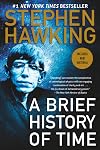
A friend of mine loves this book and has read it more than once. Reassuring, since like me, she doesn't hold a doctorate in the sciences! In fact, as someone who used to do a lot of science reading--I read many a astronomy book by Isaac Asimov and Carl Sagan once upon a time--most of the concepts here were very familiar. Well, until we reached the very weird land of quantum mechanics and string theory and imaginary numbers, where I admit I was pretty lost.
Hawking gives the history of the show more science surrounding the ultimate questions of the universe starting from the arguments of Aristotle in 340 B.C. for a round earth to the very strange land of today's physics of quantum mechanics with its different colored quarks and antimatter on the micro level and the strange interstellar beasties of relativistic physics of dark matter, black holes, quasars, and neutron stars and the very weird string theory that might unite both. I do think his explanations are lucid and elegant. I can't remember a better description of Einstein's General Theory of Relativity by explaining its historic relationship to Newton and how the theory tried to answer questions about the relationship between space and time. And Hawking manages to explain some sophisticated concepts without loading the book with jargon or equations. Hawking was also great at explaining how the theory of Relativity fits--or rather doesn't fit--with Quantum Mechanics and the search for a theory that could unify them both. I'm not saying I understood everything in the book. The concepts are counter-intuitive and hard to digest, and there's only so far you can go in explaining difficult subjects in simple terms to people lacking the background. But I understood it better, and certainly got the implications Hawking spelled out.
About the only stylistic quirk I had an issue with was Hawking's refusal to use the B-word. (A Briticism?). I find it a lot easier to wrap my mind around ten billion than "ten thousand million." The edition I read was written in 1996, updated from the first edition from 1988 which was a enormous bestseller. In the Foreword to that revised edition, Hawking wrote he thought that "within a few years we should know whether we can believe that we live in a universe that is completely self-contained and without beginning or end." Hawking definitely leaves me wanting to read more to find out the verdict. Worth reading, although not always easy to grasp. show less
Hawking gives the history of the show more science surrounding the ultimate questions of the universe starting from the arguments of Aristotle in 340 B.C. for a round earth to the very strange land of today's physics of quantum mechanics with its different colored quarks and antimatter on the micro level and the strange interstellar beasties of relativistic physics of dark matter, black holes, quasars, and neutron stars and the very weird string theory that might unite both. I do think his explanations are lucid and elegant. I can't remember a better description of Einstein's General Theory of Relativity by explaining its historic relationship to Newton and how the theory tried to answer questions about the relationship between space and time. And Hawking manages to explain some sophisticated concepts without loading the book with jargon or equations. Hawking was also great at explaining how the theory of Relativity fits--or rather doesn't fit--with Quantum Mechanics and the search for a theory that could unify them both. I'm not saying I understood everything in the book. The concepts are counter-intuitive and hard to digest, and there's only so far you can go in explaining difficult subjects in simple terms to people lacking the background. But I understood it better, and certainly got the implications Hawking spelled out.
About the only stylistic quirk I had an issue with was Hawking's refusal to use the B-word. (A Briticism?). I find it a lot easier to wrap my mind around ten billion than "ten thousand million." The edition I read was written in 1996, updated from the first edition from 1988 which was a enormous bestseller. In the Foreword to that revised edition, Hawking wrote he thought that "within a few years we should know whether we can believe that we live in a universe that is completely self-contained and without beginning or end." Hawking definitely leaves me wanting to read more to find out the verdict. Worth reading, although not always easy to grasp. show less

A light read, insofar as popular science books can be. However, this is less from any feat of writing (i.e. making difficult concepts accessible to the general reader) and more from the book's indulgence of Hawking's celebrity. In contrast to the enduringly astute bestseller A Brief History of Time, this posthumous offering – with the publisher's hand sometimes artlessly evident – is in thrall more to Stephen Hawking's status as a popular icon than to his genius achievements as a show more scientist.
We find this tonal dissonance right from the off, with Eddie Redmayne (the actor who played him in The Theory of Everything) providing a dorky and valueless Foreword. It is a mere pandering to celebrity, with Redmayne even talking about how he and Professor Hawking share the same star sign. The contrast to the more substantial Introduction – by Nobel Prize-winning physicist Kip Thorne – is marked.
As for the main body of text itself, Hawking is not at his best. Maybe it is because I read A Brief History of Time fairly recently (only a week or so before Hawking died, in fact), but I found that Brief Answers pales in comparison when it comes to the actual science. There's no in-depth discussion of his ideas, not even new initiatives like Breakthrough Starshot or his views on LIGO that he has not discussed in print before. He mentions these, but scarcely goes further than that. He mentions nuclear fusion as a potential saviour for mankind's energy problems, but doesn't explain how or why or what his wider thoughts on this topic might be. We get two or three sentences at most.
The truth is that Hawking's writing here is more polemical than suits him. Even leaving aside constant shallow digs at Brexit and Trump, the book is speculative ('should we colonise space?', 'are there aliens out there?', 'will artificial intelligence prove a threat?', etc.). His responses are grounded in science, of course, and it is interesting to get into Hawking's mind, but they are not answers that provide much in the way of new insight. In contrast to the excellent A Brief History of Time, the popular science market would not be all that poorer had Brief Answers not been published.
As a fairly keen reader of popular science, particularly astrophysics, I craved more substance. I craved expansion and insight from this, our last opportunity to engage with one of the finest scientific minds of the past century. Brief Answers is instead a sort of 'greatest hits' package, an interesting but obvious overview culled from other sources. It might draw new listeners to the band, so to speak, but if you actually want the best of Hawking you are much better off reading an updated edition of A Brief History of Time. show less
We find this tonal dissonance right from the off, with Eddie Redmayne (the actor who played him in The Theory of Everything) providing a dorky and valueless Foreword. It is a mere pandering to celebrity, with Redmayne even talking about how he and Professor Hawking share the same star sign. The contrast to the more substantial Introduction – by Nobel Prize-winning physicist Kip Thorne – is marked.
As for the main body of text itself, Hawking is not at his best. Maybe it is because I read A Brief History of Time fairly recently (only a week or so before Hawking died, in fact), but I found that Brief Answers pales in comparison when it comes to the actual science. There's no in-depth discussion of his ideas, not even new initiatives like Breakthrough Starshot or his views on LIGO that he has not discussed in print before. He mentions these, but scarcely goes further than that. He mentions nuclear fusion as a potential saviour for mankind's energy problems, but doesn't explain how or why or what his wider thoughts on this topic might be. We get two or three sentences at most.
The truth is that Hawking's writing here is more polemical than suits him. Even leaving aside constant shallow digs at Brexit and Trump, the book is speculative ('should we colonise space?', 'are there aliens out there?', 'will artificial intelligence prove a threat?', etc.). His responses are grounded in science, of course, and it is interesting to get into Hawking's mind, but they are not answers that provide much in the way of new insight. In contrast to the excellent A Brief History of Time, the popular science market would not be all that poorer had Brief Answers not been published.
As a fairly keen reader of popular science, particularly astrophysics, I craved more substance. I craved expansion and insight from this, our last opportunity to engage with one of the finest scientific minds of the past century. Brief Answers is instead a sort of 'greatest hits' package, an interesting but obvious overview culled from other sources. It might draw new listeners to the band, so to speak, but if you actually want the best of Hawking you are much better off reading an updated edition of A Brief History of Time. show less
I have wanted to read this book for a long time. I understood well about the first 1/3 but then it got into quantum physics and I got lost at the donut shop. What's that? There is no donut shop? Well, no wonder I got lost. It is not Hawking's fault that I did not follow what he was saying. It's that I don't comprehend how to observe mathematics, particularly when it is mathematics for something an ordinary person can't see. I understood the book on and off. I did learn some new things so it show more ws not a total loss of time for me. I was startled every time I ran into an explanation point
What book covering physics ever has an explanation point!
All told, the book, while interesting in the parts I could understand, was mostly a giraffe book. You know, way over my head. show less
What book covering physics ever has an explanation point!
All told, the book, while interesting in the parts I could understand, was mostly a giraffe book. You know, way over my head. show less
“A Mind-Bending Journey Through Space and Time” 5-Stars by Rebecca Raffle
⭐️⭐️⭐️⭐️⭐️
I first read A Brief History of Time in my twenties, during a period of intense curiosity about the universe and how everything fits together. Stephen Hawking didn’t just explain physics, he reshaped the way I think about reality itself.
This book is a masterclass in making the complex understandable. Hawking takes us through black holes, time warps, relativity, and the Big Bang, show more distilling some of the most profound discoveries in physics into something readable, even for non-scientists.
What makes it so compelling isn’t just the science, it’s Hawking’s ability to communicate a deep sense of wonder about the cosmos.
“If time travel is possible, where are the tourists from the future?”
That’s the charm of this book. It’s as playful as it is profound. Hawking never talks down to the reader, and even when the material gets dense, he encourages you to keep thinking, keep questioning, and keep exploring.
Why This Book Stands Out 🔥
✔️ Makes Physics Fascinating – Black holes, wormholes, the arrow of time—Hawking explains it all with clarity and wit.
✔️ Short Yet Deeply Impactful – It’s under 250 pages, but it packs a lifetime’s worth of knowledge and questions.
✔️ Leaves You Wondering – Hawking doesn’t just give answers—he leaves you with new questions to ponder long after you finish.
Who Should Read This?
✔️ Anyone Curious About the Universe – If you’ve ever wanted to understand space, time, and existence itself, this book is essential.
✔️ Readers Who Enjoy Books Like Cosmos or The Elegant Universe – If you love big ideas explained simply, you’ll love this.
✔️ Those Who Want to Understand Hawking’s Legacy – This book cemented his place as one of the greatest scientific minds of our time.
Final Thoughts 😍
I’m giving A Brief History of Time 5 stars because it’s a rare book that makes you feel smarter with every page. Hawking had a gift for explaining the inexplicable, and this book is proof.
If you’ve ever looked up at the stars and wondered about the nature of time, space, and the universe itself, this book will change the way you see everything.
📚 Enjoy my reviews? Let’s connect!
📖 Read more in-depth reviews & essays on Medium: medium.com/@RebeccaRaffle
📷 Follow my Instagram @RebeccaRaffle for book updates & foodie adventures: https://www.instagram.com/rebeccaraffle
🌍 Explore more on my website: https://www.rebeccaraffle.com show less
⭐️⭐️⭐️⭐️⭐️
I first read A Brief History of Time in my twenties, during a period of intense curiosity about the universe and how everything fits together. Stephen Hawking didn’t just explain physics, he reshaped the way I think about reality itself.
This book is a masterclass in making the complex understandable. Hawking takes us through black holes, time warps, relativity, and the Big Bang, show more distilling some of the most profound discoveries in physics into something readable, even for non-scientists.
What makes it so compelling isn’t just the science, it’s Hawking’s ability to communicate a deep sense of wonder about the cosmos.
“If time travel is possible, where are the tourists from the future?”
That’s the charm of this book. It’s as playful as it is profound. Hawking never talks down to the reader, and even when the material gets dense, he encourages you to keep thinking, keep questioning, and keep exploring.
Why This Book Stands Out 🔥
✔️ Makes Physics Fascinating – Black holes, wormholes, the arrow of time—Hawking explains it all with clarity and wit.
✔️ Short Yet Deeply Impactful – It’s under 250 pages, but it packs a lifetime’s worth of knowledge and questions.
✔️ Leaves You Wondering – Hawking doesn’t just give answers—he leaves you with new questions to ponder long after you finish.
Who Should Read This?
✔️ Anyone Curious About the Universe – If you’ve ever wanted to understand space, time, and existence itself, this book is essential.
✔️ Readers Who Enjoy Books Like Cosmos or The Elegant Universe – If you love big ideas explained simply, you’ll love this.
✔️ Those Who Want to Understand Hawking’s Legacy – This book cemented his place as one of the greatest scientific minds of our time.
Final Thoughts 😍
I’m giving A Brief History of Time 5 stars because it’s a rare book that makes you feel smarter with every page. Hawking had a gift for explaining the inexplicable, and this book is proof.
If you’ve ever looked up at the stars and wondered about the nature of time, space, and the universe itself, this book will change the way you see everything.
📚 Enjoy my reviews? Let’s connect!
📖 Read more in-depth reviews & essays on Medium: medium.com/@RebeccaRaffle
📷 Follow my Instagram @RebeccaRaffle for book updates & foodie adventures: https://www.instagram.com/rebeccaraffle
🌍 Explore more on my website: https://www.rebeccaraffle.com show less
Lists
BitLife (2)
Read in 2007 (1)
Physics (1)
Favourite Books (1)
Ambleside Year 8 (1)
To Read (1)
current (1)
Big tags (1)
important (1)
Awards


You May Also Like


Associated Authors
Statistics
- Works
- 133
- Also by
- 28
- Members
- 54,832
- Popularity
- #272
- Rating
- 3.9
- Reviews
- 694
- ISBNs
- 1,121
- Languages
- 40
- Favorited
- 83


