Reading A Briefer History of Time by Stephen Hawking & More
Original topic subject: Reading A Briefer History of Time by Stephen Hawking
Talk Journey In Books
Join LibraryThing to post.
1AnishaInkspill
Reading A Briefer History of Time book has been a few year’s goal, it was fantastic to open the book.
I always imagined this to be a dry book but Chapter 1 made me laugh with the world supported by turtles and I couldn’t disagree with what Stephen Hawkings says that we would know any better.
This has always seemed like a tough read to me, but I think I am going to enjoy this one.
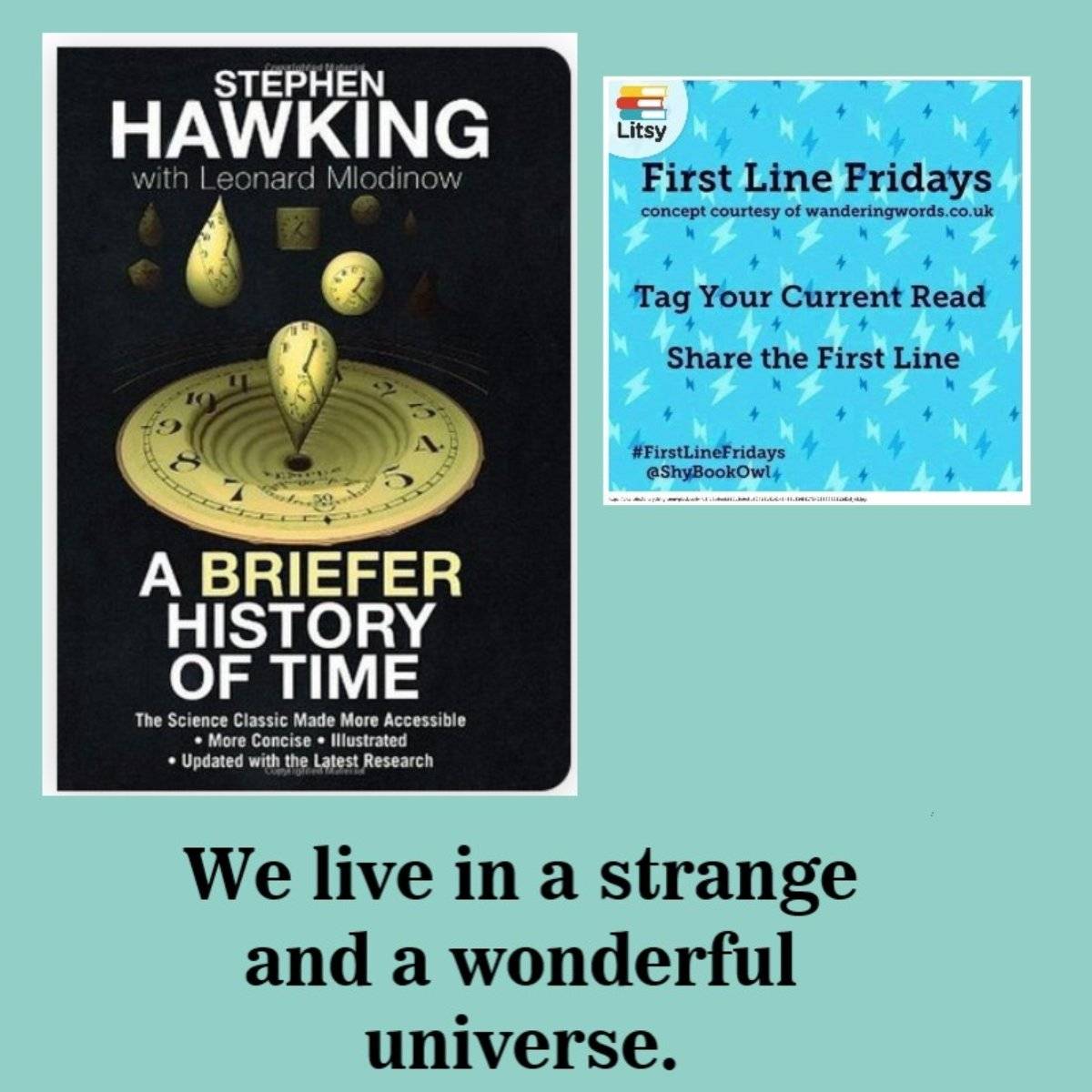
I always imagined this to be a dry book but Chapter 1 made me laugh with the world supported by turtles and I couldn’t disagree with what Stephen Hawkings says that we would know any better.
This has always seemed like a tough read to me, but I think I am going to enjoy this one.
2AnishaInkspill
I didn’t think I would ever grasp the difference between Newton’s and Einstein’s theory, and the difference between the special and the general relativity. So far, I really like the way it explains things with lots of examples, and it’s easy to follow how these ideas have developed. Reading this right after Bang: The History of the Universe makes some of what’s here more familiar, so even when I feel I am losing my bearings I am not completely lost.
I’ve made a few attempts to grasp Einstein’s and Newton’s ideas, but this is the first time I feel like I’m starting to get it.
I’ve made a few attempts to grasp Einstein’s and Newton’s ideas, but this is the first time I feel like I’m starting to get it.
3AnishaInkspill
Getting a little bit tougher now, and one of the things that made me pause was the idea of time, and how it can differ; not like if you live in different parts of the world, I think what this was saying was like on different planes or something like that.
Usually when I get stuck, I look at my other books but although I have other books, this time, as this is something I am still trying to work out, I’m going to read this through, read other books and come back to this. For now, I’ll just keep in mind that time operates differently when thinking about the cosmos and the universe.
Usually when I get stuck, I look at my other books but although I have other books, this time, as this is something I am still trying to work out, I’m going to read this through, read other books and come back to this. For now, I’ll just keep in mind that time operates differently when thinking about the cosmos and the universe.
4AnishaInkspill
Absolute time, I hadn’t realised there was any other kind, and although I can follow what is said, it’s really difficult to grasp but I can see in the way it explains things it is trying to make it easier to understand.
Part of the difficulty is that there is a lot to take in, most I do not know very well, so I am thinking of ways of how to do this part better.
Part of the difficulty is that there is a lot to take in, most I do not know very well, so I am thinking of ways of how to do this part better.
5AnishaInkspill
The uncertainty principal was even more baffling. I’ve finished reading this book but I want to this read again, and I think I’ll need to read it several times before getting to A Brief History of Time, but it was amazing to finally make an attempt to read this, I understood more than I thought I would but I want to improve on this the next time I read this.
6AnishaInkspill
Before I return to this book by Stephen Hawking's, I want to read up on the science that led to this point, I have a few books that cover this and starting with Science: A History by John Gribbin as it seems the easiest.
The opening was a bit disorientating, many names I did not know but I feel confident to read this book, John Gribbin in the Acknowledgement credits his wife to make this book readable for the layperson.
The opening was a bit disorientating, many names I did not know but I feel confident to read this book, John Gribbin in the Acknowledgement credits his wife to make this book readable for the layperson.
7AnishaInkspill
I like science but (like philosophy) it’s difficult, so many names and ideas get thrown about, and how a lot of books tend to explain it with the assumption that I have some knowledge, and maybe I do but it’s with huge, huge gaps which I’ve never expected one book to ever fill.
I’ve read the first part of Science: A History by John Gribbin, covering lives of Galileo and Bruno and many more (most of whom I’ve not heard of before) but I'm really enjoying how this explains what lead up to the first scientists.
I’ve read the first part of Science: A History by John Gribbin, covering lives of Galileo and Bruno and many more (most of whom I’ve not heard of before) but I'm really enjoying how this explains what lead up to the first scientists.
8AnishaInkspill
Science: A History by John Gribbin 24% read
Part 2 starts with a rundown on René Descartes followed by others who again are new to me. I really like how the context really brings things into perspective, where I'm not just reading science but also a little biography, history and politics. Next person up is Isaac Newton. Now I know he's important, I've always wanted to know why - so looking forward to reading this chapter.
Part 2 starts with a rundown on René Descartes followed by others who again are new to me. I really like how the context really brings things into perspective, where I'm not just reading science but also a little biography, history and politics. Next person up is Isaac Newton. Now I know he's important, I've always wanted to know why - so looking forward to reading this chapter.
9AnishaInkspill
Science: A History by John Gribbin 31% read
The second chapter in this part covered Robert Hooke and Edmond Halley as well as Isaac Newton.
I had no idea what Robert Hooke contributed, and not very gracious of Isaac blanking his input. The way John Gribbin tells it, Isaac newton comes across as a genius with a mega-ego that was very sensitive, but finally starting to get why he is an important figure in science.
The second chapter in this part covered Robert Hooke and Edmond Halley as well as Isaac Newton.
I had no idea what Robert Hooke contributed, and not very gracious of Isaac blanking his input. The way John Gribbin tells it, Isaac newton comes across as a genius with a mega-ego that was very sensitive, but finally starting to get why he is an important figure in science.
10AnishaInkspill
Science: A History by John Gribbin 34% read
The third chapter continues with Edmond Halley and his fallout with John Flamsteed, another scientist name that is new to me along with John Ray, who is the actual author of the first published book about fish (John Gribbin explains how and why the credit is given to his friend Francis Willughby), I would have never have guesses that a book about fish would lead to the theory of evolution – how exciting is that.
The third chapter continues with Edmond Halley and his fallout with John Flamsteed, another scientist name that is new to me along with John Ray, who is the actual author of the first published book about fish (John Gribbin explains how and why the credit is given to his friend Francis Willughby), I would have never have guesses that a book about fish would lead to the theory of evolution – how exciting is that.
11AnishaInkspill
Science: A History by John Gribbin 38% read
It was a surprise to see have been reading in this chapter would be referred to in Moby Dick, but in reference to whales.
The remaining third chapter in part 2 shows more people that led to the theory of evolution: Carl Linnaeus who liked systems and order and had a big hand in classify all living things on Earth; Georges Couvier who focused on different part of anatomy and its workings; and Jean-Baptist Lamarck who was thinking along the lines of natural selection decades before Darwin. There’s others this is such an interesting read.
It was a surprise to see have been reading in this chapter would be referred to in Moby Dick, but in reference to whales.
The remaining third chapter in part 2 shows more people that led to the theory of evolution: Carl Linnaeus who liked systems and order and had a big hand in classify all living things on Earth; Georges Couvier who focused on different part of anatomy and its workings; and Jean-Baptist Lamarck who was thinking along the lines of natural selection decades before Darwin. There’s others this is such an interesting read.
12AnishaInkspill
Science: A History by John Gribbin 44% read
The first chapter of part 3, The Enlightenment, is aptly named with: Chemistry catches up. This was harder to follow but I am not too worried as I do intend to go back and read this book, for this first read I am trying to glean as much information I can, what’s left an impression are the first experiments to discover some of the chemicals like oxygen.
The first chapter of part 3, The Enlightenment, is aptly named with: Chemistry catches up. This was harder to follow but I am not too worried as I do intend to go back and read this book, for this first read I am trying to glean as much information I can, what’s left an impression are the first experiments to discover some of the chemicals like oxygen.
13AnishaInkspill
Science: A History by John Gribbin 45% read
I’ve been referring to the other books I have and between them this is making more sense than it could be. Sometimes the understanding is fleeting as I am still trying understand it. An exciting moment was discovering when the term scientist is coined, John Grubbin makes a mention of this but The Science Book: Big Ideas Simply Explained explains more. Reading this has also got me opening a few other books, one of these is FREE Weights and Measures Study Guide which I just thought had measurement conversations but had a detailed explanation of Electrical Charge.
One of my goal for this year is to get more familiar with my library, this week I have felt I am doing this 🌞
I’ve been referring to the other books I have and between them this is making more sense than it could be. Sometimes the understanding is fleeting as I am still trying understand it. An exciting moment was discovering when the term scientist is coined, John Grubbin makes a mention of this but The Science Book: Big Ideas Simply Explained explains more. Reading this has also got me opening a few other books, one of these is FREE Weights and Measures Study Guide which I just thought had measurement conversations but had a detailed explanation of Electrical Charge.
One of my goal for this year is to get more familiar with my library, this week I have felt I am doing this 🌞
14AnishaInkspill
Science: A History by John Gribbin 49% read
As chapter 8 wraps up it mentions James Hutton, a geologist, whose theory was criticised by Neptunists (this is in the early 1790s), a new term for that I ended up looking on Wikipedia as I couldn’t find it in any of my books, their thinking was that rocks formed in water. Little did they know that James Hutton was actually on the right track.
As chapter 8 wraps up it mentions James Hutton, a geologist, whose theory was criticised by Neptunists (this is in the early 1790s), a new term for that I ended up looking on Wikipedia as I couldn’t find it in any of my books, their thinking was that rocks formed in water. Little did they know that James Hutton was actually on the right track.
15AnishaInkspill
Science: A History by John Gribbin 50% read
First chapter in the fourth part starts with Charles Lyell, a geologist who becomes interested in the field after reading books by James Hutton. Looking Charles up in my other books, I can see from the highlights it's a name I have come across but it didn't leave an impression as it has this time. I liked how John Gribbin in showing how his work is connected to Charles Darwin's more things are starting to make sense now.
First chapter in the fourth part starts with Charles Lyell, a geologist who becomes interested in the field after reading books by James Hutton. Looking Charles up in my other books, I can see from the highlights it's a name I have come across but it didn't leave an impression as it has this time. I liked how John Gribbin in showing how his work is connected to Charles Darwin's more things are starting to make sense now.
16AnishaInkspill
Science: A History by John Gribbin 53% read
Still on the same chapter but covering Charles Darwin, and it's amazing to read that his great-grandfather Robert found a fossil in early 1700s from the Jurassic period which he presented to the Royal Society.
Still on the same chapter but covering Charles Darwin, and it's amazing to read that his great-grandfather Robert found a fossil in early 1700s from the Jurassic period which he presented to the Royal Society.
17AnishaInkspill
Science: A History by John Gribbin 56% read
Reading about Charles Darwin and his contemporaries was starting to come together and making sense. I like John Gribbin’s style, he just explains things without gloss or judgement and shows the development of science in a social historical context. John Gribbin also mentions Erasmus Darwin’s Temple of Nature which describes the evolution of life in verse, I’m really tempted to also read this, if I wasn’t behind in my reading I would have.
Reading about Charles Darwin and his contemporaries was starting to come together and making sense. I like John Gribbin’s style, he just explains things without gloss or judgement and shows the development of science in a social historical context. John Gribbin also mentions Erasmus Darwin’s Temple of Nature which describes the evolution of life in verse, I’m really tempted to also read this, if I wasn’t behind in my reading I would have.

