
John Gribbin
Author of In Search Of Schrodinger's Cat: Quantum Physics and Reality
About the Author
John R. Gribbin (born 19 March 1946) is a British science writer, an astrophysicist, and a visiting fellow in astronomy at the University of Sussex. The topical range of his prolific writings include quantum physics, human evolution, climate change, global warming, the origins of the universe, and show more biographies of famous scientists. He also writes science fiction. In 1984, Gribbin published In Search of Schrödinger's Cat: Quantum Physics and Reality, the book that he is best known for, which continues to sell well even after years of publication. At the 2009 World Conference of Science Journalists, the Association of British Science Writers presented Gribbin with their Lifetime Achievement award. (Bowker Author Biography) John Gribbin, visiting fellow in astronomy at the University of Sussex. He is married to Mary Grivvin, also a science writer. (Publisher Provided) show less
Series
Works by John Gribbin
Schrodinger's Kittens and the Search for Reality: Solving the Quantum Mysteries (1995) 956 copies, 4 reviews
The Scientists: A History of Science Told Through the Lives of Its Greatest Inventors (2003) 828 copies, 9 reviews
The Matter Myth: Dramatic Discoveries That Challenge Our Understanding of Physical Reality (1991) 410 copies, 2 reviews
The Fellowship: Gilbert, Bacon, Harvey, Wren, Newton, and the Story of a Scentific Revolution (2005) 272 copies, 5 reviews
In Search of the Multiverse: Parallel Worlds, Hidden Dimensions, and the Ultimate Quest for the Frontiers of Reality (2009) 196 copies, 7 reviews
In the Beginning: After Cobe and Before the Big Bang (In the Beginning (Bay Back Books)) (1994) 176 copies, 1 review
The Omega Point: The Search for the Missing Mass and the Ultimate Fate of the Universe (Bantam New Age Books) (1988) 126 copies
13.8: The Quest to Find the True Age of the Universe and the Theory of Everything (2015) 122 copies, 3 reviews
Six Impossible Things: The ‘Quanta of Solace’ and the Mysteries of the Subatomic World (2019) 120 copies, 4 reviews
Fitzroy: The Remarkable Story of Darwin's Captain and the Invention of the Weather Forecast (2003) 108 copies, 1 review
On the Origin of Evolution: Tracing ‘Darwin’s Dangerous Idea’ from Aristotle to DNA (2020) 41 copies
Seven Pillars of Science: The Incredible Lightness of Ice, and Other Scientific Surprises (2020) 27 copies, 1 review
The Stuff of the Universe: Dark Matter, Mankind and the Coincidences of Cosmology (1990) 26 copies, 1 review
In Search of Superstrings: Symmetry, Membranes and the Theory of Everything (2007) 18 copies, 1 review
Eight Improbable Possibilities: The Mystery of the Moon, and Other Implausible Scientific Truths (2021) 18 copies
Nine Musings on Time: Science Fiction, Science Fact, and the Truth About Time Travel (2022) 16 copies
Ten Tantalising Truths: Why the Sky is Blue, and other Big Answers to Simple Questions (2023) 7 copies
Reunião 1.º Vol. 2 copies
Reunião 2.º Vol. 2 copies
الحياة السرية للشمس 2 copies
Complete Short Fiction 2 copies
Big Bang-Aren Bila (i) 1 copy
A idade do gelo 1 copy
John Gribbin 1 copy
The Future of Life 1 copy
Unbegotten Child 1 copy
Fisika Modern 1 copy
Τά μυστήρια τοῦ χρόνου 1 copy
Planet Earth: An Audio Guide 1 copy
Coklu Evrenler 1 copy
Τα μυστήρια του χώρου 1 copy
El libro del clima Vol I 1 copy
Associated Works
Stepping Through the Stargate: Science, Archaeology and the Military in Stargate SG1 (2004) — Contributor — 106 copies, 1 review
3 Minute Stephen Hawking (His life, theories, and influence in 3 minute particles) (2012) — Foreword — 68 copies, 2 reviews
3-minute Einstein: Digesting His Life, Theories, and Influence in 3-minute Morsels (2011) — Foreword — 65 copies, 1 review
Analog Science Fiction/Science Fact: Vol. XCVII, No. 2 (February 1977) (1977) — Contributor — 33 copies
Analog Science Fiction/Science Fact: Vol. XCVIII, No. 2 (February 1978) (1978) — Contributor — 26 copies
Analog Science Fiction/Science Fact: Vol. XCVI, No. 3 (March 1976) (1976) — Contributor — 26 copies, 1 review
Analog Science Fiction/Science Fact: Vol. CVI, No. 13 (Mid-December 1986) (1986) — Author, some editions — 19 copies
'The man who proved Einstein was wrong', New Scientist, 24 November 1990 (1990) — Contributor — 1 copy
Tagged
Common Knowledge
- Canonical name
- Gribbin, John
- Legal name
- Gribbin, John R.
- Birthdate
- 1946-03-19
- Gender
- male
- Education
- University of Sussex (BSc|physics|1966|MSc|astronomy|1967)
University of Cambridge (Ph.D|astrophysics|1971) - Occupations
- physicist
science writer
astronomer
astrophysicist
journalist
science fiction writer - Organizations
- University of Sussex
New Scientist
Nature - Awards and honors
- Royal Society of Literature (Fellow, 1999)
Association of British Science Writers Lifetime Achievement award (2009) - Agent
- David Higham Associates
- Relationships
- Gribbin, Mary (wife)
- Short biography
- Wiki:
John Gribbin graduated with his bachelor's degree in physics from the University of Sussex in 1966. Gribbin then earned his master of science (M.Sc.) degree in astronomy in 1967, also from the Univ. of Sussex, and he earned his Ph.D. in astrophysics from the University of Cambridge (1971). As a science writer, he has worked for the science journal Nature, and the magazine New Scientist and has written for The Times, The Guardian and the Independent as well as their Sunday counterparts and BBC radio.He is best known for his book In Search of Schrödinger's Cat (1984). - Nationality
- UK
- Birthplace
- Maidstone, Kent, England, UK
- Associated Place (for map)
- England, UK
Members
Discussions
Reading A Briefer History of Time by Stephen Hawking & More in Journey In Books (Tuesday 9:47am)
Anisha’s Nonfiction Challenge 2026 in Journey In Books (Sunday 11:26am)
Reviews
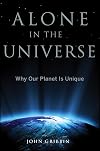
This book proceeds very deliberately in making a case concentrically for a series of coincidences as the explanation for humanity's uniqueness within the Milky Way. Concentric because Gribbin starts from the largest physical unit - the Milky Way galaxy - then narrowing his argument chapter by chapter to end with the tectonics of Earth and the consequent climate changes forced upon the hominids. *He makes no claims outside the bounds of the Milky Way.
He immediately stands the usual arguments show more for intelligent life on their heads - the Sun is by no means ordinary, nor is the Solar System, nor is Earth. The same statistics that proponents of the existence of extra-terrestrial intelligence use are employed against that same proposition. So, there are a LOT of numbers in this book. As a non-scientist I probably did not appropriately appreciate them, but the narrative was clear enough that I understood the argument - and was convinced by it.
Previously, I thought extra-terrestrial intelligence more likely than not. Now the author has convinced me that, in his oft-quoted concluding sentence, "we are alone, and we had better get used to the idea." (But that conclusion is fine by me. I think any aliens are as likely to be hostile as friendly.) show less
He immediately stands the usual arguments show more for intelligent life on their heads - the Sun is by no means ordinary, nor is the Solar System, nor is Earth. The same statistics that proponents of the existence of extra-terrestrial intelligence use are employed against that same proposition. So, there are a LOT of numbers in this book. As a non-scientist I probably did not appropriately appreciate them, but the narrative was clear enough that I understood the argument - and was convinced by it.
Previously, I thought extra-terrestrial intelligence more likely than not. Now the author has convinced me that, in his oft-quoted concluding sentence, "we are alone, and we had better get used to the idea." (But that conclusion is fine by me. I think any aliens are as likely to be hostile as friendly.) show less

John Gribbin has a real gift for elucidating the fundamental questions, advances, and mysteries in understanding the underpinnings of reality as understood with quantum mechanics. Girbbin offers a very expansive picture, showing how quantum realities touch our everyday lives:
He explains many points of QM in ways I do not recall seeing elsewhere or explained as well and often challenging popular assumptions:
Unexpectedly, at least to me, the summation is a running endorsement of the many-worlds interpretation of American physicist Hugh Everett III (father to E), who proposed it in his doctoral thesis at Princeton University in 1957. In effect, this implies that the super-universe contains within it all possible realities, which is very Leibniz. show less
...we have all heard of genetic engineering and read about the miraculous prospects—and the dangers—it holds for the future. Very few people appreciate, though, that the understanding of living molecules that makesshow more
genetic engineering possible depends on our present understanding of quantum mechanics, without which we would not be able to interpret X-ray diffraction data, apart from anything else. To understand how to construct, or reconstruct, genes, we have to understand how and why atoms join together only in certain arrangements, certain distances apart and with chemical bonds of a certain strength. That understanding is the gift of quantum physics to chemistry and to molecular biology.
I’ve labored the point a little more than I might have had it not been for a member of the University College of Wales. In March 1983, in a review in New Scientist, I mentioned in passing that “without quantum theory there would be no genetic engineering, no solid-state computers, no nuclear power stations (or bombs).” This drew a complaint from a correspondent in that respected academic institution to the effect that he was fed up with seeing genetic engineering dragged in everywhere as the new scientific buzzword, and that John Gribbin shouldn’t be allowed to get away with such outrageous remarks. What possible connection, however tenuous, could there be between quantum theory and genetics? I hope the connection is clear this time. At one level, it is delightful to be able to point out the fact that Crick’s conversion to biophysics was directly inspired by Schrödinger, and that the work that led to the discovery of the DNA double helix was carried out under the formal, if sometimes unwelcome, direction of Lawrence Bragg; at a deeper level, of course, the reason for the interest of pioneers like Bragg and Schrödinger, and the next generation of physicists such as Kendrew, Perutz, Wilkins, and Franklin in biological problems is that these problems are, as Schrödinger pointed out, simply another kind of physics, one that deals with collections of large numbers of atoms in complex molecules.
He explains many points of QM in ways I do not recall seeing elsewhere or explained as well and often challenging popular assumptions:
This misconception still arises today, partly because of the way the idea of uncertainty is often taught. Heisenberg himself used the idea of observing an electron to make his point. We can only see things by looking at them, which involves bouncing photons of light off them and into our eyes. A photon doesn’t disturb an object like a house very much, so we don’t expect the house to be affected by looking at it. For an electron, though, things are rather different. To start with, because an electron is so small we have to use electromagnetic energy with a short wavelength in order to see it (with the aid of experimental apparatus)at all. Such gamma radiation is very energetic, and any photon of gamma radiation that bounces off an electron and can be detected by our experimental apparatus will drastically change the position and momentum of the electron—if the electron is in an atom, the very act of observing it with a gamma ray microscope may knock it out of the atom altogether.
All this is true enough, and it does give a general idea of the impossibility of measuring precisely both the position and momentum of an electron. But what the uncertainty principle tells us is that, according to the fundamental equation of quantum mechanics, there is no such thing as an electron that possesses both a precise momentum and a precise position.
This has far-reaching implications. As Heisenberg said at the end of his paper in the Zeitschrift, “We cannot know, as a matter of principle, the present in all its details.” This is where quantum theory cuts free from the determinacy of classical ideas. To Newton, it would be possible to predict the entire course of the future if we knew the position and momentum of every particle in the universe; to the modern physicist, the idea of such perfect prediction is meaningless because we cannot know the position and momentum of even one particle precisely. The same conclusion comes out of all the different versions of the equations, the wave mechanics, the Heisenberg-Born-Jordan matrices, and Dirac’s q numbers, although Dirac’s approach, which carefully avoids any physical comparisons with the everyday world, seems the most appropriate. Indeed, Dirac very nearly came to the uncertainty relation before Heisenberg. In a paper for the Proceedings of the Royal Society in December 1926 he pointed out that in quantum theory it is impossible to answer any question that refers to numerical values of both q and p, although “one would expect, however, to be able to answer questions in which only the q or only the p are given numerical values.”
It was only in the 1930s that the philosophers took up the implications of these ideas for the concept of causality—the idea that every event is caused by some other specific event—and the puzzle of predicting the future. Meanwhile, although the uncertainty relations had been derived from the fundamental equations of quantum mechanics, some influential experts began to teach quantum theory by starting out from the uncertainty relations. Wolfgang Pauli was probably the key influence in this trend. He wrote a major encyclopedia article on quantum theory that began with the uncertainty relations, and he encouraged a colleague, Herman Weyl, to begin his textbook Theory of Groups and Quantum Mechanics in much the same way. This book was first published in German in 1928 and in English (by Methuen) in 1931. Together, the book and Pauli’s article set the tone for a generation of standard texts. Students raised on those texts became, in some cases, professors in their turn, and passed on the same style of teaching to subsequent generations. As a result students at university today are still, more often than not, introduced to quantum theory via the uncertainty relations...
Unexpectedly, at least to me, the summation is a running endorsement of the many-worlds interpretation of American physicist Hugh Everett III (father to E), who proposed it in his doctoral thesis at Princeton University in 1957. In effect, this implies that the super-universe contains within it all possible realities, which is very Leibniz. show less

Sometimes a book serves as a time capsule, capturing the anxieties and scientific debates of its era. The Jupiter Effect is one such book. The revised 1976 edition builds on the original 1974 prediction: a rare planetary alignment in March 1982 would supposedly unleash catastrophic events on Earth, from massive earthquakes to extreme weather. Gribbin and Plagemann hypothesized that the gravitational pull of the aligned planets could disrupt Earth’s rotation and trigger disasters, with the show more San Andreas Fault often identified as ground zero.
Unlike sensationalist works of pure pseudoscience, The Jupiter Effect was rooted in real scientific ideas, particularly astrophysics and geophysics. John Gribbin was an astrophysicist and editor for Nature, one of the leading scientific journals, and Stephen Plagemann completed his doctoral work under the eminent astronomer Sir Fred Hoyle. Both likely believed their hypothesis warranted serious attention, though its flaws quickly became apparent.
The book’s bold claims were met with intense scrutiny from the scientific community. Critics called it “pure astrology in disguise.” The underlying premise—that planetary alignments could exert enough gravitational force to affect tectonic plates—was ultimately shown to be negligible. Even Gribbin and Plagemann acknowledged the flaws in their theory, publishing The Jupiter Effect Reconsidered in 1982, where they revised their stance and cited the 1980 eruption of Mount St. Helens as evidence of their ideas, though this too failed to convince most scientists.
Adding to the intrigue is the book’s preface by Isaac Asimov. In his signature style, Asimov provided a compelling history of earthquakes and their devastation but stopped short of endorsing the authors’ predictions. His inclusion lent credibility and captured the public’s imagination, even as the scientific community remained skeptical.
I purchased this book not for its scientific merit but for nostalgia. Reading it transported me back to the early 1980s, when these ideas were the talk of my high school astronomy club. My most vivid memory is attending a star show at the Hansen Planetarium in Salt Lake City shortly before the planetary alignment. The show mirrored the book’s narrative, detailing the alignment and its supposed consequences, but ultimately debunked the hypothesis. It walked audiences through the science, showing why the dire predictions were overblown. I left with a greater appreciation for planetary mechanics—and a chuckle at humanity’s tendency to leap to doomsday scenarios.
Though its predictions didn’t come to pass, The Jupiter Effect remains a fascinating piece of scientific history. It highlights how bold, speculative ideas can capture the public imagination—even when the science doesn’t hold up. Today, it serves as a reminder of the importance of critical thinking and skepticism, particularly when bold claims about natural disasters arise. show less
Unlike sensationalist works of pure pseudoscience, The Jupiter Effect was rooted in real scientific ideas, particularly astrophysics and geophysics. John Gribbin was an astrophysicist and editor for Nature, one of the leading scientific journals, and Stephen Plagemann completed his doctoral work under the eminent astronomer Sir Fred Hoyle. Both likely believed their hypothesis warranted serious attention, though its flaws quickly became apparent.
The book’s bold claims were met with intense scrutiny from the scientific community. Critics called it “pure astrology in disguise.” The underlying premise—that planetary alignments could exert enough gravitational force to affect tectonic plates—was ultimately shown to be negligible. Even Gribbin and Plagemann acknowledged the flaws in their theory, publishing The Jupiter Effect Reconsidered in 1982, where they revised their stance and cited the 1980 eruption of Mount St. Helens as evidence of their ideas, though this too failed to convince most scientists.
Adding to the intrigue is the book’s preface by Isaac Asimov. In his signature style, Asimov provided a compelling history of earthquakes and their devastation but stopped short of endorsing the authors’ predictions. His inclusion lent credibility and captured the public’s imagination, even as the scientific community remained skeptical.
I purchased this book not for its scientific merit but for nostalgia. Reading it transported me back to the early 1980s, when these ideas were the talk of my high school astronomy club. My most vivid memory is attending a star show at the Hansen Planetarium in Salt Lake City shortly before the planetary alignment. The show mirrored the book’s narrative, detailing the alignment and its supposed consequences, but ultimately debunked the hypothesis. It walked audiences through the science, showing why the dire predictions were overblown. I left with a greater appreciation for planetary mechanics—and a chuckle at humanity’s tendency to leap to doomsday scenarios.
Though its predictions didn’t come to pass, The Jupiter Effect remains a fascinating piece of scientific history. It highlights how bold, speculative ideas can capture the public imagination—even when the science doesn’t hold up. Today, it serves as a reminder of the importance of critical thinking and skepticism, particularly when bold claims about natural disasters arise. show less

The question about this book is, "Is this the biography of James Lovelock, or of Gaia?"
For those who do not know, Gaia was the earth mother and had her name attached to Lovelock's hypothesis, now upgraded to a theory, that the geological planet, the plants and animals operate a feedback system keeping the weather conditions in check.
Lovelock, who is 94, at the time of this review, has worked tirelessly to bring credence to the concept. Scientists fought his ideas for some time. To me, a show more nonscientific type, they immediately appeared to be worthy of contemplation, so I took some time to search for reasons why the boffins should have taken so much convincing that it was worth perusal. I believe it is because it gets too close to admitting that there is a God. Interlinked systems are dangerously close to a creator. Lovelock is now careful to stress that each participant must see an advantage, there can be no altruism!
This book is only 227 pages so, it is astounding that, by the final page, one feels that one has read a full biography of Lovelock AND received a thorough background in Gaia theory. The book never preaches, it sets out the facts and leaves others to decide: just the sort of biography I like! This book comes highly recommended. show less
For those who do not know, Gaia was the earth mother and had her name attached to Lovelock's hypothesis, now upgraded to a theory, that the geological planet, the plants and animals operate a feedback system keeping the weather conditions in check.
Lovelock, who is 94, at the time of this review, has worked tirelessly to bring credence to the concept. Scientists fought his ideas for some time. To me, a show more nonscientific type, they immediately appeared to be worthy of contemplation, so I took some time to search for reasons why the boffins should have taken so much convincing that it was worth perusal. I believe it is because it gets too close to admitting that there is a God. Interlinked systems are dangerously close to a creator. Lovelock is now careful to stress that each participant must see an advantage, there can be no altruism!
This book is only 227 pages so, it is astounding that, by the final page, one feels that one has read a full biography of Lovelock AND received a thorough background in Gaia theory. The book never preaches, it sets out the facts and leaves others to decide: just the sort of biography I like! This book comes highly recommended. show less
Lists
Want To Read (1)
BusinessBooks (1)
Awards

Six Impossible Things: The ‘Quanta of Solace’ and the Mysteries of the Subatomic World (Shortlist – General – 2019)
In Search of the Multiverse: Parallel Worlds, Hidden Dimensions, and the Ultimate Quest for the Frontiers of Reality (Longlist – General – 2010)


You May Also Like


Associated Authors
Statistics
- Works
- 181
- Also by
- 14
- Members
- 15,916
- Popularity
- #1,423
- Rating
- 3.7
- Reviews
- 200
- ISBNs
- 712
- Languages
- 21
- Favorited
- 11