
Martin J. Rees
Author of Just Six Numbers: The Deep Forces That Shape The Universe
About the Author
Martin Rees is Royal Society Research Professor at Cambridge University and holds the title of Astronomer Royal.
Works by Martin J. Rees
Associated Works
Seeing Further: The Story of Science, Discovery, and the Genius of the Royal Society (2010) — Contributor — 1,157 copies, 19 reviews
This Will Make You Smarter: New Scientific Concepts to Improve Your Thinking (Edge Question Series) (2012) — Contributor — 904 copies, 17 reviews
What Is Your Dangerous Idea? Today's Leading Thinkers on the Unthinkable (2007) — Contributor — 668 copies, 8 reviews
The Next Fifty Years: Science in the First Half of the Twenty-first Century (2002) — Contributor — 410 copies, 10 reviews
Aliens: The World's Leading Scientists on the Search for Extraterrestrial Life (2016) — Contributor — 180 copies, 9 reviews
Cosmic Coincidences: Dark Matter, Mankind, and Anthropic Cosmology (1989) — Author, some editions — 140 copies, 3 reviews
30-Second Astronomy: The 50 Most Mindblowing Discoveries in Astronomy, Each Explained in Half a Minute (2013) — Foreword — 68 copies
The Guardian science course : Part VI : Building blocks — Contributor — 1 copy
Tagged
Common Knowledge
- Canonical name
- Rees, Martin J.
- Legal name
- Rees, Martin John
- Other names
- Rees, Lord
Rees, Sir Martin - Birthdate
- 1942-06-23
- Gender
- male
- Education
- Shrewsbury School
University of Cambridge (Trinity College) - Occupations
- astrophysicist
astronomer royal (1995|incumbent|2020)
cosmologist - Organizations
- Trinity College, Cambridge University (Master)
- Awards and honors
- Dannie Heineman Prize (1984)
Royal Astronomical Society (gold medal|1987)
Balzan Prize (1989)
Knight Bachelor (1992)
Bruce Medal (1993)
Bruno Rossi Prize (2000) (show all 19)
Gruber Prize (2001)
Oskar Klein Medal (2002)
Michael Faraday Prize (2004)
Life Peerage (2005)
Crafoord Prize (2005)
Royal Society (president|2005|incumbent)
Order of Merit (2007)
Caird Medal (2007)
Lewis Thomas Prize for Writing about Science (2009)
BBC Reith Lecturer (2010)
Templeton Prize (2011)
Royal Society (fellow)
Asteroid Namesake (4587) - Relationships
- Humphrey, Caroline (wife)
- Short biography
- Sir Martin Rees is a professor of cosmology and astrophysics and the master of Trinity College at the University of Cambridge. He holds the honorary title of Astronomer Royal and is also a visiting professor at Imperial College London and Leicester University. [from What We Believe But Cannot Prove (2006)]
- Nationality
- UK
- Birthplace
- York, Yorkshire, England, UK
- Places of residence
- Cambridge, Cambridgeshire, England, UK
- Map Location
- England, UK
Members
Reviews

You may be familiar with a so called “proof” for the existence of a creator [or do I mean “Creator” (?)] from the apparent design of [his or her] creatures. This argument has been pretty much debunked as it applies to living animals by (1) the theory of evolution and (2) a deep understanding how the phenomenon of emergence can result in complex order arising from randomness despite the second law of thermodynamics. Nonetheless, it does seem as if the earth is very well suited for show more human life and probably will continue to be so unless climate change deniers prevent sensible people from taking steps necessary to protect our environment.
Indeed, the fact that human life evolved as it did seems to be dependent on the fact that a number of ratios of physical phenomena fall within some very sensitive parameters. Martin Rees, a Royal Society Research Professor at Cambridge University, who was also the official Astronomer Royal of Great Britain, wrote a very interesting book in 1999 that explored the sensitivity of six of those parameters, which he argues are fundamental to modern physics and the known structure of the universe.
Rees observes that each of these ratios has to fall within a very narrow range or, for example (in no particular order): (1) atoms could not have formed after the Big Bang, (2) galaxies could not have formed, (3) the universe would have already collapsed upon itself, (4) the nuclear power generated at the core of the sun would not diffuse outward at just the right rate to balance the heat lost at the surface, and (5) there could be no complex chemistry, atoms larger than helium being unstable.
Although arguing that the universe is spookily “fine tuned,” Rees draws no conclusions as to whether a benign Creator made it so. Other sources like YouTube indicate that he is an atheist. Instead of God, he discusses the cosmological theory of the “multiverse,” the possibility that there are many, if not an infinite number of, other universes that are not as finely tuned as our own. In such a case, the anthropic principal dictates that our universe is finely tuned for human benefit because if it were not, we would not be here!
Evaluation: This book is well worth reading for a lot of reasons. It gives a lucid explication of many physics principles and serves as an excellent introduction to advances in cosmology. I would quibble with the premise that all the constants are “fine tuned,” but his argument that human life depends on several of them falling within narrow limits appears irrefutable.
(JAB) show less
Indeed, the fact that human life evolved as it did seems to be dependent on the fact that a number of ratios of physical phenomena fall within some very sensitive parameters. Martin Rees, a Royal Society Research Professor at Cambridge University, who was also the official Astronomer Royal of Great Britain, wrote a very interesting book in 1999 that explored the sensitivity of six of those parameters, which he argues are fundamental to modern physics and the known structure of the universe.
Rees observes that each of these ratios has to fall within a very narrow range or, for example (in no particular order): (1) atoms could not have formed after the Big Bang, (2) galaxies could not have formed, (3) the universe would have already collapsed upon itself, (4) the nuclear power generated at the core of the sun would not diffuse outward at just the right rate to balance the heat lost at the surface, and (5) there could be no complex chemistry, atoms larger than helium being unstable.
Although arguing that the universe is spookily “fine tuned,” Rees draws no conclusions as to whether a benign Creator made it so. Other sources like YouTube indicate that he is an atheist. Instead of God, he discusses the cosmological theory of the “multiverse,” the possibility that there are many, if not an infinite number of, other universes that are not as finely tuned as our own. In such a case, the anthropic principal dictates that our universe is finely tuned for human benefit because if it were not, we would not be here!
Evaluation: This book is well worth reading for a lot of reasons. It gives a lucid explication of many physics principles and serves as an excellent introduction to advances in cosmology. I would quibble with the premise that all the constants are “fine tuned,” but his argument that human life depends on several of them falling within narrow limits appears irrefutable.
(JAB) show less
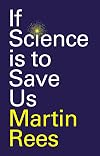
Here highly regarded British astronomer Rees offers his personal takes on the "tensions that can arise between scientists, the public, and policymakers" when it comes to addressing today's raft of global threats and challenges such as climate change. These threats are mostly traceable, I'd say, to the world's gross overpopulation, though Rees steers clear of saying that. The book has sections on what science is and how it works; connections with the military; different countries' science show more policies, organizations, and education (largely but not wholly focusing on the UK and the US), and various other topics and issues regarding the milieux for scientific work. How can we get political leaders to read it all? show less
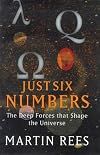
An excellent Popular Science trip through the bits that just seem weird with one of the world's great cosmologists. Sir Martin manages to keep things just about understandable for someone who needs to remind himself which one lambda is, but thinks it's Einstein's one.
It's 20 years since this was published and that means I'm off to figure out what's moved on as I certainly know parts have, but I'll feel more comfortable so doing having read this book.
It's 20 years since this was published and that means I'm off to figure out what's moved on as I certainly know parts have, but I'll feel more comfortable so doing having read this book.
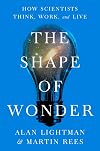
This book's title and subtitle accurately describe its content. It, or one like it, should be read by everyone prone to dismiss scientists as privileged elitists who are at last being treated with the scorn they deserve. (Trouble is, in these polarized times, I fear that it won't be.) The distinguished authors offer plenty of both simple facts, such as science having a mindset of disciplined wonder, and more elaborate truths, such as the enterprise's objectivity arising from interactions show more within the scientific community rather than from individual scientists. "Anecdotalism", a trait I often find to be unwelcome in contexts such as newscasts, finds an appropriate place here: eight detailed profiles of particular scientists are included, one in a chapter of its own and the others between chapters. The profilees of most interest to me were physicists John Mather and Werner Heisenberg. show less
Lists
Awards


You May Also Like


Associated Authors
Statistics
- Works
- 34
- Also by
- 17
- Members
- 3,438
- Popularity
- #7,396
- Rating
- 3.7
- Reviews
- 43
- ISBNs
- 140
- Languages
- 18
- Favorited
- 5