
Timothy Ferris
Author of Coming of Age in the Milky Way
About the Author
Timothy Ferris was born on August 29, 1944, in Miami, Florida. He graduated from Northwestern University with a B.A. in 1966 and did graduate work from 1966-1967. Ferris is the author of Coming of Age in the Milky Way, for which he was awarded the American Institute of Physics Prize and nominated show more for a Pulitzer Prize; The Red Limit; The Whole Shebang: A State of the Universe(s) Report; Galaxies; The Mind's Sky; The Science of Liberty: Democracy, Reason, and the Laws of Nature, and other popular books on astronomy and physics. He has received the American Institute of Physics Prize, the American Association for the Advancement of Science Prize, the Klumpke-Roberts Prize, and a Guggenheim Fellowship. Books by Ferris have been nominated for the National Book Award and the Pulitzer Prize. His PBS special, The Creation of the Universe, won an Emmy nomination in 1986. In addition to his books, Ferris is a former editor of Rolling Stone magazine and has authored more than 100 articles, essays, and reviews in such publications as Esquire, Nature, The New Republic, The New York Times Book Review, and Reader's Digest. He is a regular contributor to The New Yorker, writes a column for Scientific American, has served as an essayist for The MacNeil-Lehrer News Hour, and is a commentator for National Public Radio's All Things Considered. Ferris produced the Voyager phonograph record, an artifact of human civilization containing music, the sounds of Earth, and encoded photographs, that was launched aboard the Voyager spacecraft. He serves as a consultant to NASA on long-term space exploration policy. A polymath scholar, Ferris has taught in five disciplines at four universities including City University of New York and University of Southern California. Professor Ferris lives with his wife and family in San Francisco and teaches at the University of California, Berkeley, in the departments of journalism and astronomy, where he is an emeritus professor. (Bowker Author Biography) Timothy Ferris, author of seven books on astronomy, regularly contributes to such publications as The New Yorker, Life, Nature, Esquire, & The New York Times Magazine. He wrote & narrated the award-winning PBS television special "The Creation of the Universe." He lives in San Francisco, California. (Bowker Author Biography) show less
Disambiguation Notice:
Timothy Ferris, the author of The Whole Shebang and Red Limit, is not the same person as the Tim Ferriss, author of The Four Hour Work Week (note the second "s").
Works by Timothy Ferris
Associated Works
Perfectly Reasonable Deviations from the Beaten Track: The Letters of Richard P. Feynman (2005) — Foreword, some editions — 1,134 copies, 19 reviews
NightWatch : A Practical Guide to Viewing the Universe, 3rd ed. (1998) — Foreword, some editions — 431 copies, 3 reviews
The Second Creation: Makers of the Revolution in Twentieth-Century Physics (1986) — Foreword, some editions — 209 copies, 2 reviews
Tagged
Common Knowledge
- Birthdate
- 1944-08-29
- Gender
- male
- Education
- Northwestern University (BA|1966)
Coral Gables High School - Occupations
- emeritus professor (Journalism)
journalist
science writer - Organizations
- American Association for the Advancement of Science
National Aeronautics and Space Administration (Near-Earth Object Office Steering Committee)
University of California, Berkeley
United Press International
Rolling Stone - Awards and honors
- Klumpke-Roberts Award (1986)
Guggenheim Fellowship (1986-87)
American Association for the Advancement of Science (Fellow)
American Institute of Physics Prize - Nationality
- USA
- Birthplace
- Miami, Florida, USA
- Places of residence
- San Francisco, California, USA
- Disambiguation notice
- Timothy Ferris, the author of The Whole Shebang and Red Limit, is not the same person as the Tim Ferriss, author of The Four Hour Work Week (note the second "s").
- Associated Place (for map)
- USA
Members
Reviews
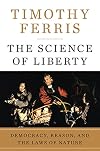
If knowledge is divine, than science is religion. This is the premise behind Ferris' "Science of Liberty," an epic journey beyond how science informs liberalism as a political ideology.
Wildly entertaining, profound and poignant at times, "The Science of Liberty" charts the roots of science to the humanism of Western Enlightenment. It details how rationalists refuted the conventional discourses of Fideism, challenged contemporary interpretations of God or altogether discarded them in their show more pursuit of comprehending nature.
While entertaining, it is lucid and informative. Indeed, if rationalism is your Creed than "The Science of Liberty" should be your scripture. show less
Wildly entertaining, profound and poignant at times, "The Science of Liberty" charts the roots of science to the humanism of Western Enlightenment. It details how rationalists refuted the conventional discourses of Fideism, challenged contemporary interpretations of God or altogether discarded them in their show more pursuit of comprehending nature.
While entertaining, it is lucid and informative. Indeed, if rationalism is your Creed than "The Science of Liberty" should be your scripture. show less

This ambitious work chronicles the history of how humans have come to understand the size, age, and origin of the universe. Given that this book was originally published in 1988, I'm sure that some of the data in the later chapters has since been disproven by more recent research; however, since it is primarily a history, it is not nearly as dated as most 1980's books on astrophysics probably are, and I wouldn't hesitate to recommend it to modern readers with an interest in the history of show more astronomy and physics.
Coming of Age in the Milky Way is in many ways a formative book for me. I first read it as a teen, and it helped to encourage my love for astronomy and physics (and later, to major in physics at university). The first two sections, which are a history of pre-20th century physics, are the most interesting to me personally. Ferris does an excellent job both of capturing the personalities involved (especially of figures like Galileo, Kepler, and Newton) and of describing the science in a succinct and understandable way. He covers a lot of ground, touching on geology and evolution as well as astronomy. The final section is less interesting to me, as quantum mechanics and the various theories associated with the Big Bang tend to make my head spin, and I kept wondering which 1980's theories are no longer valid today. Still, Coming of Age in the Milky Way is a well-written book that will likely always have a place on my bookshelf. show less
Coming of Age in the Milky Way is in many ways a formative book for me. I first read it as a teen, and it helped to encourage my love for astronomy and physics (and later, to major in physics at university). The first two sections, which are a history of pre-20th century physics, are the most interesting to me personally. Ferris does an excellent job both of capturing the personalities involved (especially of figures like Galileo, Kepler, and Newton) and of describing the science in a succinct and understandable way. He covers a lot of ground, touching on geology and evolution as well as astronomy. The final section is less interesting to me, as quantum mechanics and the various theories associated with the Big Bang tend to make my head spin, and I kept wondering which 1980's theories are no longer valid today. Still, Coming of Age in the Milky Way is a well-written book that will likely always have a place on my bookshelf. show less

This fascinating and very readable history of physics takes the read step-by-step through the great discoveries about the universe we live in. The book is divided into three sections. I was right with the author all through Space, got a little lost in Time, and then was quite overcome by Creation. No matter. Ferris's style is accessible for the non-scientist reader, but he doesn't talk down either.
I particularly enjoyed getting to know the great thinkers of human history: Galileo, Newton, show more Darwin, Einstein. Ferris sprinkles his narrative with personal anecdotes that give these geniuses personality. But he keeps pulling the reader onward, from the earliest conceptions of the universe as a closed system, the stars a ceiling just over our heads, to the vast reaches of time and space that we now know the universe to contain, to the mind-warping properties of the sub-molecular universe and the early moments following the Big Bang. I won't claim to have understood it all, but I found it all fascinating, and would recommend this book to anyone who looks out at the night sky and longs to understand what she sees. show less
I particularly enjoyed getting to know the great thinkers of human history: Galileo, Newton, show more Darwin, Einstein. Ferris sprinkles his narrative with personal anecdotes that give these geniuses personality. But he keeps pulling the reader onward, from the earliest conceptions of the universe as a closed system, the stars a ceiling just over our heads, to the vast reaches of time and space that we now know the universe to contain, to the mind-warping properties of the sub-molecular universe and the early moments following the Big Bang. I won't claim to have understood it all, but I found it all fascinating, and would recommend this book to anyone who looks out at the night sky and longs to understand what she sees. show less
Really enjoyed this as I did Timothy Ferris's other book "Coming of Age in the Milky Way." Part science, part history, part philosophy this book explores the connection between advances in scientific discovery and democratic liberalism. His thesis is that one cannot exist without the other, each feeding off the other as they progress. He believes society can only prosper in such an environment.
Most of the book cites examples that illustrate this, from Newton to the present day. He explores show more the relative freedom of liberal democratic societies comparing them with those that have tried to suppress it. He cites fascism, communism, religious fanaticism and postmodernism as culprits that inhibit this progress. Each he says, substitutes scientific objectivity with a relativism that encourages abuses of power and causes backwardness.
He levels some of his most pointed criticisms at the wave of postmodern deconstruction that has become fashionable at academic institutions in the 20th century. He views this trend with alarm as scholars make claims about the relativism of scientific discovery; asserting there is no objective scientific truth, and that any discovery that makes that claim is inherently tainted by the bias of the discoverer. A notion he views as beyond ridiculous - and dangerous. By assuming all scientific discovery is thus subject to disproof, students aren't encouraged to actually learn the science they have been trained to criticize.
Ferris even takes on one of the most influential works describing the history of science - Thomas Kuhn's landmark work "The Structure of Scientific Revolutions." Kuhn's assertion in that work is that scientific truth is not based on objective criteria, but is defined by the consensus of the scientific community. As such it consists not only of objective observation, but of the subjective perceptions of those forming that consensus. Discovery that comes into conflict with this consensus and breaks through it to form a new consensus are said to have initiated "paradigm shifts" - a term Kuhn coined to describe this sudden and successful change in that consensus. Since scientific truth cannot be ascertained objectively, there can be no such thing as an assertion of scientific truth.
Ferris views this as nonsense and simply another way to inject relativism and subjectivity into perceptions of scientific discovery. In this way those who have agendas other than the search for truth can assert that flaws in the scientific method are no different than flaws in any other system. They can thus conform their view of scientific discovery with whatever ideology they have constructed (e.g. "Socialist Science").
He also describes the ideological spectrum as a triangle. Instead of progressive and conservative at two ends of a line, they populate two vertices of a triangle, with liberalism at the other. As societies implement policies they move along these vertices toward more or less liberalism...and that these shifts can validly come from either the progressive or conservative side. Liberal democratic societies thus oscillate between them constantly trying to find the right balance of freedom and regulation to maximize progress. (this is a very quick and crude explanation of what Ferris describes in the book).
All of this is very well written in a smooth and non technical way. While reading it I found I suddenly understood concepts I had only a dim comprehension of before. It's only weakness in my opinion is the scrupulous effort made to balance any criticism of conservative ideology with one of progressivism...even if that attempt was strained. I also think he is too dismissive of criticisms of globalization, income inequality, and corporate power.
Highly recommended! show less
Most of the book cites examples that illustrate this, from Newton to the present day. He explores show more the relative freedom of liberal democratic societies comparing them with those that have tried to suppress it. He cites fascism, communism, religious fanaticism and postmodernism as culprits that inhibit this progress. Each he says, substitutes scientific objectivity with a relativism that encourages abuses of power and causes backwardness.
He levels some of his most pointed criticisms at the wave of postmodern deconstruction that has become fashionable at academic institutions in the 20th century. He views this trend with alarm as scholars make claims about the relativism of scientific discovery; asserting there is no objective scientific truth, and that any discovery that makes that claim is inherently tainted by the bias of the discoverer. A notion he views as beyond ridiculous - and dangerous. By assuming all scientific discovery is thus subject to disproof, students aren't encouraged to actually learn the science they have been trained to criticize.
Ferris even takes on one of the most influential works describing the history of science - Thomas Kuhn's landmark work "The Structure of Scientific Revolutions." Kuhn's assertion in that work is that scientific truth is not based on objective criteria, but is defined by the consensus of the scientific community. As such it consists not only of objective observation, but of the subjective perceptions of those forming that consensus. Discovery that comes into conflict with this consensus and breaks through it to form a new consensus are said to have initiated "paradigm shifts" - a term Kuhn coined to describe this sudden and successful change in that consensus. Since scientific truth cannot be ascertained objectively, there can be no such thing as an assertion of scientific truth.
Ferris views this as nonsense and simply another way to inject relativism and subjectivity into perceptions of scientific discovery. In this way those who have agendas other than the search for truth can assert that flaws in the scientific method are no different than flaws in any other system. They can thus conform their view of scientific discovery with whatever ideology they have constructed (e.g. "Socialist Science").
He also describes the ideological spectrum as a triangle. Instead of progressive and conservative at two ends of a line, they populate two vertices of a triangle, with liberalism at the other. As societies implement policies they move along these vertices toward more or less liberalism...and that these shifts can validly come from either the progressive or conservative side. Liberal democratic societies thus oscillate between them constantly trying to find the right balance of freedom and regulation to maximize progress. (this is a very quick and crude explanation of what Ferris describes in the book).
All of this is very well written in a smooth and non technical way. While reading it I found I suddenly understood concepts I had only a dim comprehension of before. It's only weakness in my opinion is the scrupulous effort made to balance any criticism of conservative ideology with one of progressivism...even if that attempt was strained. I also think he is too dismissive of criticisms of globalization, income inequality, and corporate power.
Highly recommended! show less
Lists
For Science! (3)
Read These Too (1)
Awards


You May Also Like


Associated Authors
Statistics
- Works
- 23
- Also by
- 11
- Members
- 6,783
- Popularity
- #3,602
- Rating
- 4.0
- Reviews
- 63
- ISBNs
- 142
- Languages
- 15
- Favorited
- 17
