

Johann Peter Hebel (1760–1826)
Author of How a Ghastly Story Was Brought to Light by a Common or Garden Butcher's Dog
About the Author
Disambiguation Notice:
(yid) VIAF:22180115
(ger) VIAF:22180115
Image credit: Image © ÖNB/Wien
Works by Johann Peter Hebel
How a Ghastly Story Was Brought to Light by a Common or Garden Butcher's Dog (2015) 239 copies, 7 reviews
Die schönsten Erzählungen aus Johann Peter Hebels "Schatzkästlein des rheinischen Hausfreundes" (1943) 3 copies
Kannitverstan — Author — 2 copies
Honorarordnung für architekten und ingenieure - HOAI 2013 : textausgabe mit Einführung und anmerkungen zu den wichtigsten neuerungen (2013) 2 copies
Erzählungen und Schwänke 2 copies
Der Vorsatz [Kurzgeschichte] 1 copy
Vergeltung [Kurzgeschichte] 1 copy
Der Akkord [Kurzgeschichte] 1 copy
Schweinfurt [Kurzgeschichte] 1 copy
Die Wette [Kurzgeschichte] 1 copy
Takvim Öyküleri 1 copy
Historias bíblicas 1 copy
Der Hering [Kurzgeschichte] 1 copy
Das Billard [Kurzgeschichte] 1 copy
Wenn da war [Kurzgeschichte] 1 copy
Gegenlüge [Kurzgeschichte] 1 copy
Werke in einem Band 1 copy
Teure Eier [Kurzgeschichte] 1 copy
Biblische Erzählungen 1 copy
Reinfahrt 1 copy
Geschichten und Anekdoten 1 copy
Francisca and Other Stories. 1 copy
Böser Markt [Kurzgeschichte] 1 copy
Die Probe [Kurzgeschichte] 1 copy
Das Merkmal [Kurzgeschichte] 1 copy
Gute Geduld [Kurzgeschichte] 1 copy
Der Rekrut [Kurzgeschichte] 1 copy
Associated Works
Poems Bewitched and Haunted (Everyman's Library Pocket Poets Series) (2005) — Contributor — 230 copies
Deutschland erzählt. Von Johann Wolfgang von Goethe bis Ludwig Tieck (1970) — Contributor — 26 copies
Dichtung der Romantik (10. Band) Volkstum I Lied, Märchen, Sage, Legende. Übersetztes aus fremdem Volkstum — Contributor — 3 copies
Lebensgut — Ein deutsches Lesebuch für Mädchen — 5. Teil (9. Schuljahr) — Contributor — 1 copy
Tagged
Common Knowledge
- Birthdate
- 1760-05-10
- Date of death
- 1826-09-22
- Gender
- male
- Occupations
- poet
teacher
theologian - Nationality
- Germany
- Birthplace
- Basel, Basel-Stadt, Switzerland
- Places of residence
- Basel, Switzerland
Hausen, Baden, Germany
Erlangen, Bayern, Deutschland
Hertingen, Bad Bellingen, Germany
Lörrach, Germany
Karlsruhe, Germany - Place of death
- Schwetzingen, Germany
- Burial location
- Friedhof Schwetzingen, Germany
- Disambiguation notice
- VIAF:22180115
- Associated Place (for map)
- Germany
Members
Reviews
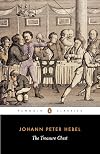
"What do you think I'm worth as I stand before you now?" — Hebel
On Being a Dunyazade
We often forget Dunyazade, sister of Scheherazade, who provides the initial hook leading into the 1001 Nights by asking the well-timed rhetorical question, "How about a story before bed?" Yet it's not clear why her presence is necessary in the frame narrative. One wonders whether she's surreptitiously helping the stories along as a mnemonic/rhetorical aide. (John Barth appears to explore this hypothetical show more in Chimera (1977).) Perhaps her presence as a third party is also serving a more subtle social/psychological role with respect to our modest king, Shahryar, who is quick to lop off a woman's head, but can't work up the courage to ask an importune question of a family guest (many such cases).
Occasionally, when reading 1001 Nights, one imagines Dunyazade fit for the role of a pivotal minor character. In Ali Baba and the Forty Thieves, she reminds us of Morgiana, Ali Baba's loyal slave who kills 37 thieves with a little pot of boiling oil. There's something wrong in that tale, but it's not the hole in the mountain that opens to the magic words, "Open Sesame." Rather, we wonder how it happens that our thieves, insensate as stone, continue to await the magic words as their comrades are slowly being burnt alive. There must be a trick that silences the screams of agony by which they would alert one another, perhaps the same one that forgets the murderous tension of the small hours in which Morgiana is heating a little can of lethal oil all night on a portable stove.
It takes a lot of time and effort to create bizarre narrative lapses such as this. The several centuries in which scholars have revised 1001 Nights, (and, per Heti, "put a lot of shit in the [tales]") have left their impression. This wasted time is useful, and quite literally gravid, in the sense that 1001 Nights concludes with the birth of Scheherazade's third child — 1001 days being the possible duration of three gestations in succession, albeit closely timed — Shahryar then spares the life of this mother of three. Even "wasted" time has a purpose. Narrative imperfection can also be useful, giving us something to hook onto, as the Disney Corporation has lucratively demonstrated by its improvements to Aladdin.
Martin Paul Eve is frequently commenting on the attraction of the modern "Mega-Novel," as in 2666, Gravity's Rainbow, and Ducks, Newburyport. In these expansive, repetitive, and often loosely-written texts, authors are suggesting that a lot of benefit derives from the didactic function of "slogging through a lot of shit," a phenomenon some would call "immersion in the text," but such a term neglects the actual work (and "wasted hours") spent deciphering the thousand-page book. When such a text is has been "worked over" by the years, we might occasionally be presented with something worth reading simply because it's as fraught as Aesop's Fables or as tangential as Grimm's Fairy Tales, or as uneven as the Complete Tales of Hans Christian Andersen, who often made a mess of it.
Some authors in this genre, ill-advised as Hebel, are going in the opposite direction. Those who are paring things down to a lilliputian "Treasure Chest," are thereby also becoming a Dunyazade — a merely "remarkable" entrée to a more interesting story being told by someone else. Perhaps, as we have been imagining, Dunyazade is doing great work behind the scenes. More likely, she's in the process of becoming Kierkegaard's humorous "encliticon to nothing." Though Hebel's work contains occasional burning spots of brightness:
On avoiding leading questions
"What do you think I’m worth as I stand here before you now?"
On not being put to death
"My masters back home are so fond of me that I know for certain if I went home they would never let me leave again."
On having one's nail cut clean off on a bet
"Alas, I have won." show less
On Being a Dunyazade
We often forget Dunyazade, sister of Scheherazade, who provides the initial hook leading into the 1001 Nights by asking the well-timed rhetorical question, "How about a story before bed?" Yet it's not clear why her presence is necessary in the frame narrative. One wonders whether she's surreptitiously helping the stories along as a mnemonic/rhetorical aide. (John Barth appears to explore this hypothetical show more in Chimera (1977).) Perhaps her presence as a third party is also serving a more subtle social/psychological role with respect to our modest king, Shahryar, who is quick to lop off a woman's head, but can't work up the courage to ask an importune question of a family guest (many such cases).
Occasionally, when reading 1001 Nights, one imagines Dunyazade fit for the role of a pivotal minor character. In Ali Baba and the Forty Thieves, she reminds us of Morgiana, Ali Baba's loyal slave who kills 37 thieves with a little pot of boiling oil. There's something wrong in that tale, but it's not the hole in the mountain that opens to the magic words, "Open Sesame." Rather, we wonder how it happens that our thieves, insensate as stone, continue to await the magic words as their comrades are slowly being burnt alive. There must be a trick that silences the screams of agony by which they would alert one another, perhaps the same one that forgets the murderous tension of the small hours in which Morgiana is heating a little can of lethal oil all night on a portable stove.
It takes a lot of time and effort to create bizarre narrative lapses such as this. The several centuries in which scholars have revised 1001 Nights, (and, per Heti, "put a lot of shit in the [tales]") have left their impression. This wasted time is useful, and quite literally gravid, in the sense that 1001 Nights concludes with the birth of Scheherazade's third child — 1001 days being the possible duration of three gestations in succession, albeit closely timed — Shahryar then spares the life of this mother of three. Even "wasted" time has a purpose. Narrative imperfection can also be useful, giving us something to hook onto, as the Disney Corporation has lucratively demonstrated by its improvements to Aladdin.
Martin Paul Eve is frequently commenting on the attraction of the modern "Mega-Novel," as in 2666, Gravity's Rainbow, and Ducks, Newburyport. In these expansive, repetitive, and often loosely-written texts, authors are suggesting that a lot of benefit derives from the didactic function of "slogging through a lot of shit," a phenomenon some would call "immersion in the text," but such a term neglects the actual work (and "wasted hours") spent deciphering the thousand-page book. When such a text is has been "worked over" by the years, we might occasionally be presented with something worth reading simply because it's as fraught as Aesop's Fables or as tangential as Grimm's Fairy Tales, or as uneven as the Complete Tales of Hans Christian Andersen, who often made a mess of it.
Some authors in this genre, ill-advised as Hebel, are going in the opposite direction. Those who are paring things down to a lilliputian "Treasure Chest," are thereby also becoming a Dunyazade — a merely "remarkable" entrée to a more interesting story being told by someone else. Perhaps, as we have been imagining, Dunyazade is doing great work behind the scenes. More likely, she's in the process of becoming Kierkegaard's humorous "encliticon to nothing." Though Hebel's work contains occasional burning spots of brightness:
On avoiding leading questions
"What do you think I’m worth as I stand here before you now?"
On not being put to death
"My masters back home are so fond of me that I know for certain if I went home they would never let me leave again."
On having one's nail cut clean off on a bet
"Alas, I have won." show less
How a Ghastly Story Was Brought to Light by a Common or Garden Butchers Dog (Penguin Little Black Classics) by Johann Peter Hebel
My parents were afraid of my sexuality, and so they kept me over-protected and forbidden from interacting or knowing much about the world until they spat me out into it. As a child I spent most of my time alone and understimulated. Now an adult, I do enjoy reading folk tales such as these, imagining that if I had at least discovered such things at an earlier age I might have been less surprised by people's cunning, duplicitousness and insincerity.
This collection is sold as containing show more "Kafka's favourite story," which is also presumably the one chosen for the title. Although that story did seem pretty straight forward to me, so I am surprised it was Kafka's favourite, but who knows! show less
This collection is sold as containing show more "Kafka's favourite story," which is also presumably the one chosen for the title. Although that story did seem pretty straight forward to me, so I am surprised it was Kafka's favourite, but who knows! show less
How a Ghastly Story Was Brought to Light by a Common or Garden Butchers Dog (Penguin Little Black Classics) by Johann Peter Hebel
A simple but entertaining collection of short stories. I enjoyed this book; it was a quick read and a good palate cleanser before I move onto something new (and longer!).

53 pages of brief morality tales - the biter bit - from early 19th C. Europe. Slight but fun.
Awards


You May Also Like


Associated Authors
Statistics
- Works
- 228
- Also by
- 15
- Members
- 764
- Popularity
- #33,304
- Rating
- 3.8
- Reviews
- 9
- ISBNs
- 87
- Languages
- 5
- Favorited
- 2