
Roman Krznaric
Author of How to Find Fulfilling Work
About the Author
Roman Krznaric is a cultural thinker and founding faculty member of The School of Life. He studied at the universities of Oxford, London and Essex, and has taught in Cambridge and London, where he gained his PhD. For several years he was Project Director at The Oxford Muse. His books include The show more Wonderbox: Curious Histories of How to Live and How to Find Fulfilling Work, and Empathy. He is the founder of the world's first Empathy Museum and of the digital Empathy Library. (Bowker Author Biography) show less
Works by Roman Krznaric
Associated Works
Future Ethics: Climate Change and Apocalyptic Imagination (2010) — Contributor — 16 copies, 2 reviews
Tagged
Common Knowledge
- Birthdate
- 1970
- Gender
- male
- Occupations
- cultural thinker
- Organizations
- The School of Life (founding faculty member)
Oxford University
Empathy Museum - Places of residence
- Sydney, New South Wales, Australia
Hong Kong - Map Location
- England, UK
Members
Reviews
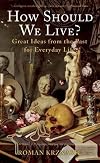
This review is based on the Blinkist version of the book...thus a summary and my review needs to be qualified as such. Presumably the original full text has much more details and research.....but it also takes much longer to read. If I like the Blinkist version, I might seek out and read the full book. Meantime here are a few nuggets that particularly struck me:
We might want to take a tip from the ancient Greeks, who had a much better approach to love. They believed that love took six show more distinguishable forms: Eros, the fiery, passionate yet dangerous love; Philia, the platonic love between friends and comrades; Ludus, the playfulness that is found among new lovers and children; Pragma, the deep understanding that grows over time between partners; Agape, the selfless, charitable love for our fellow humans; and Philautia, the love of the self, which could be either a positive acceptance or a detrimental self-obsession.
Rather than relying on one partner to satisfy all these needs, the ancient Greeks believed that each role could be fulfilled by different individuals. This allowed them to spread their emotional needs across a wide range of relationships, making it easier for them to find love.
Unfortunately, over the centuries, the six Greek forms of love gradually merged together. This merging began in the medieval literature of Arabia, which popularized the passion of eros between two lovers, and the joining of their souls....The idea spread to medieval Europe, where it was combined with the selflessness of agape and became cortezia, or courtly love. Chivalric culture expected knights to perform noble, selfless deeds in the name of passionate love. In the sixteenth century, the Dutch made these passions central to marriage, which was previously just a contract of alliance, and, in the process, combined them with the philia and pragma that grew between spouses. Finally, twentieth-century capitalism brought the narcissism of philautia, as love became tied to consumerism.
The word “husband” originally derived from a combination of “house” and “bound”? Originally, it referred to a man whose work was based around the home....In the United States today, housewives outnumber house-husbands by around 40:1. This situation is so widespread that many people consider it to be “natural.”....Right up until the Industrial Revolution–which forced many men into factory work–men and women would generally both work around the home, and share in the housework.
Another huge problem is that modern family members don’t speak to each other enough,
in nineteenth-century France, a culture developed where women would first serve the men at the table, before going off to eat their own dinners on their own, either standing or holding it on their laps.....Then there’s eating in silence, which evolved from early Christian ideas of piety. Monks and other devotees would avoid unnecessary conversation......Finally, we have the emotional repression that resulted from the eighteenth-century belief that conversation should be intellectual rather than trivial......These historical factors have recently found another ally in technology. Couples today spend more time watching television together–around 55 minutes per day–than they do directly conversing.
It’s now thought that empathy may have evolved among our ancestors to help them develop communities, thus improving their chances of survival. Indeed, other social animals such as dolphins and elephants also display empathetic behaviour.
There are three historical templates that facilitate empathy: experience, conversation and social action......By embracing and engaging our empathy, we can both change our own perspectives and have a positive effect on the lives of others, too.
Before the Industrial Revolution, almost everything was produced by individual craftspeople. A cobbler made the whole shoe; a tailor, the whole shirt.......In the eighteenth century, the economist Adam Smith argued that the best way to increase productivity was by dividing complex work into stages.....increasing productivity from 1 pin per day to almost 5,000.
Though this model did increase productivity, it also eroded people’s engagement with their work......History offers four purpose-providing templates that might help us become less alienated from our work.
The first is to work toward meaningful goals. Psychotherapist Viktor Frankl lived through both world wars, and survived multiple Nazi concentration camps. [This is true but appears to be a bit overstated. He spent most of his time in a showpiece concentration camp...then about 6 months in a “serious” death camp but was somewhat protected because of his Dr status and at the end of his incarceration he was held in a comparatively “humane” camp and he maintained a relationship with the commandant after the war]. He found that other camp survivors generally had a goal beyond survival.....We can also find motivation in our desire to help others. In the early twentieth century, polymath Albert Schweitzer abandoned his musical and academic careers and retrained as a doctor.....Earning respect and recognition also imbues work with purpose. Ever since Henry Ford argued that his employees wouldn’t mind the monotonous production-line work as long as their wages were high enough, companies have opted to pay workers more money and less respect.
Or we could find engagement by employing our full skill set. Most workers today specialize in a limited range of tasks. But during the Italian Renaissance, being a generalist–like Leonardo da Vinci–was considered the ultimate achievement.
Time seems like a natural part of things, but it wasn’t properly measured......First came the invention of the mechanical clock, back in thirteenth-century Europe. Initially used to notify monks when to pray, clocks......In 1370, one was built in Cologne, Germany, and within four years it was dictating the start and end of workers’ days, as well as a one-hour lunch break. Sound familiar?..... According to the historian Lewis Mumford, the clock defined the age even more than the steam engine..... Josiah Wedgwood, introduced the system of clocking into work in the late eighteenth century, and penalizing tardy workers....This growing preoccupation with time eventually led to the world we know today, where everything moves at an ever-faster pace, be it transport, technology or food.....Viking warriors believed that their actions would be judged by descendants and ancestors alike, and so they acted with great consideration and without haste.....Perhaps we could just slow down, like the novelist Gustave Flaubert, who took five years to write Madam Bovary.
What we know as consumerism developed with industrialization....By the end of the nineteenth century, shopping and lifestyle had fused together, a merger that would go on to define modern life....In the late 1800s, Bon Marché, one of the first department stores, opened in Paris.....Buying things was now a leisure pursuit.....We feel the need for the latest and most expensive things simply because we want to stay abreast of current trends, and this drives us to relentlessly pursue money....Could simple living offer a refreshing alternative?....Henry David Thoreau grew disillusioned with the growing consumerism around him. He retreated to a woodland cabin just outside town. For two years, he lived off the land, catching and growing his own food, but spending most of his
time at leisure, and recording his experiences in the book Walden. [I believe that this might be somewhat overstated as well....I understand that Thoreau regularly went home for lunch or dinner with friends and family ....nice if you have an accommodating mother...takes some of the stress out of catching your own squirrel].
Aristotle believed in an overarching symmetry. Aristotle posited that, since there were five elements (fire, air, water, earth and ether), there must only be five senses. But, recently, scientists have been able to confirm Plato’s idea of temperature perception, now known as thermoception. And it doesn’t stop there. They’ve also identified a sense of balance, equilibrioception, and even magnetoreception, an ability–albeit extremely weak–to detect magnetic fields, much like homing pigeons.......The dominant sense in Western society today is vision, but this dominance is by no means natural; it’s cultural.......Consider Kaspar Hauser, a boy who suddenly appeared one day in nineteenth-century Nuremberg. Having been raised away from society–he claimed he’d grown up in a dark dungeon–he was unable to communicate, but he possessed extremely heightened senses. As he assimilated and shared his story and experiences, however, his sensitivities faded, until he was not much different from the people around him......Hauser shows us that our sensory preferences are learned.....Medieval science believed in five additional “inner” senses: fantasy, instinct, memory, imagination and “common sense.” [I’ve just been following a medical conference where balance was a major issue and it’s centred on the inner ear and links with the brain. I don’t see the sense of balance mentioned much but it’s certainly not the same as touch...though some of the sense is from the feet and some (about 30% from sight and if hearing is lost in one ear, then the brain can gradually learn to compensate...though it’s never 100%).
In the nineteenth century, English preacher Thomas Cook organized a trip from Leicester to Loughborough for poor workers to attend a temperance meeting. Five hundred people attended, which inspired him to organize further tours to Europe, the general goal being to open people up to travel and expand their worldviews......If we look to the past, we find four historical personas whose example could help us reclaim Cook’s vision of travel as a force of change, rather than a simple leisure pursuit....The first is the pilgrim.....We could also emulate the nomad......There’s also the explorer......Cobbett, who travelled Victorian England to learn about the effects of industrialization.....by keeping an open mind and actually exploring what was out there, found that travel fundamentally changed his worldview. Or we could just reimagine what it is to be a tourist.
Today, nature serves as a source of three things: beauty, psychological health and natural resources.....The Romantic movement, responding to urbanization and industrialization, painted nature as a frightening yet beautiful.....Before this movement, forests were often feared.....In fact, we have a tendency to be drawn to nature, and actually derive calm and health from it, which is known scientifically as biophilia.....With industrialization, we have reached a point where we consume natural resources at an alarming rate, all in the name of human comfort....This separation from, and ultimate human dominance of, nature has brought about what is known as the end of nature. But what if we swapped a carbon-emission heavy flight to the Caribbean for a camping trip in the local forest?
Every one of us holds some sort of belief.....But where do all these beliefs come from?
They are the personal values against which we judge the goodness or harm of a particular action, and they shape our relationship with the world. But we rarely question beliefs’ validity. [Confusing beliefs and values here. Beliefs are NOT values. You can have a belief that the sun will rise tomorrow. Or that you will bleed if you cut yourself. These beliefs have nothing to do with values. Values are (at very least) second order desires; at the second level it certainly involves a belief...the besire to desire. So one might have a belief that taking drugs is bad for them combined with a desire that they NOT desire drugs]......A major American study into post-World War II religious preferences showed that 90 percent of Protestants, 82 percent of Catholics and 87 percent of Jews still adhere to the religion they were raised in.......about one-third of people leave their religion at some point, only to return to it in later life, which shows how our upbringing has an effect on us that will likely last a lifetime.....Another good example [of the difficulty of changing] is nationalism. Many people believe in the importance or even superiority of their own country.......George Bernard Shaw saw the absurdity of this. Where you’re born is entirely a matter of chance, so the likelihood that your country is actually superior is extremely small, and is, in fact, just a cultural idea
you’ve inherited from those around you.
So it’s important to scrutinize what we are taught and be ready to change our beliefs.
Consider the case of the author Leo Tolstoy, who was born into the Russian aristocracy in the 1800s,.....By questioning the beliefs held by those around him, he completely altered his way of life and followed his own moral compass for the rest of his days.
“Common sense is the collection of prejudices acquired by age eighteen.”–Albert Einstein
The word creativity comes from creare, the Latin for “to make or produce,” and it is a vital part of evolutionary activity.In medieval Europe, it was thought that only God could create from nothing.....However, in fifteenth-century Italy, the “genius of man”–that is, his ability to create, and not just copy, beautiful things–was finally declared.....Michelangelo produced an extensive and enormously popular body of work, which earned him a reputation during his lifetime that still persists today. Even now, he embodies the notion of “God-given talent”
we should try to bring a craftsman mentality to our existing work, as William Morris did in nineteenth-century Britain.......This is an almost direct rebuke of Adam Smith’s pin-factory method, which removed these skills and pleasures from our work......Historian Philippe Ariès claims that people in the Middle Ages were probably the most in love with life. Forever facing the risk of death from violence, hunger and disease gave people the sense that life is a gift to be cherished. [So is he suggesting that this short brutish life is preferable to what we have today?].....We can see the parallels of this today in the transformation of those who undergo near-death experiences–people who, having stared death in the face, now live life to the fullest.
Despite 70 percent of people today saying they too would like to die at home, over half will die in hospitals, an environment from which children are often kept away.....Funerals have also become more modest. Elaborate processions have been replaced by swift and efficient services, and while stranger participation was at one time a common and almost expected occurrence, this would be almost unthinkable today.....Between 1960 and 2008, cremations in Britain increased from 35 to 72 percent. Cremated bodies are much less likely to be given any monument, not to mention that they’ve been completely removed from view......We might want to consider breaking the taboo and redefining our relationship with death through open conversation and public ritual.
The key message: The modern art of living can be hard to master. But by remembering how our ancestors lived, we can rediscover and incorporate some helpful practices, such as challenging ourselves and our beliefs, rethinking romantic paradigms, embracing our inner creativity, getting back in touch with nature, only spending money on what we really need and challenging taboos surrounding death. As Johann Wolfgang von Goethe said, “He who cannot draw on three thousand years of history is living from hand to mouth.”
Actionable advice: Swim against the social tide. All of the examples of better living in these blinks have one thing in common: they require us to go against prevailing conventions. If we scrutinize our perceptions and are ready to break from convention, we can develop the freedom to create our own individual art of living that works best for us.
My take on the book? Generally, I don’t have too much argument with the individual things he recommends though he really doesn’t understand the difference between values and beliefs. But the idea that somehow, the ancients got it all right and we just have to return to a simpler way of living to live the “good life” I find risible. Living with casual violence, disease, famine, slavery, freezing in winter--- sweltering in summer, lack of choice, lack of running water, sewerage, electricity, subject to tyrants, no freedom of belief, supporting fat abbots etc etc......doesn’t sound so great to me. But maybe he’s not really arguing this but is simply saying that we should learn from the past and incorporate it into our modern way of life. OK. Not too much to argue with there. An interesting book. Three stars from me. show less
We might want to take a tip from the ancient Greeks, who had a much better approach to love. They believed that love took six show more distinguishable forms: Eros, the fiery, passionate yet dangerous love; Philia, the platonic love between friends and comrades; Ludus, the playfulness that is found among new lovers and children; Pragma, the deep understanding that grows over time between partners; Agape, the selfless, charitable love for our fellow humans; and Philautia, the love of the self, which could be either a positive acceptance or a detrimental self-obsession.
Rather than relying on one partner to satisfy all these needs, the ancient Greeks believed that each role could be fulfilled by different individuals. This allowed them to spread their emotional needs across a wide range of relationships, making it easier for them to find love.
Unfortunately, over the centuries, the six Greek forms of love gradually merged together. This merging began in the medieval literature of Arabia, which popularized the passion of eros between two lovers, and the joining of their souls....The idea spread to medieval Europe, where it was combined with the selflessness of agape and became cortezia, or courtly love. Chivalric culture expected knights to perform noble, selfless deeds in the name of passionate love. In the sixteenth century, the Dutch made these passions central to marriage, which was previously just a contract of alliance, and, in the process, combined them with the philia and pragma that grew between spouses. Finally, twentieth-century capitalism brought the narcissism of philautia, as love became tied to consumerism.
The word “husband” originally derived from a combination of “house” and “bound”? Originally, it referred to a man whose work was based around the home....In the United States today, housewives outnumber house-husbands by around 40:1. This situation is so widespread that many people consider it to be “natural.”....Right up until the Industrial Revolution–which forced many men into factory work–men and women would generally both work around the home, and share in the housework.
Another huge problem is that modern family members don’t speak to each other enough,
in nineteenth-century France, a culture developed where women would first serve the men at the table, before going off to eat their own dinners on their own, either standing or holding it on their laps.....Then there’s eating in silence, which evolved from early Christian ideas of piety. Monks and other devotees would avoid unnecessary conversation......Finally, we have the emotional repression that resulted from the eighteenth-century belief that conversation should be intellectual rather than trivial......These historical factors have recently found another ally in technology. Couples today spend more time watching television together–around 55 minutes per day–than they do directly conversing.
It’s now thought that empathy may have evolved among our ancestors to help them develop communities, thus improving their chances of survival. Indeed, other social animals such as dolphins and elephants also display empathetic behaviour.
There are three historical templates that facilitate empathy: experience, conversation and social action......By embracing and engaging our empathy, we can both change our own perspectives and have a positive effect on the lives of others, too.
Before the Industrial Revolution, almost everything was produced by individual craftspeople. A cobbler made the whole shoe; a tailor, the whole shirt.......In the eighteenth century, the economist Adam Smith argued that the best way to increase productivity was by dividing complex work into stages.....increasing productivity from 1 pin per day to almost 5,000.
Though this model did increase productivity, it also eroded people’s engagement with their work......History offers four purpose-providing templates that might help us become less alienated from our work.
The first is to work toward meaningful goals. Psychotherapist Viktor Frankl lived through both world wars, and survived multiple Nazi concentration camps. [This is true but appears to be a bit overstated. He spent most of his time in a showpiece concentration camp...then about 6 months in a “serious” death camp but was somewhat protected because of his Dr status and at the end of his incarceration he was held in a comparatively “humane” camp and he maintained a relationship with the commandant after the war]. He found that other camp survivors generally had a goal beyond survival.....We can also find motivation in our desire to help others. In the early twentieth century, polymath Albert Schweitzer abandoned his musical and academic careers and retrained as a doctor.....Earning respect and recognition also imbues work with purpose. Ever since Henry Ford argued that his employees wouldn’t mind the monotonous production-line work as long as their wages were high enough, companies have opted to pay workers more money and less respect.
Or we could find engagement by employing our full skill set. Most workers today specialize in a limited range of tasks. But during the Italian Renaissance, being a generalist–like Leonardo da Vinci–was considered the ultimate achievement.
Time seems like a natural part of things, but it wasn’t properly measured......First came the invention of the mechanical clock, back in thirteenth-century Europe. Initially used to notify monks when to pray, clocks......In 1370, one was built in Cologne, Germany, and within four years it was dictating the start and end of workers’ days, as well as a one-hour lunch break. Sound familiar?..... According to the historian Lewis Mumford, the clock defined the age even more than the steam engine..... Josiah Wedgwood, introduced the system of clocking into work in the late eighteenth century, and penalizing tardy workers....This growing preoccupation with time eventually led to the world we know today, where everything moves at an ever-faster pace, be it transport, technology or food.....Viking warriors believed that their actions would be judged by descendants and ancestors alike, and so they acted with great consideration and without haste.....Perhaps we could just slow down, like the novelist Gustave Flaubert, who took five years to write Madam Bovary.
What we know as consumerism developed with industrialization....By the end of the nineteenth century, shopping and lifestyle had fused together, a merger that would go on to define modern life....In the late 1800s, Bon Marché, one of the first department stores, opened in Paris.....Buying things was now a leisure pursuit.....We feel the need for the latest and most expensive things simply because we want to stay abreast of current trends, and this drives us to relentlessly pursue money....Could simple living offer a refreshing alternative?....Henry David Thoreau grew disillusioned with the growing consumerism around him. He retreated to a woodland cabin just outside town. For two years, he lived off the land, catching and growing his own food, but spending most of his
time at leisure, and recording his experiences in the book Walden. [I believe that this might be somewhat overstated as well....I understand that Thoreau regularly went home for lunch or dinner with friends and family ....nice if you have an accommodating mother...takes some of the stress out of catching your own squirrel].
Aristotle believed in an overarching symmetry. Aristotle posited that, since there were five elements (fire, air, water, earth and ether), there must only be five senses. But, recently, scientists have been able to confirm Plato’s idea of temperature perception, now known as thermoception. And it doesn’t stop there. They’ve also identified a sense of balance, equilibrioception, and even magnetoreception, an ability–albeit extremely weak–to detect magnetic fields, much like homing pigeons.......The dominant sense in Western society today is vision, but this dominance is by no means natural; it’s cultural.......Consider Kaspar Hauser, a boy who suddenly appeared one day in nineteenth-century Nuremberg. Having been raised away from society–he claimed he’d grown up in a dark dungeon–he was unable to communicate, but he possessed extremely heightened senses. As he assimilated and shared his story and experiences, however, his sensitivities faded, until he was not much different from the people around him......Hauser shows us that our sensory preferences are learned.....Medieval science believed in five additional “inner” senses: fantasy, instinct, memory, imagination and “common sense.” [I’ve just been following a medical conference where balance was a major issue and it’s centred on the inner ear and links with the brain. I don’t see the sense of balance mentioned much but it’s certainly not the same as touch...though some of the sense is from the feet and some (about 30% from sight and if hearing is lost in one ear, then the brain can gradually learn to compensate...though it’s never 100%).
In the nineteenth century, English preacher Thomas Cook organized a trip from Leicester to Loughborough for poor workers to attend a temperance meeting. Five hundred people attended, which inspired him to organize further tours to Europe, the general goal being to open people up to travel and expand their worldviews......If we look to the past, we find four historical personas whose example could help us reclaim Cook’s vision of travel as a force of change, rather than a simple leisure pursuit....The first is the pilgrim.....We could also emulate the nomad......There’s also the explorer......Cobbett, who travelled Victorian England to learn about the effects of industrialization.....by keeping an open mind and actually exploring what was out there, found that travel fundamentally changed his worldview. Or we could just reimagine what it is to be a tourist.
Today, nature serves as a source of three things: beauty, psychological health and natural resources.....The Romantic movement, responding to urbanization and industrialization, painted nature as a frightening yet beautiful.....Before this movement, forests were often feared.....In fact, we have a tendency to be drawn to nature, and actually derive calm and health from it, which is known scientifically as biophilia.....With industrialization, we have reached a point where we consume natural resources at an alarming rate, all in the name of human comfort....This separation from, and ultimate human dominance of, nature has brought about what is known as the end of nature. But what if we swapped a carbon-emission heavy flight to the Caribbean for a camping trip in the local forest?
Every one of us holds some sort of belief.....But where do all these beliefs come from?
They are the personal values against which we judge the goodness or harm of a particular action, and they shape our relationship with the world. But we rarely question beliefs’ validity. [Confusing beliefs and values here. Beliefs are NOT values. You can have a belief that the sun will rise tomorrow. Or that you will bleed if you cut yourself. These beliefs have nothing to do with values. Values are (at very least) second order desires; at the second level it certainly involves a belief...the besire to desire. So one might have a belief that taking drugs is bad for them combined with a desire that they NOT desire drugs]......A major American study into post-World War II religious preferences showed that 90 percent of Protestants, 82 percent of Catholics and 87 percent of Jews still adhere to the religion they were raised in.......about one-third of people leave their religion at some point, only to return to it in later life, which shows how our upbringing has an effect on us that will likely last a lifetime.....Another good example [of the difficulty of changing] is nationalism. Many people believe in the importance or even superiority of their own country.......George Bernard Shaw saw the absurdity of this. Where you’re born is entirely a matter of chance, so the likelihood that your country is actually superior is extremely small, and is, in fact, just a cultural idea
you’ve inherited from those around you.
So it’s important to scrutinize what we are taught and be ready to change our beliefs.
Consider the case of the author Leo Tolstoy, who was born into the Russian aristocracy in the 1800s,.....By questioning the beliefs held by those around him, he completely altered his way of life and followed his own moral compass for the rest of his days.
“Common sense is the collection of prejudices acquired by age eighteen.”–Albert Einstein
The word creativity comes from creare, the Latin for “to make or produce,” and it is a vital part of evolutionary activity.In medieval Europe, it was thought that only God could create from nothing.....However, in fifteenth-century Italy, the “genius of man”–that is, his ability to create, and not just copy, beautiful things–was finally declared.....Michelangelo produced an extensive and enormously popular body of work, which earned him a reputation during his lifetime that still persists today. Even now, he embodies the notion of “God-given talent”
we should try to bring a craftsman mentality to our existing work, as William Morris did in nineteenth-century Britain.......This is an almost direct rebuke of Adam Smith’s pin-factory method, which removed these skills and pleasures from our work......Historian Philippe Ariès claims that people in the Middle Ages were probably the most in love with life. Forever facing the risk of death from violence, hunger and disease gave people the sense that life is a gift to be cherished. [So is he suggesting that this short brutish life is preferable to what we have today?].....We can see the parallels of this today in the transformation of those who undergo near-death experiences–people who, having stared death in the face, now live life to the fullest.
Despite 70 percent of people today saying they too would like to die at home, over half will die in hospitals, an environment from which children are often kept away.....Funerals have also become more modest. Elaborate processions have been replaced by swift and efficient services, and while stranger participation was at one time a common and almost expected occurrence, this would be almost unthinkable today.....Between 1960 and 2008, cremations in Britain increased from 35 to 72 percent. Cremated bodies are much less likely to be given any monument, not to mention that they’ve been completely removed from view......We might want to consider breaking the taboo and redefining our relationship with death through open conversation and public ritual.
The key message: The modern art of living can be hard to master. But by remembering how our ancestors lived, we can rediscover and incorporate some helpful practices, such as challenging ourselves and our beliefs, rethinking romantic paradigms, embracing our inner creativity, getting back in touch with nature, only spending money on what we really need and challenging taboos surrounding death. As Johann Wolfgang von Goethe said, “He who cannot draw on three thousand years of history is living from hand to mouth.”
Actionable advice: Swim against the social tide. All of the examples of better living in these blinks have one thing in common: they require us to go against prevailing conventions. If we scrutinize our perceptions and are ready to break from convention, we can develop the freedom to create our own individual art of living that works best for us.
My take on the book? Generally, I don’t have too much argument with the individual things he recommends though he really doesn’t understand the difference between values and beliefs. But the idea that somehow, the ancients got it all right and we just have to return to a simpler way of living to live the “good life” I find risible. Living with casual violence, disease, famine, slavery, freezing in winter--- sweltering in summer, lack of choice, lack of running water, sewerage, electricity, subject to tyrants, no freedom of belief, supporting fat abbots etc etc......doesn’t sound so great to me. But maybe he’s not really arguing this but is simply saying that we should learn from the past and incorporate it into our modern way of life. OK. Not too much to argue with there. An interesting book. Three stars from me. show less
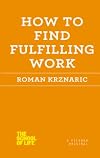
This is a brief but laser-focused manual whose clear intention is to get you out of the rat race. It basically comes to the same conclusion as Daniel Pink's Drive. Both agree that three main motivators keep people satisfied, and maybe even happy, at work: freedom, flow, and meaning. (Pink calls them autonomy, mastery, and purpose.) What about money? status? Both men shoot those down as ultimately unsatisfying. Find work that gives you the magic trifecta, and you'll be happier. The book gives show more you several fun and practical activities to help you get on the road to finding more fulfilling work -- even if you have to make up your own job title. show less

This self-help book is for people who are having second thoughts about their work, and who have felt unhappy about it for a while, but are feeling unable to do anything about it. It may help you sort out your thoughts and guide you through a few exercises that, in turn, might help you realise what it is that you dislike about your work and what exactly you can attempt to change. I am sure that some people may even realise that it is not their work that they are unhappy about... it is a show more simple book with a lovely smooth cover - you will want to cradle it in your hands forever. That would probably be a bad idea, though, because what the book urges you to do is - act first, think about it later. I like that approach a lot, I must admit. show less
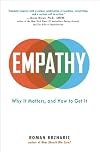
Krznaric is no mug. Starting with the discovery of the mirror neurone, which seems to explain how humans can be empathic, he provides a practical road map for exercising and developing one's empathic capacities. The book is easy to read, full of interesting examples, and well referenced and indexed.
I searched in vain for any reference to an explanation of just how our brain's empathic ability works--a psychology of empathy perhaps. It's surprising that Krznaric seems not to have heard of show more René Girard. As one reviewer here observes, mirror neurones perhaps work both selfishly and selflessly. Indeed, Girard's work explicates that.
However, the triumph of books like this one is that they help us to knock down the myth of Individualism that pervades so much of existence today. The alternative, that humans are social inter-dividual beings is becoming clearer. Whether we shall use our interdividuality for empathy, or resentment and scapegoating, depends on how well be begin to understand ourselves. show less
I searched in vain for any reference to an explanation of just how our brain's empathic ability works--a psychology of empathy perhaps. It's surprising that Krznaric seems not to have heard of show more René Girard. As one reviewer here observes, mirror neurones perhaps work both selfishly and selflessly. Indeed, Girard's work explicates that.
However, the triumph of books like this one is that they help us to knock down the myth of Individualism that pervades so much of existence today. The alternative, that humans are social inter-dividual beings is becoming clearer. Whether we shall use our interdividuality for empathy, or resentment and scapegoating, depends on how well be begin to understand ourselves. show less
Lists
Awards


You May Also Like


Associated Authors
Statistics
- Works
- 14
- Also by
- 3
- Members
- 887
- Popularity
- #28,886
- Rating
- 3.6
- Reviews
- 11
- ISBNs
- 74
- Languages
- 8