
Kathleen McCleary
Author of House and Home
About the Author
Image credit: Kathleen McCleary
Works by Kathleen McCleary
(Folio) Nora O'Donnell 1 copy
Associated Works
Author in Progress: A No-Holds-Barred Guide to What It Really Takes to Get Published (2016) — Contributor — 72 copies, 1 review
Tagged
Common Knowledge
- Canonical name
- McCleary, Kathleen
- Gender
- female
- Birthplace
- Grosse Pointe Farms, Michigan, USA
- Places of residence
- Grosse Pointe Farms, Michigan, USA
New York, USA
Tennessee, USA
Virginia, USA
Oregon, USA - Associated Place (for map)
- USA
Members
Reviews
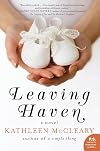
Best friends are there for each other no matter what. A best friend is the person you turn to when things are hard in your life, a pillar to support you. She's the family you've chosen rather than the family you've been born into. There's little or nothing you wouldn't do for your best friend. But there are things that can tear even best friends apart. There are still "no go" zones. In Kathleen McCleary's newest novel, Leaving Haven, a pair of best friends, closer than sisters, are show more irreparably broken by the unimaginable choices of one of the pair.
Opening with Georgia having just given birth to a baby boy, telling him she didn't think she was going to love him but that she does, and then abandoning him at the hospital, the novel immediately signals to the reader that there is something very, very amiss. It quickly jumps backwards in time to life before baby Haven. Georgia and Alice are best friends. They met when their 13 year old daughters were babies and they've been inseparable, if very different, friends ever since. Georgia, a baker and cake designer, is creative, maternal, and spontaneous. Her husband John is a chef and he's impulsive and passionate. They have the one daughter, Liza, and have struggled for ten years through miscarriages and infertility trying to have another baby. Alice is calm and controlled, always meticulous, a planner. Her husband Duncan is unruffled, a workaholic, steady and dependable, and just the tiniest bit dull. They also have only the one daughter, Wren, and Alice doesn't want another child. But Alice sees how desperately Georgia does and she offers to donate her eggs to Georgia and John so that Georgia's long held dream of another baby can come true.
And miracle upon miracles, Georgia, thanks to Alice's donated egg, becomes pregnant. But with the pregnancy come complications and a betrayal so enormous they expose the cracks in Georgia and John's marriage as well as Alice and Duncan's marriage, and threaten to destroy Georgia and Alice's friendship forever. The middle section of the novel jumps around in time (sometimes a bit confusingly) and changes focus from Alice to Georgia in alternating chapters, making clear to the reader what they love about each other, the ways in which each desperately envies her dearest friend, and what drives each of them in her life. The changing character focus lays bare each woman's emotional needs, the state of her marriage, and the ways the past formed each of them and continues to influence their presents. But it is in the end, when the story's chronology returns to linear, where the emotional pitch is most focused, after an explosive discovery and Georgia walks away from her baby.
The plot twist that fuels the story is meant to be slowly revealed but it is fairly obvious right from the beginning and the catalyst that made it possible, teenaged Liza and Wren's relationship, seemed unlikely to have been handled as it was by Alice. For such a large plot driver, there was actually very little made of the situation between the girls so their young instance of betrayal, which, in some ways, should have mirrored the larger betrayal between their mothers, didn't quite get there. Husbands Duncan and John are described mainly in relation to their wives and so never quite come completely, dimensionally to life. And the ending is just a bit too much, a bit too over the top and unbelievable. Despite these weaknesses, McCleary has imbued this sorrowful tale of a friendship's demise with all the shattered, raw emotion that such stakes call for. She has drawn the all-encompassing waves of hurt surrounding all of the major characters and the devastating fall-out beautifully. And no matter the ultimate outcome of the horrible, gaping rift between them, Georgia and Alice will always be together, embodied in the person of baby Haven, genetically Alice's son but nurtured or nine months by Georgia's body and whose name provides many levels of symbolism through the story. If the premise of the story is rather unlikely, still the emotional truth is spot on in this tale of friendship, betrayal, fidelity, trust, and shame. show less
Opening with Georgia having just given birth to a baby boy, telling him she didn't think she was going to love him but that she does, and then abandoning him at the hospital, the novel immediately signals to the reader that there is something very, very amiss. It quickly jumps backwards in time to life before baby Haven. Georgia and Alice are best friends. They met when their 13 year old daughters were babies and they've been inseparable, if very different, friends ever since. Georgia, a baker and cake designer, is creative, maternal, and spontaneous. Her husband John is a chef and he's impulsive and passionate. They have the one daughter, Liza, and have struggled for ten years through miscarriages and infertility trying to have another baby. Alice is calm and controlled, always meticulous, a planner. Her husband Duncan is unruffled, a workaholic, steady and dependable, and just the tiniest bit dull. They also have only the one daughter, Wren, and Alice doesn't want another child. But Alice sees how desperately Georgia does and she offers to donate her eggs to Georgia and John so that Georgia's long held dream of another baby can come true.
And miracle upon miracles, Georgia, thanks to Alice's donated egg, becomes pregnant. But with the pregnancy come complications and a betrayal so enormous they expose the cracks in Georgia and John's marriage as well as Alice and Duncan's marriage, and threaten to destroy Georgia and Alice's friendship forever. The middle section of the novel jumps around in time (sometimes a bit confusingly) and changes focus from Alice to Georgia in alternating chapters, making clear to the reader what they love about each other, the ways in which each desperately envies her dearest friend, and what drives each of them in her life. The changing character focus lays bare each woman's emotional needs, the state of her marriage, and the ways the past formed each of them and continues to influence their presents. But it is in the end, when the story's chronology returns to linear, where the emotional pitch is most focused, after an explosive discovery and Georgia walks away from her baby.
The plot twist that fuels the story is meant to be slowly revealed but it is fairly obvious right from the beginning and the catalyst that made it possible, teenaged Liza and Wren's relationship, seemed unlikely to have been handled as it was by Alice. For such a large plot driver, there was actually very little made of the situation between the girls so their young instance of betrayal, which, in some ways, should have mirrored the larger betrayal between their mothers, didn't quite get there. Husbands Duncan and John are described mainly in relation to their wives and so never quite come completely, dimensionally to life. And the ending is just a bit too much, a bit too over the top and unbelievable. Despite these weaknesses, McCleary has imbued this sorrowful tale of a friendship's demise with all the shattered, raw emotion that such stakes call for. She has drawn the all-encompassing waves of hurt surrounding all of the major characters and the devastating fall-out beautifully. And no matter the ultimate outcome of the horrible, gaping rift between them, Georgia and Alice will always be together, embodied in the person of baby Haven, genetically Alice's son but nurtured or nine months by Georgia's body and whose name provides many levels of symbolism through the story. If the premise of the story is rather unlikely, still the emotional truth is spot on in this tale of friendship, betrayal, fidelity, trust, and shame. show less
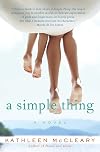
I don't read a lot of domestic fiction. Too often it's about the problems of suburban housewives/mommies or families with a much higher than average income and I just don't really relate having been neither of those categories. I was an urban mommy and have never had a stratospheric income. I decided I was interested in A Simple Thing because the story sounded different and also because it takes place on one of the San Juan Islands - one of my favorite places in the Pacific Northwest. As I show more child I was in a camp at the Seattle Zoo and one of thing things we got to do was go camping for a weekend in the San Juans and I've never forgotten the experience.
A Simple Thing did not disappoint. A good read with issues of anxiety, mourning, death, learning to trust, marriages ending or renewing, a new awareness of self threaded throughout. I loved that there were two stories here - that of Susannah and of Betty. The friendship that develops between the two women in the book and the ways their stories intertwined really works for the reader. They both gave me some things to think about. Highly recommended. show less
A Simple Thing did not disappoint. A good read with issues of anxiety, mourning, death, learning to trust, marriages ending or renewing, a new awareness of self threaded throughout. I loved that there were two stories here - that of Susannah and of Betty. The friendship that develops between the two women in the book and the ways their stories intertwined really works for the reader. They both gave me some things to think about. Highly recommended. show less
When I first picked up this book I wondered if it was going to be one of those character-driven novels where there is a lot of talking, very little actually going on, and by the end of which you're wondering what is it exactly you've just read. I am not too big of a fan of those. But "A Simple Thing" turned out to focus both on the characters and on plot. From the very first chapter it was obvious that Susannah is a woman who is not afraid to act, even if fear is what propels her. She, as show more well as her children, made things happen, and I liked that about them as much as I liked that Susannah recognized her mistakes and was willing to correct her course when necessary. She may seem flighty to some, but to me she is a woman figuring it out as she goes, and I feel that this makes her relatable for most people. Betty, the second protagonist, is her antipode in many ways, a solid, sure woman who makes plans and follows them, even if she realizes later on that she has made a mistake somewhere. The blurb on the back cover suggests that both Susannah and Betty undergo a transformation but I found this misleading. Suzannah is the one discovering herself and while Betty's story often mirrors that of the younger woman she has already recovered from the pain of her past and is now there to sympathize, listen, and provide a gentle nudge in the direction of healing.
There are a few good messages woven into this novel, and one of my favorites is the one that talks about the necessity of nurturing oneself. We forget about that much too frequently and it really is a universal truth that applies to both men and women, although women are the ones who need reminders most frequently. Susannah getting in touch with her artistic side after a hiatus of many years was the turning point of the book for me, echoed by Betty's recollection of the time whine she remembered that she was more than just a woman who took care of everything and everyone. The parallels between these two women's lives were eery at times, and while they are very different people their stories somehow anchored each other, showing that no matter how different the people the same principles of recovery apply.
For the most part this was a very enjoyable book filled with interesting characters (Barefoot stole every scene he was in and Katie definitely made things interesting with her indomitable spirit) and sage advice on subjects such as guilt, responsibility, knowing when to hold on and when to let go, and it worked for me until almost the very end when a dramatic event seemed to be too over the top to fit in with the rest of the story while remaining its climax. That chapter was well-written but it was just too much for me, although it did help Susannah put a lot of things in perspective and move forward with her life. Throughout the book this was a relatively subtle story with the struggle mostly internal and turning it almost into an adventure story at the eleventh hour seemed incongruent.
A friend offered me an ARC of this book when she somehow got two copies and I'm glad that she did. It is a solid novel and I won't hesitate to pick up other novels by Kathleen McCleary should I happen upon them. show less
There are a few good messages woven into this novel, and one of my favorites is the one that talks about the necessity of nurturing oneself. We forget about that much too frequently and it really is a universal truth that applies to both men and women, although women are the ones who need reminders most frequently. Susannah getting in touch with her artistic side after a hiatus of many years was the turning point of the book for me, echoed by Betty's recollection of the time whine she remembered that she was more than just a woman who took care of everything and everyone. The parallels between these two women's lives were eery at times, and while they are very different people their stories somehow anchored each other, showing that no matter how different the people the same principles of recovery apply.
For the most part this was a very enjoyable book filled with interesting characters (Barefoot stole every scene he was in and Katie definitely made things interesting with her indomitable spirit) and sage advice on subjects such as guilt, responsibility, knowing when to hold on and when to let go, and it worked for me until almost the very end when a dramatic event seemed to be too over the top to fit in with the rest of the story while remaining its climax. That chapter was well-written but it was just too much for me, although it did help Susannah put a lot of things in perspective and move forward with her life. Throughout the book this was a relatively subtle story with the struggle mostly internal and turning it almost into an adventure story at the eleventh hour seemed incongruent.
A friend offered me an ARC of this book when she somehow got two copies and I'm glad that she did. It is a solid novel and I won't hesitate to pick up other novels by Kathleen McCleary should I happen upon them. show less

Personally, I really enjoyed this book. At first I was uncertain as to whether I'd like it because it sounded a little far-fetched to me. I also got the feeling I wasn't going to like Ellen because, from the description, she seemed like an impetuous child - burning down her house because somebody else had bought it outright? Puh-lease! BUT I loved this book. I got through it quickly and what I found was that, despite the cover's description, the book was about much more than Ellen and her show more house.
House & Home is about learning to distinguish between what makes a house and what makes a home. The two words conjure up very different meanings in my mind, and I was glad that Ellen was finally able to see that what made her house a happy place was not necessarily the things that filled it, but the people.
I thought the characters in this book were really well developed and I loved every one of them. Sam was one of my favorites, despite his flaws (probably because he reminds me so much of my own beau). Some of Ellen's complaints about him really caught me off guard because I have had so many of those complaints myself.
I also found that I really connected with Ellen on a different level, in that she reminded me of my own mother in some of the passages. As a child I moved often, and I have to say I reacted much like her children. I threw huge tantrums every time we moved and would hold it against my parents for months afterward. Here is one passage that I highlighted in the text:
"And then Ellen simply refusted to move again. After years of putting off having children, and working endless hours to get her decorating business up and running in one town after another, she was done. She wanted to buy a house and paint the walls red, not some neutral rental color. She watned to get pregnant and have babies. She wanted to plant bulbs and know she'd be there in the spring to watch them bloom. She wanted to make friends and reminisce over shared memories that went back more than twelve months."
I think this one passage so encapsulates that desire, after years of moving, to stay put, to have some roots. I know I've felt this way as recently as March when I moved back to Sacramento from Paris. I absolutely had every intention of settling down here, finally. And I still dream of owning my own house and knowing it will be a place I can always come back to.
This book was very relatable in many ways. It's more than a story of a house - it's the story of a family. I really want that to come across in my review because I feel that some people may avoid this book as I did at first, thinking it was too far-fetched. show less
House & Home is about learning to distinguish between what makes a house and what makes a home. The two words conjure up very different meanings in my mind, and I was glad that Ellen was finally able to see that what made her house a happy place was not necessarily the things that filled it, but the people.
I thought the characters in this book were really well developed and I loved every one of them. Sam was one of my favorites, despite his flaws (probably because he reminds me so much of my own beau). Some of Ellen's complaints about him really caught me off guard because I have had so many of those complaints myself.
I also found that I really connected with Ellen on a different level, in that she reminded me of my own mother in some of the passages. As a child I moved often, and I have to say I reacted much like her children. I threw huge tantrums every time we moved and would hold it against my parents for months afterward. Here is one passage that I highlighted in the text:
"And then Ellen simply refusted to move again. After years of putting off having children, and working endless hours to get her decorating business up and running in one town after another, she was done. She wanted to buy a house and paint the walls red, not some neutral rental color. She watned to get pregnant and have babies. She wanted to plant bulbs and know she'd be there in the spring to watch them bloom. She wanted to make friends and reminisce over shared memories that went back more than twelve months."
I think this one passage so encapsulates that desire, after years of moving, to stay put, to have some roots. I know I've felt this way as recently as March when I moved back to Sacramento from Paris. I absolutely had every intention of settling down here, finally. And I still dream of owning my own house and knowing it will be a place I can always come back to.
This book was very relatable in many ways. It's more than a story of a house - it's the story of a family. I really want that to come across in my review because I feel that some people may avoid this book as I did at first, thinking it was too far-fetched. show less
You May Also Like


Associated Authors
Statistics
- Works
- 7
- Also by
- 1
- Members
- 258
- Popularity
- #88,949
- Rating
- 3.6
- Reviews
- 38
- ISBNs
- 16
- Languages
- 2
- Favorited
- 1
