
Martin Schwabacher
Author of The Fishy Field Trip (A Magic School Bus Science Chapter Book)
About the Author
Works by Martin Schwabacher
Tagged
Common Knowledge
- Gender
- male
Members
Reviews
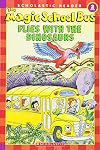
Magic School Bus books are a great way to inform your students on a specific topic while keeping them entertained as well. I really liked this book because it taught you a wide range of different dinosaurs and how they may be related to animals that still exist now a days. However, it also tells a story Ms. Frizzle's class taking a trip back in time to go see the dinosaurs in person. Younger kids will think that it is really cool to see dinosaurs up close and personal so they will probably show more want to imagine themselves in the classmates positions and really engage in the reading. The book is very nicely organized with different characters that have thought bubbles every time they talk so readers can see who is saying what and how those characters are feeling. It flows well as it goes from dinosaur to dinosaur trying to see what one is most closely related with birds. The illustrations are very detailed with lots of color and text to show extra dialogue and information. This booked is packed with information in such a small amount of text. show less
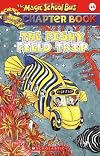
In The Magic School Bus: The Fishy Field Trip, there is not a central lesson or message. There is a central theme, however- coral reefs. Ms. Frizzle's class has been working for days to prepare presentations for the school's big assembly for Ocean Awareness Day. When the class project on coral reefs accidentally falls into the aquarium, everyone is upset. Ms. Frizzle tells her students not to worry and that they can make another one. Tim tells Ms. Frizzle that he does not think he can do all show more that research again in one day. Ms. Frizzle reassures all her students that they can if they go right to the source. So, the class climbs on the Magic School Bus which Ms. Frizzle turns into a plane to learn all about the Great Barrier Reef and the amazing creatures that claim it as their home. When the class arrives at the Great Barrier Reef, Ms. Frizzle turns the Magic School Plane into the Magic School Boat where the class observes a patch of the coral reef through its glass bottom. During this time, the class learns where the Great Barrier Reef is located, about how big the reef is, the three kinds of coral reefs (Fringing reefs, Barrier reefs, and Atoll reefs), and how many kinds of coral there are that help build reefs and how most are named for how they look (brain coral, antler coral, and bubble coral are just a few of the examples provided in this book). When the boat passes over the coral patch and ends ups floating over bare sand with no coral, fish, or plants, Ms. Frizzle brings the importance of coral to her students’ attention. Ms. Frizzle states, “All the fish and other animals we were seeing depend on the coral reef for protection, shelter, and food. Small animals come to hide in the coral, and plants grow on top of it. Fish come to eat the small animals and plants. Their droppings fertilize the reef even more. Before you know it, there’s a whole community. But not of it would be here without the coral.” Ms. Fizzle then turns the bus into the Magic School Fish to take a closer look. When the Magic School Fish scoots into a crack between two pieces of coral, the students could see how lumpy coral really is. During this time, Ms. Frizzle informs her students that each of the bumps is called a coral polyp and the rocky parts are the coral polyp’s skeletons. She also informs them that algae live inside polyps and of the partnership they have for survival. When a parrot fish swims by the Magic School Fish and bits off a piece of coral, Ms. Frizzle informs her students that this type of fish eats the coral skeleton, so it can get the coral animals and algae. She then goes on to say that the rock comes out of the back of fish as sand which is why the beaches are so full of white sand in Australia, Florida, and the Caribbean. As Ms. Frizzle’s class continues their tour of the reef, they learn about a variety of fish such as damselfish, surgeonfish, clownfish, porcupine fish, parrot fish, and cleanerfish, sea anemone, sea sponges, and sea fans (soft coral). When the Magic School Fish gets caught in a net, the class learns about the threats to coral reefs. During this part of the book, Schwabacher helps the reader understand how important it is to respect how everything in nature works together. As the tour of the reef comes to an end, the class learns about how coral reefs reproduce. When the class got back to the school, the students shared their report and all they learned from their under-water adventure with the students and families of the school. show less
The magic School Bus is a fun way for kids to learn about the world around them. This book is no different. D.A. says her parrot is a dinosaur and the class does not believe her so they go back in time to see the dinosaurs. They examine many different types of dinosaurs, some have feathers and some actually flied. The illustrations are bright and playful and the book reads like a comic book which is fun for children.
science, dinosaurs, fossils, magic school bus series, scholastic reader, grade 1, grade 2, Science, STEM, Informational Fiction, Educational, Early Reader, Easy Reader, Picture Book, Adventure, Ms. Frizzle, Field Trip, Scholastic Reader, Children's Books, Science for Kids, Classroom Read-Aloud, Level 2
You May Also Like


Associated Authors
Statistics
- Works
- 24
- Members
- 1,722
- Popularity
- #14,918
- Rating
- 3.3
- Reviews
- 8
- ISBNs
- 50
- Languages
- 3
- Favorited
- 1