

Jonathan Tepperman
Author of The Fix: How Nations Survive and Thrive in a World in Decline
Works by Jonathan Tepperman
The Clash of Ideas: The Ideological Battles that Made the Modern World- And Will Shape the Future (2011) — Editor — 16 copies
Tagged
Common Knowledge
- Gender
- male
- Education
- Yale University (B.A.|English Literature|1993)
New York University School of Law (LL.M.|International Law and Legal Studies|1998)
University of Oxford (M.A.|Law|1997) - Nationality
- Canada
- Birthplace
- Windsor, Ontario, Canada
- Places of residence
- Windsor, Ontario, Canada
New Haven, Connecticut, USA
New York, New York, USA
Members
Reviews
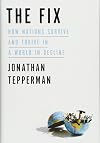
Former President Theodore Roosevelt, in the midst of his 1912 Presidential Campaign, once said that “One thing to remember in politics, is that it takes a long time to overcome inertia, and that when it has been overcome, it takes an equally long time to stop momentum.” In The Fix: How Nations Survive and Thrive in a World in Decline, Jonathan Tepperman shows how certain nations have overcome that inertia for solving their various problems and attempts to show how other countries can show more follow their examples. Such problems range from inequality to immigration to Islamic extremism to corruption in general.
The Fix starts out with reminding us of how bleak and saturnine the world’s affairs have become, listing ten specific areas as the foremost problems the planet is facing today: Inequality, immigration, Islamic extremism, civil war, corruption, the resource curse, energy, the middle-income trap, gridlock I and gridlock II.
In Brazil for example, former Presidnet Luiz Inacio Lula da Silva initiated a “poverty-fighting effort” called Bolsa Familia (Family Grant) that differed from the majority of welfare programs in two important respects: the program simply handed out cash to the poor, and the cash goes to the mothers, not the fathers. There are also several conditions a family would have to meet to qualify for this program, such as being able to prove it lived in extreme poverty and insuring that the children of the family go to school at least 85 percent of the time. If nothing else, Bolsa Familia disproves the widely accepted myth that if you give money directly to the poor they will spend it on alcohol/drugs/gambling. Although I don’t see the mothers-not-fathers rule passing the intermediate scrutiny required by the United States Constitution.
In Canada the government has solved their immigration problem (they did not have enough workers in the country and the workers they had were looking for better opportunities abroad) by embracing multiculturalism. A critical distinction regarding Canada’s immigration policy and that of the United States is that Canada does not use family reunification as its primary way of entering the country as the United States does currently. Canada instead looks at what a potential immigrant can contribute to the country as a whole as its primary entrance criterion; this leads to more immigrants entering the country that the Canadian workforce actually needs as opposed to immigrants who were simply lucky enough to have a relative enter the country before them.
Indonesia has taken a two-sided approach to combating Islamic extremism: the government has appropriated key chunks of the Islamic parties’ agenda in order to undermine their support, while putting an emphasis on rehabilitating captured terrorists. America might be able to learn something regarding the latter, as Indonesia’s approach to the “War on Terror” is to treat terrorism as a law-enforcement problem instead of a military one. Indonesia tries terror suspects in open court instead of sending them to secret prisons indefinitely, and generously rewards cooperative prisoners.
Not all the solutions presented in The Fix could reasonably work in America however. In writing about how Singapore tackled its massive corruption problem, Mr. Tepperman shows the extreme measures the government took to ensure that its public officials were not on the take, my personal favorite being that
“…today [Singapore’s] police officers are required to report whatever petty cash they have in their pockets at the beginning and the end of each shift; those found with more than they started out with are assumed to have taken a bribe.”
As amusing as it would be for the American police to be complaining of Terry Frisks, one doesn’t see the various police unions in the United States taking it so humorously.
In a similar vein, one cannot see China willingly loosening the metaphorical chains placed on its intellectuals and engineers long enough for the kind of ingenuity necessary for taking advantage of its shale abundance. The same government that willingly went through the Great Leap Forward and the Cultural Revolution has not exactly built a reputation for admitting when it is wrong and then fixing the problem (incidentally, the Chinese government might want to rethink the throwing around of “five-year plans” for shale…).
South Korea has had enormous economic growth for the last 50 years. However in order to accomplish this it had to become authoritarian, then democratic at exactly the right time; a process I do not see being iterative. Meanwhile Mexico’s ability to break their partisan deadlock and gets its government operating again gives me hope that America could perhaps do the same.
All in all, The Fix provides uncommon stories of leaders practically applying themselves and their governments in order to solve enormous social and political problems. I agree with Mr. Tepperman when he states in his conclusion that too much of the writing on these and other problems focus on diagnosing the problems instead of what to do about said problems. This book is certainly enough to get a conversation going on practical solutions to problems that absolutely must be addressed; and that, along with the fact that it is an interesting read, make it worth buying. show less
The Fix starts out with reminding us of how bleak and saturnine the world’s affairs have become, listing ten specific areas as the foremost problems the planet is facing today: Inequality, immigration, Islamic extremism, civil war, corruption, the resource curse, energy, the middle-income trap, gridlock I and gridlock II.
In Brazil for example, former Presidnet Luiz Inacio Lula da Silva initiated a “poverty-fighting effort” called Bolsa Familia (Family Grant) that differed from the majority of welfare programs in two important respects: the program simply handed out cash to the poor, and the cash goes to the mothers, not the fathers. There are also several conditions a family would have to meet to qualify for this program, such as being able to prove it lived in extreme poverty and insuring that the children of the family go to school at least 85 percent of the time. If nothing else, Bolsa Familia disproves the widely accepted myth that if you give money directly to the poor they will spend it on alcohol/drugs/gambling. Although I don’t see the mothers-not-fathers rule passing the intermediate scrutiny required by the United States Constitution.
In Canada the government has solved their immigration problem (they did not have enough workers in the country and the workers they had were looking for better opportunities abroad) by embracing multiculturalism. A critical distinction regarding Canada’s immigration policy and that of the United States is that Canada does not use family reunification as its primary way of entering the country as the United States does currently. Canada instead looks at what a potential immigrant can contribute to the country as a whole as its primary entrance criterion; this leads to more immigrants entering the country that the Canadian workforce actually needs as opposed to immigrants who were simply lucky enough to have a relative enter the country before them.
Indonesia has taken a two-sided approach to combating Islamic extremism: the government has appropriated key chunks of the Islamic parties’ agenda in order to undermine their support, while putting an emphasis on rehabilitating captured terrorists. America might be able to learn something regarding the latter, as Indonesia’s approach to the “War on Terror” is to treat terrorism as a law-enforcement problem instead of a military one. Indonesia tries terror suspects in open court instead of sending them to secret prisons indefinitely, and generously rewards cooperative prisoners.
Not all the solutions presented in The Fix could reasonably work in America however. In writing about how Singapore tackled its massive corruption problem, Mr. Tepperman shows the extreme measures the government took to ensure that its public officials were not on the take, my personal favorite being that
“…today [Singapore’s] police officers are required to report whatever petty cash they have in their pockets at the beginning and the end of each shift; those found with more than they started out with are assumed to have taken a bribe.”
As amusing as it would be for the American police to be complaining of Terry Frisks, one doesn’t see the various police unions in the United States taking it so humorously.
In a similar vein, one cannot see China willingly loosening the metaphorical chains placed on its intellectuals and engineers long enough for the kind of ingenuity necessary for taking advantage of its shale abundance. The same government that willingly went through the Great Leap Forward and the Cultural Revolution has not exactly built a reputation for admitting when it is wrong and then fixing the problem (incidentally, the Chinese government might want to rethink the throwing around of “five-year plans” for shale…).
South Korea has had enormous economic growth for the last 50 years. However in order to accomplish this it had to become authoritarian, then democratic at exactly the right time; a process I do not see being iterative. Meanwhile Mexico’s ability to break their partisan deadlock and gets its government operating again gives me hope that America could perhaps do the same.
All in all, The Fix provides uncommon stories of leaders practically applying themselves and their governments in order to solve enormous social and political problems. I agree with Mr. Tepperman when he states in his conclusion that too much of the writing on these and other problems focus on diagnosing the problems instead of what to do about said problems. This book is certainly enough to get a conversation going on practical solutions to problems that absolutely must be addressed; and that, along with the fact that it is an interesting read, make it worth buying. show less
 This review was written for LibraryThing Early Reviewers.
The Fix is a hopeful book, and goodness knows we could do with more of that in today’s world. Most of the chapters deal with a particular place and time in recent world history: a recounting of how one nation managed to successfully handle a particular sociopolitical challenge. I found most of these to be quite thought-provoking. However, one area where Tepperman’s book falls short is in addressing the question of how transferable these solutions are. Can a fix for corruption in an Asian show more nation apply equally to less blatant, more insidious forms of corruption on the other side of the globe? The answer is unclear. But perhaps the strongest message to hear from this book is that daunting social challenges can be ameliorated or solved by a resolute leader who is creative in proposing solutions, courageous in carrying them out, and who has the best interests of his or her people at heart. show less
This review was written for LibraryThing Early Reviewers.Jonathan Tepperman discusses the many variables which together affect the success and failure of national programs in his latest book, “The Fix”. Drawing on extensive research from nine countries he carefully explains the history of the problems and the eventual fixes. While the book caries a clear liberal stand, I believe the author succeeded in most cases of sticking to facts and the undeniable results obtained in each sample case. Tepperman makes it clear that there is no one solution show more for all national problems, and what worked for one nation may not be the best course of action for another, as again there are many variables. None-the-less, seeing that positive results can be achieved is refreshing and encouraging. “The Fix” should be read by all who are interested in solving complicated national problems. show less
This review was written for LibraryThing Early Reviewers.Jonathan Tepperman, managing editor of Foreign Affairs magazine, says he grew tired of researching and writing about the world’s problems and their causes. His book, “The fix : how nations survive and thrive in a world in decline” is his attempt to look at solutions, how some nations have managed to overcome some of the biggest problems facing the world today.
Tepperman manages to nail the problems, income inequality, racism, nationalism, corruption, violence, political and religious show more intolerance. He manages to find countries that have made progress toward fixing one of them, or at least a part of one of them. As he admits there are overlaps. Poverty, income inequality, and political corruption are just interconnected, Tepperman recognizes this and acknowledges how much more complicated it makes actually solving them.
I thought the book was interesting, Tepperman identified real problems facing the world and looks at nations making progress solving them. I did have a few issues with his analysis. As I was reading about how Brazil was making progress on income inequality with a novel anti-poverty program I was hearing about corrupt legislators impeaching the Brazilian president to halt investigations into their corruption. How would this program, that the president's party started, survive? His success story about agricultural South Korea becoming an industrial giant was in the right ballpark but he seemed to miss the most important aspects of their progress, it was not lead by businessmen. Ha-Joon Chang’s book “23 Things They Don't Tell You About Capitalism” offers much more insight into that success story and from a winner of the Nobel Prize in Economics.
Tepperman choose to look at fracking as a solution to the world's energy crisis but he glossed over the many problems that technology perpetuates and creates. Government support for technological research, the core of solution he discusses, is also involved in the efforts to develop clean, renewable energy. Solyndra may have lost money and become a political whipping boy but in time the research paid off.
Despite the problems I had with the book it is worth reading. It renewed my lagging faith that we can overcome our problems. show less
Tepperman manages to nail the problems, income inequality, racism, nationalism, corruption, violence, political and religious show more intolerance. He manages to find countries that have made progress toward fixing one of them, or at least a part of one of them. As he admits there are overlaps. Poverty, income inequality, and political corruption are just interconnected, Tepperman recognizes this and acknowledges how much more complicated it makes actually solving them.
I thought the book was interesting, Tepperman identified real problems facing the world and looks at nations making progress solving them. I did have a few issues with his analysis. As I was reading about how Brazil was making progress on income inequality with a novel anti-poverty program I was hearing about corrupt legislators impeaching the Brazilian president to halt investigations into their corruption. How would this program, that the president's party started, survive? His success story about agricultural South Korea becoming an industrial giant was in the right ballpark but he seemed to miss the most important aspects of their progress, it was not lead by businessmen. Ha-Joon Chang’s book “23 Things They Don't Tell You About Capitalism” offers much more insight into that success story and from a winner of the Nobel Prize in Economics.
Tepperman choose to look at fracking as a solution to the world's energy crisis but he glossed over the many problems that technology perpetuates and creates. Government support for technological research, the core of solution he discusses, is also involved in the efforts to develop clean, renewable energy. Solyndra may have lost money and become a political whipping boy but in time the research paid off.
Despite the problems I had with the book it is worth reading. It renewed my lagging faith that we can overcome our problems. show less
This review was written for LibraryThing Early Reviewers.Awards

Statistics
- Works
- 6
- Members
- 162
- Popularity
- #130,373
- Rating
- 3.6
- Reviews
- 14
- ISBNs
- 14
- Languages
- 1
