
Frank Schaeffer
Author of Crazy for God
About the Author
Frank Schaeffer is the author of the New York Times bestseller Keeping Faith and the memoir Crazy for God. His novels including Portofino, have been translated into nine languages. He and his wife, Genie, live in Massachusetts and have three children.
Image credit: Photo by Lance Cpl. Patrick M. Fleischman, cropped by uploader (marines.mil)
Series
Works by Frank Schaeffer
Dancing Alone: The Quest for Orthodox Faith in the Age of False Religion (1994) 146 copies, 1 review
Patience with God: Faith for People Who Don't Like Religion (or Atheism) (2009) 125 copies, 4 reviews
Why I am an Atheist Who Believes in God: How to give love, create beauty and find peace (2014) 101 copies, 4 reviews
Sex, Mom, and God: How the Bible's Strange Take on Sex Led to Crazy Politics--and How I Learned to Love Women (and Jesus) Anyway (2011) 97 copies, 3 reviews
The Great evangelical disaster 2 copies
A Christian view of the West 1 copy
The Mark of a Christian 1 copy
Fast Food Nation 1 copy
Letter to Lucy: A Manifesto of Creative Redemption—In the Age of Trump, Fascism and Lies (2018) 1 copy
AWOL 1 copy
Wired to Kill [VHS] 1 copy
An Act of Love DVD 1 copy
Associated Works
Semper Fi: Stories of the United States Marines from Boot Camp to Battle (2003) — Contributor — 34 copies, 1 review
Tagged
Common Knowledge
- Canonical name
- Schaeffer, Frank
- Other names
- Schaeffer, Francis A.
Schaeffer, Franky - Birthdate
- 1952-08-03
- Gender
- male
- Occupations
- writer
film director
screenwriter - Relationships
- Schaeffer, Francis A. (father)
Schaeffer, Edith (mother) - Nationality
- USA
- Birthplace
- Champery, Switzerland
- Places of residence
- Switzerland
Massachusetts, USA - Associated Place (for map)
- Champery, Switzerland
Members
Reviews
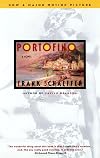
This novel is set over the summers of 1962 and 1965 when Calvin Becker vacations with his family at the Italian beach town of Portofino. They are Americans, but have been living in Switzerland where his missionary parents are attempting to convert heathen Roman Catholics to their one true Christian sect. Calvin is 10 yrs old in the first section, and starting to have serious questions about big life questions, but his two older pious sisters, his fundamentalist mother, and his moody show more self-absorbed father are not giving him the answers he needs. So he forges new friendships with the Italian locals and Jennifer from England.
Portofino is wonderfully evocative of holiday life at a magical Italian beach resort and the sort of adventures a 10 and 14 year old boy might get himself into when he’s trying to have a fun time despite his dysfunctional family. The scenes where he attempts to distance himself from his embarrassing family, especially when he’s mortified by his mother’s attempts to evangelize, are hilarious in a cringe-worthy way. show less
Portofino is wonderfully evocative of holiday life at a magical Italian beach resort and the sort of adventures a 10 and 14 year old boy might get himself into when he’s trying to have a fun time despite his dysfunctional family. The scenes where he attempts to distance himself from his embarrassing family, especially when he’s mortified by his mother’s attempts to evangelize, are hilarious in a cringe-worthy way. show less
This book appears to be either loved or hated by the majority. I read it out of curiosity; and I found myself right in the middle of the extremes of opinion. The descriptions of an Italian seaside resort are realistic and evocative, and some of the narrator's thought-processes humorously logical. Yet there's violence and sordidity which mean I'm unlikely to want to read the sequels.
Evidently at least part autobiographical, I found this novel at times amusing - sometimes against my better show more judgement - and at times disturbing. I hope that the horrors of the protagonist's Calvinist upbringing are exaggerated; the hypocrisy is bad enough, the verbal abuse upsetting, and the violent 'punishments' described unbelievable in their viciousness.
And yet, there's a lot of clever irony as the 11-year-old protagonist - whose name (Calvin) is itself an irony - quotes his parents' fundamentalist beliefs, and wonders about the logic of a theory of 'election of saints' which doesn't guarantee anyone salvation, and makes something of a mockery of the whole idea of evangelism.
It was an interesting read - and by the last few chapters I found it quite hard to put down. Yet it left something of an unpleasant taste in my mouth. If even half of the violence is honestly true, why fictionalise it? If it's not true, why exaggerate, and paint Calvinist missionaries in such a poor light? show less
Evidently at least part autobiographical, I found this novel at times amusing - sometimes against my better show more judgement - and at times disturbing. I hope that the horrors of the protagonist's Calvinist upbringing are exaggerated; the hypocrisy is bad enough, the verbal abuse upsetting, and the violent 'punishments' described unbelievable in their viciousness.
And yet, there's a lot of clever irony as the 11-year-old protagonist - whose name (Calvin) is itself an irony - quotes his parents' fundamentalist beliefs, and wonders about the logic of a theory of 'election of saints' which doesn't guarantee anyone salvation, and makes something of a mockery of the whole idea of evangelism.
It was an interesting read - and by the last few chapters I found it quite hard to put down. Yet it left something of an unpleasant taste in my mouth. If even half of the violence is honestly true, why fictionalise it? If it's not true, why exaggerate, and paint Calvinist missionaries in such a poor light? show less
Sex, mom, and God : how the Bible's strange take on sex led to crazy politics, and how I learned to love women (and Jesus) anyway by Frank Schaeffer
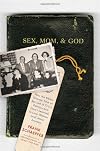
I haven't read any Franky Schaeffer since he abandoned his youthful evangelicalism in favor of the ineffable God of Orthodoxy. He has since repented from his part in creating the religious right (with his dad and others).
This book repeats intimate details of the Schaeffer house. If you want to know about Francis and Edith's sex life, the time little Franky put his *ahem* franky into an ice sculpture, the physical and verbal abuse that Francis inflicted on Edith, and the time Edith almost show more left with another man. I think it is impossible to read this book and maintain uncritical respect for any of the Schaeffers.
But it isn't a smear campaign. Frank speaks warmly of both parents, especially his mother, of where their practice was better than their theology.
Frank thinks that the God-of-the-Bible promotes misogynistic tendencies and unhealthy sexuality. He is critiquing a version of biblical literalism which is worth critiquing, but is not really fair to the Bible.
Enjoyed the book for the most part, but there is enough here that is kinda ugh. show less
This book repeats intimate details of the Schaeffer house. If you want to know about Francis and Edith's sex life, the time little Franky put his *ahem* franky into an ice sculpture, the physical and verbal abuse that Francis inflicted on Edith, and the time Edith almost show more left with another man. I think it is impossible to read this book and maintain uncritical respect for any of the Schaeffers.
But it isn't a smear campaign. Frank speaks warmly of both parents, especially his mother, of where their practice was better than their theology.
Frank thinks that the God-of-the-Bible promotes misogynistic tendencies and unhealthy sexuality. He is critiquing a version of biblical literalism which is worth critiquing, but is not really fair to the Bible.
Enjoyed the book for the most part, but there is enough here that is kinda ugh. show less
Crazy for God: How I Grew Up as One of the Elect, Helped Found the Religious Right, and Lived to Take All (or Almost All) of It Back by Frank Schaeffer
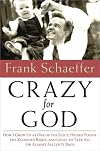
One of our history’s most prized and famous sayings is, “You can’t judge a book by it’s cover.” It’s oft repeated because the truth in those words is evidenced nearly every day of our lives. Sometimes you get something far less than you hoped for, which is a unique and terrible type of disappointment. Yet, on luckier occasions, you just might find something unexpected and surprising under that front facing disguise. On the surface this book seems to be about the dangerous mix of show more politics and religion, coming from the viewpoint of someone who was there in the beginning of this recent flare up of the religious right wing, but what you find in these pages is far less about politics and far more about family.
Crazy for God is a memoir by Frank Schaeffer, who grew up in a very conservative religious household, one that physically roamed throughout his childhood until they landed in their own commune for people to come and learn their holier-than-most viewpoints. What began as an evangelical camp for those looking to escape or rebound from the peace & love generation, Frank witnessed his parents become religious dignitaries at a level they never expected, causing internal strife about what they wanted to be, healers and teachers, and what they had become, weapons.
Having an interest in politics and especially the dangerous mixing of that with religion, the title of this book grabbed me, but politics is merely the context for a much deeper story here, the one between Frank and his family. While finding himself imprinted with his parents views on God, the Bible and the true reason for living, Frank found himself at odds with himself. His internal voice did not match the outer voice he using to appease those around him. Eventually, as his parents find themselves in the middle of this religious revolution in politics, Frank breaks with the family’s creed and has to deal with the consequences.
While I was hoping for more insight into some of the backroom deals made to further the religious right and episodes of hypocrisy in the face of their proposed beliefs, what I got was a profile of a son watching his father lose himself in a movement far beyond his control. The memoir, while being from Frank’s perspective, is more about his father and the toll inflicted on him by the far-right conservative block he helped build with his teachings. It was almost ironic that it grew to something he couldn’t even recognize or control, because that seems to be the fate of almost all religions. I wonder day after day what the early prophets would think of the religions they helped start all those years ago.
In opposition to his father, Frank’s mother revels in the power and glory that the movement grows to and takes each and every chance to bask in the glory of the powerful people in her orbit. The relationship between his parents is another area where the story dives underneath the waves of religious fervor and shows the strain and tension wrought upon people when they are thrust from normalcy into celebrity. What they preach to their followers in the open air of their living room and lecture halls is utterly and totally tossed out the window behind closed doors. It became increasingly impossible for both parents to feel they were doing the right thing when the definition of that was in total contention.
Another chasm that opened widely between Frank’s father and the movement was his treatment of the gay lifestyle. He believed that you can be gay and still love God, but those that rose in the ranks of the religious right alongside him were aghast at the idea. Frank’s father relegated himself farther and farther away from the spotlight, which after many years had begun to burn. By this point Frank himself had turned against the teachings of his parents and while still having his own personal faith had come to the conclusion that his parents’ methods were far from anything he wanted to pass on.
In the end, Crazy for God will resonate less with the political and religious crowd and more with those who have ever had to break the tethers of their parents and blaze a trail in complete opposition to what they were brought up to believe. show less
Crazy for God is a memoir by Frank Schaeffer, who grew up in a very conservative religious household, one that physically roamed throughout his childhood until they landed in their own commune for people to come and learn their holier-than-most viewpoints. What began as an evangelical camp for those looking to escape or rebound from the peace & love generation, Frank witnessed his parents become religious dignitaries at a level they never expected, causing internal strife about what they wanted to be, healers and teachers, and what they had become, weapons.
Having an interest in politics and especially the dangerous mixing of that with religion, the title of this book grabbed me, but politics is merely the context for a much deeper story here, the one between Frank and his family. While finding himself imprinted with his parents views on God, the Bible and the true reason for living, Frank found himself at odds with himself. His internal voice did not match the outer voice he using to appease those around him. Eventually, as his parents find themselves in the middle of this religious revolution in politics, Frank breaks with the family’s creed and has to deal with the consequences.
While I was hoping for more insight into some of the backroom deals made to further the religious right and episodes of hypocrisy in the face of their proposed beliefs, what I got was a profile of a son watching his father lose himself in a movement far beyond his control. The memoir, while being from Frank’s perspective, is more about his father and the toll inflicted on him by the far-right conservative block he helped build with his teachings. It was almost ironic that it grew to something he couldn’t even recognize or control, because that seems to be the fate of almost all religions. I wonder day after day what the early prophets would think of the religions they helped start all those years ago.
In opposition to his father, Frank’s mother revels in the power and glory that the movement grows to and takes each and every chance to bask in the glory of the powerful people in her orbit. The relationship between his parents is another area where the story dives underneath the waves of religious fervor and shows the strain and tension wrought upon people when they are thrust from normalcy into celebrity. What they preach to their followers in the open air of their living room and lecture halls is utterly and totally tossed out the window behind closed doors. It became increasingly impossible for both parents to feel they were doing the right thing when the definition of that was in total contention.
Another chasm that opened widely between Frank’s father and the movement was his treatment of the gay lifestyle. He believed that you can be gay and still love God, but those that rose in the ranks of the religious right alongside him were aghast at the idea. Frank’s father relegated himself farther and farther away from the spotlight, which after many years had begun to burn. By this point Frank himself had turned against the teachings of his parents and while still having his own personal faith had come to the conclusion that his parents’ methods were far from anything he wanted to pass on.
In the end, Crazy for God will resonate less with the political and religious crowd and more with those who have ever had to break the tethers of their parents and blaze a trail in complete opposition to what they were brought up to believe. show less
Awards

You May Also Like


Associated Authors
Statistics
- Works
- 39
- Also by
- 1
- Members
- 2,782
- Popularity
- #9,234
- Rating
- 3.6
- Reviews
- 51
- ISBNs
- 79
- Languages
- 3
- Favorited
- 1