
David Aberbach
Author of Bialik
About the Author
David Aberbach is Associate Professor of Hebrew and Comparative Literature, McGill University, Montreal, Canada, and Visiting Professor at London University (UCL and LSE) since 1992.
Works by David Aberbach
At the Handles of the Lock: Themes in the Fiction of Shmuel Yosef Agnon (Littman Library of Jewish Civilization) (1984) 7 copies
The European Jews, patriotism and the liberal state, 1789-1939 a study of literature and social psychology (2012) 2 copies
Revolutionary Hebrew, Empire and Crisis: Four Peaks in Hebrew Literature and Jewish Survival (1998) 2 copies, 1 review
Nationalism, War and Jewish Education: From the Roman Empire to Modern Times (Routledge Jewish Studies Series) (2018) 2 copies
The Hebrew Bible, Nationalism and the Origins of Anti-Judaism (Routledge Jewish Studies Series) (2022) 2 copies
Realism, Caricature and Bias 1 copy
Tagged
Common Knowledge
- Birthdate
- 1953
- Gender
- male
- Education
- University College, London
University of Oxford - Nationality
- England (birth)
- Map Location
- UK
Members
Reviews
Revolutionary Hebrew, Empire and Crisis: Four Peaks in Hebrew Literature and Jewish Survival by David Aberbach
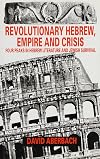
Aberbach returns here to topics he's explored in previous books (Surviving Trauma: Loss, Literature, and Psychoanalysis, Realism, Caricature, and Bias: The Fiction of Mendele Mocher Sefarim), and he previews the topics of several books to come (The Roman-Jewish Wars and Hebrew Cultural Nationalism, Major Turning Points in Jewish Intellectual History). His main focus, however, is the relationship between imperial crisis and Hebrew creativity. Examining the Prophets (who emerged amid the show more various Mesopotamian empires), the Mishnah (during the Roman empire), the golden age of medieval Hebrew poetry (Muslim Spain), and the peak of modern Hebrew literature before 1948 (Tsarist Russia), Aberbach concludes that Jews were spurred to peak creativity by a mix of envy, superiority, and anxiety, precisely when these empires were about to collapse.
Aberbach proves to be a convincing, if sometimes unnuanced, reader of these works. Yet he never explains why the end of these empires spurred major creativity, while others didn't. Why didn't Babylonian Jewry produce major works in Hebrew immediately prior to the conquest of Islam? Why didn't Grecian Jewry do so prior to the conquest of Rome? Why didn't British Jewry before the sunset of the British Empire? A reader can charitably speculate about the factors involved (degree of assimilation, duration and severity of collapse, whether caused by internal issues or unexpected conquest, etc.), but at least some criteria of distinction would have been appreciated.
Indeed, the unspoken key criteria seemed rather to be aesthetic than historical. That is to say, the periods of peak literary creativity also happen to be those in which Jews worked outstandingly in genres Aberbach likes, namely, poetry, fable, short story, and novel. But Jews' main creative output, at least since the turn of the second millennium, has clearly been the glosses, novellae, and legal codes of rabbinic Judaism, which Aberbach several times knocks. And that creativity hasn't been confined to the periods considered here. show less
Aberbach proves to be a convincing, if sometimes unnuanced, reader of these works. Yet he never explains why the end of these empires spurred major creativity, while others didn't. Why didn't Babylonian Jewry produce major works in Hebrew immediately prior to the conquest of Islam? Why didn't Grecian Jewry do so prior to the conquest of Rome? Why didn't British Jewry before the sunset of the British Empire? A reader can charitably speculate about the factors involved (degree of assimilation, duration and severity of collapse, whether caused by internal issues or unexpected conquest, etc.), but at least some criteria of distinction would have been appreciated.
Indeed, the unspoken key criteria seemed rather to be aesthetic than historical. That is to say, the periods of peak literary creativity also happen to be those in which Jews worked outstandingly in genres Aberbach likes, namely, poetry, fable, short story, and novel. But Jews' main creative output, at least since the turn of the second millennium, has clearly been the glosses, novellae, and legal codes of rabbinic Judaism, which Aberbach several times knocks. And that creativity hasn't been confined to the periods considered here. show less

Ranging over Western literature, Aberbach, professor at McGill University, examines the experience of grief as a wellspring of creativity. Dense with illustrative excerpts from poems, stories and essays, the study, led off by a consideration of reflections by Holocaust survivors, looks at works of writers, such as Walt Whitman, D. H. Lawrence, Dante, Descartes and Cocteau, for whom loss of a parent figures centrally in their oeuvre. With the view that art, like dreams, expresses the show more imagination's attempt to "confront and master grief," Aberbach demonstrates persuasively that a writer's involvement with his or her work can be an effort to reestablish psychically a union severed by death. Also explored are pathological expressions of grief as found in the writings of Tolstoy and Poe, and loss as the driving force behind the careers of such nonliterary personalities as Marilyn Monroe, Hitler and Churchill. show less
Statistics
- Works
- 22
- Members
- 96
- Popularity
- #196,088
- Rating
- 4.0
- Reviews
- 2
- ISBNs
- 52
- Favorited
- 1