
Evan Turk
Author of The storyteller
Works by Evan Turk
A Thousand Glass Flowers: Marietta Barovier and the Invention of the Rosetta Bead (2020) 33 copies, 1 review
Associated Works
The People's Painter: How Ben Shahn Fought for Justice with Art (2021) — Illustrator — 125 copies, 10 reviews
Tagged
Common Knowledge
- Agent
- Brenda Bowen
Members
Reviews
I feel like a lot of the biographical details in this book are either oversimplified or speculative, but the exuberant and glorious illustrations more than make up for it. I also love the juxtaposition of song lyrics throughout, and the repetitive refrain that "he was never good at doing how he was told". It's a strong and vibrant and celebratory book, as it should be, and the sheer number of different artistic techniques are astonishing -- from paste paper painting, to collage, to chalk show more marking. It all comes together to create a loud and harmonious whole. I sincerely hope it makes the Caldecott list. It's a strong contender. show less
The music of Muddy Waters provided my own introduction to the blues, and I have loved that particular genre ever since.
The Blues are distinguished by a 12-bar sequence played on a unique scale, involving a flatted 3rd or 5th note. These “bent” or “blue” notes are what give the Blues a sound of its own. As the author writes:
“To have the blues was to feel bad.
But to play the blues was to take that low-down,
skunk-funk, deep-stomach hurt
And turn it into something else.”
McKinley show more Morganfield, called Muddy because he loved to play in the muddy bayous behind his grandmother’s house, was born in Rolling Fork, Mississippi on April 4, 1915. Muddy helped transform Delta Blues into the more upbeat Chicago Blues which then became known as “rhythm and blues.”
From the time he was young, Muddy loved music. Growing up, he worked as a sharecropper in the fields and saved his money, eventually able to buy himself a used guitar. He played in local juke joints on weekends. In 1943, tired of his sharecropping boss picking on him and calling him “boy,” he quit, and made his way to Chicago.
The author writes:
“Chicago was plugged in,
Turned on, and turned up.
And so was its music.
Records with electrified guitars
And jazzy horns were making the blues
Jump all over town.”
Muddy started adding a beat to his blues in the 1950’s. He called it “fast” blues as opposed to “slow” blues. As the author comments in an afterword, while Muddy was not the only musician to make this change, “he quickly became one of the most influential”:
“The instrumental composition of Muddy’s bands - which always included a guitar, harmonica, piano, bass, and drums - laid the rhythmic and tonal foundation for what would become rock and roll.”
He also became known for playing a mean slide guitar that hardly anyone has been able to duplicate.
Blues fans are familiar with the idea of a “mojo,” or “mojo hand.” A mojo hand was a little red flannel bag that smelled of oil and perfumes, purchased from a specialist in charms and magic. Muddy Waters said that black people in the South all used to believe that these mojo hands would bring them luck. He knew they didn’t work, and he also knew mojo “doctors” - those who made and sold the bags - were getting rich off of poor people’s superstitions and dreams. But he said he wrote songs about them because people always requested them. In fact, "Louisiana Blues," with the lyric "I'm goin' down in New Orleans, Get me a mojo hand" was Muddy’s first nationwide hit.
Muddy’s first recording for Leonard Chess was memorable:
“He called up the sticky heat of a summer
night, the power of love, and the need
For connection in a world that was
So good at pulling people apart.”
The record sold out in twenty-four hours. The author concludes with a coda foretelling Muddy’s future:
“One day, the Beatles would be shaking Muddy’s hand.
One day, the president of the United States would be tapping his toes.
One day, the world world would know the name Muddy Waters.
One day was on its way.”
Muddy toured Europe in 1958, and his popularity took off with young white audiences. He inspired Mick Jagger, Eric Clapton, the Beatles, Jim Morrison, and others.
The Rolling Stones, of course, named themselves after a record - “Rolling Stone” - recorded in the 1950’s by Muddy Waters. Bob Dylan’s hit, “Like a Rolling Stone,” also comes from Muddy’s record, as does the name of the music magazine.
As the Afterword relates, in 1971, Muddy won his first of six grammy Awards. In 1978, he played for President Jimmy Carter at the White House. In 1987, he was inducted (posthumously) into the Rock & Roll Hall of Fame.
Muddy died in 1983 at age 68, but he left a lasting legacy not only because of his own work but because of the music he inspired in others. Amazingly, this towering talent never got a chance to go to school, nor did he ever learn to read and write. He is a true inspiration.
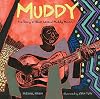
The narration is done in free verse, with imagined dialogue. All of it comes to life via the stunning expressionist artwork by Evan Turk, an Ezra jack Keats New Illustrator Honor recipient. Turk reports on his blog that he did research in both Mississippi and Chicago to find the right visual style for the story. He chose rich warm colors for Mississippi and then switched his palette for Chicago to express “the clashing neon colors of the city.” But as Muddy’s skill develops in the story, the palettes merge, just as Muddy’s music came to reflect both his Delta past and his Chicago present.
You may notice that Turk’s unique style shows the influence of such black artists as Jacob Lawrence, William H. Johnson, and the famous quilt work of the African-American women of Gee’s Bend Alabama. Turk also employs stenciling with striking results. He reports:
“I drew out the composition, and then cut out each of the shapes to make stencils. Then I filled in the shapes thickly with oil pastel on top of a watercolor/gouache background. Then details and patterns were created by adding more oil pastel, or scraping it away with a palette knife to make textures and different
effects.”
Evaluation: This book celebrates African-American heritage, and its seminal contributions to and influence on culture throughout the world. It may help readers understand the historicity of musical forms, and how music not only reflects the social world of its time but also affects it. The prose is both musical and educational, and the illustrations are exceptional. show less
The Blues are distinguished by a 12-bar sequence played on a unique scale, involving a flatted 3rd or 5th note. These “bent” or “blue” notes are what give the Blues a sound of its own. As the author writes:
“To have the blues was to feel bad.
But to play the blues was to take that low-down,
skunk-funk, deep-stomach hurt
And turn it into something else.”
McKinley show more Morganfield, called Muddy because he loved to play in the muddy bayous behind his grandmother’s house, was born in Rolling Fork, Mississippi on April 4, 1915. Muddy helped transform Delta Blues into the more upbeat Chicago Blues which then became known as “rhythm and blues.”
From the time he was young, Muddy loved music. Growing up, he worked as a sharecropper in the fields and saved his money, eventually able to buy himself a used guitar. He played in local juke joints on weekends. In 1943, tired of his sharecropping boss picking on him and calling him “boy,” he quit, and made his way to Chicago.
The author writes:
“Chicago was plugged in,
Turned on, and turned up.
And so was its music.
Records with electrified guitars
And jazzy horns were making the blues
Jump all over town.”
Muddy started adding a beat to his blues in the 1950’s. He called it “fast” blues as opposed to “slow” blues. As the author comments in an afterword, while Muddy was not the only musician to make this change, “he quickly became one of the most influential”:
“The instrumental composition of Muddy’s bands - which always included a guitar, harmonica, piano, bass, and drums - laid the rhythmic and tonal foundation for what would become rock and roll.”
He also became known for playing a mean slide guitar that hardly anyone has been able to duplicate.
Blues fans are familiar with the idea of a “mojo,” or “mojo hand.” A mojo hand was a little red flannel bag that smelled of oil and perfumes, purchased from a specialist in charms and magic. Muddy Waters said that black people in the South all used to believe that these mojo hands would bring them luck. He knew they didn’t work, and he also knew mojo “doctors” - those who made and sold the bags - were getting rich off of poor people’s superstitions and dreams. But he said he wrote songs about them because people always requested them. In fact, "Louisiana Blues," with the lyric "I'm goin' down in New Orleans, Get me a mojo hand" was Muddy’s first nationwide hit.
Muddy’s first recording for Leonard Chess was memorable:
“He called up the sticky heat of a summer
night, the power of love, and the need
For connection in a world that was
So good at pulling people apart.”
The record sold out in twenty-four hours. The author concludes with a coda foretelling Muddy’s future:
“One day, the Beatles would be shaking Muddy’s hand.
One day, the president of the United States would be tapping his toes.
One day, the world world would know the name Muddy Waters.
One day was on its way.”
Muddy toured Europe in 1958, and his popularity took off with young white audiences. He inspired Mick Jagger, Eric Clapton, the Beatles, Jim Morrison, and others.
The Rolling Stones, of course, named themselves after a record - “Rolling Stone” - recorded in the 1950’s by Muddy Waters. Bob Dylan’s hit, “Like a Rolling Stone,” also comes from Muddy’s record, as does the name of the music magazine.
As the Afterword relates, in 1971, Muddy won his first of six grammy Awards. In 1978, he played for President Jimmy Carter at the White House. In 1987, he was inducted (posthumously) into the Rock & Roll Hall of Fame.
Muddy died in 1983 at age 68, but he left a lasting legacy not only because of his own work but because of the music he inspired in others. Amazingly, this towering talent never got a chance to go to school, nor did he ever learn to read and write. He is a true inspiration.
The narration is done in free verse, with imagined dialogue. All of it comes to life via the stunning expressionist artwork by Evan Turk, an Ezra jack Keats New Illustrator Honor recipient. Turk reports on his blog that he did research in both Mississippi and Chicago to find the right visual style for the story. He chose rich warm colors for Mississippi and then switched his palette for Chicago to express “the clashing neon colors of the city.” But as Muddy’s skill develops in the story, the palettes merge, just as Muddy’s music came to reflect both his Delta past and his Chicago present.
You may notice that Turk’s unique style shows the influence of such black artists as Jacob Lawrence, William H. Johnson, and the famous quilt work of the African-American women of Gee’s Bend Alabama. Turk also employs stenciling with striking results. He reports:
“I drew out the composition, and then cut out each of the shapes to make stencils. Then I filled in the shapes thickly with oil pastel on top of a watercolor/gouache background. Then details and patterns were created by adding more oil pastel, or scraping it away with a palette knife to make textures and different
effects.”
Evaluation: This book celebrates African-American heritage, and its seminal contributions to and influence on culture throughout the world. It may help readers understand the historicity of musical forms, and how music not only reflects the social world of its time but also affects it. The prose is both musical and educational, and the illustrations are exceptional. show less

Long ago, in the kingdom of Morocco, the people, neglecting the lessons taught by their storytellers, began to forget their fear of the desert. They remained oblivious as the dry Sahara began to creep up on them, unaware that their drying wells would provide them scant protection in the coming crisis. One boy however, searching for water, instead found a storyteller who unfolded a tale within a tale, about a beautiful blue water bird who provided one family with that life-giving substance, show more and about how that bird was created. As the boy listened, day after day, he found his cup filled with water, and when the desert arrived in full force, with a terrible djinn at its head, it was the power of stories that saved the day...
Having illustrated Arun Gandhi's Grandfather Gandhi, a picture-book meditation on the lessons the author learned from his famous grandparent, Evan Turk turns here to writing and illustrating his own book. Inspired by the folkloric traditions of Morocco, he has crafted a tale that highlights the power of stories and storytellers, and their important role in preserving knowledge and wisdom. I appreciated the many different layers of story in Turk's narrative, and thought the conclusion, in which the boy himself has become the storyteller, was as fitting as it was satisfactory. The artwork, done in a variety of media, including crayon, ink and pencil, is absolutely beautiful, with a vivid color palette and a stylized sensibility that nevertheless manages to convey the intertwining developments in the various levels of story. Turk's work here reminded me a bit of Patricia Polacco, particularly in his depiction of female characters. While I don't agree with the publisher's description of this as an 'original folktale' - folktales are by their nature derived from folk tradition, not (as fairy-tales are) original creations - I would recommend this to anyone looking for fairy-tales for the picture-book audience. show less
Having illustrated Arun Gandhi's Grandfather Gandhi, a picture-book meditation on the lessons the author learned from his famous grandparent, Evan Turk turns here to writing and illustrating his own book. Inspired by the folkloric traditions of Morocco, he has crafted a tale that highlights the power of stories and storytellers, and their important role in preserving knowledge and wisdom. I appreciated the many different layers of story in Turk's narrative, and thought the conclusion, in which the boy himself has become the storyteller, was as fitting as it was satisfactory. The artwork, done in a variety of media, including crayon, ink and pencil, is absolutely beautiful, with a vivid color palette and a stylized sensibility that nevertheless manages to convey the intertwining developments in the various levels of story. Turk's work here reminded me a bit of Patricia Polacco, particularly in his depiction of female characters. While I don't agree with the publisher's description of this as an 'original folktale' - folktales are by their nature derived from folk tradition, not (as fairy-tales are) original creations - I would recommend this to anyone looking for fairy-tales for the picture-book audience. show less
Wow, what a powerful book about Muddy Waters. It grabs you and pulls you and lets you experience the beauty and the depth of his music without even listening to it. Both illustrations and the words are very moving, especially to me since MS is my second home ans I am familiar with the history of that area, I understand. "To play the blues was to take that low-down, skunk-funk, deep-stomach hurt and turn it to something else". Muddy's determination and loyalty to his own style are very show more inspiring. He is part of American heritage that everyone should be proud of, and not only because he paved a foundation of rock and roll. show less
Lists
Awards


You May Also Like


Associated Authors
Statistics
- Works
- 7
- Also by
- 3
- Members
- 650
- Popularity
- #38,840
- Rating
- 4.1
- Reviews
- 41
- ISBNs
- 25