
Laura Vaccaro Seeger
Author of First the Egg
About the Author
Laura Vaccaro Seeger is a New York Times best-selling author and illustrator. Laura is also a 2-time Caldecott Honor Award winner as well as a winner of the New York Times Best Illustrated Book Award, the Boston Globe/Horn Book Award for Best Picture Book, and a 2-time winner of the Theodor Seuss show more Geisel Honor Award. She is also the recipient of the Empire State Award for Body of Work and Contribution to Children's Literature. Laura's paintings have been exhibited in many museums and galleries including the Art Institute of Chicago and the New York Public Library. Laura earned her BFA degree at the School of Fine Art and Design at the State University of New York at Purchase. She moved to Manhattan to begin a career as an animator, artist, designer, and editor in the network television business. She created show openings and special segments for NBC and ABC for many years and won an Emmy Award for an NBC Special opening animation. Laura is the author of the Dog and Bear Series, First the Egg, Green, I Had a Rooster, Lemons are Not Red, One Boy, The Hidden Alphabet, Walter was Worried, and What If? (Bowker Author Biography) show less
Image credit: Courtesy Laura Vaccaro Seeger
Series
Works by Laura Vaccaro Seeger
Chien et ours joue avec moi 1 copy
POR QUÊ? 1 copy
Tagged
Common Knowledge
- Gender
- female
- Nationality
- USA
- Birthplace
- Long Island, New York, USA
- Places of residence
- Rockville Centre, New York, USA
- Associated Place (for map)
- New York, USA
Members
Reviews
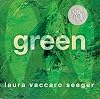
Seeger's full-bleed paintings for Green are beautiful with cleverly selected and placed diecuts that turn the book into a puzzle of sorts (a trademark for Seeger at this point). The textures she creates just beg for you to reach out and touch them. Each spread feels like an art-gallery painting that rewards extended viewing. My favorite spread is the fern green one – I love the pop of the yellow moths. I do think the “wacky green” spread is a little weak – not because of the green show more zebra, but because I can’t tell what the diecuts on the grass it’s eating are supposed to be - if anyone can clear that up for me, I'd appreciate it! This is such a quiet, restful sort of book that grows on you with repeated readings. The last four or five spreads add some contemplative depth as well - just when you think you know what's going on (we're naming colors of green, right?) Seeger switches things up on you. show less
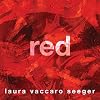
What I love about wordless (or nearly wordless) books is the depth of emotion that they convey. Just like Aaron Becker's "Journey" trilogy, Laura Vaccaro Seeger does the same with her color trilogy. She says
"I believe that readers should make their own connections with characters in books, but in my mind, the boy we watched grow up in "Blue" is the father of the little girl we see at the end of "Green." And a few years late, that little girl plays a pivotal role in "Red.""
That is the type of show more storytelling that I am here for! show less
"I believe that readers should make their own connections with characters in books, but in my mind, the boy we watched grow up in "Blue" is the father of the little girl we see at the end of "Green." And a few years late, that little girl plays a pivotal role in "Red.""
That is the type of show more storytelling that I am here for! show less

Perpetually asking "why?," a little rabbit receives answers from his patient ursine friend in this gentle, thought-provoking new picture-book from author/illustrator Laura Vaccaro Seeger. Some questions - why are the birds flying off in formation? why is bear eating honey? - are easy to answer, but others - why has the little redbird died? - are more difficult. Always honest, the bear admits when he doesn't have the answers, and eventually heads for his winter hibernation spot. When the show more rabbit pleads with him to stay, it is his turn to ask why...
A simple but ultimately thoughtful text is paired with beautiful watercolor artwork in Why?, which highlights the importance both of asking questions and of accepting the fact that we can't always know the answers. This is a difficult idea to grasp sometimes, and not just for children, so kudos to Seeger for exploring it here. The heartwarming ending, in which the friendship between the bear and rabbit is emphasized, allows the reader and listener to close the book with the feeling that, although some things may be uncertain and unknowable, friendship and love can be relied upon. Recommended to young questioners. show less
A simple but ultimately thoughtful text is paired with beautiful watercolor artwork in Why?, which highlights the importance both of asking questions and of accepting the fact that we can't always know the answers. This is a difficult idea to grasp sometimes, and not just for children, so kudos to Seeger for exploring it here. The heartwarming ending, in which the friendship between the bear and rabbit is emphasized, allows the reader and listener to close the book with the feeling that, although some things may be uncertain and unknowable, friendship and love can be relied upon. Recommended to young questioners. show less
First the Egg (Caldecott Honor Book and Theodor Seuss Geisel Honor Book (Awards)) by Laura Vaccaro Seeger
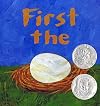
This book starts with the die cut in an egg shape on the cover, which completes the title (First THE), which delivers some joyful surprises for the young readers. The story basically tells the children about nature, and what comes first, for instance, the egg is first, then comes the baby chicken, and finally the adult chicken. Interestingly, the "first, and then" pattern is repeated in almost each page ("First the egg/ then the chicken. / First the seed/ then the flower). The die-cut is show more also on every other page. When children flip a page, they will see the cut out in two contexts. For example, when an ovoid shape overlies on a white ground, it's an egg; a tiny fingernail-size shape is superimposed on a brown ground, it's a seed. Suddenly, the author changes her writing about the stages of development in the natural world, and writes “First the WORD, ” “then the STORY.” In this page, she writes a short story about the whole thing that the readers have read at the beginning of the story. Seeger's clever ending her book by brings all the characters together to return the children to the onset. At the last two pages, the author puts all of the colors that are presented at the beginning of the book on one page, “First the PAINT . . . Then the PICTURE,” then showing a beautiful outdoor view that includes the chicken, flower, frog, and the butterfly playing together. I loved the smart idea when the author concludes the story by showing the chicken first and the egg which is the opposite of what she mentions in the in the first page; that shows the idea of the life-cycle of nature. When I gave my daughter three stories including “First the egg” to read and to tell me which one is the best for her, she chose this one. She said it is a fascinating book and she enjoyed flipping the pages and discover what comes next. show less
Lists
Awards


You May Also Like


Associated Authors
Statistics
- Works
- 25
- Members
- 5,216
- Popularity
- #4,779
- Rating
- 3.9
- Reviews
- 569
- ISBNs
- 109
- Languages
- 4
- Favorited
- 2