
Andrew Hussie
Author of Homestuck Book 2
About the Author
Series
Works by Andrew Hussie
Psycholonials 1 copy
Associated Works
William Shakespeare Punches a Friggin' Shark and/or Other Stories (2017) — Illustrator — 52 copies, 1 review
Tagged
Common Knowledge
Members
Reviews

This printed book collects the first 200 pages or so of a webcomic called Homestuck. I'm going to review the webcomic as a whole, rather than the printed book. Although Homestuck is not, strictly speaking, a book, I'm just as fond of it as I am of my favorite books, and I feel like it deserves a place on my Goodreads shelf.
It's hard to know where to begin to describe Homestuck because it's so idiosyncratic in so many different ways. For one thing, it's the longest webcomic ever created -- as show more of this writing, it's 5762 pages long and counting. The almost pathologically productive author, Andrew Hussie, posts an average of four new comic pages every day, and it's highly uncommon for a day to go by when he doesn't post at least one. Since Hussie puts text in its own box below each panel rather than enclosing it in speech bubbles and the like, he can include as much text as he wants on each page, and it's not uncommon for a single page of Homestuck to include several printed pages' worth of dialogue. The text of Homestuck alone is (again, as of this writing) 618,723 words long, and (this is the really remarkable part) the vast majority of that is dialogue.
The comic is written in a format that parodies classic computer adventure games: rather than a generic "next page" link, the bottom of each page is a "command" to one of the characters like "John: Look out window" or "Rose: Consult the grimoire." The next page depicts the character following the command, as though they were the reader's avatar in a computer game. (In the early days, many of these commands were chosen from suggestions made by the readership, but Hussie stopped taking suggestions once the story started to take a definite shape.) Over time, the format expands to include music, animation, interactive segments, creative use of the website's layout, and much more -- as well as metafictionally reaching back to interact with the plot, as when the commands at the bottom of the screen turn out to have been written by a set of alien creatures at computer terminals whose mind-controlling messages induce powerful and otherwise inexplicable urges in the main characters. (If that kind of creative linkage of form and content appeals to you, then you will probably love Homestuck.)
The comic's dramatic structure is every bit as weird as its format. Huge numbers of potential readers have been turned away by the first 100 pages, which are about as unpromising as you can get -- they look like something made by a not-very-talented 12-year-old in an out-of-date paint program, and exhibit roughly the sense of humor you'd expect that 12-year-old to have. The writing is either tediously "zany" comedy hijinx or bad-on-purpose purple prose. But from there the comic grows in every sense of the word, extruding new plot threads at every turn, adding subtlety to the initially inane characterization, re-contextualizing the early dumb jokes until they seem brilliant in retrospect, incubating its own set of internal verbal and visual motifs that seem funnier and more resonant with each repetition. And it just keeps growing, for thousands upon thousands of pages.
For sheer scope, comic absurdity, and fever-dream inventiveness, Homestuck blows most so-called "fantasy" writing out of the water. It may not be great literature, but it is certainly a great work of exuberant invention, displaying the kind of endless creativity one rarely sees outside of dreams and children's games, yet bound, in a way those fantasies are not, by a (demented but self-consistent) internal logic. It's easy to casually throw around words like "dreamlike" and "absurd," but Homestuck makes good on them in a way few other works do. I read it in a kind of trance over the course of two weeks (in summer 2011, back when it was "merely" 4000 pages long), and at the end I was left wondering, in earnest, whether I had dreamed the whole thing up.
What is Homestuck? It's a metafictional black comedy, an over-the-top parody of every convoluted fantasy story ever written that can nonetheless hold its own as a serious entry in the genre, a better send-up of the hero's journey than John Barth could manage, a time travel story that's genuinely new and mind-bending (no, really), one of the only works of fiction out there that focuses on the dynamics of internet friendships, a exploration of the comedic potential of the science-fictional "sense of wonder" that would make Douglas Adams proud, a version of the "mystical serial mystery" story a la Lost that blows most of that genre out of the water by actually resolving its own mysteries when appropriate rather than endlessly deferring them to keep you tuned in . . . and it's all locked up in an ugly, uninviting online comic that no one except a cult following of mostly teenage hardcore internet nerds has ever heard of. It's sometimes unbelievably dumb, sometimes unbelievably clever, and undoubtedly like nothing else you will ever read. Bookmark it and set it aside for a sick day -- you will start out a skeptic, but if you're anything like me, you'll end up hooked. show less
It's hard to know where to begin to describe Homestuck because it's so idiosyncratic in so many different ways. For one thing, it's the longest webcomic ever created -- as show more of this writing, it's 5762 pages long and counting. The almost pathologically productive author, Andrew Hussie, posts an average of four new comic pages every day, and it's highly uncommon for a day to go by when he doesn't post at least one. Since Hussie puts text in its own box below each panel rather than enclosing it in speech bubbles and the like, he can include as much text as he wants on each page, and it's not uncommon for a single page of Homestuck to include several printed pages' worth of dialogue. The text of Homestuck alone is (again, as of this writing) 618,723 words long, and (this is the really remarkable part) the vast majority of that is dialogue.
The comic is written in a format that parodies classic computer adventure games: rather than a generic "next page" link, the bottom of each page is a "command" to one of the characters like "John: Look out window" or "Rose: Consult the grimoire." The next page depicts the character following the command, as though they were the reader's avatar in a computer game. (In the early days, many of these commands were chosen from suggestions made by the readership, but Hussie stopped taking suggestions once the story started to take a definite shape.) Over time, the format expands to include music, animation, interactive segments, creative use of the website's layout, and much more -- as well as metafictionally reaching back to interact with the plot, as when the commands at the bottom of the screen turn out to have been written by a set of alien creatures at computer terminals whose mind-controlling messages induce powerful and otherwise inexplicable urges in the main characters. (If that kind of creative linkage of form and content appeals to you, then you will probably love Homestuck.)
The comic's dramatic structure is every bit as weird as its format. Huge numbers of potential readers have been turned away by the first 100 pages, which are about as unpromising as you can get -- they look like something made by a not-very-talented 12-year-old in an out-of-date paint program, and exhibit roughly the sense of humor you'd expect that 12-year-old to have. The writing is either tediously "zany" comedy hijinx or bad-on-purpose purple prose. But from there the comic grows in every sense of the word, extruding new plot threads at every turn, adding subtlety to the initially inane characterization, re-contextualizing the early dumb jokes until they seem brilliant in retrospect, incubating its own set of internal verbal and visual motifs that seem funnier and more resonant with each repetition. And it just keeps growing, for thousands upon thousands of pages.
For sheer scope, comic absurdity, and fever-dream inventiveness, Homestuck blows most so-called "fantasy" writing out of the water. It may not be great literature, but it is certainly a great work of exuberant invention, displaying the kind of endless creativity one rarely sees outside of dreams and children's games, yet bound, in a way those fantasies are not, by a (demented but self-consistent) internal logic. It's easy to casually throw around words like "dreamlike" and "absurd," but Homestuck makes good on them in a way few other works do. I read it in a kind of trance over the course of two weeks (in summer 2011, back when it was "merely" 4000 pages long), and at the end I was left wondering, in earnest, whether I had dreamed the whole thing up.
What is Homestuck? It's a metafictional black comedy, an over-the-top parody of every convoluted fantasy story ever written that can nonetheless hold its own as a serious entry in the genre, a better send-up of the hero's journey than John Barth could manage, a time travel story that's genuinely new and mind-bending (no, really), one of the only works of fiction out there that focuses on the dynamics of internet friendships, a exploration of the comedic potential of the science-fictional "sense of wonder" that would make Douglas Adams proud, a version of the "mystical serial mystery" story a la Lost that blows most of that genre out of the water by actually resolving its own mysteries when appropriate rather than endlessly deferring them to keep you tuned in . . . and it's all locked up in an ugly, uninviting online comic that no one except a cult following of mostly teenage hardcore internet nerds has ever heard of. It's sometimes unbelievably dumb, sometimes unbelievably clever, and undoubtedly like nothing else you will ever read. Bookmark it and set it aside for a sick day -- you will start out a skeptic, but if you're anything like me, you'll end up hooked. show less

I just got this for my birthday and rushed through it. Of course, this is better to read online for the occasional animations (not as many in this first part of the story as later), but I think most of the best stuff in Problem Sleuth is right here in the beginning. There is some commentary, but there's not as much insight there as I'd hoped.
Normally, I reserve recommending MSPaintAdventures to some people because in order to truly appreciate the ridiculous intricacy of the plot, you really show more need to pay attention and get super involved with the world. But this early part of the story succeeds on a different level. The sheer inventiveness and counter-intuitiveness of the bizarre gamelike world in which Problem Sleuth exists is at its best right at the beginning, when the depth of the insanity isn't quite clear yet. So I can easily recommend this part of the story to just about anyone who can appreciate silliness.
If, in addition to being willing to giggle at a hard-boiled detective who uses candy corn to make vampire teeth, you're also the sort of person who was excited because the movie Primer finally got time travel right, then read it all the way through to the end, and I'll talk to you in a few months when you're done. show less
Normally, I reserve recommending MSPaintAdventures to some people because in order to truly appreciate the ridiculous intricacy of the plot, you really show more need to pay attention and get super involved with the world. But this early part of the story succeeds on a different level. The sheer inventiveness and counter-intuitiveness of the bizarre gamelike world in which Problem Sleuth exists is at its best right at the beginning, when the depth of the insanity isn't quite clear yet. So I can easily recommend this part of the story to just about anyone who can appreciate silliness.
If, in addition to being willing to giggle at a hard-boiled detective who uses candy corn to make vampire teeth, you're also the sort of person who was excited because the movie Primer finally got time travel right, then read it all the way through to the end, and I'll talk to you in a few months when you're done. show less
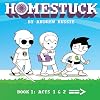
Four friends start playing a video game. Unfortunately, this particular game triggers the apocalypse, and these four dorks are the ones responsible for creating a new universe in its place.
Three rival detectives are stuck in their offices and must cooperate to solve the increasingly-complex puzzles and obstacles in-between them and their freedom.
Lists
You May Also Like


Associated Authors
Statistics
- Works
- 24
- Also by
- 4
- Members
- 515
- Popularity
- #48,204
- Rating
- 4.1
- Reviews
- 7
- ISBNs
- 23