
W. E. Johns (1893–1968)
Author of Biggles of the Camel Squadron
About the Author
Disambiguation Notice:
(dut) Do not list titles (Dr., Sir, Saint, etc.) or degrees (PhD, MA, DDS, etc.) with names. A book whose author is named Edward Pedant, PhD should appear simply as Pedant, Edward. Because of this, I removed the Captain title from the authors name
Series
Works by W. E. Johns
A Biggles Omnibus: Biggles Learns to Fly / Biggles Flies East / Biggles in the Orient (1994) 48 copies, 1 review
Biggles' Big Adventures: Biggles in the Baltic / Biggles Sees it Through / Biggles Flies North / Biggles in the Jungle (2007) 44 copies
The Bumper Biggles Book: Biggles, Pioneer Air Fighter / Biggles Flies South / Biggles in the Orient / Biggles Defies the Swastika / Biggles in the Jungle (1983) 39 copies
The First Biggles Omnibus: Biggles Sweeps the Desert / Biggles in the Orient / Biggles Delivers the Goods / Biggles “Fails to Return” (1953) 30 copies
Biggles' Dangerous Missions: Biggles and the Secret Mission / Biggles – Secret Agent / Biggles – Flying Detective / Biggles in Australia (2008) 27 copies
The Biggles Air Detective Omnibus: Sergeant Bigglesworth, C.I.D. / Biggles’ Second Case / Another Job for Biggles / Biggles Works it Out (1956) 18 copies
The Best of Biggles: Biggles in Africa / Biggles Flies North / Biggles in the South Seas / Biggles and the Black Mask / Biggles and the Dark Intruder (1985) 18 copies
Biggles WWII Collection (Biggles Defies the Swastika, Biggles Delivers the Goods, Biggles Defends the Desert & Biggles Fails to Return) (2012) 18 copies
Biggles Story Collection: Biggles in France / Biggles Defends the Desert / Biggles Foreign Legionnaire (1999) 17 copies
The Biggles Adventure Omnibus: Biggles Gets His Men / No Rest for Biggles / Another Job for Biggles / Biggles Takes a Holiday (1965) 7 copies
The Biggles Flying Omnibus. Biggles Flies North; Biggles Flies South; Biggles Flies West (1941) 6 copies
The Biggles book of treasure hunting 4 copies
The Unknown Quantity 3 copies
Biggles lever farligt 3 copies
Dr Vane Answers the Call 3 copies
Wings of Romance 3 copies
The Man Who Vanished into Space 2 copies
Steeley and the Missing Page 1 copy
The Death Rays of Ardilla 1 copy
To Outer Space 1 copy
Now to the Stars 1 copy
The Third Biggles Omnibus 1 copy
Biggles Special Case 1 copy
Gimlet Goes Home 1 copy
Mossyface 1 copy
Sky Fever, and other stories 1 copy
Blue Blood Runs Red 1 copy
To Worlds Unknown 1 copy
The Man Who Lost His Way 1 copy
Biggles in Arabie 1 copy
Desert Night 1 copy
Sky Fever 1 copy
Biggles Annual 1 copy
Squadron Biggles 1 copy
Nattflyg : Detektivroman 1 copy
Pojkarnas flygbok 1 copy
Fire In Provence - 2 1 copy
The Wotan Sword 1 copy
Biggles in The Turkey {ss} 1 copy
Huit Affaires Pour Biggles 1 copy
Biggles and the Poor Rich Boy; Biggles Hits the Trail; & Biggles Delivers the Goods [3 volumes] (1952) 1 copy
ACES UP 1 copy
Every boy's Annual 1 copy
Associated Works
Daily Mail boys annual (circa 1957) — Contributor — 1 copy
Tagged
Common Knowledge
- Legal name
- Johns, William Earl
- Other names
- Johns, William Earl
Johns, Captain W. E.
Earle, William (pseudonym) - Birthdate
- 1893-02-05
- Date of death
- 1968-06-21
- Gender
- male
- Education
- Hertford Grammar School
- Occupations
- municipal surveyor
sanitary inspector
Trooper, British Territorial Army
2nd lieutenant, Royal Flying Corps
flying instructor
bomber pilot (show all 11)
prisoner-of-war
Flying Officer, Royal Air Force
recruiting officer
journalist
writer - Organizations
- Norfolk Yeomanry
Machine Gun Corps
Royal Flying Corps
No. 55 Squadron, RAF - Relationships
- Johnson, Amy (friend)
- Cause of death
- heart attack
- Nationality
- UK
- Birthplace
- Bengeo, Hertfordshire, England, UK
- Places of residence
- Swaffham, Norfolk, England, UK
- Place of death
- Hampton Court, Herefordshire, England, UK
- Burial location
- Kingston-upon-Thames Crematorium, UK (cremation)
- Map Location
- England, UK
- Disambiguation notice
- Do not list titles (Dr., Sir, Saint, etc.) or degrees (PhD, MA, DDS, etc.) with names. A book whose author is named Edward Pedant, PhD should appear simply as Pedant, Edward.
Because of this, I removed the Captain title from the authors name
Members
Reviews
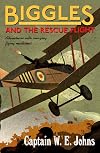
A Biggles book where you can see how he's going to get drawn into Major Raymond's end of things. This story is about a schoolboy who pretends to be in the RAF to rescue his brother. His mentor in 266 squadron is Biggles, and Algy also features.
The interesting part for me as an adult is the descriptions of what it was like.
"...Looking down he saw an expanse of brown earth, perhaps a mile in width, gradually merging into dull green on either side. Through the brown expanse that coiled like a show more mighty serpent across the landscape from west to east ran tiny zigzag lines, hundreds of them, making a cobweb-like pattern. His breath suddenly came faster as he realized that he was looking at the actual lines where two mighty armies were entrenched, grappling in a stupendous life and death struggle. From time to time tiny white puffs appeared, and drifted sluggishly across the brown expanse. They looked harmless enough, but he knew that they must be the smoke of bursting shells."
Any story where one of the heroes falls asleep during the debrief has a fair bit of realism involved.
with Peter "Thirty" Fortymore as the main character you can see him losing his innocence about what war was about quite quickly, he still has a lot of derring do but this isn't going to be an easy or simple thing to do, to rescue his brother. He really works at it and finds himself at the front lines and learning the reality of war. Yes it's a boy's own adventure type thing and there were moments where my suspension of disbelief was strained but overall it's an interesting read with interesting characters who were probably fairly true-to-life. show less
The interesting part for me as an adult is the descriptions of what it was like.
"...Looking down he saw an expanse of brown earth, perhaps a mile in width, gradually merging into dull green on either side. Through the brown expanse that coiled like a show more mighty serpent across the landscape from west to east ran tiny zigzag lines, hundreds of them, making a cobweb-like pattern. His breath suddenly came faster as he realized that he was looking at the actual lines where two mighty armies were entrenched, grappling in a stupendous life and death struggle. From time to time tiny white puffs appeared, and drifted sluggishly across the brown expanse. They looked harmless enough, but he knew that they must be the smoke of bursting shells."
Any story where one of the heroes falls asleep during the debrief has a fair bit of realism involved.
with Peter "Thirty" Fortymore as the main character you can see him losing his innocence about what war was about quite quickly, he still has a lot of derring do but this isn't going to be an easy or simple thing to do, to rescue his brother. He really works at it and finds himself at the front lines and learning the reality of war. Yes it's a boy's own adventure type thing and there were moments where my suspension of disbelief was strained but overall it's an interesting read with interesting characters who were probably fairly true-to-life. show less

In the early years of the Cold War, British scientists and others involved in the atomic weapons program mysteriously disappear.
Biggles and his colleagues of the Special Air Police are directed by Air Commodore Raymond are travel to a remote region within Mongolia where it is believed the kidnapped men are hidden away.
Another outstanding tale from W E Johns. The mystery is well laid out, the setting both dangerous and extremely isolated. Johns’ crafts another excellent, lean narrative. show more Each chapter built around plot points both significant and enthralling.
Another outstanding Biggles tale. show less
Biggles and his colleagues of the Special Air Police are directed by Air Commodore Raymond are travel to a remote region within Mongolia where it is believed the kidnapped men are hidden away.
Another outstanding tale from W E Johns. The mystery is well laid out, the setting both dangerous and extremely isolated. Johns’ crafts another excellent, lean narrative. show more Each chapter built around plot points both significant and enthralling.
Another outstanding Biggles tale. show less

There are a couple of different types of Biggles books. This is the war adventure variant. People will die. There will be blood.
The story is set in the middle of the Sahara desert where Biggles and his squadron has been sent to stop the losses of transport planes going to Egypt. Quite quickly they figure out that there are Nazis in the desert as well and from them on it's a never-stopping battle between
Somewhere in the story there is a morality message saying that you will come out ahead if show more you behave honorable. I think the author screwed up that message a bit. Anyway, nobody reads Biggles books for those things. We all read them for the adventure, the action and this book has a lot of action. Very high pace. show less
The story is set in the middle of the Sahara desert where Biggles and his squadron has been sent to stop the losses of transport planes going to Egypt. Quite quickly they figure out that there are Nazis in the desert as well and from them on it's a never-stopping battle between
Somewhere in the story there is a morality message saying that you will come out ahead if show more you behave honorable. I think the author screwed up that message a bit. Anyway, nobody reads Biggles books for those things. We all read them for the adventure, the action and this book has a lot of action. Very high pace. show less

I want to begin by saying that I never realised how funny Biggles was until I read this collection of short stories. Don't get me wrong, not all of the Biggle's stories (and there are an awful lot of them) are comical, many of them are adventure stories, but from John's introduction to this book, and the nature of air combat in World War I, the stories can be quite amusing, especially since he indicates that when it came to air combat truth is stranger than fiction (at which point he tells a show more story of a pilot who flipped the plane, fell out of the cockpit, grabbed hold of the machinegun, and then managed to flip the plane back over).
Captain W.E. Johns was a war veteran so the two things he knew really well was fighting in World War I (he fought in Gallipoli, the Middle East, and on the Western Front) and air combat. The reason I say air combat is because halfway through the war he returned to England, learned how to fly (planes were only beginning to appear in the second half of the war, and were used as scouts, as well as to drop bricks on enemy positions) and then began teaching others to fly. Remember that at this time flight was still a very new invention and there was a high chance that when you went up you would not be coming back. This actually happened to Johns in that he only flew combat missions for six weeks before being shot down by a German and ended up spending the rest of the war in a POW camp (and being in September 1918 he wasn't there for very long).
Johns remained in the Royal Flying Corps until 1927 when he retired and began writing books, his most popular being the Biggles books. This is not surprising since by the 1930s pilots were looked on a heroes, and as such Biggles was created as being the pinnacle of this new hero. In World War I the pilots were on the cutting edge of technology and acted more like special forces operatives than the airforce pilots that are around today. Consider this, you could probably name more World War I pilots than you could name pilots from any other era, even if the only pilot that you can name is The Red Baron (and you can add Captain Johns to that list to make two).
As I said, these World War I stories are much more comical than adventurous. The later Biggles stories have him as a spy and as an air policeman, however it is these World War I stories that everybody remembers. Seriously, Biggles is forever crashing planes (he crashes three of them in this book) as well as shooting down at least 15 German planes (which makes him an Ace, even if the British did not measure success based on how many planes you shot down. Personally I would measure success based upon the number of missions that you come back from, and from what I understand, even surviving one mission is a effort in itself).
As for the stories, the first one has him take the plane up into the air to test it out and while up there he decides to go for a fly over enemy territory. Biggles then proceeds to crash the plane and escapes back to friendly territory by stealing a balloon (and almost get shot down by friendly fire in the process). Another has him flying over enemy lines on Christmas purely to steal a turkey, and another one is a competition as to who can fly the furthest over enemies lines to dump propaganda leaflets on the enemy. Oh, and there is the one with the camera which, surprise surprise, results in Biggles crashing the plane. show less
Captain W.E. Johns was a war veteran so the two things he knew really well was fighting in World War I (he fought in Gallipoli, the Middle East, and on the Western Front) and air combat. The reason I say air combat is because halfway through the war he returned to England, learned how to fly (planes were only beginning to appear in the second half of the war, and were used as scouts, as well as to drop bricks on enemy positions) and then began teaching others to fly. Remember that at this time flight was still a very new invention and there was a high chance that when you went up you would not be coming back. This actually happened to Johns in that he only flew combat missions for six weeks before being shot down by a German and ended up spending the rest of the war in a POW camp (and being in September 1918 he wasn't there for very long).
Johns remained in the Royal Flying Corps until 1927 when he retired and began writing books, his most popular being the Biggles books. This is not surprising since by the 1930s pilots were looked on a heroes, and as such Biggles was created as being the pinnacle of this new hero. In World War I the pilots were on the cutting edge of technology and acted more like special forces operatives than the airforce pilots that are around today. Consider this, you could probably name more World War I pilots than you could name pilots from any other era, even if the only pilot that you can name is The Red Baron (and you can add Captain Johns to that list to make two).
As I said, these World War I stories are much more comical than adventurous. The later Biggles stories have him as a spy and as an air policeman, however it is these World War I stories that everybody remembers. Seriously, Biggles is forever crashing planes (he crashes three of them in this book) as well as shooting down at least 15 German planes (which makes him an Ace, even if the British did not measure success based on how many planes you shot down. Personally I would measure success based upon the number of missions that you come back from, and from what I understand, even surviving one mission is a effort in itself).
As for the stories, the first one has him take the plane up into the air to test it out and while up there he decides to go for a fly over enemy territory. Biggles then proceeds to crash the plane and escapes back to friendly territory by stealing a balloon (and almost get shot down by friendly fire in the process). Another has him flying over enemy lines on Christmas purely to steal a turkey, and another one is a competition as to who can fly the furthest over enemies lines to dump propaganda leaflets on the enemy. Oh, and there is the one with the camera which, surprise surprise, results in Biggles crashing the plane. show less
Lists
A Novel Cure (1)
Elevenses (1)
Awards

You May Also Like


Associated Authors
Statistics
- Works
- 275
- Also by
- 3
- Members
- 10,630
- Popularity
- #2,237
- Rating
- 3.5
- Reviews
- 204
- ISBNs
- 670
- Languages
- 8
- Favorited
- 10