
Ginnie Lo
Author of Auntie Yang's Great Soybean Picnic
Works by Ginnie Lo
Tagged
Common Knowledge
There is no Common Knowledge data for this author yet. You can help.
Members
Reviews

This lovely story was inspired by memories of visits to their Auntie Yang's in the Chicago area by the author and illustrator sisters. Auntie Yang made sure their family visited often, so the four cousins would grow up “as close as four soybeans in a soybean pod.”
One Sunday, after dinner, the two families went for a drive, and they discovered a field of soybeans. As the author explains: “In Illinois, soybeans were grown to feed cows and pigs, not people - but in China, soybeans were show more one of the most important foods of all.” Auntie Yang yelled “Stop the car!” They spoke to the farmer, who allowed them to take some soybean plants home. They cooked them, and Auntie Yang taught them how to eat them. That, the author, reports, was our family’s first soybean picnic.
The next summer they did it again, this time inviting other Chinese families from around Chicago. Word spread, and the picnic eventually got too big to hold in Auntie Yang’s yard:
“Eventually, more than two hundred Chinese mothers, fathers, grandparents, and children gathered at a city park for the annual soybean event.”
When Auntie and Uncle Yang were in their seventies, all their brothers and sisters from China were finally able to come to America and they held a special soybean picnic in their honor, declaring it the greatest soybean picnic ever.
The author and illustrator sisters have notes at the end of the book, including real pictures of the four cousins, photos of picking soybeans, and of the actual picnic buffet table. There is also a sidebar with information about soybeans, called mao dou in Chinese (known as edamame by the Japanese and by American consumers, who do not always realize the “exotic” edamame is actually a soybean).
There is also a glossary at the end with an “approximate” pronunciation guide for some Mandarin words. (Mandarin, the official language of China and Taiwan, as well as one of four official languages of Singapore, uses tones in addition to letters to convey meaning, so it is hard to reproduce just by seeing the letters.)
Beth Lo is an award-winning ceramic artist, and she came up with the idea of painting the pictures for the story on porcelain plates. The results are not only gorgeous, but exemplify the theme of feasting.
At a charming website dedicated to the book, you can see each character with their names written in Mandarin and English. You can also check out the wonderful review by Jama, who reveals she has six Auntie Yangs, as well as many fond memories of eating boiled soybeans just like the characters in the story.
Evaluation: The story is lovely, but the enchanting illustrations alone are worth the price of the ticket! show less
One Sunday, after dinner, the two families went for a drive, and they discovered a field of soybeans. As the author explains: “In Illinois, soybeans were grown to feed cows and pigs, not people - but in China, soybeans were show more one of the most important foods of all.” Auntie Yang yelled “Stop the car!” They spoke to the farmer, who allowed them to take some soybean plants home. They cooked them, and Auntie Yang taught them how to eat them. That, the author, reports, was our family’s first soybean picnic.
The next summer they did it again, this time inviting other Chinese families from around Chicago. Word spread, and the picnic eventually got too big to hold in Auntie Yang’s yard:
“Eventually, more than two hundred Chinese mothers, fathers, grandparents, and children gathered at a city park for the annual soybean event.”
When Auntie and Uncle Yang were in their seventies, all their brothers and sisters from China were finally able to come to America and they held a special soybean picnic in their honor, declaring it the greatest soybean picnic ever.
The author and illustrator sisters have notes at the end of the book, including real pictures of the four cousins, photos of picking soybeans, and of the actual picnic buffet table. There is also a sidebar with information about soybeans, called mao dou in Chinese (known as edamame by the Japanese and by American consumers, who do not always realize the “exotic” edamame is actually a soybean).
There is also a glossary at the end with an “approximate” pronunciation guide for some Mandarin words. (Mandarin, the official language of China and Taiwan, as well as one of four official languages of Singapore, uses tones in addition to letters to convey meaning, so it is hard to reproduce just by seeing the letters.)
Beth Lo is an award-winning ceramic artist, and she came up with the idea of painting the pictures for the story on porcelain plates. The results are not only gorgeous, but exemplify the theme of feasting.
At a charming website dedicated to the book, you can see each character with their names written in Mandarin and English. You can also check out the wonderful review by Jama, who reveals she has six Auntie Yangs, as well as many fond memories of eating boiled soybeans just like the characters in the story.
Evaluation: The story is lovely, but the enchanting illustrations alone are worth the price of the ticket! show less
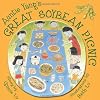
The author and illustrator recall the family soybean picnics of their youth and how they came to be. A pleasing multicultural story that kids will follow with great interest as they pick up cultural tidbits of food, traditions and vocabulary.
I had mixed feelings about this book for several reasons. I did enjoy the illustrations that were very detailed, especially since some of the story was confusing and hard to imagine. So, the pictures helped the reader understand it easier. Also, I thought the overall story was very unique and unexpected. The book was about a young girl, Jiny and her family, who visit their Auntie and Uncle Yang’s house, all who remained in the United States after finishing college here, but are originally show more from China. While on a Sunday drive through the country, they discover a soybean field at a nearby farm and ask the farmer if they could pick some. The family, who is homesick for China, uses the soybeans and organizes a picnic for the other Chinese families in the community. Each year, the picnic grows larger and becomes a local tradition for hundreds of Chinese families for many years. I thought this was not your typical story and wondered what would make someone come up with a far-fetched story like that. However, at the end of the book, the author explains that this is based on a true story of her own Auntie Yang and how she started this picnic. She also discusses the importance of the soybean in China as a staple food. I was pleasantly surprised to reveal that this was not a fabricated story and that although it was long and a little drawn out, it had a true history and meaning. This made me enjoy it more. show less
The author tells the story of how her aunt started a small picnic that blossomed into a a massive annual even that would grow to include hundreds of people. The picnic starts as a way to bring together local chinese immigrant families that miss home, but can't go back b/c of war.
The illustrations are from a series of plates the illustrator designed. This sounds kind of strange at first but the illustrations are very beautiful and I thought they did a great job allowing you to see the family show more and how this picnic had such simple happy origins.
I thoroughly enjoyed this a lot more then I expected to. show less
The illustrations are from a series of plates the illustrator designed. This sounds kind of strange at first but the illustrations are very beautiful and I thought they did a great job allowing you to see the family show more and how this picnic had such simple happy origins.
I thoroughly enjoyed this a lot more then I expected to. show less
Awards


You May Also Like


Statistics
- Works
- 2
- Members
- 176
- Popularity
- #121,981
- Rating
- 3.4
- Reviews
- 16
- ISBNs
- 7