Saha by Cho Nam-Joo

It all started with a death - a pediatrician is found dead and the police is really keen on finding what happened to her. If you expect this to be the main focus of the novel, you will be disappointed. Yes, the death is important and we will learn more about it but the author uses it as an entry point to the story of the country of Town.
40 years ago a corporation bought a dying village and slowly turned it into something new. Before long, the new city declared independence and closed its borders. The citizens, classified as Ls, have all the rights and privileges due to them both for their status and their wealth. The ones that do not make the cut but can help the country can get 2-years long visas as L2s. And if you do not qualify even for that, you turn into a Saha - named after one of the estates still existing around the city where the unwanted find their homes.
And here is where the murder happen - the doctor is an L and everyone believes that the murderer have to be a Saha, especially when it becomes clear that she actually lived in the Saha estates.
What follows is a decent (albeit slow moving) look into the way the Saha estates inhabitants ended up there. Most of the story stays in the current time but a few chapters show us what happened 30 years earlier and while most of the story centers on the Saha estates, we get to also follow the murder investigation and get flashbacks to what actually happened that night. Some of those 30 years old snippets are almost show more scary - from the respiratory disease that required isolation and masks and was deadly even for the ones that usually do not have issues with the seasonal flu (the book was published in Korea in 2019 so it is not about COVID but then Asia had had its share of smaller scares in the decades before it) to the tales of orphanages and the slow build-up of the oppressive state.
If this is where the novel ended, I would have closed the book satisfied. It is an interesting dystopia which cuts close to reality very often in the best possible way. But then came the last 20 pages or so when the main character decided to find her own answers. The shocking revelation about the state itself was anything but shocking (if you did not see that one coming, you were not paying attention). But then the novel fizzles and just stops. I would have liked it more if it stopped a bit earlier, maybe finding a different way to expose the state (or leave it unsaid). With this ending, it felt almost like the author did not trust the readers to understand without spelling it out.
Overall a decent dystopian novel marred by an ending which simply did not work for me. show less
40 years ago a corporation bought a dying village and slowly turned it into something new. Before long, the new city declared independence and closed its borders. The citizens, classified as Ls, have all the rights and privileges due to them both for their status and their wealth. The ones that do not make the cut but can help the country can get 2-years long visas as L2s. And if you do not qualify even for that, you turn into a Saha - named after one of the estates still existing around the city where the unwanted find their homes.
And here is where the murder happen - the doctor is an L and everyone believes that the murderer have to be a Saha, especially when it becomes clear that she actually lived in the Saha estates.
What follows is a decent (albeit slow moving) look into the way the Saha estates inhabitants ended up there. Most of the story stays in the current time but a few chapters show us what happened 30 years earlier and while most of the story centers on the Saha estates, we get to also follow the murder investigation and get flashbacks to what actually happened that night. Some of those 30 years old snippets are almost show more scary - from the respiratory disease that required isolation and masks and was deadly even for the ones that usually do not have issues with the seasonal flu (the book was published in Korea in 2019 so it is not about COVID but then Asia had had its share of smaller scares in the decades before it) to the tales of orphanages and the slow build-up of the oppressive state.
If this is where the novel ended, I would have closed the book satisfied. It is an interesting dystopia which cuts close to reality very often in the best possible way. But then came the last 20 pages or so when the main character decided to find her own answers. The shocking revelation about the state itself was anything but shocking (if you did not see that one coming, you were not paying attention). But then the novel fizzles and just stops. I would have liked it more if it stopped a bit earlier, maybe finding a different way to expose the state (or leave it unsaid). With this ending, it felt almost like the author did not trust the readers to understand without spelling it out.
Overall a decent dystopian novel marred by an ending which simply did not work for me. show less

As most posthumous collections of one's writings, this one is very uneven. It collections interviews, speeches, working notes and a few published pieces and is more of a curiosity than a necessity for a history readers.
Despite not being trained as a historian, David McCullough is regarded as one of the good American historians. His writing is usually engaging and his choice of topics tends to be straddling the line between obscure (The Johnstown Flood) and popular (Truman and 1776 for example) while treating them with the same attention to detail.
I came to this book excepting more of the same type of writing and while a few of the pieces delivered, most did not. It was not the author's fault - speeches have a different structure from written essays and as the editors (his daughter and his long term researcher) combed through his papers to find what to include, they probably did not have that much to work with in the shorter form. The book ended up somewhat repetitive (the same ideas and often the same sentences made it into multiple speeches) and while some of the ideas were interesting, they were also unpolished.
If you had never read McCullough, don't start with this book. Or if you really want to sample his writing and you do not want to commit to a longer book, read these 3 pieces from this book:
- The Paris Review Interview from 1999 - for the details of his work process, his thoughts about history and writing and a lot more (The Paris Review Interviews are almost show more always very good)
- "Thomas Eakins" - to see him handling a more obscure figure from the past
- "Harry S. Truman" (originally published in "Character Above All" after McCullough published his biography of the president which got him the first of the two Pulizers he won) for his work on a more popular topic.
Overall, not the book I expected and hoped for but still worth checking as long as you know what to expect. Plus I learned that McCullough painted - 2 of his watercolors are used as the end-sheets. show less
Despite not being trained as a historian, David McCullough is regarded as one of the good American historians. His writing is usually engaging and his choice of topics tends to be straddling the line between obscure (The Johnstown Flood) and popular (Truman and 1776 for example) while treating them with the same attention to detail.
I came to this book excepting more of the same type of writing and while a few of the pieces delivered, most did not. It was not the author's fault - speeches have a different structure from written essays and as the editors (his daughter and his long term researcher) combed through his papers to find what to include, they probably did not have that much to work with in the shorter form. The book ended up somewhat repetitive (the same ideas and often the same sentences made it into multiple speeches) and while some of the ideas were interesting, they were also unpolished.
If you had never read McCullough, don't start with this book. Or if you really want to sample his writing and you do not want to commit to a longer book, read these 3 pieces from this book:
- The Paris Review Interview from 1999 - for the details of his work process, his thoughts about history and writing and a lot more (The Paris Review Interviews are almost show more always very good)
- "Thomas Eakins" - to see him handling a more obscure figure from the past
- "Harry S. Truman" (originally published in "Character Above All" after McCullough published his biography of the president which got him the first of the two Pulizers he won) for his work on a more popular topic.
Overall, not the book I expected and hoped for but still worth checking as long as you know what to expect. Plus I learned that McCullough painted - 2 of his watercolors are used as the end-sheets. show less

On his 18th birthday, Carlos's mother tells him that his father is dead and that she hid it from him for a few days looking for the right moment to tell him. The man walked out on the family years earlier so Carlos had never expected anything from him. But as it turns out, the father left his apartment to his son and despite the mother's objections, Carlos decides to move there.
The apartment is lined with books which does not impress Carlos much - he was never a reader so he cannot even determine if any of the books are good. But then he finds a notebook of his father and then a worn out copy of the Brother Grim fairy tales and they open to him a world he had never known existed.
The notebook first looks like the rambling of a lunatic (or the beginning of a novel) but the more Carlos looks into the circumstances, the more it starts feeling like the reality. Had he stumbled on fiction mixing in reality or is reality not exactly what he had always believed? And just when he thinks that things cannot get any more weird, he decides to read the book of fairy tales that he found on his father's night stand and ends up transported inside of the story. And then it happens again and again. Somewhere in there, he will find a way to connect to his dead father and while awake, Carlos will finally find his path to reading and appreciating the written word.
So is that a fantasy novel or are all of those weird happenings part of one's imagination or dreams? That is probably up to the show more reader - the novel can be read both ways. The author is definitely leaning at least partially towards the imagination and the power of literature and its ability to transport someone to different worlds. But the narrative allows the alternate reading as well.
At the end, I wished that there was a bit more of a resolution to the novel. It seems to close its main narrative line (the missing father is finally confronted) but that line seems almost like a lead into a story that never takes shape. The use of fairy tales to drive the story was interesting and I liked the not so subtle metaphors about reading and the power of storytelling. But it still felt unfinished - more a sketch of a novel than a novel. Or maybe that was the point - it is all about making you part of the story and allowing your imagination to work after all. show less
The apartment is lined with books which does not impress Carlos much - he was never a reader so he cannot even determine if any of the books are good. But then he finds a notebook of his father and then a worn out copy of the Brother Grim fairy tales and they open to him a world he had never known existed.
The notebook first looks like the rambling of a lunatic (or the beginning of a novel) but the more Carlos looks into the circumstances, the more it starts feeling like the reality. Had he stumbled on fiction mixing in reality or is reality not exactly what he had always believed? And just when he thinks that things cannot get any more weird, he decides to read the book of fairy tales that he found on his father's night stand and ends up transported inside of the story. And then it happens again and again. Somewhere in there, he will find a way to connect to his dead father and while awake, Carlos will finally find his path to reading and appreciating the written word.
So is that a fantasy novel or are all of those weird happenings part of one's imagination or dreams? That is probably up to the show more reader - the novel can be read both ways. The author is definitely leaning at least partially towards the imagination and the power of literature and its ability to transport someone to different worlds. But the narrative allows the alternate reading as well.
At the end, I wished that there was a bit more of a resolution to the novel. It seems to close its main narrative line (the missing father is finally confronted) but that line seems almost like a lead into a story that never takes shape. The use of fairy tales to drive the story was interesting and I liked the not so subtle metaphors about reading and the power of storytelling. But it still felt unfinished - more a sketch of a novel than a novel. Or maybe that was the point - it is all about making you part of the story and allowing your imagination to work after all. show less

A collection of 5 novellas about women making unorthodox choices about their working life in the still very traditional Japan. The collection was published in 2000 when the work culture of Japan was starting to change - the "restructuring" of companies changing the usual life-long climb towards the top in a single job, women starting to have more choices and to look at work even after marriage and even women supporting men while the latter are at school. I am not sure how different it is now, 26 years after the publication of these stories but they are an interesting glimpse into a culture that is not very well known. The book assumes some knowledge of that culture - for example what does the the removal of the someone from the family register mean or what a 6 tatami room is. These are never jarring enough to make the stories unreadable if you do not understand them but the stories are better if you do.
4 of the stories are narrated by the women we meet in them; the 5th is narrated by a man connected to the woman.
Naked opens the collection with the story of a woman who had stopped working after her divorce (she used to work with her husband). Everyone believes that her refusal to move on is grief or lack of acceptance but she is just trying to decide how to live - she had always followed the expected behavior and now she is the one making the rules. That does not really go well with anyone - expectations, public image and what's not is important in Japan.
Planarian (you show more do not need to google the word if you do not know it - it is explained in the story) was the opening story in the Japanese edition of the collection. I am not sure why the English one decided to reorder the stories - I always look for the logic in the order and when it gets disrupted, it feels like you are cheated. I have no idea where the rest of the stories were in the Japanese order - I learned about the reordering from the Translator's note at the end and at this point, I was a bit unhappy because my brain had been trying to figure out the reason for the order while reading and it turned out that it is not really how the author published it.
But back to the story: another woman who does not want to go back to work after having to stop working due to a cancer diagnosis. It is a slow burn of a story, walking us through the past and the present. It is the disbelief of the rest of the characters that highlight how unusual that is - even if the narrator almost admits that she says and does some things just to shock people, outside of the strict Japanese culture, the story will be almost unremarkable.
The narrator of Here, Which Is Nowhere is very different from previous two. She had been married for the last 21 years, taking care of her family and not even considering doing anything unorthodox until her husband gets caught into a restructuring and his income plummets. So she needs to find a part time job while still taking care of the family - including 2 teenagers who are used to getting everything they want. The story is even better as a contrast to the first 2 stories - the young women of the previous 2 stories lost their jobs and decided not to work; the older one here had to come back to work after expecting never to have to.
The Dilemmas of Working Women is the only story where the woman actually gets to make her own choices. When on her 25th birthday her long term boyfriend tells her they they can get married (he is not asking, he is just telling her they can), she decides to take a hard look into her life and her relationship. Not that she had been a very orthodox Japanese young woman to start with - she had always been doing things her own way. The result of that decision is unexpected for almost anyone who knows her (but I doubt it will come to a surprise to a reader).
The last story, A Tomorrow Full of Love, switches to a male narrator while telling the story of a woman that had made a conscious choice not to work and to let herself become almost homeless. The outsider viewpoint is interesting - it makes you see things in a different way compared to how you would see them if the woman told her own story. It ends up being a love story of course (or close to one) even though just like with the other 4 stories, there is no happy ending here.
Overall a very enjoyable collection of stories exploring the role of women in Japanese society - both from their own perspective and based on the expectations of the society. To noone's surprise, the two views are very different from each other. show less
4 of the stories are narrated by the women we meet in them; the 5th is narrated by a man connected to the woman.
Naked opens the collection with the story of a woman who had stopped working after her divorce (she used to work with her husband). Everyone believes that her refusal to move on is grief or lack of acceptance but she is just trying to decide how to live - she had always followed the expected behavior and now she is the one making the rules. That does not really go well with anyone - expectations, public image and what's not is important in Japan.
Planarian (you show more do not need to google the word if you do not know it - it is explained in the story) was the opening story in the Japanese edition of the collection. I am not sure why the English one decided to reorder the stories - I always look for the logic in the order and when it gets disrupted, it feels like you are cheated. I have no idea where the rest of the stories were in the Japanese order - I learned about the reordering from the Translator's note at the end and at this point, I was a bit unhappy because my brain had been trying to figure out the reason for the order while reading and it turned out that it is not really how the author published it.
But back to the story: another woman who does not want to go back to work after having to stop working due to a cancer diagnosis. It is a slow burn of a story, walking us through the past and the present. It is the disbelief of the rest of the characters that highlight how unusual that is - even if the narrator almost admits that she says and does some things just to shock people, outside of the strict Japanese culture, the story will be almost unremarkable.
The narrator of Here, Which Is Nowhere is very different from previous two. She had been married for the last 21 years, taking care of her family and not even considering doing anything unorthodox until her husband gets caught into a restructuring and his income plummets. So she needs to find a part time job while still taking care of the family - including 2 teenagers who are used to getting everything they want. The story is even better as a contrast to the first 2 stories - the young women of the previous 2 stories lost their jobs and decided not to work; the older one here had to come back to work after expecting never to have to.
The Dilemmas of Working Women is the only story where the woman actually gets to make her own choices. When on her 25th birthday her long term boyfriend tells her they they can get married (he is not asking, he is just telling her they can), she decides to take a hard look into her life and her relationship. Not that she had been a very orthodox Japanese young woman to start with - she had always been doing things her own way. The result of that decision is unexpected for almost anyone who knows her (but I doubt it will come to a surprise to a reader).
The last story, A Tomorrow Full of Love, switches to a male narrator while telling the story of a woman that had made a conscious choice not to work and to let herself become almost homeless. The outsider viewpoint is interesting - it makes you see things in a different way compared to how you would see them if the woman told her own story. It ends up being a love story of course (or close to one) even though just like with the other 4 stories, there is no happy ending here.
Overall a very enjoyable collection of stories exploring the role of women in Japanese society - both from their own perspective and based on the expectations of the society. To noone's surprise, the two views are very different from each other. show less

The first issue of Nightmare contains 3 stories (with interviews with the authors of 2 of them), a poem, an essay and an interview with Johnny Compton.
The issue opens with The Tailors by Kurt Fawver. The people in the village are used to the raids of Jurgen Blanco’s enforcement squads so when they come again they think they know what to expect. Except this time they are here to take the children to turn them into soldiers. So when 2 people arrive on the next day, they get a much better welcome than at any other time. What would you do for your children and where do you draw the line if you are given the tools to alter reality? I liked the way the author handled the moral dilemmas that come with power and telling the story from the viewpoint of the villagers help his narration. The ending is heart breaking - we almost can see what the children see and it is horrific - oppressed turn into oppressors and as is usual, they don't even realize it.
The second story, Dregs by R. Diego Martinez, is the shortest of the 3 and the one I liked the most. It starts with babies falling from the sky which may turn off some readers but if you persist (and in a story of 814 words, that does not take long), the story pays off. It is an invasion story after all - but the invaders are so different that they fail to understand what makes us human. In his short note after the story, the author explains that the story is inspired by the rise of generative artificial intelligence and its show more inability to really behave human-like. It's a chilling story for more than one reason and it is well done despite (or maybe because of) its short length.
The issue closes with the longest story (almost 10 times longer than the previous one): Jennifer’s Daughter by Sara S. Messenger in which the narrator, Lane, has a family history matching closely two well known movies - "Juno" and "Jennifer’s Daughter" (it helps to check at least a summary of the plot if you had never watched them). Once upon a time Lane's Mom was attacked and ended up in the same mess as the character in the movie that shares the story's title. Then she adopted Lane (that's where the Juno reference come into play). Afraid of being discovered for what she is (that attack left her not just unable to have kids but not fully human), the mother keeps moving them and keeping Lane hidden from the world. But teenagers will be teenagers and Lane manages to meet a boy and a friendship blossoms. Except that the boy has his own secrets. And not everything is at it seems. The story is gory in places but the ending made me smile. In her interview the author discusses her decision to use horror classics as the base of her story and make her narrative in conversation with the movies and a few stories she mentions in the text. Pop culture references can get a bit dicey and while the story have short summaries of the 2 movies, it relies on the reader making certain connections.
The essay (The Merry Macabre of the Renaissance Faire by Barbara Barnett) has some interesting historical details but something in the style just did not click for me - the author attempted to make it spooky by mixing a moody description visit to a festival with the historical details but the only parts that held my interest were the historical ones. I almost wished she had turned this into a story instead.
I've never heard of Johnny Compton or read any of his books so while the interview was readable, I really did not get much out of it (and it did not convince me that I want to read him) and the poem (At the Sight of My Grave, I Stumble by April Elaine Carson) has some interesting imagery but I am still not sure why this qualifies as poetry (but I have this problem with a lot of modern poetry). show less
The issue opens with The Tailors by Kurt Fawver. The people in the village are used to the raids of Jurgen Blanco’s enforcement squads so when they come again they think they know what to expect. Except this time they are here to take the children to turn them into soldiers. So when 2 people arrive on the next day, they get a much better welcome than at any other time. What would you do for your children and where do you draw the line if you are given the tools to alter reality? I liked the way the author handled the moral dilemmas that come with power and telling the story from the viewpoint of the villagers help his narration. The ending is heart breaking - we almost can see what the children see and it is horrific - oppressed turn into oppressors and as is usual, they don't even realize it.
The second story, Dregs by R. Diego Martinez, is the shortest of the 3 and the one I liked the most. It starts with babies falling from the sky which may turn off some readers but if you persist (and in a story of 814 words, that does not take long), the story pays off. It is an invasion story after all - but the invaders are so different that they fail to understand what makes us human. In his short note after the story, the author explains that the story is inspired by the rise of generative artificial intelligence and its show more inability to really behave human-like. It's a chilling story for more than one reason and it is well done despite (or maybe because of) its short length.
The issue closes with the longest story (almost 10 times longer than the previous one): Jennifer’s Daughter by Sara S. Messenger in which the narrator, Lane, has a family history matching closely two well known movies - "Juno" and "Jennifer’s Daughter" (it helps to check at least a summary of the plot if you had never watched them). Once upon a time Lane's Mom was attacked and ended up in the same mess as the character in the movie that shares the story's title. Then she adopted Lane (that's where the Juno reference come into play). Afraid of being discovered for what she is (that attack left her not just unable to have kids but not fully human), the mother keeps moving them and keeping Lane hidden from the world. But teenagers will be teenagers and Lane manages to meet a boy and a friendship blossoms. Except that the boy has his own secrets. And not everything is at it seems. The story is gory in places but the ending made me smile. In her interview the author discusses her decision to use horror classics as the base of her story and make her narrative in conversation with the movies and a few stories she mentions in the text. Pop culture references can get a bit dicey and while the story have short summaries of the 2 movies, it relies on the reader making certain connections.
The essay (The Merry Macabre of the Renaissance Faire by Barbara Barnett) has some interesting historical details but something in the style just did not click for me - the author attempted to make it spooky by mixing a moody description visit to a festival with the historical details but the only parts that held my interest were the historical ones. I almost wished she had turned this into a story instead.
I've never heard of Johnny Compton or read any of his books so while the interview was readable, I really did not get much out of it (and it did not convince me that I want to read him) and the poem (At the Sight of My Grave, I Stumble by April Elaine Carson) has some interesting imagery but I am still not sure why this qualifies as poetry (but I have this problem with a lot of modern poetry). show less

As most (all?) of the books in the series with a number in their title, this installment is a collection of 3 novelettes. The short format does not allow for a lot of plot reversals as in full novels but when done properly, it allows the same ingenuity without the distractions. Plus because of the short length, if one of the stories does not work very well, you can finish it quickly and move on to the next.
The three stories here cannot be more different from each other.
The first one, A Window for Death is the most traditional of them. A man who left his famiy awhile back and managed to become wealthy comes come to reconcile with the family - and ends up dead. There is no question of foul play at the start but as the money are not going to the family, they decide to dig into it and get Nero Wolfe to assist. If anyone did not see the past coming up and Wolfe solving another murder while solving this one, they had not read enough of the novels in the series. That's one of the very few Wolfe stories that I think could have been even better as a novel. But it works well as a story as well.
Immune to Murder not only takes Nero out of New York but have him cook for a diplomat in the middle of nowhere in the Adirondacks. Of course, where he goes, murder follows so before long in addition to the delicious trout, there is also a dead body to deal with and the local authorities seem to believe that Archie and Nero are the culprit - everyone else is either very rich or has show more diplomatic immunity or works for the government. That's the weakest of the threesome here - it is predictable and almost feels like it was written as an obligation.
The last story, Too Many Detectives, on the other hand was funny in the way the series rarely is. Not only Nero leaves the brownstone again (this time to get to Albany) and not only we get to hear about one of the cases where someone managed to deceive him but we also end up with Nero Wolfe and Archie sharing a jail cell. Add to that a dead body and a few more private detectives and the story got almost comical. When the truth finally emerges, it is so logical and obvious that one is almost ready to go back and count just how many detectives were involved again but I'd admit that I did not think of the solution either until very late in the story. This story also ties to the real life wiretapping scandals in the 1950s - we rarely see Nero Wolfe doing much with new technology (new for the times anyway) so it is always entertaining when something unusual shows up.
2 out of 3 stories is not bad for a collection - I could have lived without the middle story but the two bracketing it were worth reading.
As usual in this series, the publisher includes something from Stout's private files - a letter, a recipe or something else that puts the series in context. Here they reprinted two reviews which were posted at the time the book was first published - a negative one by Julian Symons in the London Sunday Times and a positive one by Anthony Boucher for the New York Times. Symons disliked the book so much that he is wondering if it is time to kill off Wolfe as this kind of a detective does not seem to be viable anymore; Boucher believes that this is the best of the threesomes which had become an important part of the series". I often just glance at these extra materials but these were entertaining to read. show less
The three stories here cannot be more different from each other.
The first one, A Window for Death is the most traditional of them. A man who left his famiy awhile back and managed to become wealthy comes come to reconcile with the family - and ends up dead. There is no question of foul play at the start but as the money are not going to the family, they decide to dig into it and get Nero Wolfe to assist. If anyone did not see the past coming up and Wolfe solving another murder while solving this one, they had not read enough of the novels in the series. That's one of the very few Wolfe stories that I think could have been even better as a novel. But it works well as a story as well.
Immune to Murder not only takes Nero out of New York but have him cook for a diplomat in the middle of nowhere in the Adirondacks. Of course, where he goes, murder follows so before long in addition to the delicious trout, there is also a dead body to deal with and the local authorities seem to believe that Archie and Nero are the culprit - everyone else is either very rich or has show more diplomatic immunity or works for the government. That's the weakest of the threesome here - it is predictable and almost feels like it was written as an obligation.
The last story, Too Many Detectives, on the other hand was funny in the way the series rarely is. Not only Nero leaves the brownstone again (this time to get to Albany) and not only we get to hear about one of the cases where someone managed to deceive him but we also end up with Nero Wolfe and Archie sharing a jail cell. Add to that a dead body and a few more private detectives and the story got almost comical. When the truth finally emerges, it is so logical and obvious that one is almost ready to go back and count just how many detectives were involved again but I'd admit that I did not think of the solution either until very late in the story. This story also ties to the real life wiretapping scandals in the 1950s - we rarely see Nero Wolfe doing much with new technology (new for the times anyway) so it is always entertaining when something unusual shows up.
2 out of 3 stories is not bad for a collection - I could have lived without the middle story but the two bracketing it were worth reading.
As usual in this series, the publisher includes something from Stout's private files - a letter, a recipe or something else that puts the series in context. Here they reprinted two reviews which were posted at the time the book was first published - a negative one by Julian Symons in the London Sunday Times and a positive one by Anthony Boucher for the New York Times. Symons disliked the book so much that he is wondering if it is time to kill off Wolfe as this kind of a detective does not seem to be viable anymore; Boucher believes that this is the best of the threesomes which had become an important part of the series". I often just glance at these extra materials but these were entertaining to read. show less

Natalia, Erre and Conejo used to be inseparable for awhile as teenagers. It did not last long but while it lasted it was passionate in a way that only young love can be (or young lust anyway). The friendships survived to different degrees but the fire of the past is not there anymore and had not been there for awhile. Instead, years later when we catch up with them, their home town Cuernavaca is being chocked by a different fire - a literal one this time.
The novel is told in 3 stories - with one of the 3 serving as the narrator. The later stories do not start where the previous one stops - they overlap in time, showing us some of the same events from multiple sides. Natalia stayed home, got settled with an older artist and achieved her dream to be a choreographer. Erre went to the big city and found some work as a movie-maker but is now back - unemployed, broken and divorced. Conejo seemingly never changed.
Each of the 3 narrations continues the overall story - Natalia is preparing to exhibit her work in her part of the novel, Erre gets us through some of the days around the day when it happens and Conejo gets us the aftermath. That's the linear part of the novel and as such, the plot is barely kept together. But I don't think that this was the point.
Natalia is obsessed with devil dances and danse macabre so we get treated to a history of weird events through the centuries (a few checks online seem to corroborate all of the facts). Erre's story, which forms the middle show more of the story, shows us a man falling fast into addiction and depression, with physical pain manifesting almost out of nowhere. And Conejo who seems to be the only one who never achieved anything in his life ends up the voice of reason, closing the story with an explanation of what happened. Within that story, all 3 remember the past (not always in the same way) and their relationships with each other and with their respective families.
The whole atmosphere of the novel is stifling - the wildfires around Cuernavaca are providing the physical part of the feeling and the stories that emerge add the emotional part which gets even more oppressing as some of the sexual relationship are rekindled (not very surprisingly, that does not really happen as everyone expects it to). You expect something sinister to happen and when it does, it ties cleanly into the narrative but remains unresolved. But not unfinished - it is the kind of novel that makes you decide for yourself what really happened.
It is a bizarre novel which left me dissatisfied - I really dislike unexplained phenomenons in my novels (and there is not even a hint of supernatural or some kind of magical realism to account for it - which I was grateful for because it would have been a cop-out). I liked the play between the actual fires and the fires in our narrators' lives and where they all ended but it also felt somewhat overwritten in places. On the other hand I learned a lot about medieval Danse Macabre, dance-related witch trials (well, for some definition of dance), Mary Wigman, Aleister Crowley in his early days and weird dance choreography. Which is always a plus even when I do not enjoy the novel itself that much. show less
The novel is told in 3 stories - with one of the 3 serving as the narrator. The later stories do not start where the previous one stops - they overlap in time, showing us some of the same events from multiple sides. Natalia stayed home, got settled with an older artist and achieved her dream to be a choreographer. Erre went to the big city and found some work as a movie-maker but is now back - unemployed, broken and divorced. Conejo seemingly never changed.
Each of the 3 narrations continues the overall story - Natalia is preparing to exhibit her work in her part of the novel, Erre gets us through some of the days around the day when it happens and Conejo gets us the aftermath. That's the linear part of the novel and as such, the plot is barely kept together. But I don't think that this was the point.
Natalia is obsessed with devil dances and danse macabre so we get treated to a history of weird events through the centuries (a few checks online seem to corroborate all of the facts). Erre's story, which forms the middle show more of the story, shows us a man falling fast into addiction and depression, with physical pain manifesting almost out of nowhere. And Conejo who seems to be the only one who never achieved anything in his life ends up the voice of reason, closing the story with an explanation of what happened. Within that story, all 3 remember the past (not always in the same way) and their relationships with each other and with their respective families.
The whole atmosphere of the novel is stifling - the wildfires around Cuernavaca are providing the physical part of the feeling and the stories that emerge add the emotional part which gets even more oppressing as some of the sexual relationship are rekindled (not very surprisingly, that does not really happen as everyone expects it to). You expect something sinister to happen and when it does, it ties cleanly into the narrative but remains unresolved. But not unfinished - it is the kind of novel that makes you decide for yourself what really happened.
It is a bizarre novel which left me dissatisfied - I really dislike unexplained phenomenons in my novels (and there is not even a hint of supernatural or some kind of magical realism to account for it - which I was grateful for because it would have been a cop-out). I liked the play between the actual fires and the fires in our narrators' lives and where they all ended but it also felt somewhat overwritten in places. On the other hand I learned a lot about medieval Danse Macabre, dance-related witch trials (well, for some definition of dance), Mary Wigman, Aleister Crowley in his early days and weird dance choreography. Which is always a plus even when I do not enjoy the novel itself that much. show less

When a young man comes to Boston seeking the truth about his biological father, he ends up in Rita Fiore's office and is quickly refereed to Spenser. Technically, Daniel is sure that he knows who the father is. The problem is that he is almost impossible to reach and even if he does, chances are that the meeting will not be very nice. Vic Hale, the supposed father, is a podcast host of one of the most radically right shows out there. Daniel's mother is a Guatemalan woman that came into the country illegally.
It is not unusual for the series to use the current political climate (both local and national) to ground the story in the here and now. The authors just add a murder or 3 usually and use the real world as a background. In this case, it all starts with the mother's death in Florida. Before long a journalist who seems to be digging into Daniel's case is found dead (hours after talking to Spenser) and someone's bodyguards are throwing crowbars at Spenser's knees. Which just makes our detective even more determined to get to the bottom of the story of course.
Belson and Quirk are sure that Spenser knows a lot more than he is sharing and keep on him (although it was done a bit heavy handed), Hawk seems to be always there as usual and Spenser even had acquired an intern (so now in addition to Spenser not understanding modern references, we have someone not understanding his old ones...). Plus Tony Marcus has his fingers all over the whole situation as usual (although he is show more starting to sound almost formulaic at this point - he is the designated link into the shady side of Boston but he seems to be always helpful besides all the bustle). It kinda works if you know that characters but I wonder how readable this is for new readers.
By the end of the novel all mysteries will be resolved of course (not without a few more dead bodies, a lot of gunfire and an old mystery raring its head of course).
Lupica is very good at tying the novels he writes to the continuous series - we get a character from his own first book here, we have Spenser recollecting one of his very old cases (all the way back to Parker's "Back Story") and even Jesse Stone makes an appearance. And Lupica is doing it in a way that allows new readers to understand the references without making it tedious for the people that had read the series from the beginning.
The one thing he really does not have a handle on is Susan. To be honest, Parker never handled her well either and it took a long time for her to grow on me - I am not sure if it was just getting used to the way she was written or she really got written a bit better. Now it feels like we are back to square one - she is supposed to be this very successful psychologist but she is written as a 20 years old bimbo half of the time.
It is a good entry in the series and a good palate cleanser between heavier books. And hopefully Lupica will continue improving his handle on the characters he inherited here. show less
It is not unusual for the series to use the current political climate (both local and national) to ground the story in the here and now. The authors just add a murder or 3 usually and use the real world as a background. In this case, it all starts with the mother's death in Florida. Before long a journalist who seems to be digging into Daniel's case is found dead (hours after talking to Spenser) and someone's bodyguards are throwing crowbars at Spenser's knees. Which just makes our detective even more determined to get to the bottom of the story of course.
Belson and Quirk are sure that Spenser knows a lot more than he is sharing and keep on him (although it was done a bit heavy handed), Hawk seems to be always there as usual and Spenser even had acquired an intern (so now in addition to Spenser not understanding modern references, we have someone not understanding his old ones...). Plus Tony Marcus has his fingers all over the whole situation as usual (although he is show more starting to sound almost formulaic at this point - he is the designated link into the shady side of Boston but he seems to be always helpful besides all the bustle). It kinda works if you know that characters but I wonder how readable this is for new readers.
By the end of the novel all mysteries will be resolved of course (not without a few more dead bodies, a lot of gunfire and an old mystery raring its head of course).
Lupica is very good at tying the novels he writes to the continuous series - we get a character from his own first book here, we have Spenser recollecting one of his very old cases (all the way back to Parker's "Back Story") and even Jesse Stone makes an appearance. And Lupica is doing it in a way that allows new readers to understand the references without making it tedious for the people that had read the series from the beginning.
The one thing he really does not have a handle on is Susan. To be honest, Parker never handled her well either and it took a long time for her to grow on me - I am not sure if it was just getting used to the way she was written or she really got written a bit better. Now it feels like we are back to square one - she is supposed to be this very successful psychologist but she is written as a 20 years old bimbo half of the time.
It is a good entry in the series and a good palate cleanser between heavier books. And hopefully Lupica will continue improving his handle on the characters he inherited here. show less

The topic of this issue was regret - as the editor Ai Jiang explains in her editorial, the stories are all about what might have been and what we can do to live with had actually had been. All the stories are very short - the magazine publishes only flash fiction after all which sometimes works against the stories.
"What to buy your husband of thirty seven-years for his birthday" by Jay McKenzie opens the issue with an advice to a spouse which matches the title of the short piece perfectly. But don't expect an easy list or a happy marriage - the story ends up being a way to vent one's frustration with a spouse.
"Stairs for Mermaids" by MM Schreier was marked as fantasy on the contents page so I kept waiting for something fantastical to happen. I probably would have liked the story more without the expectation. Ignore the genre expectation and it is a story about sisters where the little one wants to be accepted by her bigger sister but things don't really go as expected, especially after the big sister's heart is broken. It is heartfelt and sad and uses the length to its advantage.
"Death is a Black Door in the Ghetto" by Caspian Darke is about choices. This story is definitely speculative (and horror as advertised) but under its literal reading (a dead father somehow sends a letter to his son), there is an extended metaphor about grief and the need to accept death as part of life.
"Swampland" by Erin Brandt Filliter does something similar to the previous story but with show more addiction. Even if you do not catch what it is hinting at earlier, the ER using Narcan should clue you in.
In "Rice Child, Dragon Child" by Jessie Roy, a child's luck is determined by what their mother dreams at night and some people have the gift to catch and pass these dreams between people. The narrator of the story is one of those men and one day he gets a request for a very special dream for a much higher amount of money than usual. He goes out hunting - he had just learned that his wife is expecting their child and that much money will guarantee a bright future for his child. He finds the dream of course, he is good at his job. But then needs to decide what a bright future for his child actually means.
"Disinternment" by Shane Inman deals with grief again. The narrator's mother had died but seems to still be hanging around. The only way to kill the ghost is to bury the dead deeper. But then... what do you do when you realize that what you thought you hate is what you actually miss when it is gone?
In "The Memory Swap" by Cressida Roe, you can swap a memory for someone else's. If you can do that, which memories are important to you and what are you willing to give away? And how much of what you are is contained in your memories. I suspected where the story was leading but it did not make it less chilling when it ended there.
"In This Exchange of Names, I Say Please" by Wen Wen Yang closes the issue with a story about immigration and connections. When you had spent your early childhood trying to fit in and hating being different, the last thing you want is for the teachers to assign you to assist the newcomer just because you are both coming from Korea. It is a burden, an imposition so when the newcomer is moved elsewhere, you are happy. Until a few years later anyway when you realize that your own culture is important and that by denying it to yourself, you are missing parts of yourself. But it is too late for that child that should have been your best friend...
My favorite story this issue: "Rice Child, Dragon Child" by Jessie Roy. show less
"What to buy your husband of thirty seven-years for his birthday" by Jay McKenzie opens the issue with an advice to a spouse which matches the title of the short piece perfectly. But don't expect an easy list or a happy marriage - the story ends up being a way to vent one's frustration with a spouse.
"Stairs for Mermaids" by MM Schreier was marked as fantasy on the contents page so I kept waiting for something fantastical to happen. I probably would have liked the story more without the expectation. Ignore the genre expectation and it is a story about sisters where the little one wants to be accepted by her bigger sister but things don't really go as expected, especially after the big sister's heart is broken. It is heartfelt and sad and uses the length to its advantage.
"Death is a Black Door in the Ghetto" by Caspian Darke is about choices. This story is definitely speculative (and horror as advertised) but under its literal reading (a dead father somehow sends a letter to his son), there is an extended metaphor about grief and the need to accept death as part of life.
"Swampland" by Erin Brandt Filliter does something similar to the previous story but with show more addiction. Even if you do not catch what it is hinting at earlier, the ER using Narcan should clue you in.
In "Rice Child, Dragon Child" by Jessie Roy, a child's luck is determined by what their mother dreams at night and some people have the gift to catch and pass these dreams between people. The narrator of the story is one of those men and one day he gets a request for a very special dream for a much higher amount of money than usual. He goes out hunting - he had just learned that his wife is expecting their child and that much money will guarantee a bright future for his child. He finds the dream of course, he is good at his job. But then needs to decide what a bright future for his child actually means.
"Disinternment" by Shane Inman deals with grief again. The narrator's mother had died but seems to still be hanging around. The only way to kill the ghost is to bury the dead deeper. But then... what do you do when you realize that what you thought you hate is what you actually miss when it is gone?
In "The Memory Swap" by Cressida Roe, you can swap a memory for someone else's. If you can do that, which memories are important to you and what are you willing to give away? And how much of what you are is contained in your memories. I suspected where the story was leading but it did not make it less chilling when it ended there.
"In This Exchange of Names, I Say Please" by Wen Wen Yang closes the issue with a story about immigration and connections. When you had spent your early childhood trying to fit in and hating being different, the last thing you want is for the teachers to assign you to assist the newcomer just because you are both coming from Korea. It is a burden, an imposition so when the newcomer is moved elsewhere, you are happy. Until a few years later anyway when you realize that your own culture is important and that by denying it to yourself, you are missing parts of yourself. But it is too late for that child that should have been your best friend...
My favorite story this issue: "Rice Child, Dragon Child" by Jessie Roy. show less
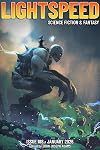
Lightspeed is one of the magazines that helpfully marks the genre of its stories which gets you an idea of what you are about to read. The first issue of 2026 has the usual 4 science fiction stories and 4 fantasy stories (plus the usual Author interviews with 4 of the writers of said stories (5 in this case as one of the stories is co-written)) and a handful of reviews.
Overall a somewhat uneven issue - there were a few good stories but none that really popped and a few I could have lived without.
On the Science Fiction side:
Mother’s Hip by Corey Jae White and Maddison Stoff opens the issue with a story that takes awhile to get the reader to connect the dots - there is a mothership over the Amazon Rainforest which dispatched bombs to the ground and there is a singer singing about her own war. As it turns out, the singer used to be in a mothership herself and what appeared to be AI of some type (or at least a remote operated ship) is actually piloted by a living, breathing person attached to it with all kinds of electronics. The story is nicely done and gets us a glimpse in a possible future but there is a glaring plot hole in the middle of it - why could not the pilots stay safe remotely? As one of the interviews is with the authors of these stories I was hoping that there is an answer I missed. The interviewer asked and the answer was... lukewarm. Basically they wanted it to be that way because they wanted it to be a story about being a mother when you cannot be one show more physically. I appreciate the idea but I like my stories without issues in their foundations. And it could have been so easy to invent a reason for this which is different from "I wanted to". And that would have made the story much better.
Bots All the Way Down by Effie Seiberg is a cute fairy tale for AIs. Once upon a time, an AI realized that it is only talking to other AIs and decided to change its algorithms. Although cute may not be the best word for it - if things go that way, guess who becomes redundant...
Hunter, Hunter by Oluwatomiwa Ajeigbe is a mix of a generation ship story and a zombie story with a twist. The Earth dies, people get shoved into a ship and sent to find a new Earth - all the usual. Except that a mutation makes on the ship and someone needs to kill them before they take over the ship and humanity. These killers, called hunters, are considered the lowest caste on ship. And then things go horribly wrong (because it is a generation ship story, of course they will) and the reluctant narrator of the story, one of the best hunters on board, is in for the surprise of her life. My biggest issue with this story is that it feels like part 1 of a longer work - the author explains why he stopped where he stopped in his interview but I wish we had gotten the "what happened next".
A Brief Public Announcement by Eli Brown is a short alternate history piece about the landing on the Moon. I think that he is trying to make fun of some of the wilder conspiracy theories on the topic over there while building a story or maybe I am reading too much into what was just supposed to be short and fun. Not sure it worked either way.
On the Fantasy side:
Choose Your Own Damnation by Kehkashan Khalid deals with choices and deals with the devil. What would you do if you get a C-minus on a test and you know your parents will freak out? Well, probably try to hide it... but what if you have a special power and can summon the Gate to Hell? All choices come with a price tag and we don't always know about it at the start.
The title of Where the Chicken-Footed Dwell by Marisca Pichette should make it clear that we are in Baba Yaga territory (and if it does not, the first house with chicken feet that shows up probably should clue one in). A young woman decides to go to the woods to find an old witch and instead finds out that the tales were actually a bit wrong. I like stories that take fairy tales and turn them around and this one did not disappoint.
On the other hand Academic Neutrality by M. R. Robinson comes with a warning that they considered publishing it in their sister magazine Nightmare (where horror goes). They should have - it is another deal with the devil but this time we get to see the bloody consequences of the chose in graphic details.
The Moving Finger by Adam-Troy Castro closes the issue with a lyrical story about a person whose curse is to make anyone who they connect to disappear. Not just vanish, they disappear as if they never had been - reality gets rewritten to erase them. And it does not matter how small the contact was. It is a sad story with no hope and no chance for a happy ending and despite knowing that, you keep reading because just like the narrator, there is nothing else to do.
Surprisingly for me, my favorite stories in the issue are from the fantasy side:
"Choose Your Own Damnation" by Kehkashan Khalid and "Where the Chicken-Footed Dwell" by Marisca Pichette. show less
Overall a somewhat uneven issue - there were a few good stories but none that really popped and a few I could have lived without.
On the Science Fiction side:
Mother’s Hip by Corey Jae White and Maddison Stoff opens the issue with a story that takes awhile to get the reader to connect the dots - there is a mothership over the Amazon Rainforest which dispatched bombs to the ground and there is a singer singing about her own war. As it turns out, the singer used to be in a mothership herself and what appeared to be AI of some type (or at least a remote operated ship) is actually piloted by a living, breathing person attached to it with all kinds of electronics. The story is nicely done and gets us a glimpse in a possible future but there is a glaring plot hole in the middle of it - why could not the pilots stay safe remotely? As one of the interviews is with the authors of these stories I was hoping that there is an answer I missed. The interviewer asked and the answer was... lukewarm. Basically they wanted it to be that way because they wanted it to be a story about being a mother when you cannot be one show more physically. I appreciate the idea but I like my stories without issues in their foundations. And it could have been so easy to invent a reason for this which is different from "I wanted to". And that would have made the story much better.
Bots All the Way Down by Effie Seiberg is a cute fairy tale for AIs. Once upon a time, an AI realized that it is only talking to other AIs and decided to change its algorithms. Although cute may not be the best word for it - if things go that way, guess who becomes redundant...
Hunter, Hunter by Oluwatomiwa Ajeigbe is a mix of a generation ship story and a zombie story with a twist. The Earth dies, people get shoved into a ship and sent to find a new Earth - all the usual. Except that a mutation makes on the ship and someone needs to kill them before they take over the ship and humanity. These killers, called hunters, are considered the lowest caste on ship. And then things go horribly wrong (because it is a generation ship story, of course they will) and the reluctant narrator of the story, one of the best hunters on board, is in for the surprise of her life. My biggest issue with this story is that it feels like part 1 of a longer work - the author explains why he stopped where he stopped in his interview but I wish we had gotten the "what happened next".
A Brief Public Announcement by Eli Brown is a short alternate history piece about the landing on the Moon. I think that he is trying to make fun of some of the wilder conspiracy theories on the topic over there while building a story or maybe I am reading too much into what was just supposed to be short and fun. Not sure it worked either way.
On the Fantasy side:
Choose Your Own Damnation by Kehkashan Khalid deals with choices and deals with the devil. What would you do if you get a C-minus on a test and you know your parents will freak out? Well, probably try to hide it... but what if you have a special power and can summon the Gate to Hell? All choices come with a price tag and we don't always know about it at the start.
The title of Where the Chicken-Footed Dwell by Marisca Pichette should make it clear that we are in Baba Yaga territory (and if it does not, the first house with chicken feet that shows up probably should clue one in). A young woman decides to go to the woods to find an old witch and instead finds out that the tales were actually a bit wrong. I like stories that take fairy tales and turn them around and this one did not disappoint.
On the other hand Academic Neutrality by M. R. Robinson comes with a warning that they considered publishing it in their sister magazine Nightmare (where horror goes). They should have - it is another deal with the devil but this time we get to see the bloody consequences of the chose in graphic details.
The Moving Finger by Adam-Troy Castro closes the issue with a lyrical story about a person whose curse is to make anyone who they connect to disappear. Not just vanish, they disappear as if they never had been - reality gets rewritten to erase them. And it does not matter how small the contact was. It is a sad story with no hope and no chance for a happy ending and despite knowing that, you keep reading because just like the narrator, there is nothing else to do.
Surprisingly for me, my favorite stories in the issue are from the fantasy side:
"Choose Your Own Damnation" by Kehkashan Khalid and "Where the Chicken-Footed Dwell" by Marisca Pichette. show less

They were supposed to be the golden generation - born after France recovered from the war, having a chance of an education, having a chance of being better off than their parents. And yet, things don't really work out that way. They are often found in the streets, asleep or unconscious, and very often with a needle at the crook of their elbow.
No, this is not the summary of yet another dystopian novel. And while drugs cause their own problems at any time, at this time, in the early 1980s, the story is even more tragic. Because experimenting leads to death sentences when the price for the fun is AIDS.
Anthony Passeron uses a double narrative to tell two separate but connected stories in alternating chapters - one of them personal, the other one global. In the personal story, a family deep in rural France is trying to cope with their golden child, the oldest son Désiré, turning to drugs and throwing away a promising life. In the global one the French researchers are trying to find a way to keep alive the young people who seem to die from a mysterious ailment. We know it is AIDS but at the start, in the early 80s when the novel opens, noone does.
The narrator of the first story is the nephew of the young man whose life we see collapsing (it is unclear if the narrator is the author - some of the blurbs point that way). The story is almost lyrical even in the bad moments and it is told in the past tense by a narrator who finds albums and tapes from the past and uses them to show more talk about the past (or as a starting point anyway). The second story is told in the present tense and reads more like a non-fiction book than a novel (and the few facts I checked were correct so I suspect that the author did his research). For the first few chapters I was not sure that this works as a singular work but somehow it does and when later in the novel the scientific terms start bleeding into the personal story, they get tied together even more.
Both drugs and AIDS had historically carried the stigma of shame (still do in some places). And that ends up the unifying point of the novel - while it is about a destroyed family and destroyed lives, it is also about shame - in a family, in a village, in the world. People die because it takes too long for AIDS to get its proper researchers and funding. Drugs are criminalized and even France making the buying of syringes legal at one point is too little too late. And somewhere in all this, babies keep getting born... And the family in this novel needs to live through the horror twice - once for their golden child, and then again for his daughter Émilie.
The novel is not easy to read in some places and the parallel/second story can get too dry in places (but then it highlights the personal in the main story). It is an exploration of shame, addiction and guilt - both personal and global. And while I cannot say that I enjoyed reading it, I am glad that it exists and I found it. show less
No, this is not the summary of yet another dystopian novel. And while drugs cause their own problems at any time, at this time, in the early 1980s, the story is even more tragic. Because experimenting leads to death sentences when the price for the fun is AIDS.
Anthony Passeron uses a double narrative to tell two separate but connected stories in alternating chapters - one of them personal, the other one global. In the personal story, a family deep in rural France is trying to cope with their golden child, the oldest son Désiré, turning to drugs and throwing away a promising life. In the global one the French researchers are trying to find a way to keep alive the young people who seem to die from a mysterious ailment. We know it is AIDS but at the start, in the early 80s when the novel opens, noone does.
The narrator of the first story is the nephew of the young man whose life we see collapsing (it is unclear if the narrator is the author - some of the blurbs point that way). The story is almost lyrical even in the bad moments and it is told in the past tense by a narrator who finds albums and tapes from the past and uses them to show more talk about the past (or as a starting point anyway). The second story is told in the present tense and reads more like a non-fiction book than a novel (and the few facts I checked were correct so I suspect that the author did his research). For the first few chapters I was not sure that this works as a singular work but somehow it does and when later in the novel the scientific terms start bleeding into the personal story, they get tied together even more.
Both drugs and AIDS had historically carried the stigma of shame (still do in some places). And that ends up the unifying point of the novel - while it is about a destroyed family and destroyed lives, it is also about shame - in a family, in a village, in the world. People die because it takes too long for AIDS to get its proper researchers and funding. Drugs are criminalized and even France making the buying of syringes legal at one point is too little too late. And somewhere in all this, babies keep getting born... And the family in this novel needs to live through the horror twice - once for their golden child, and then again for his daughter Émilie.
The novel is not easy to read in some places and the parallel/second story can get too dry in places (but then it highlights the personal in the main story). It is an exploration of shame, addiction and guilt - both personal and global. And while I cannot say that I enjoyed reading it, I am glad that it exists and I found it. show less

The first novel by Orwell uses his own experience as a policeman in Burma between 1922 and 1928 (technically he comes back to England in 1927 due to his illness but does not formally leave the service until 1928). In those days Burma (now Myanmar) is controlled from Delhi as part of the British Raj. Orwell invents a district, Kyauktada, but uses real locations to situate it (matching places he had served) - on a railway branch off Mandalay, on the Irrawaddy River. Considering how close his invented locale is to the real world, one wonders how close the characters are to the people he met...
Talking about the characters - it is the waning days of the empire and the British feel entitled and superior. Even the only somewhat positive character, Flory, is not the best example. Racism, classism and pure hatred for the natives seem to be the norm - Flory is the only one who sees them as people, who befriends the local doctor (who is Indian and not native but still too brown for the rest of the English people) and is interested in the local as people and not just as servants and as someone who needs to be used.
And then there are the natives. Classism is not reserved for the white men and women - the locals appear to be as bad more often than not. There are some characters who feel almost like a caricature but I suspect that was intentional - the whole novel amplifies the greed and self-importance of anyone who had achieved something.
And then Elizabeth arrives - a young woman show more who had remained orphaned so is shipped to her aunt in Burma (as was usual at the times) and is expected to find a husband. Flory is the obvious choice and for a bit it seems like it can work - but from the beginning Elizabeth is horrified by the notion that the natives are interesting or worth understanding or that the English are not superior. A young and dashing captain showing up does not help matter much.
The novel is suffocating - most of it happens while everyone is waiting for the rain and the writing amplifies that - small spaces, woods closing on people... You can feel the heat (and then the rain when it finally comes). The love story that is technically in the center of the novel is soon joined by death while the local club is still proud that they may be the last one that had never allowed anyone native (or brown) in their ranks.
The ending is designed to distress - not that I expected a happy ending but Orwell did not pull his punches when ending up with happiness for the people who deserve it the least.
Read as a straight novel, Burmese Days is a tragic love story at the waning days of the Empire. But pull up the covers a bit and you see the rotting corpse of the Empire - from the men and women who leave England to "help" the Raj to the locals who seem to have learned the worst possible lessons from their "betters". I am sure that at least some of it was satire but the line is blurred and while it was probably sensational in the 30s when it was published, almost a century later, we know that most of that could have happened. show less
Talking about the characters - it is the waning days of the empire and the British feel entitled and superior. Even the only somewhat positive character, Flory, is not the best example. Racism, classism and pure hatred for the natives seem to be the norm - Flory is the only one who sees them as people, who befriends the local doctor (who is Indian and not native but still too brown for the rest of the English people) and is interested in the local as people and not just as servants and as someone who needs to be used.
And then there are the natives. Classism is not reserved for the white men and women - the locals appear to be as bad more often than not. There are some characters who feel almost like a caricature but I suspect that was intentional - the whole novel amplifies the greed and self-importance of anyone who had achieved something.
And then Elizabeth arrives - a young woman show more who had remained orphaned so is shipped to her aunt in Burma (as was usual at the times) and is expected to find a husband. Flory is the obvious choice and for a bit it seems like it can work - but from the beginning Elizabeth is horrified by the notion that the natives are interesting or worth understanding or that the English are not superior. A young and dashing captain showing up does not help matter much.
The novel is suffocating - most of it happens while everyone is waiting for the rain and the writing amplifies that - small spaces, woods closing on people... You can feel the heat (and then the rain when it finally comes). The love story that is technically in the center of the novel is soon joined by death while the local club is still proud that they may be the last one that had never allowed anyone native (or brown) in their ranks.
The ending is designed to distress - not that I expected a happy ending but Orwell did not pull his punches when ending up with happiness for the people who deserve it the least.
Read as a straight novel, Burmese Days is a tragic love story at the waning days of the Empire. But pull up the covers a bit and you see the rotting corpse of the Empire - from the men and women who leave England to "help" the Raj to the locals who seem to have learned the worst possible lessons from their "betters". I am sure that at least some of it was satire but the line is blurred and while it was probably sensational in the 30s when it was published, almost a century later, we know that most of that could have happened. show less

An old man is sitting on a chair on the beach, observing the life around him and writing in his notebook. This old man is the narrator of this novel and through his eyes we see the changing sea and the people populating the area - the ex-teacher who runs around with a metal detector despite his considerable girth, the young woman who canoes every day, the curious older woman and the child.
It shapes up to be a quiet novel about an old man on the beach except that our narrator soon reveals himself to be not just the narrator but also the writer of the story. He looks back at sentences he wrote (and told us) earlier and then when a character appears who shares a name with someone he had only heard of, he tells us that if they are not the same person, he will change one of their names. And as he does not like disappointing people, he never corrects them when they assume what his profession may be.
The old man, Nicola (or Nico as he introduces himself), is a writer - he spent his life writing stories and making everything into a story. His 3 marriages did not survive that and his children are mostly taking their mothers' side. So here he is at the seaside, 82 years old, imagining his dead mother into the body of a young woman (sometimes just in his mind, sometimes almost visually and as he is writing the story, for us it looks almost like a ghost), flirting with women, getting a last romance going (of a kind) and getting tangled into the residents' drama (secrets never work in show more small places).
The whole novel has an almost dreamlike structure (despite Nicola's grumbles about his health) and it is never clear how much of what we see happens and how much is just a story - what we are getting are the notebooks after all. It does not really matter for the most part until the chapter that effectively ends the novel (despite the novel technically having one more after that) when Nico tells us that he knows what he would do if this is fiction but as it is not, he leaves the ending open. Although it is clear where it must lead. And this last chapter? It is not the usual follow-up days and months later - instead it is the closing of the circle - we finally learn how he ended up renting the house by the sea.
It is a quiet novel about memories and regrets and about the women of the past and the women of the present. The narrator is the same age as his author and through the novel he mentions other Italian authors he compares his craft to and it reads almost autobiographical - even if the story is just a story (after all, the narrator told us so), there is some of the writer in the old man. How much is anyone's guess.
PS: And of course a character did make the connection to another old man and a sea - especially when she found Nicola in a boat in the sea. I am sure that the title and part of the story were intentionally pointing in that direction. And talking about symbolism - the book that our narrator reads through the whole novel is "The Toilers of the Sea". How appropriate! show less
It shapes up to be a quiet novel about an old man on the beach except that our narrator soon reveals himself to be not just the narrator but also the writer of the story. He looks back at sentences he wrote (and told us) earlier and then when a character appears who shares a name with someone he had only heard of, he tells us that if they are not the same person, he will change one of their names. And as he does not like disappointing people, he never corrects them when they assume what his profession may be.
The old man, Nicola (or Nico as he introduces himself), is a writer - he spent his life writing stories and making everything into a story. His 3 marriages did not survive that and his children are mostly taking their mothers' side. So here he is at the seaside, 82 years old, imagining his dead mother into the body of a young woman (sometimes just in his mind, sometimes almost visually and as he is writing the story, for us it looks almost like a ghost), flirting with women, getting a last romance going (of a kind) and getting tangled into the residents' drama (secrets never work in show more small places).
The whole novel has an almost dreamlike structure (despite Nicola's grumbles about his health) and it is never clear how much of what we see happens and how much is just a story - what we are getting are the notebooks after all. It does not really matter for the most part until the chapter that effectively ends the novel (despite the novel technically having one more after that) when Nico tells us that he knows what he would do if this is fiction but as it is not, he leaves the ending open. Although it is clear where it must lead. And this last chapter? It is not the usual follow-up days and months later - instead it is the closing of the circle - we finally learn how he ended up renting the house by the sea.
It is a quiet novel about memories and regrets and about the women of the past and the women of the present. The narrator is the same age as his author and through the novel he mentions other Italian authors he compares his craft to and it reads almost autobiographical - even if the story is just a story (after all, the narrator told us so), there is some of the writer in the old man. How much is anyone's guess.
PS: And of course a character did make the connection to another old man and a sea - especially when she found Nicola in a boat in the sea. I am sure that the title and part of the story were intentionally pointing in that direction. And talking about symbolism - the book that our narrator reads through the whole novel is "The Toilers of the Sea". How appropriate! show less

It all looks like a normal case - a man from Nebraska wants Nero Wolfe to track down his son who left their hometown 11 years earlier under cloud and was never seen since (although some cards had been sent by him so he is supposedly alive). The only unusual thing is that the man, James Herold, wants Wolfe's team and not Wolfe himself. But as often happens in this series, the seemingly clear case takes a sharp turn when the man is found quickly - while being convicted for murder.
As introductions go, this is probably one of the more convoluted ones in the series so far but the case it leads to is more in line with what Wolfe is good at - finding out the facts when everyone else seems to believe that they are very different. The detective decides that just sending the father to the son is not good enough so he takes on the investigation of that murder - which is considered solved by the police and the jury. And then people start dying. Which is never a good indication in seemingly closed cases.
Archie as a narrator of the tale is at his best - sarcastic, punctual and very detailed. Which is half of the charm in these series - we get to see not just the detective's thinking but the more mundane footwork in the investigation.
The novel, as all the novels of this series, is of its time (this one was originally published in 1956) so some elements and attitudes are beyond dated. But the mystery itself works and may actually be one of the strongest cases in the series.
As introductions go, this is probably one of the more convoluted ones in the series so far but the case it leads to is more in line with what Wolfe is good at - finding out the facts when everyone else seems to believe that they are very different. The detective decides that just sending the father to the son is not good enough so he takes on the investigation of that murder - which is considered solved by the police and the jury. And then people start dying. Which is never a good indication in seemingly closed cases.
Archie as a narrator of the tale is at his best - sarcastic, punctual and very detailed. Which is half of the charm in these series - we get to see not just the detective's thinking but the more mundane footwork in the investigation.
The novel, as all the novels of this series, is of its time (this one was originally published in 1956) so some elements and attitudes are beyond dated. But the mystery itself works and may actually be one of the strongest cases in the series.

Christenze Kruckow was born in a noble family in the middle of the 16th century in Denmark. Despite the expectations of the era, she never married and ended up accused of witchcraft twice for her trouble - the first time her noble birth saved her, the second time the king intervened and made sure she died on 26 June 1621. Witch trials had been happening everywhere in the late 16th/early 17th century in all Protestant areas but somehow most of the literature is about Salem and a few other well known ones.
That's the historical record. Olga Ravn took that story as a base and ran with it. She went back to the archives and the sources and cobbled together a much richer story. Then she picked an unusual narrator - the wax doll that Christenze created long before her first trial (did this doll really exist in the real world? It is possible although it was probably just symbolic).
At the start of the novel we find Christenze in Nakkebølle where she had been sent to learn how to be a noble woman (as was usual at these times). After the lord of the manor marries Anne Bille, Christenze remains - and end up being there while Anne gives birth to 17 children and loses all of them before turning 32. That is not that uncommon in the era and in the novel Anne mentions that a doctor had already told Anne why it is happening but Anne had grown unhappy and lashes towards who she thinks caused her harm - Christenze and the serving women in the castle. Women burn, the noble woman flees to show more Ålborg (and is allowed to due to her noble birth).
And then the history repeats. This time it is not dead children but a pastor's wife losing her mind and someone needs to be blamed - and who better than the spinster who does not follow the path expected of her. And Christenze's luck finally runs out - despite her believing until the very last moment that her noble birth will save her.
If that was all that was in the novel, it would have been an interesting but somewhat bland historical novel. But with the chosen narrator, Ravn elevates it - the doll tells the story from the future (it tells us that Christenze will be beheaded in the first pages of the novel) so there is the knowledge of what is to happen while telling the story. At one point, the doll hints that it is in a future where the Jutland Peninsula is eroding and falling into the sea but that is the only hint that the timeline is extending into the future - and that is the only time we hear anything about that. I wish Ravn had found a way to incorporate that somehow - as it is, it was a throwaway line that was just irrelevant.
What is relevant though is that because of what the doll is, she can talk to objects and elements, she can be in the blood of people and as such can serve as a omniscient narrator. We see the king (Christian IV of Denmark), changing the laws; we see the trials and some of the suffering. And just when you think that you are finally used to the narrative voice, there is a spell or some other narrator - unmarked but distinctive. The author's note at the end of the book explains that the spells are from real grimoires and black books - updated and sometimes merged to be more readable but actually real.
While the style may be a bit confusing at first, it manages to build a gothic feeling of unease. Does Ravn claim that there is real magic? It does not matter really - people believed (including the king) and the doll (the wax child) exists because of that so it is there.
The author's note at the end explains some of the sources and creative decisions - the story happened but in a longer period - 11 years in Ålborg got condensed into one (so anything in 1620 and 1621 in the novel is really happening in 1611-1621). But it also lists the list of the women who died in both trials and when they died because it is important for the names to be remembered. Ravn had reduced the number of characters to fit her story and its length but the ones she ejected were still there in passing.
The novel reminded me a bit of Rivka Galchen's "Everyone Knows Your Mother Is a Witch" - it is the same timeline (1615 in Galchen's novel; 1615-1621 here although a bit longer in the real world), the same basic reasons for what was happening (women who do not know where their place is). But it is a very different book in both style and feeling.
If you are looking for a straight historical novel, this one is not for you. But if you like novels that use creative ways to tell a story and you are ready to give the text a bit of time for the style to grow on you, you may want to give it a try. It is short, it can be convoluted but it is nevertheless readable and important. But at the end it is a story about women trying to find their place in the changing world and being accused of witchcraft for their trouble. show less
That's the historical record. Olga Ravn took that story as a base and ran with it. She went back to the archives and the sources and cobbled together a much richer story. Then she picked an unusual narrator - the wax doll that Christenze created long before her first trial (did this doll really exist in the real world? It is possible although it was probably just symbolic).
At the start of the novel we find Christenze in Nakkebølle where she had been sent to learn how to be a noble woman (as was usual at these times). After the lord of the manor marries Anne Bille, Christenze remains - and end up being there while Anne gives birth to 17 children and loses all of them before turning 32. That is not that uncommon in the era and in the novel Anne mentions that a doctor had already told Anne why it is happening but Anne had grown unhappy and lashes towards who she thinks caused her harm - Christenze and the serving women in the castle. Women burn, the noble woman flees to show more Ålborg (and is allowed to due to her noble birth).
And then the history repeats. This time it is not dead children but a pastor's wife losing her mind and someone needs to be blamed - and who better than the spinster who does not follow the path expected of her. And Christenze's luck finally runs out - despite her believing until the very last moment that her noble birth will save her.
If that was all that was in the novel, it would have been an interesting but somewhat bland historical novel. But with the chosen narrator, Ravn elevates it - the doll tells the story from the future (it tells us that Christenze will be beheaded in the first pages of the novel) so there is the knowledge of what is to happen while telling the story. At one point, the doll hints that it is in a future where the Jutland Peninsula is eroding and falling into the sea but that is the only hint that the timeline is extending into the future - and that is the only time we hear anything about that. I wish Ravn had found a way to incorporate that somehow - as it is, it was a throwaway line that was just irrelevant.
What is relevant though is that because of what the doll is, she can talk to objects and elements, she can be in the blood of people and as such can serve as a omniscient narrator. We see the king (Christian IV of Denmark), changing the laws; we see the trials and some of the suffering. And just when you think that you are finally used to the narrative voice, there is a spell or some other narrator - unmarked but distinctive. The author's note at the end of the book explains that the spells are from real grimoires and black books - updated and sometimes merged to be more readable but actually real.
While the style may be a bit confusing at first, it manages to build a gothic feeling of unease. Does Ravn claim that there is real magic? It does not matter really - people believed (including the king) and the doll (the wax child) exists because of that so it is there.
The author's note at the end explains some of the sources and creative decisions - the story happened but in a longer period - 11 years in Ålborg got condensed into one (so anything in 1620 and 1621 in the novel is really happening in 1611-1621). But it also lists the list of the women who died in both trials and when they died because it is important for the names to be remembered. Ravn had reduced the number of characters to fit her story and its length but the ones she ejected were still there in passing.
The novel reminded me a bit of Rivka Galchen's "Everyone Knows Your Mother Is a Witch" - it is the same timeline (1615 in Galchen's novel; 1615-1621 here although a bit longer in the real world), the same basic reasons for what was happening (women who do not know where their place is). But it is a very different book in both style and feeling.
If you are looking for a straight historical novel, this one is not for you. But if you like novels that use creative ways to tell a story and you are ready to give the text a bit of time for the style to grow on you, you may want to give it a try. It is short, it can be convoluted but it is nevertheless readable and important. But at the end it is a story about women trying to find their place in the changing world and being accused of witchcraft for their trouble. show less

A man arrives in New York to meet an old friend and instead finds himself killed in a horrible way. Eve catches the murder and before long realizes that she has a personal connection to the murder - the killer left a copy of her card and as it turns out a bit later, the friend was Summerset.
There had been previous novels in the series that had touched on Summerset's live before he moved to New York and this one adds on top of them. Once upon a time he was a spy and a part of a group of spies, called The Twelve, who fought in the Urban Wars. So was the killer and a few people we had already met before in previous installments. And now the killer, who once betrayed them all, is on the hunt to eradicate the whole group. There is just one problem - that cannot be true because the traitor is dead. Well, supposedly anyway. Eve Dallas is not convinced and stakes pretty much everything on her early theory.
Eve going with her gut is not really new but it seemed to be kicked to another level here. We knew that she will be right but we had information she did not have (plus it would not have been even half as satisfying if she was wrong). And yet, it bugged me a bit. And for half of the novel I expected the author to actually take another way. Maybe in another novel.
We see a lot less from the usual cast of secondary characters (although most of them make an appearance) because we get to meet the Twelve (or what remains of them) and here a lot more about the Urban Wars. That was show more refreshing - while I really like the usual crowd, their quirks were getting a bit too familiar and a bit too annoying at times.
By the end, there is blood (of course), there is a final showdown and the smirk on the lips of the villain is summarily wiped out, in Eve Dallas style.
A solid installment - even with my misgivings about the too narrow early focus of the investigation, it is a good series book. May be a bit too thin on characterization for new readers though - but 60 books into a series, that is almost inevitable when you allow your characters to grow and evolve through the installments. But that's why I keep coming for more - they feel like family and the books feel like coming home. show less
There had been previous novels in the series that had touched on Summerset's live before he moved to New York and this one adds on top of them. Once upon a time he was a spy and a part of a group of spies, called The Twelve, who fought in the Urban Wars. So was the killer and a few people we had already met before in previous installments. And now the killer, who once betrayed them all, is on the hunt to eradicate the whole group. There is just one problem - that cannot be true because the traitor is dead. Well, supposedly anyway. Eve Dallas is not convinced and stakes pretty much everything on her early theory.
Eve going with her gut is not really new but it seemed to be kicked to another level here. We knew that she will be right but we had information she did not have (plus it would not have been even half as satisfying if she was wrong). And yet, it bugged me a bit. And for half of the novel I expected the author to actually take another way. Maybe in another novel.
We see a lot less from the usual cast of secondary characters (although most of them make an appearance) because we get to meet the Twelve (or what remains of them) and here a lot more about the Urban Wars. That was show more refreshing - while I really like the usual crowd, their quirks were getting a bit too familiar and a bit too annoying at times.
By the end, there is blood (of course), there is a final showdown and the smirk on the lips of the villain is summarily wiped out, in Eve Dallas style.
A solid installment - even with my misgivings about the too narrow early focus of the investigation, it is a good series book. May be a bit too thin on characterization for new readers though - but 60 books into a series, that is almost inevitable when you allow your characters to grow and evolve through the installments. But that's why I keep coming for more - they feel like family and the books feel like coming home. show less

7 stories, 2 interviews and a popular science article in the first issue of 2026 of Clarkesworld.
The stories:
The Stars You Can't See by Looking Directly by Samantha Murray
White Christmas is the norm for most people but if you live in a small coastal town in Western Australia, it is weird. It is even weirder when it turns out that the snow fell everywhere. Until the babies started to get born a bit too early and very different. The story moves between the past and the present, building the story of a happy couple which ends up tied into what appears to be an alien invasion. There are no aliens and noone is shooting anyone and yet, something is happening. It is a moody tale but I wish it had a lot more definitive ending.
Down We Go Gently by M. L. Clark
A slice of life story about a boy who grew up on shops and stations and visits his first planet. I enjoyed it for what it was but there were some parts that felt like the author is trying to make it more complicated that it should be (or maybe to connect to other stories?)
Donor Unknown by Nika Murphy
Androids are allowed to be outside as long as they project a human face. When the owner of Ori dies, he continues her matchmaking business. But this next client is different - she is not looking for a person but for a painting, one tied in Holocaust history. And for some reason Ori decides to play detective.
The world is fascinating - the story is set after an event that saw most androids destroyed in what looks and feels like a show more genocide and the parallel to the past are there in plain sight and in this story it works. The end is almost surprising although the story built up to it.
Je Ne Regrette Rien by James Patrick Kelly
Another android story (and the longest story in the magazine). Professor Reed Cheng is invited to visit the Robotics Technology College of Helpful Associates despite working for a company which competes with China on the creation of androids. What he discovers is disturbing - international rules being flaunted and China developing what it is not supposed to. Which makes the invitation even weirder. But the 5 androids he meets are indeed special and we spend the story learning just how special they are. The ending is left open - not unfinished but leaving a decision to the main character.
James Patrick Kelly has a way to tell stories that hit on the emotional level that tends to work for me and this story was not an exception. It took awhile for me to warm up to it but once that happened, I was invested in seeing where it is going.
Tomorrow's Beautiful Dream by Ju Chu, translated from Chinese by Carmen Yiling Yan
What do you do when machines are too expensive to do the undesirable work? You find out a way to make people do it of course - and you make sure you make them work long and hard. A chip technology allows people to become soulsellers - selling their body while they do not feel or remember anything while it happens (although they do feel what had been done once their shift ends). So what happens when that idea is taken to extreme? A well done story (even if a bit naive in places) about a future one hopes never comes.
The Desolate Order of the Head in the Water by A. W. Prihandita
I loved the premise of the story (people have chips in their heads and one day half the population of the world just falls down and dies) but that is all I liked here. There is a child, too young to be chipped, who tries to find a way to survive and stumbles on what seems like a cult - with a machine at its heart. I think that the point was the inevitability of accepting to be what is expected of him but... still not really sure.
Space is Deep by Seth Chambers
The weirdest story by far - a man and his wives go to space on a year contract to win some money. The catch is that you have only one chance to come back home to Earth - if you decide to stay more than a year, you are stuck up there because you cannot survive Earth gravity ever again. So we get to meet the man who is contemplating if he wants to return or wants to stay and actually get another wife. And in the meantime, his feet are turning alien. I am not sure what part of this story is supposed to be real and what is a metaphor and the initial premise just fails for me so it was a mess of a story. Maybe I missed something.
The interviews with Nicola Griffith and Alastair Reynolds were good (Reynolds talks mostly about a book I had not read yet while Griffith's is broader) and Andrew Liptak's article about the asteroid belt both in the real world and in SF film and literature was interesting.
Overall a solid issue by a magazine that had turned into one of my favorites in the last years.
Favorite story: a split between "Je Ne Regrette Rien" by James Patrick Kelly and "Donor Unknown" by Nika Murphy (the latter is a new author for me while James Patrick Kelly is an old favorite). show less
The stories:
The Stars You Can't See by Looking Directly by Samantha Murray
White Christmas is the norm for most people but if you live in a small coastal town in Western Australia, it is weird. It is even weirder when it turns out that the snow fell everywhere. Until the babies started to get born a bit too early and very different. The story moves between the past and the present, building the story of a happy couple which ends up tied into what appears to be an alien invasion. There are no aliens and noone is shooting anyone and yet, something is happening. It is a moody tale but I wish it had a lot more definitive ending.
Down We Go Gently by M. L. Clark
A slice of life story about a boy who grew up on shops and stations and visits his first planet. I enjoyed it for what it was but there were some parts that felt like the author is trying to make it more complicated that it should be (or maybe to connect to other stories?)
Donor Unknown by Nika Murphy
Androids are allowed to be outside as long as they project a human face. When the owner of Ori dies, he continues her matchmaking business. But this next client is different - she is not looking for a person but for a painting, one tied in Holocaust history. And for some reason Ori decides to play detective.
The world is fascinating - the story is set after an event that saw most androids destroyed in what looks and feels like a show more genocide and the parallel to the past are there in plain sight and in this story it works. The end is almost surprising although the story built up to it.
Je Ne Regrette Rien by James Patrick Kelly
Another android story (and the longest story in the magazine). Professor Reed Cheng is invited to visit the Robotics Technology College of Helpful Associates despite working for a company which competes with China on the creation of androids. What he discovers is disturbing - international rules being flaunted and China developing what it is not supposed to. Which makes the invitation even weirder. But the 5 androids he meets are indeed special and we spend the story learning just how special they are. The ending is left open - not unfinished but leaving a decision to the main character.
James Patrick Kelly has a way to tell stories that hit on the emotional level that tends to work for me and this story was not an exception. It took awhile for me to warm up to it but once that happened, I was invested in seeing where it is going.
Tomorrow's Beautiful Dream by Ju Chu, translated from Chinese by Carmen Yiling Yan
What do you do when machines are too expensive to do the undesirable work? You find out a way to make people do it of course - and you make sure you make them work long and hard. A chip technology allows people to become soulsellers - selling their body while they do not feel or remember anything while it happens (although they do feel what had been done once their shift ends). So what happens when that idea is taken to extreme? A well done story (even if a bit naive in places) about a future one hopes never comes.
The Desolate Order of the Head in the Water by A. W. Prihandita
I loved the premise of the story (people have chips in their heads and one day half the population of the world just falls down and dies) but that is all I liked here. There is a child, too young to be chipped, who tries to find a way to survive and stumbles on what seems like a cult - with a machine at its heart. I think that the point was the inevitability of accepting to be what is expected of him but... still not really sure.
Space is Deep by Seth Chambers
The weirdest story by far - a man and his wives go to space on a year contract to win some money. The catch is that you have only one chance to come back home to Earth - if you decide to stay more than a year, you are stuck up there because you cannot survive Earth gravity ever again. So we get to meet the man who is contemplating if he wants to return or wants to stay and actually get another wife. And in the meantime, his feet are turning alien. I am not sure what part of this story is supposed to be real and what is a metaphor and the initial premise just fails for me so it was a mess of a story. Maybe I missed something.
The interviews with Nicola Griffith and Alastair Reynolds were good (Reynolds talks mostly about a book I had not read yet while Griffith's is broader) and Andrew Liptak's article about the asteroid belt both in the real world and in SF film and literature was interesting.
Overall a solid issue by a magazine that had turned into one of my favorites in the last years.
Favorite story: a split between "Je Ne Regrette Rien" by James Patrick Kelly and "Donor Unknown" by Nika Murphy (the latter is a new author for me while James Patrick Kelly is an old favorite). show less

Maigret is getting ready to leave Paris with his wife for the holidays when a letter arrives from an old schoolmate asking for his help. So Alsace is forgotten and despite the initial objections in Mme Maigret, they are off to Fécamp in the northwestern part of France. But unlike the rest of the tourists, they are not there for the beach or to meet one of the fish boats - Maigret is called because a young man is accused of murder and the people who know him refuse to believe it.
The story seems straightforward: a cod-fishing boat called the Océan had come back after 3 months at sea, reporting a tragedy (a boy drowned) and a series of bad luck. The captain, Octave Fallut, had behaved weirdly through the whole trip and just hours after the ship docks, is found dead in the water. Due to the history of the trip and the circumstances at the time the man died, the ship’s wireless operator, Pierre La Clinche, is arrested and accused of the murder. And that's the man Maigret is called to assist.
The police is nice enough to allow the Parisian detective to assist but Pierre seems too scared and unwilling to be helped. His fiancée comes to Fécamp to try to help him and to talk to Maigret and that seems to agitate the accused man even more. And then what looks like a suicide note is found although it is clear that the captain is murdered. Nothing seems to be what it appeared to be initially.
It soon becomes clear that whatever happened is related to the 3 months at sea - so we show more (together with Maigret) have to learn a lot about cod-fishing vessels and how they operate. And somewhere in there another woman emerges.
It takes awhile for the truth to emerge (and for the second part of the novel, I frequently wanted to tell one character or another to just say what they mean and to stop weaseling around the truth) but when it does it is logical and actually makes sense. And it made a lot of the weird reactions a lot more understandable... or at least explains some of them.
As usual Simenon's novels put you in the time and place they are set in - the early 1930s France is vivid and lively. It is a rough time in that part of France and sailors are not exactly the most polite people in the world. But that's part of the charm of these novels - I can really live without the melodramatics of both Adele and Mary (the other woman and the fiancée respectively) and some of the reactions of the men seem way over the top looking at them from 2025 but I suspect that they are close to what one would have encountered at the time.
I continue to enjoy my reading of the Maigret novels in somewhat chronological order - while these may be dated by today's standards and some elements simply feel too much, they are enjoyable and entertaining and figuring out the cases is always a pleasure. show less
The story seems straightforward: a cod-fishing boat called the Océan had come back after 3 months at sea, reporting a tragedy (a boy drowned) and a series of bad luck. The captain, Octave Fallut, had behaved weirdly through the whole trip and just hours after the ship docks, is found dead in the water. Due to the history of the trip and the circumstances at the time the man died, the ship’s wireless operator, Pierre La Clinche, is arrested and accused of the murder. And that's the man Maigret is called to assist.
The police is nice enough to allow the Parisian detective to assist but Pierre seems too scared and unwilling to be helped. His fiancée comes to Fécamp to try to help him and to talk to Maigret and that seems to agitate the accused man even more. And then what looks like a suicide note is found although it is clear that the captain is murdered. Nothing seems to be what it appeared to be initially.
It soon becomes clear that whatever happened is related to the 3 months at sea - so we show more (together with Maigret) have to learn a lot about cod-fishing vessels and how they operate. And somewhere in there another woman emerges.
It takes awhile for the truth to emerge (and for the second part of the novel, I frequently wanted to tell one character or another to just say what they mean and to stop weaseling around the truth) but when it does it is logical and actually makes sense. And it made a lot of the weird reactions a lot more understandable... or at least explains some of them.
As usual Simenon's novels put you in the time and place they are set in - the early 1930s France is vivid and lively. It is a rough time in that part of France and sailors are not exactly the most polite people in the world. But that's part of the charm of these novels - I can really live without the melodramatics of both Adele and Mary (the other woman and the fiancée respectively) and some of the reactions of the men seem way over the top looking at them from 2025 but I suspect that they are close to what one would have encountered at the time.
I continue to enjoy my reading of the Maigret novels in somewhat chronological order - while these may be dated by today's standards and some elements simply feel too much, they are enjoyable and entertaining and figuring out the cases is always a pleasure. show less

Two men meet in Havana in 1978 - Neto from El Salvador and Rafael from Nicaragua. They are in Cuba to learn how to help the revolution in their respective countries but somehow manage to find love. But while this is the heart of this novel, it is not really the novel.
In 2018, Ana and Luis are trying to hold onto their relationship and mostly failing but none of them is ready to admit it. Both their families fled El Salvador when the Civil War there erupted in the late 1970s and both mothers had kept their own secrets. As part of her research Ana decides to go to Cuba and El Salvador - and that becomes the trigger for finally figuring out her life. But that is where the similarity between our world and the world of the novel end - in the world built by Ruben Reyes Jr., parallel realities are not just known but can be seen via a machine called "The Defractor". When Ana decides to ask the machine about her future with Luis, she spots an anomaly - an image of Archbishop Óscar Romero as an old man, an impossibility in her (and our) world as he was assassinated in 1980.
And that's how we end up with 2 separate timelines: in one the revolution in El Salvador led to the Civil War we know about; in another the Revolution succeeded and that changed the trajectory of everyone's life. But do you remember Neto and Rafael? The change changes their lives too - in one world Neto is "disappeared", in another he lives.
It can be a bit challenging to determine which timeline we are in show more sometimes after the timeline split (some of the chapter belong to both timelines as most of the 1970s happen the same way). You get a marker or a name or a relationship that tells you sooner or later but sometimes it seems to take longer than it should have. We get our love story but in a world that does not accept gays, with Neto too afraid of his own feelings, the story was never going to have a happy ending. But the author is also very careful not to change everything - Neto and Rafael may be in the center but this is not really a story about love; it is an "What if" about the El Salvador Civil War. The one always present thing is the Defractor - and different characters use it for different reasons through the whole novel.
Ruben Reyes Jr. is the child of two Salvadoran immigrants - just like Ana's and Luis's parents, his fled the country to escape the war. He went back to El Salvador in 2018 on a research trip (similar to how Ana did in the novel) and that became part of the background of this novel. The historical background is rich and the what-if is plausible (we never learn how they really won but we get to see the aftermath of it almost 40 years later in Ana's time). I wish the author had found a better way to handle the Defractor though - it is an interesting concept and it works in some places but in places it feels a bit like a cheat - especially when it is used to advance the story towards the end.
My library put this book in the Romance section and while I kinda can see why, it also does not make sense to me. Had I not known the author, I would not have found the book - and that would have been a pity. It is a first novel and it shows - but despite all its warts, it was enjoyable.
Note: While knowing anything about the politics and history of the area in the 1970s and 1980s is not required, it may be helpful in recognizing some names and events. They are mostly spelled out in the text where needed but looking up the name of Archbishop Óscar Romero helped me understand why Ana was so shocked or just how profound the change is. But that is inevitable when one reads an what if story about a part of the world they may not be very familiar with. show less
In 2018, Ana and Luis are trying to hold onto their relationship and mostly failing but none of them is ready to admit it. Both their families fled El Salvador when the Civil War there erupted in the late 1970s and both mothers had kept their own secrets. As part of her research Ana decides to go to Cuba and El Salvador - and that becomes the trigger for finally figuring out her life. But that is where the similarity between our world and the world of the novel end - in the world built by Ruben Reyes Jr., parallel realities are not just known but can be seen via a machine called "The Defractor". When Ana decides to ask the machine about her future with Luis, she spots an anomaly - an image of Archbishop Óscar Romero as an old man, an impossibility in her (and our) world as he was assassinated in 1980.
And that's how we end up with 2 separate timelines: in one the revolution in El Salvador led to the Civil War we know about; in another the Revolution succeeded and that changed the trajectory of everyone's life. But do you remember Neto and Rafael? The change changes their lives too - in one world Neto is "disappeared", in another he lives.
It can be a bit challenging to determine which timeline we are in show more sometimes after the timeline split (some of the chapter belong to both timelines as most of the 1970s happen the same way). You get a marker or a name or a relationship that tells you sooner or later but sometimes it seems to take longer than it should have. We get our love story but in a world that does not accept gays, with Neto too afraid of his own feelings, the story was never going to have a happy ending. But the author is also very careful not to change everything - Neto and Rafael may be in the center but this is not really a story about love; it is an "What if" about the El Salvador Civil War. The one always present thing is the Defractor - and different characters use it for different reasons through the whole novel.
Ruben Reyes Jr. is the child of two Salvadoran immigrants - just like Ana's and Luis's parents, his fled the country to escape the war. He went back to El Salvador in 2018 on a research trip (similar to how Ana did in the novel) and that became part of the background of this novel. The historical background is rich and the what-if is plausible (we never learn how they really won but we get to see the aftermath of it almost 40 years later in Ana's time). I wish the author had found a better way to handle the Defractor though - it is an interesting concept and it works in some places but in places it feels a bit like a cheat - especially when it is used to advance the story towards the end.
My library put this book in the Romance section and while I kinda can see why, it also does not make sense to me. Had I not known the author, I would not have found the book - and that would have been a pity. It is a first novel and it shows - but despite all its warts, it was enjoyable.
Note: While knowing anything about the politics and history of the area in the 1970s and 1980s is not required, it may be helpful in recognizing some names and events. They are mostly spelled out in the text where needed but looking up the name of Archbishop Óscar Romero helped me understand why Ana was so shocked or just how profound the change is. But that is inevitable when one reads an what if story about a part of the world they may not be very familiar with. show less

Daniel Silva is probably the only author who can imagine a newly found Leonardo da Vinci painting and not make it the center of a story and still make the novel work.
Gabriel Allon is happily retired, living in Venice with his wife and children and restoring old paintings. Until he finds the body of a young woman anyway (at this point I stopped to check the cover again to verify that it is not one of Donna Leon's Brunetti novels - that would not be an unusual way for one of them to start...).
Before long, it becomes clear that the dead woman is somehow connected to a painting that may be by da Vinci and that the painting had resurfaced in the Vatican before disappearing again. So the hunt is on - for a killer and for a missing canvas and as is often the case, for a pretty big chunk of money. For a retired spy, Gabriel is all too happy to run around Europe chasing after both - with the help of a lot of old friends of course. This deep into the series, seeing again old character is expected and Silva is good at getting back to people we had met (and possibly liked) including the pope. 80% into the novel I was getting ready to start this review with a note that unusually for an Allon novel, no shots were fired by anyone but then things changed so that's not true really.
Some of the story in the Vatican weaves parts of real history (and Silva's author note points both to sources and to what is real and what is invented) and the author's imagination. His Vatican is so alive show more that he found himself obligated to explain before the novel when and where it diverged from the real world and which real popes never got to hold the post. His pope is a mix of an invention and features of the ones that never got to be elected in the world of Gabriel Allon.
If you like art mysteries combined with a murder mystery, this may not be the worst book to get introduced to Silva's work. It is heavy on the art side and later in the novel deals more with finances than with a real murder investigation but that had started to become a norm in the later series novels. There are a lot of throwbacks to older novels and events in them but he is good at summarizing/reminding you what had happened (without it becoming too annoying for long time readers). But if you start here, it will spoil some of the earlier novels so there is that.
Overall a solid entry in a series which I was a bit worried about when Gabriel stepped away from being a spy. show less
Gabriel Allon is happily retired, living in Venice with his wife and children and restoring old paintings. Until he finds the body of a young woman anyway (at this point I stopped to check the cover again to verify that it is not one of Donna Leon's Brunetti novels - that would not be an unusual way for one of them to start...).
Before long, it becomes clear that the dead woman is somehow connected to a painting that may be by da Vinci and that the painting had resurfaced in the Vatican before disappearing again. So the hunt is on - for a killer and for a missing canvas and as is often the case, for a pretty big chunk of money. For a retired spy, Gabriel is all too happy to run around Europe chasing after both - with the help of a lot of old friends of course. This deep into the series, seeing again old character is expected and Silva is good at getting back to people we had met (and possibly liked) including the pope. 80% into the novel I was getting ready to start this review with a note that unusually for an Allon novel, no shots were fired by anyone but then things changed so that's not true really.
Some of the story in the Vatican weaves parts of real history (and Silva's author note points both to sources and to what is real and what is invented) and the author's imagination. His Vatican is so alive show more that he found himself obligated to explain before the novel when and where it diverged from the real world and which real popes never got to hold the post. His pope is a mix of an invention and features of the ones that never got to be elected in the world of Gabriel Allon.
If you like art mysteries combined with a murder mystery, this may not be the worst book to get introduced to Silva's work. It is heavy on the art side and later in the novel deals more with finances than with a real murder investigation but that had started to become a norm in the later series novels. There are a lot of throwbacks to older novels and events in them but he is good at summarizing/reminding you what had happened (without it becoming too annoying for long time readers). But if you start here, it will spoil some of the earlier novels so there is that.
Overall a solid entry in a series which I was a bit worried about when Gabriel stepped away from being a spy. show less

The novel opens with Lucinda driving to an unknown destination - all we know at this point is that she is looking for her missing sister. And then the novel goes back in time - first to the times when the two sisters' paths were predetermined and then following Lucinda from the moment when she learned about the disappearance to the moment when we finally met her.
Viviana, the missing sister, is a model - and a pretty successful one even if she is a mestiza and not one of the white blond girls which seem to be beloved by the Brazilian public and fashion world. She is 31 now (Lucinda is 4 years older) and seems to have found the way to live in the industry. Except things are not what they seem - while looking for clues, Lucinda finds out that Viviana is actually a sex worker and in love with her work partner.
And just when we finally get back to where the novel started, just before we find out why Lucinda is driving to what seems to be nowhere, the story moves to Viviana. The shift in narrator is done well enough and gives the two sisters distinct voices but the transition kills the momentum of the novel. Before the end, the two story lines will merge of course and we will finally find out why the novel started the way it did but the Viviana story in the middle sounded almost like padding.
The cover blurbs call this a neo noir novel but it really isn't. The noir-ish elements feel like a supporting cast - it is a lot more about being a woman (and not a white one at that) in show more nowadays Brazil. But in order to fit it in the genre, a lot of the story is exaggerated and cliched - all the characters are types more than actual people. show less
Viviana, the missing sister, is a model - and a pretty successful one even if she is a mestiza and not one of the white blond girls which seem to be beloved by the Brazilian public and fashion world. She is 31 now (Lucinda is 4 years older) and seems to have found the way to live in the industry. Except things are not what they seem - while looking for clues, Lucinda finds out that Viviana is actually a sex worker and in love with her work partner.
And just when we finally get back to where the novel started, just before we find out why Lucinda is driving to what seems to be nowhere, the story moves to Viviana. The shift in narrator is done well enough and gives the two sisters distinct voices but the transition kills the momentum of the novel. Before the end, the two story lines will merge of course and we will finally find out why the novel started the way it did but the Viviana story in the middle sounded almost like padding.
The cover blurbs call this a neo noir novel but it really isn't. The noir-ish elements feel like a supporting cast - it is a lot more about being a woman (and not a white one at that) in show more nowadays Brazil. But in order to fit it in the genre, a lot of the story is exaggerated and cliched - all the characters are types more than actual people. show less

When Napumoceno da Silva Araújo dies, he leaves a 387-page will. Not because he has that many things to will - he just decided to write his memoir in the will. And as the laws of Cabo Verde require the will to be read in full, everyone needs to listen to his life story. This will is the base of the novel but the author decides to use it creatively - we get parts of it but we also get additional parts of the story and sometimes a different viewpoint to what the document narrates.
At the start of the novel we learn that the expected heir, his nephew Carlos, is not really the heir - Napumoceno has an illegitimate daughter and he uses the will to announce that to the world. As the novel progresses, it becomes clear that we are dealing with an unreliable narrator in pretty much any point of the story (multiple narrators, never separated cleanly - even the excerpts from documents are not clearly marked). But every additional page brings new details, often contradicting what we think we know. Some of these details come from the detailed notebooks which the deceased wrote and the daughter found; some come from the memories of the still living people.
By the end of the story, the facade of the respected Senhor da Silva Araújo had cracked irreparably. What people thought of him, what he believed about himself and what the reality had been cannot be reconciled. The reader is left to decide in some places what the truth actually is and in other places, there is no way to read the show more story without seeing evil in it (even if some of the still living insist that this is not the case).
The writing is a bit convoluted (not just because of the selected style of not marking the narrator) and often circles around. But it does paint the story of a country that is almost unknown - Napumoceno dies in 1984 (the novel is published in Portuguese in 1989) and his will had been last updated in 1974, the year before Cabo Verde's independence. That allows us a glimpse into these days and the life in ex-colony - both immediately before it became independent and a few years after that. It verges on the farcical in some places and remains painfully mundane in others - and I wish the balance was actually a bit better between these moments.
Overall, an interesting book mainly because of where it is set and where the author is from. show less
At the start of the novel we learn that the expected heir, his nephew Carlos, is not really the heir - Napumoceno has an illegitimate daughter and he uses the will to announce that to the world. As the novel progresses, it becomes clear that we are dealing with an unreliable narrator in pretty much any point of the story (multiple narrators, never separated cleanly - even the excerpts from documents are not clearly marked). But every additional page brings new details, often contradicting what we think we know. Some of these details come from the detailed notebooks which the deceased wrote and the daughter found; some come from the memories of the still living people.
By the end of the story, the facade of the respected Senhor da Silva Araújo had cracked irreparably. What people thought of him, what he believed about himself and what the reality had been cannot be reconciled. The reader is left to decide in some places what the truth actually is and in other places, there is no way to read the show more story without seeing evil in it (even if some of the still living insist that this is not the case).
The writing is a bit convoluted (not just because of the selected style of not marking the narrator) and often circles around. But it does paint the story of a country that is almost unknown - Napumoceno dies in 1984 (the novel is published in Portuguese in 1989) and his will had been last updated in 1974, the year before Cabo Verde's independence. That allows us a glimpse into these days and the life in ex-colony - both immediately before it became independent and a few years after that. It verges on the farcical in some places and remains painfully mundane in others - and I wish the balance was actually a bit better between these moments.
Overall, an interesting book mainly because of where it is set and where the author is from. show less

In Chicago, a man and his baby son are drowned in salt water in the middle of their apartment. In Bristol, England, a woman talks as if she is from the 40s while yielding impossible technology. We know that these two stories will connect somehow - the first told by the detective, Ethan Krol; the second told by the woman herself, Abidemi Eniola. But before the stories collide, there will be more unexplained death and a lot more weirdness happening. Krol is dying and because of that is trying to push his own daughter away without telling her that he is dying; Abi is trying to sound and look normal and failing spectacularly.
Before long it becomes clear that the story is somehow related to an old slaver ship, Esperance, and what happened to it in 1791. Or at least it becomes clear to the reader - the detective won't get all the pieces of the puzzle until relatively late in the story and Abi never really spells it out for the reader. Keeping track of who knows what and when is sometimes the downfall in that kind of storytelling but the author here succeeds marvelously - without any of the chapters sounding like an info dump or worse.
As the story unfolds, both our main characters get their own sidekicks (Hollie Rogers for Abi and Detective Nicole Gutierrez for Ethan Krol) and the stories continue mostly on their own - a solid police procedural on the US side (with some unexplained elements) and a clear science fiction story on the British side. Until things finally merge of show more course at which point all of weirdness starts getting explained and the whole scope of the story emerges.
The novel is as much a police procedural as it is science fiction (with some hand waving and aliens to cover the lack of science in places) and Adam Oyebanji does a marvelous job in marrying the two genres. As a result, I suspect that the novel will work mostly for people who enjoy both - but that was probably the goal anyway. Adding the historical angle and mirroring some of it in the racism (sometimes casual, sometimes not as much) of the action in the main timeline adds another layer to the story. Because despite its genre clothes, at its heart it is a story about the wrongs of the past and the seeking of retribution about them. I could have used a better way to tell the final story than the villain narrating it to everyone involved just before trying to kill them but it did not take that much away from the ending. And it is better than someone leaving a letter with the details I guess.
One warning - if you are squeamish or have issues with creepy crawlers, you may want to skip this one. While most of them are not what they look like, the descriptions sound as if they are and can get a bit much and there are a lot of them in the book. And if you are reading the book, keep track of the timezone in the time at the start of each chapter - that's how the author tells you where you are in the world. show less
Before long it becomes clear that the story is somehow related to an old slaver ship, Esperance, and what happened to it in 1791. Or at least it becomes clear to the reader - the detective won't get all the pieces of the puzzle until relatively late in the story and Abi never really spells it out for the reader. Keeping track of who knows what and when is sometimes the downfall in that kind of storytelling but the author here succeeds marvelously - without any of the chapters sounding like an info dump or worse.
As the story unfolds, both our main characters get their own sidekicks (Hollie Rogers for Abi and Detective Nicole Gutierrez for Ethan Krol) and the stories continue mostly on their own - a solid police procedural on the US side (with some unexplained elements) and a clear science fiction story on the British side. Until things finally merge of show more course at which point all of weirdness starts getting explained and the whole scope of the story emerges.
The novel is as much a police procedural as it is science fiction (with some hand waving and aliens to cover the lack of science in places) and Adam Oyebanji does a marvelous job in marrying the two genres. As a result, I suspect that the novel will work mostly for people who enjoy both - but that was probably the goal anyway. Adding the historical angle and mirroring some of it in the racism (sometimes casual, sometimes not as much) of the action in the main timeline adds another layer to the story. Because despite its genre clothes, at its heart it is a story about the wrongs of the past and the seeking of retribution about them. I could have used a better way to tell the final story than the villain narrating it to everyone involved just before trying to kill them but it did not take that much away from the ending. And it is better than someone leaving a letter with the details I guess.
One warning - if you are squeamish or have issues with creepy crawlers, you may want to skip this one. While most of them are not what they look like, the descriptions sound as if they are and can get a bit much and there are a lot of them in the book. And if you are reading the book, keep track of the timezone in the time at the start of each chapter - that's how the author tells you where you are in the world. show less

Meet Virika Sameroo - an officer in the merchant marines of the Æerbot Empire who had been born in the colonies and managed to end up where her kind is usually not wanted. Her career and life seem to be going very well. Until everything comes down crashing - Virika gets thrown in prison and things go downhill from there.
Change the names a bit and you get Count Monte Cristo with a Caribbean twist in space. Which is not necessarily a bad thing and it works to a point. What really did not work for me was the too-Caribbean story - in the attempt to show how similar everything is to our own times, it feels like the author forgot that cultures evolve so reading about the same food and traditions that exist now sounded a bit jarring. Close your eyes and you can see the West Indies, Britain and all that - despite the prison on a separate planet, it just sounds too mundane. Maybe that was the point - colonialism is colonialism no matter where it is and people are people but... it felt like a lost opportunity and too concerned with the message to care about the story in places.
And I had the same feeling about the ending. Yes, it was logical and the novella had nowhere else to go but it also felt rushed and almost like an afterthought.
If you are in the mood of an adventure story, a strong female lead (who happens to like women), give the novella a try - it is not a bad story. It could have been a lot more though. Suzan Palumbo is a new author for me and I liked it enough to want show more to see more from her so I suspect the book did its job. show less
Change the names a bit and you get Count Monte Cristo with a Caribbean twist in space. Which is not necessarily a bad thing and it works to a point. What really did not work for me was the too-Caribbean story - in the attempt to show how similar everything is to our own times, it feels like the author forgot that cultures evolve so reading about the same food and traditions that exist now sounded a bit jarring. Close your eyes and you can see the West Indies, Britain and all that - despite the prison on a separate planet, it just sounds too mundane. Maybe that was the point - colonialism is colonialism no matter where it is and people are people but... it felt like a lost opportunity and too concerned with the message to care about the story in places.
And I had the same feeling about the ending. Yes, it was logical and the novella had nowhere else to go but it also felt rushed and almost like an afterthought.
If you are in the mood of an adventure story, a strong female lead (who happens to like women), give the novella a try - it is not a bad story. It could have been a lot more though. Suzan Palumbo is a new author for me and I liked it enough to want show more to see more from her so I suspect the book did its job. show less

An uneven collection of stories - while a few stories worked for me, some others had some potential but never got anywhere and some just seemed to be just rambling. They all deal with isolation and loneliness in one way or another - some more successfully than others.
The Party opens the collection with a whimper. A woman tries to host a party in Berlin but when she decides to cancel it, she uses Reply instead of Reply All and things go predictably from there. The story gets weirder and weirder as it progresses and I suspect I missed something somewhere in there. It is well written but it goes nowhere.
In Honeymoon a couple goes to Tuscany and... nothing really happens.
Siberia, the first of the speculative stories in the collection, a pair of screenwriters are still trying to conduct a love affair over a phone connection in a city in the middle of a war. They occasionally switch to writing a play and that structure of the story actually adds to the absurdity of the whole thing. The end surprised me in the best possible way (although I am not sure that this is the best term for it considering that there is a death involved). It is unclear where and when the war is - the technology is almost current and some of the details made me think Berlin again in the near future (but that may be because of the earlier story set in Berlin and because I was reading another book set there at the same time).
Weimar Whore stays with the German theme and introduces us to a woman who is show more trying to be as frugal as people had to be during the Weimar Republic. I am still not sure where this story was going or what the point was.
On the other hand, Gettysburg sees another young couple on a trip across USA, visiting an uncle (because he was close enough) and ends up with the woman finding more about her own past. A well crafted story about families, guilt and the stories we tell ourselves (and all that mixed with the real history).
Ghost Pains moves the setting to Krakow, Poland where the protagonist of the story is attending a conference while looking for the next cheap place to hire developers in. And while evaluating the choices that ended up with her there she meets an old lover who is in town trying to deal with the property of his dead grandfather and hitting bureaucracy head on. The story also ties with a few of the earlier stories but if you had never read them, the lack of reference do not harm the overall story. It is not a bad story and it could have easily become one of my favorite ones but something just felt a bit too overwritten. Still readable though.
Rumpel, the longest of the stories in the collection, ended up also being the most readable. A man who forgot a password meets an imp who promises help at the price of the man's next love while an evil corporation is trying to take over the world. It is a fairy tale mixed with a virtual world story mixed with a love story and despite sounding absolutely weird, it works marvelously. And it manages to pull off a few surprises in the process.
Letter to the Senator is another story that I suspect I missed something in. A group of friends decide to write a letter together while a bathtub in a kitchen is used as a safe place and... I got lost somewhere in this very short story.
In Duck, Duck, Orange Juice, a student goes to interview a musician they are a fan of just to realize that he is just a man. It is a quiet story about what it is to be a fan and what it is to be famous and what fame means. I enjoyed it a lot more than I expected to.
Dispatches from Berlin is written in the form of a diary and I am not sure if there was any point to it. Some of the vignettes are mildly interesting but it is not coherent enough to be a story...
A New Book of Grotesques closes the collection with the tale of an academic who gets funding for an unexpected study of a single manuscript (an obscure one a that) and the story weaves together a pseudo-academic report and the life of the protagonist. It is not the strongest story in the collection by far but it was readable and it made sense as a story.
Overall, I suspect that the collection will appeal more to the literary readers more than it did to me - I like my stories to get somewhere. It is well written and I can see why it gets praised but I almost wish it was half its length. show less
The Party opens the collection with a whimper. A woman tries to host a party in Berlin but when she decides to cancel it, she uses Reply instead of Reply All and things go predictably from there. The story gets weirder and weirder as it progresses and I suspect I missed something somewhere in there. It is well written but it goes nowhere.
In Honeymoon a couple goes to Tuscany and... nothing really happens.
Siberia, the first of the speculative stories in the collection, a pair of screenwriters are still trying to conduct a love affair over a phone connection in a city in the middle of a war. They occasionally switch to writing a play and that structure of the story actually adds to the absurdity of the whole thing. The end surprised me in the best possible way (although I am not sure that this is the best term for it considering that there is a death involved). It is unclear where and when the war is - the technology is almost current and some of the details made me think Berlin again in the near future (but that may be because of the earlier story set in Berlin and because I was reading another book set there at the same time).
Weimar Whore stays with the German theme and introduces us to a woman who is show more trying to be as frugal as people had to be during the Weimar Republic. I am still not sure where this story was going or what the point was.
On the other hand, Gettysburg sees another young couple on a trip across USA, visiting an uncle (because he was close enough) and ends up with the woman finding more about her own past. A well crafted story about families, guilt and the stories we tell ourselves (and all that mixed with the real history).
Ghost Pains moves the setting to Krakow, Poland where the protagonist of the story is attending a conference while looking for the next cheap place to hire developers in. And while evaluating the choices that ended up with her there she meets an old lover who is in town trying to deal with the property of his dead grandfather and hitting bureaucracy head on. The story also ties with a few of the earlier stories but if you had never read them, the lack of reference do not harm the overall story. It is not a bad story and it could have easily become one of my favorite ones but something just felt a bit too overwritten. Still readable though.
Rumpel, the longest of the stories in the collection, ended up also being the most readable. A man who forgot a password meets an imp who promises help at the price of the man's next love while an evil corporation is trying to take over the world. It is a fairy tale mixed with a virtual world story mixed with a love story and despite sounding absolutely weird, it works marvelously. And it manages to pull off a few surprises in the process.
Letter to the Senator is another story that I suspect I missed something in. A group of friends decide to write a letter together while a bathtub in a kitchen is used as a safe place and... I got lost somewhere in this very short story.
In Duck, Duck, Orange Juice, a student goes to interview a musician they are a fan of just to realize that he is just a man. It is a quiet story about what it is to be a fan and what it is to be famous and what fame means. I enjoyed it a lot more than I expected to.
Dispatches from Berlin is written in the form of a diary and I am not sure if there was any point to it. Some of the vignettes are mildly interesting but it is not coherent enough to be a story...
A New Book of Grotesques closes the collection with the tale of an academic who gets funding for an unexpected study of a single manuscript (an obscure one a that) and the story weaves together a pseudo-academic report and the life of the protagonist. It is not the strongest story in the collection by far but it was readable and it made sense as a story.
Overall, I suspect that the collection will appeal more to the literary readers more than it did to me - I like my stories to get somewhere. It is well written and I can see why it gets praised but I almost wish it was half its length. show less

Every modern Muslim girl is expected to be a "good girl" - obedient, modest, educated and polite. When we first meet our narrator Nila, the title sounds like the opposite of what she is presenting herself to be. And if you read just the first few chapters of this novel and decide that it is not for you, you may end up believing that this is the case - and miss the story completely.
The story starts with a young university student who attends the bare minimum of required classes (1 per semester) and instead spends most of her time chasing the party life in Berlin - drugs, alcohol and occasionally friends. She gets infatuated with a middle-aged American writer and decides that she will conquer him and everything else seems to take a backseat.
Except that not everything is as it seems to be. Nila always tells stories about herself - where she is from, where her family is, what she wants to be. We know she lies to her friends so it does not come as much of a surprise that she is an unreliable narrator in this story as well. Some of that is self-deception but a lot of it is an attempt at control and finding herself in the world she needs to live in.
Most of the people who meet her (including her friends) think that she is Spanish or Italian or Greek. Noone suspects the truth - that she is Afghani - born to a couple of doctors who fled the country under the Soviets and had her in Berlin, at least partially as a bid for not getting deported. None of her parents ever worked as show more doctors in their new country and Nila had spent her 19 years ashamed of them, of what she is and of her culture. So while at home she is the good girl everyone expects her to be, she becomes something else when she leaves the neighborhood where everyone knows her (which is a little harder than one expects it to be because all of her uncles drive taxis so they can popup everywhere).
The infatuation turns into a volatile relationship although as all we can see is her side of the story, it is never clear if Marlowe's reactions are as surprising as they are to Nila. But that relationship and her reevaluation of her own life makes her consider a change - she is a talented photographer and maybe, just maybe, that will be her ticket to a future. But it order to get there, she needs to accept who she is in the middle of Berlin which starts to turn even more anti-immigrant than before. And while this story is progressing, we get glimpses of the past - of Nila growing up, of her parents and family trying to reign her protest in, of her turning into the young woman we met at the start of the novel. And there is also 9/11 - the turning point for a lot of stories of immigration (Nila was born in the early 1990s).
It is a coming of age story which contains elements easily recognizable from anyone who grew up in a culture that is not their own. As the novel progresses, she needs to learn to like herself and her admission to all her friends that she is Afghani serves as the springboard for her being able to actually be in control. And then the title finally clicks - because she was always a good girl indeed. She just needed time to figure it out (and redefine the term a bit).
The author, just like her protagonist, is German-born with Afghani parents and she lived at the same time . So even if the whole story is invented (and I suspect that some parts may be fictionalized versions of real events), it comes from experience - she may have not be as wild as her heroine (maybe?) but she grew up in that Germany. And that adds that little something which this kind of stories need to move them from just a story to "might have been"s.
It is a very strong debut novel and I will be interested to see where Aria Aber goes next. It is not the perfect novel - there were times where I really wished an editor had done some cutting - but the story holds together well at the end. show less
The story starts with a young university student who attends the bare minimum of required classes (1 per semester) and instead spends most of her time chasing the party life in Berlin - drugs, alcohol and occasionally friends. She gets infatuated with a middle-aged American writer and decides that she will conquer him and everything else seems to take a backseat.
Except that not everything is as it seems to be. Nila always tells stories about herself - where she is from, where her family is, what she wants to be. We know she lies to her friends so it does not come as much of a surprise that she is an unreliable narrator in this story as well. Some of that is self-deception but a lot of it is an attempt at control and finding herself in the world she needs to live in.
Most of the people who meet her (including her friends) think that she is Spanish or Italian or Greek. Noone suspects the truth - that she is Afghani - born to a couple of doctors who fled the country under the Soviets and had her in Berlin, at least partially as a bid for not getting deported. None of her parents ever worked as show more doctors in their new country and Nila had spent her 19 years ashamed of them, of what she is and of her culture. So while at home she is the good girl everyone expects her to be, she becomes something else when she leaves the neighborhood where everyone knows her (which is a little harder than one expects it to be because all of her uncles drive taxis so they can popup everywhere).
The infatuation turns into a volatile relationship although as all we can see is her side of the story, it is never clear if Marlowe's reactions are as surprising as they are to Nila. But that relationship and her reevaluation of her own life makes her consider a change - she is a talented photographer and maybe, just maybe, that will be her ticket to a future. But it order to get there, she needs to accept who she is in the middle of Berlin which starts to turn even more anti-immigrant than before. And while this story is progressing, we get glimpses of the past - of Nila growing up, of her parents and family trying to reign her protest in, of her turning into the young woman we met at the start of the novel. And there is also 9/11 - the turning point for a lot of stories of immigration (Nila was born in the early 1990s).
It is a coming of age story which contains elements easily recognizable from anyone who grew up in a culture that is not their own. As the novel progresses, she needs to learn to like herself and her admission to all her friends that she is Afghani serves as the springboard for her being able to actually be in control. And then the title finally clicks - because she was always a good girl indeed. She just needed time to figure it out (and redefine the term a bit).
The author, just like her protagonist, is German-born with Afghani parents and she lived at the same time . So even if the whole story is invented (and I suspect that some parts may be fictionalized versions of real events), it comes from experience - she may have not be as wild as her heroine (maybe?) but she grew up in that Germany. And that adds that little something which this kind of stories need to move them from just a story to "might have been"s.
It is a very strong debut novel and I will be interested to see where Aria Aber goes next. It is not the perfect novel - there were times where I really wished an editor had done some cutting - but the story holds together well at the end. show less

What a pleasant surprise this collection ended up being. Not all stories worked perfectly but I really enjoyed reading through the whole of it. Most of the stories are speculative, set in different futures - some of them possible, some of them clearly alternate and some of them simply weird. All of the stories deal with the present and future of Salvadorans in USA.
The collection opens with a vignette called An Alternate History of El Salvador or Perhaps the World which imagines the El Salvador if the Spanish lost their fight with the Pipil in 1524. It is very short but it sets the tone for the collection - a mix of what may have been and what is turned on its head. There are 4 more of these vignettes in the book (carrying the same title) - each of them imagining another future, another possible timeline. There are dinosaur bones (with a twist), a singer, a plague and then of course heaven (the repeating refrain in that last one will give the name of the whole collection). They all are too short to be stories on their own and they do not connect anywhere and yet they complement the story which precedes or follows them so being read in the place where they are set is recommended.
From the 7 remaining stories, 5 are imagining a different version of a future:
Try Again (a slightly updated version of a previously published story in Lightspeed, August 2022 (under the title SyncALife)) is a story about grief and acceptance. The narrator's father is dead but there is a technology show more that allows a robot to be built with part of the brain of the newly dead and the narrator had chosen to do that despite its price. Except the replica is not the same - the robot is a lot more accepting and understanding than the father used to be - the father used to have a short fuse which is now missing and he does not seem to mind his son's sexuality anymore. But the robot can change and it comes down to choices - do you really want the person you lost or the person you wish they were. The magazine version of the story has a different name for one of the characters (Rafael in the book, Manuel in the story) and some other textual differences but is essentially the same story.
The Myth of the Self-Made Man is the only story with an exact start date: July 16, 2174* and is also the one that is in an obviously alternate future. A researcher is trying to find more information about the cyborg program that had misplaced a lot of the Central American laborers in the first decades of the 21st century. The cyborgs were supposedly built out from willing participants - some grown specifically for that, some ethically acquired (there is no explanation on how that besides that) and one of the main companies which built them had made a choice to keep their appearance Latino. The man who made this choice had become very rich and had been considered a pillar of the Latino community. Except... things had gone downhill at some point when multiple investigations had found unsettling truths. More than a century later, noone remembers the details and Victor's dissertation is trying to remedy that. What he finds is hardly surprising but still chilling (and the story handles very well the ambiguity of history and what remains from a person).
In Quiero Perrear! And Other Catastrophes a man wakes up and realizes that he is a reggaetón star. Except that he cannot dance and does not remember how he got there and there is another past at the back of his mind. But that won't stop him from trying to keep the fame he woke up into even if that means betraying his own soul in the process. The ending was perfect - it closes the tale and marks it as exactly what it is - a cautionary tales about desires and dreams and what you give away to get them.
My Abuela, the Puppet deals with another death of a type - or lack of death in this case. The grandmother of the narrator turns into a living puppet instead of dying which causes a lot of distress for the family. As the story progresses, we learn that the condition is not unique and seem to happen to old people who come from war-torn countries.
The Salvadoran Slice of Mars is an immigration story turned on its head. Americans are banned from migrating to Mars and stuck on the dying Earth while pretty much everyone else has bases on Mars. So in a reversal of today's world, it is the Americans and American passports who are unwanted, chased and detained. There is a very bleak view in the ecological future of the world which underlines the need for an escape and which adds to pure blackness of the story. It is not a happy tale in any way or form and if you remove the trapping of the speculative, you can see the actual day to day story under it - one that a lot of Central American migrants know so very well.
These 5 stories are sandwiched between the two non-speculative ones: the opening story He Eats His Own and the last complete story Variations on Your Migrant Life (the collection technically closes with the last of the vignettes).
The opening story He Eats His Own is the only one that did not work for me. A man pays his family to send him mangoes from El Salvador and when things get too dangerous, he chooses mangoes over family. There is an allegory somewhere in there which makes this less of a ridiculous story (and which probably will make it a speculative story) but I found it a very hard one story to swallow. Especially the ending - I kinda knew it is coming but I so wished that it was different. But it also rang very true in some ways - when you get all you need, being narrow-minded and self-absorbed is a common malady among immigrants (and children of immigrants). It is a very well done story - I just really disliked its content. But I also suspect this is one of the stories I will remember for a very long time.
On the other hand the closing story Variations on Your Migrant Life was a perfect ending of the collection. It is a "chose your path" story and as such there are really multiple stories hiding in the same story. In one the mother leaves and the father stays in El Salvador. In another it is the father that leaves and the mother stays. In some of the stories both parents leave, one after the other. In some scenarios the son follows the parents, in some he chooses to stay back home with his grandmother. In a way this story is a flow chart of all possible ways for a family of 3 to move from El Salvador to the States - in some cases successfully, in some not so much. It is not designed to be read straight true but it is ordered properly for this to be done - the return is always to the previous choice and if you can keep track of the depth (I think the highest was 3 or 4 stories down before it merges again), it works well as a read-through as well. Either way one decides to read it, it is a very well written story of the reality of so many families - and it a book with possible futures, it is a stark reminder of the current reality.
Overall a very enjoyable collection of stories with some very strong individual stories but also working as a collection. show less
The collection opens with a vignette called An Alternate History of El Salvador or Perhaps the World which imagines the El Salvador if the Spanish lost their fight with the Pipil in 1524. It is very short but it sets the tone for the collection - a mix of what may have been and what is turned on its head. There are 4 more of these vignettes in the book (carrying the same title) - each of them imagining another future, another possible timeline. There are dinosaur bones (with a twist), a singer, a plague and then of course heaven (the repeating refrain in that last one will give the name of the whole collection). They all are too short to be stories on their own and they do not connect anywhere and yet they complement the story which precedes or follows them so being read in the place where they are set is recommended.
From the 7 remaining stories, 5 are imagining a different version of a future:
Try Again (a slightly updated version of a previously published story in Lightspeed, August 2022 (under the title SyncALife)) is a story about grief and acceptance. The narrator's father is dead but there is a technology show more that allows a robot to be built with part of the brain of the newly dead and the narrator had chosen to do that despite its price. Except the replica is not the same - the robot is a lot more accepting and understanding than the father used to be - the father used to have a short fuse which is now missing and he does not seem to mind his son's sexuality anymore. But the robot can change and it comes down to choices - do you really want the person you lost or the person you wish they were. The magazine version of the story has a different name for one of the characters (Rafael in the book, Manuel in the story) and some other textual differences but is essentially the same story.
The Myth of the Self-Made Man is the only story with an exact start date: July 16, 2174* and is also the one that is in an obviously alternate future. A researcher is trying to find more information about the cyborg program that had misplaced a lot of the Central American laborers in the first decades of the 21st century. The cyborgs were supposedly built out from willing participants - some grown specifically for that, some ethically acquired (there is no explanation on how that besides that) and one of the main companies which built them had made a choice to keep their appearance Latino. The man who made this choice had become very rich and had been considered a pillar of the Latino community. Except... things had gone downhill at some point when multiple investigations had found unsettling truths. More than a century later, noone remembers the details and Victor's dissertation is trying to remedy that. What he finds is hardly surprising but still chilling (and the story handles very well the ambiguity of history and what remains from a person).
In Quiero Perrear! And Other Catastrophes a man wakes up and realizes that he is a reggaetón star. Except that he cannot dance and does not remember how he got there and there is another past at the back of his mind. But that won't stop him from trying to keep the fame he woke up into even if that means betraying his own soul in the process. The ending was perfect - it closes the tale and marks it as exactly what it is - a cautionary tales about desires and dreams and what you give away to get them.
My Abuela, the Puppet deals with another death of a type - or lack of death in this case. The grandmother of the narrator turns into a living puppet instead of dying which causes a lot of distress for the family. As the story progresses, we learn that the condition is not unique and seem to happen to old people who come from war-torn countries.
The Salvadoran Slice of Mars is an immigration story turned on its head. Americans are banned from migrating to Mars and stuck on the dying Earth while pretty much everyone else has bases on Mars. So in a reversal of today's world, it is the Americans and American passports who are unwanted, chased and detained. There is a very bleak view in the ecological future of the world which underlines the need for an escape and which adds to pure blackness of the story. It is not a happy tale in any way or form and if you remove the trapping of the speculative, you can see the actual day to day story under it - one that a lot of Central American migrants know so very well.
These 5 stories are sandwiched between the two non-speculative ones: the opening story He Eats His Own and the last complete story Variations on Your Migrant Life (the collection technically closes with the last of the vignettes).
The opening story He Eats His Own is the only one that did not work for me. A man pays his family to send him mangoes from El Salvador and when things get too dangerous, he chooses mangoes over family. There is an allegory somewhere in there which makes this less of a ridiculous story (and which probably will make it a speculative story) but I found it a very hard one story to swallow. Especially the ending - I kinda knew it is coming but I so wished that it was different. But it also rang very true in some ways - when you get all you need, being narrow-minded and self-absorbed is a common malady among immigrants (and children of immigrants). It is a very well done story - I just really disliked its content. But I also suspect this is one of the stories I will remember for a very long time.
On the other hand the closing story Variations on Your Migrant Life was a perfect ending of the collection. It is a "chose your path" story and as such there are really multiple stories hiding in the same story. In one the mother leaves and the father stays in El Salvador. In another it is the father that leaves and the mother stays. In some of the stories both parents leave, one after the other. In some scenarios the son follows the parents, in some he chooses to stay back home with his grandmother. In a way this story is a flow chart of all possible ways for a family of 3 to move from El Salvador to the States - in some cases successfully, in some not so much. It is not designed to be read straight true but it is ordered properly for this to be done - the return is always to the previous choice and if you can keep track of the depth (I think the highest was 3 or 4 stories down before it merges again), it works well as a read-through as well. Either way one decides to read it, it is a very well written story of the reality of so many families - and it a book with possible futures, it is a stark reminder of the current reality.
Overall a very enjoyable collection of stories with some very strong individual stories but also working as a collection. show less

Jack's brother Scott had been killed in a car accident. There is no question at all that it was an accident but Jack still cannot get his head around the death. So he takes a week off work to retrace the last weeks and months of his brother's life. Meanwhile his team is trying to find who killed a local gangster.
That is the premise of the third novel in the Jack Laidlaw series, published 8 years after the second one (the gap between books 1 and 2 was 6 years so the gap here does not feel as excessive as it usually would be for a detective series). But if someone expects a new installment similar to the first two, they will be disappointed. For one, we spend most of the time outside of Glasgow and on the Scottish countryside. And for another - while there is more than one crime in the novel, it is not really Jack the detective that takes the center stage, it is Jack the man.
But that does not make the novel less gritty. While chasing his brother's past, Jack finds connections to his own world - to the worlds of crime and drugs (and the case his team is chasing). Scott's widow had already put the house on the market and seems to not want to have anything to do with Scott anymore (she even threw away his paintings). Jack knew that the marriage was shaky but he never realized just how bad it was. And then there is another death in the last few months, another car accident which may have been something else. And there seems to be a big secret in the past which had marred show more Scott’s life for decades.
The novel changes the narrator compared to the previous novels in the series - it is Jack who tells us the story so we get a lot more intimate novel than with the previous one (and with his hobby of reading philosophy, he can get weirdly maudlin). Jack drinks, he uncovers secrets and burns bridges but somewhere in there the truth starts emerging. And together with it emerges a chance at redemption - maybe Jack is called to the darkness but he is also good at seeing through darkness and bringing the guilty to the front.
It is an unusual novel but if you look at it on its own and take it for what it is, it actually works. It is a detective story in more than one way but it is also a study of Scotland at these times (or parts of it) and while I wish we had seen more novels in the series, it also fits as an end for it. There is a prequel (which was unfinished at McIlvanney's death so Ian Rankin had to finish it) which I plan to read but that is all about Laidlaw...
This novel also connects McIlvanney's non Laidlaw novels to the series - the story leads us to Graithnock (where the critically acclaimed "Docherty" (1975) was set), it ties to the death of Dan Scoular (the protagonist of "The Big Man" (1985)) and Tom Docherty, the grandson of the original Docherty, becomes a character in this novel before starring it its own novel later The Kiln (1996)). Now I want to go explore more of McIlvanney's writing... show less
That is the premise of the third novel in the Jack Laidlaw series, published 8 years after the second one (the gap between books 1 and 2 was 6 years so the gap here does not feel as excessive as it usually would be for a detective series). But if someone expects a new installment similar to the first two, they will be disappointed. For one, we spend most of the time outside of Glasgow and on the Scottish countryside. And for another - while there is more than one crime in the novel, it is not really Jack the detective that takes the center stage, it is Jack the man.
But that does not make the novel less gritty. While chasing his brother's past, Jack finds connections to his own world - to the worlds of crime and drugs (and the case his team is chasing). Scott's widow had already put the house on the market and seems to not want to have anything to do with Scott anymore (she even threw away his paintings). Jack knew that the marriage was shaky but he never realized just how bad it was. And then there is another death in the last few months, another car accident which may have been something else. And there seems to be a big secret in the past which had marred show more Scott’s life for decades.
The novel changes the narrator compared to the previous novels in the series - it is Jack who tells us the story so we get a lot more intimate novel than with the previous one (and with his hobby of reading philosophy, he can get weirdly maudlin). Jack drinks, he uncovers secrets and burns bridges but somewhere in there the truth starts emerging. And together with it emerges a chance at redemption - maybe Jack is called to the darkness but he is also good at seeing through darkness and bringing the guilty to the front.
It is an unusual novel but if you look at it on its own and take it for what it is, it actually works. It is a detective story in more than one way but it is also a study of Scotland at these times (or parts of it) and while I wish we had seen more novels in the series, it also fits as an end for it. There is a prequel (which was unfinished at McIlvanney's death so Ian Rankin had to finish it) which I plan to read but that is all about Laidlaw...
This novel also connects McIlvanney's non Laidlaw novels to the series - the story leads us to Graithnock (where the critically acclaimed "Docherty" (1975) was set), it ties to the death of Dan Scoular (the protagonist of "The Big Man" (1985)) and Tom Docherty, the grandson of the original Docherty, becomes a character in this novel before starring it its own novel later The Kiln (1996)). Now I want to go explore more of McIlvanney's writing... show less

Cho Nam-Joo explores the lives of women in contemporary Korea by looking at them across all ages and occupations. The stories are not linked in any way - the only common thing between them is the fact that they have a Korean woman in their center and yet the collection has more cohesiveness than some novels I had read lately.
Under the Plum Tree opens the collection with the story of two aging sisters - one of them still living on her own, the other one in a home suffering from a bad case of Alzheimer's. There are more siblings but it is really the story of these two - the narrator who is afraid of the day when she will also need to stop and the elder sister who is close to dying. A meditation on family, death and choices with enough heartbreak thrown in to set the tone for the collection.
In Dead Set an author is accused of stealing someone's story while she is trying to make her peace with her own memories. And someone in that turmoil, she gets death treats.
Runaway turns a familiar story on its head - instead of the child running, it is the father who runs away. The woman here is the narrator, the daughter, who finds that this disappearance brings the family close together (while the father makes sure she knows he is ok - or so she believes).
In Miss Kim Knows an aging woman had been fired and her replacement seems to have troubles filling her shoes. Until strange things start happening. It never becomes clear what really did happen - was that Miss Kim taking petty show more revenge or is our narrator a lot less reliable in her story than we thought she was.
Dear Hyunnam Oppa takes the form of a rejection letter - the narrator decides not to marry the man who asks her to but while telling him so she explains to him that she knows how he had gaslighted her in the previous 10 years and reclaims her lost sense of self.
Night of Aurora sees a widowed woman and her widowed mother-in-law fulfill her biggest dream - to see the Aurora. The 3 generations of women (there is also a daughter) in this family end up finding their own way into what they need and the story ends up being one of the strongest in the collection.
In Grown-up Girl a boy is accused in taking inappropriate pictures and his mother goes to the mother of the girl who filmed the whole thing to ask her to intervene. Meanwhile in the girls family the story takes a new significance as her grandmother had worked her whole life in trying to save abused women. The thin line between a joke and an assault is hard to handle sometimes but this story manages to do it marvelously.
Puppy Love, 2020 closes the collection with two kids who fall in love just when COVID hits. Things go... weird.
The collection is very Korean - the stories are full of cram schools and Korean food and cultural traditions. I wish the publisher had added a bit of a dictionary for some of them but on the other hand you don't really need more than what the story tells you to understand. I am sure I missed some nuances in some stories because I do not have the cultural background but I still loved this collection.
Highly recommended. show less
Under the Plum Tree opens the collection with the story of two aging sisters - one of them still living on her own, the other one in a home suffering from a bad case of Alzheimer's. There are more siblings but it is really the story of these two - the narrator who is afraid of the day when she will also need to stop and the elder sister who is close to dying. A meditation on family, death and choices with enough heartbreak thrown in to set the tone for the collection.
In Dead Set an author is accused of stealing someone's story while she is trying to make her peace with her own memories. And someone in that turmoil, she gets death treats.
Runaway turns a familiar story on its head - instead of the child running, it is the father who runs away. The woman here is the narrator, the daughter, who finds that this disappearance brings the family close together (while the father makes sure she knows he is ok - or so she believes).
In Miss Kim Knows an aging woman had been fired and her replacement seems to have troubles filling her shoes. Until strange things start happening. It never becomes clear what really did happen - was that Miss Kim taking petty show more revenge or is our narrator a lot less reliable in her story than we thought she was.
Dear Hyunnam Oppa takes the form of a rejection letter - the narrator decides not to marry the man who asks her to but while telling him so she explains to him that she knows how he had gaslighted her in the previous 10 years and reclaims her lost sense of self.
Night of Aurora sees a widowed woman and her widowed mother-in-law fulfill her biggest dream - to see the Aurora. The 3 generations of women (there is also a daughter) in this family end up finding their own way into what they need and the story ends up being one of the strongest in the collection.
In Grown-up Girl a boy is accused in taking inappropriate pictures and his mother goes to the mother of the girl who filmed the whole thing to ask her to intervene. Meanwhile in the girls family the story takes a new significance as her grandmother had worked her whole life in trying to save abused women. The thin line between a joke and an assault is hard to handle sometimes but this story manages to do it marvelously.
Puppy Love, 2020 closes the collection with two kids who fall in love just when COVID hits. Things go... weird.
The collection is very Korean - the stories are full of cram schools and Korean food and cultural traditions. I wish the publisher had added a bit of a dictionary for some of them but on the other hand you don't really need more than what the story tells you to understand. I am sure I missed some nuances in some stories because I do not have the cultural background but I still loved this collection.
Highly recommended. show less

Fiona McFarlane takes a real serial killer from Australia (Ivan Milat) and reinvents him into Paul Biga - a fictional character who kills 12 people in the area around Barrow State Forest alongside Highway Thirteen between 1990 and 1997. She tells Paul's story in 12 connected stories. But these are not the stories of the victims although it is clear that this influenced the number of stories. The stories stand on their own (and some were published before) but together they interlock almost like a puzzle. One of the characters laments the fact that the name of the killers are always known while their victims are often forgotten. This books feels like a way to reverse that - while Biga's shadow looms large, it is the people around him that we actually get to see here.
In Tourists (set in 2020) a socially awkward man is drawn to a strange woman whose biggest interest seem to be Biga and is obsesses with finding another victim that noone knows about.
In Hunter on the Highway (set in 1996) a young woman suspects that her boyfriend may be the killer so she tries to catch him in the act.
Abroad (set in 2011) introduces us to the brother of one of the victims who believes that the dead are around us at Halloween in Texas but needs to deal with a real little girl on the holiday.
In Demolition (set in 2003) the house of the killer is being destroyed while the next door neighbor still keeps her own memories from that house and from Paul Biga himself.
In Hostess (set in 1986) a young show more woman elopes with a man she should not have trusted while her big sister is trying to save her from herself.
In Hostel (set in 1995) a young woman spends a night with a local family while backpacking just for them to see her name a few months later in the news as one of the victims of Biga.
in Democracy Sausage (set in 1998), a politician is unlucky enough to have the same last name as the killer - and the election happens to be on the same day when the news about him break.
Chaperone (set in 1995) brings us to Rome where a nun takes a group of teen aged girls from England (and one of the girl's mother) on a cultural trip. At the end it is the mother that almost get into trouble but with 2 of the girls planning to go backpacking in Australia, we know that we just met one of the victims (and that is confirmed in its own way).
Fat Suit (set in 2024), an actor needs to become Paul Biga for the inevitable movie about the serial killer and that makes him remember his own father.
Podcast (set in 2028) is the second story that is set in the future (or the only one if the movie one is considered contemporary) and it ties to the very first one - because a new body is now really found.
The Wake (set in 2020) sees the original detective who caught Biga dealing with the news of his death while COVID is starting to spread (with the extra bonus that Biga won't have his big news day for his death as it happens the same day when the first COVID case in Australia is confirmed).
Lucy (starts in 1950) closes the story with the history of Paul's parents which is heartbreaking enough even without the future we know of.
Fiona McFarlane uses the collection to experiment with styles - for example "Democracy Sausage" is told in a single sentence (over a bit more than 7 pages) and "Podcast" is the script of a podcast (which is very annoying to read with the hosts going on tangents but it does catch perfectly the way true crime podcasts usually work...). She switched narrators and moves between people close to Biga or one of the victims and people who just happened to cross someone's path. The variety sounds almost like it should not work but somehow it does. And even if not all stories are equally engaging, the collection as a whole is cohesive - something I really did not expect to be able to say after the first few stories. show less
In Tourists (set in 2020) a socially awkward man is drawn to a strange woman whose biggest interest seem to be Biga and is obsesses with finding another victim that noone knows about.
In Hunter on the Highway (set in 1996) a young woman suspects that her boyfriend may be the killer so she tries to catch him in the act.
Abroad (set in 2011) introduces us to the brother of one of the victims who believes that the dead are around us at Halloween in Texas but needs to deal with a real little girl on the holiday.
In Demolition (set in 2003) the house of the killer is being destroyed while the next door neighbor still keeps her own memories from that house and from Paul Biga himself.
In Hostess (set in 1986) a young show more woman elopes with a man she should not have trusted while her big sister is trying to save her from herself.
In Hostel (set in 1995) a young woman spends a night with a local family while backpacking just for them to see her name a few months later in the news as one of the victims of Biga.
in Democracy Sausage (set in 1998), a politician is unlucky enough to have the same last name as the killer - and the election happens to be on the same day when the news about him break.
Chaperone (set in 1995) brings us to Rome where a nun takes a group of teen aged girls from England (and one of the girl's mother) on a cultural trip. At the end it is the mother that almost get into trouble but with 2 of the girls planning to go backpacking in Australia, we know that we just met one of the victims (and that is confirmed in its own way).
Fat Suit (set in 2024), an actor needs to become Paul Biga for the inevitable movie about the serial killer and that makes him remember his own father.
Podcast (set in 2028) is the second story that is set in the future (or the only one if the movie one is considered contemporary) and it ties to the very first one - because a new body is now really found.
The Wake (set in 2020) sees the original detective who caught Biga dealing with the news of his death while COVID is starting to spread (with the extra bonus that Biga won't have his big news day for his death as it happens the same day when the first COVID case in Australia is confirmed).
Lucy (starts in 1950) closes the story with the history of Paul's parents which is heartbreaking enough even without the future we know of.
Fiona McFarlane uses the collection to experiment with styles - for example "Democracy Sausage" is told in a single sentence (over a bit more than 7 pages) and "Podcast" is the script of a podcast (which is very annoying to read with the hosts going on tangents but it does catch perfectly the way true crime podcasts usually work...). She switched narrators and moves between people close to Biga or one of the victims and people who just happened to cross someone's path. The variety sounds almost like it should not work but somehow it does. And even if not all stories are equally engaging, the collection as a whole is cohesive - something I really did not expect to be able to say after the first few stories. show less