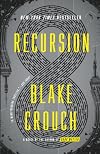
There’s an old saying about reach being beyond one’s actual grasp. Well, I just finished reading a book that proved to be the embodiment of that particular bit of wisdom.
The book in question is Recursion, by Blake Crouch.
I’ll begin by saying that the book frustrated me for almost the whole three days I spend reading it, so much so, in fact, that my wife asked several times why I was continuing if it annoyed me so…and finally told be to shut up because she was sick of my complaining.
So why did I continue reading it?
The answer is because, from 30,000 feet, it sounded like SUCH a cool concept.
At that 30,000 ft. level, the book presents as sci-fi. I know: NOT to everyone’s taste.
But to his credit, Crouch makes it SO much more, effortlessly shifting from that underlying genre to a who-done-it, to a global political potboiler, to a compelling love story.
The problem was the execution, because I feel Mr. Crouch’s reach exceeded his grasp by a wide margin.
The cover flap synopsis alone was enough, I will admit, to put me off reading it for over a year. It was the usual tripe: The world is in unimaginable danger, and ONLY our intrepid hero, a former Navy SEAL/ex-CIA operative/grizzled private eye/ace reporter/brilliant scientist/avid bowler can save the planet….
Yawn….
Been there. Done that.
Then there is the WAY too frequent use of off-the-shelf tropes from Central Casting. The villain, by way of illustration, is presented as Steve Jobs gone bad…a mad, immoral, show more manipulative, multi-billionaire genius out to conquer the world. Yeah…we’ve met this guy before. His name is Lex Luthor.
Yawn redux.
And the central plot is also familiar…the idea of changing the past.
Zzzzzzzzzzzzzzzzzzzzzzz……………
BUT……..
Even as these flaws do mar the surface of the book, Crouch has added underlying surprises that made it a compelling read.
To begin with, the story’s protagonists –presented on the cover flap as Amazing-Man and Lady Fabulous- are not only each FLAWED individuals, but they are unaware of one another and never meet until 2/3 of the way through the story…so there’s no improbable Dynamic Duo to have to swallow from page 10.
Score 1 Point.
Next, Snidley Whiplash, it turns out, is NOT as he initially is presented. Score Point #2.
Unfortunately, he turns out to be Biff from Back to the Future.
Forfeit one point!
However, what really gets interesting is Crouch’s narrative reflections on the familiar “changing the past” concept.
Now this is well-trodden territory, and most authors who’ve meandered down this path have cautioned that it isn’t a good idea.
By way of illustration, Rod Serling in "Of Late I Think of Cliffordville," a 1963 episode of The Twilight Zone, has evil tycoon William J. Feathersmith go back in time so he can have the fun of re-amassing his fortune all over again, but even more quickly this time because of his knowledge of future events. Of course, it fails in spectacular fashion.
Stephen King’s 11/22/63 sends Jake Epping into the past to prevent the Kennedy assassination, under the popular assumption that JFK would have been a great president and all would have been right with the world…only to find upon his return to the present that Kennedy had a disastrous second term and the world is now a complete dystopia.
Things proved to be even bleaker over in Comic Book Land in 2011’s Flashpoint mini-series when The Flash goes back in time to successfully prevent his mother’s murder, but comes back to learn that time became unhinged and, by way of illustration, Batman was now a murderous nut case.
What Crouch does to this oh-so familiar story is pose an also somewhat familiar question: if I change MY past (and hence my present) what does that do to the past (and present) of those with whom I have interacted in any significant way over the years?
So, as an example, take the very human rumination on “What if I had continued dating Studley or Edwina way back when? Where would we be today?
Well, clearly the answer is that we would not be where we are today.
But Crouch’s reminder is that, in addition, neither Studley nor Edwina would be where they are today. Nor would be our current significant others. The reminder is that they all might be worse off than they are today…perhaps FAR worse.
OK…so here we recognize both 2004’s Butterfly Effect and Capra’s Wonderful Life.
Granted.
But Crouch also adds an unforeseen and imaginative twist that makes this a thought-provoking new take on these admittedly old themes.
But in addition to the Central Casting flavor of SO MUCH of the book –yes, a Black Ops, SECRET Government Agency shows up to set up the penultimate challenge- I will also add that the attempted “science” that drives the story is muddled, murky, and probably should have been simply glossed over. Unlike Stephen King, who, in the aforementioned 11/22/63 never bothers to even try to explain or account for the time tunnel in the dinner, Crouch makes Star Trek’s transporter and Warp Drive look commonplace as he cobbles together a barely comprehensible McGuffin to power his story. He’d have done better to simply borrow Mr. King’s time portal in the shed.
Then there’s the Oh-So-Predictable crisis of the last 25% of the story: TECHNOLOGY MANKIND IS TOO STUPID/EVIL/SHORTSIGHTED TO HANDLE.
Much the same could be said of the Interweb…..
Finally, just as Monty Python never seemed to know when to stop beating a clever joke to death (Spam, Spam, Spam, Spam, and Spam…) the path to the author’s ultimate resolution is dragged out through failed attempt, after failed attempt, after failed attempt. Two or three would have been quite enough.
Oh, yes…I almost forgot: the last page effectively has Higgins pulling his hat down over his face and asking Liza where his slippers are. Ugh………………
In the end, this was a book that proved to be sadly beyond the author’s grasp…an interesting concept that someone like Stephen King probably could have turned into a much better story. Unfortunately, as it is, it is simply annoying… show less
The book in question is Recursion, by Blake Crouch.
I’ll begin by saying that the book frustrated me for almost the whole three days I spend reading it, so much so, in fact, that my wife asked several times why I was continuing if it annoyed me so…and finally told be to shut up because she was sick of my complaining.
So why did I continue reading it?
The answer is because, from 30,000 feet, it sounded like SUCH a cool concept.
At that 30,000 ft. level, the book presents as sci-fi. I know: NOT to everyone’s taste.
But to his credit, Crouch makes it SO much more, effortlessly shifting from that underlying genre to a who-done-it, to a global political potboiler, to a compelling love story.
The problem was the execution, because I feel Mr. Crouch’s reach exceeded his grasp by a wide margin.
The cover flap synopsis alone was enough, I will admit, to put me off reading it for over a year. It was the usual tripe: The world is in unimaginable danger, and ONLY our intrepid hero, a former Navy SEAL/ex-CIA operative/grizzled private eye/ace reporter/brilliant scientist/avid bowler can save the planet….
Yawn….
Been there. Done that.
Then there is the WAY too frequent use of off-the-shelf tropes from Central Casting. The villain, by way of illustration, is presented as Steve Jobs gone bad…a mad, immoral, show more manipulative, multi-billionaire genius out to conquer the world. Yeah…we’ve met this guy before. His name is Lex Luthor.
Yawn redux.
And the central plot is also familiar…the idea of changing the past.
Zzzzzzzzzzzzzzzzzzzzzzz……………
BUT……..
Even as these flaws do mar the surface of the book, Crouch has added underlying surprises that made it a compelling read.
To begin with, the story’s protagonists –presented on the cover flap as Amazing-Man and Lady Fabulous- are not only each FLAWED individuals, but they are unaware of one another and never meet until 2/3 of the way through the story…so there’s no improbable Dynamic Duo to have to swallow from page 10.
Score 1 Point.
Next, Snidley Whiplash, it turns out, is NOT as he initially is presented. Score Point #2.
Unfortunately, he turns out to be Biff from Back to the Future.
Forfeit one point!
However, what really gets interesting is Crouch’s narrative reflections on the familiar “changing the past” concept.
Now this is well-trodden territory, and most authors who’ve meandered down this path have cautioned that it isn’t a good idea.
By way of illustration, Rod Serling in "Of Late I Think of Cliffordville," a 1963 episode of The Twilight Zone, has evil tycoon William J. Feathersmith go back in time so he can have the fun of re-amassing his fortune all over again, but even more quickly this time because of his knowledge of future events. Of course, it fails in spectacular fashion.
Stephen King’s 11/22/63 sends Jake Epping into the past to prevent the Kennedy assassination, under the popular assumption that JFK would have been a great president and all would have been right with the world…only to find upon his return to the present that Kennedy had a disastrous second term and the world is now a complete dystopia.
Things proved to be even bleaker over in Comic Book Land in 2011’s Flashpoint mini-series when The Flash goes back in time to successfully prevent his mother’s murder, but comes back to learn that time became unhinged and, by way of illustration, Batman was now a murderous nut case.
What Crouch does to this oh-so familiar story is pose an also somewhat familiar question: if I change MY past (and hence my present) what does that do to the past (and present) of those with whom I have interacted in any significant way over the years?
So, as an example, take the very human rumination on “What if I had continued dating Studley or Edwina way back when? Where would we be today?
Well, clearly the answer is that we would not be where we are today.
But Crouch’s reminder is that, in addition, neither Studley nor Edwina would be where they are today. Nor would be our current significant others. The reminder is that they all might be worse off than they are today…perhaps FAR worse.
OK…so here we recognize both 2004’s Butterfly Effect and Capra’s Wonderful Life.
Granted.
But Crouch also adds an unforeseen and imaginative twist that makes this a thought-provoking new take on these admittedly old themes.
But in addition to the Central Casting flavor of SO MUCH of the book –yes, a Black Ops, SECRET Government Agency shows up to set up the penultimate challenge- I will also add that the attempted “science” that drives the story is muddled, murky, and probably should have been simply glossed over. Unlike Stephen King, who, in the aforementioned 11/22/63 never bothers to even try to explain or account for the time tunnel in the dinner, Crouch makes Star Trek’s transporter and Warp Drive look commonplace as he cobbles together a barely comprehensible McGuffin to power his story. He’d have done better to simply borrow Mr. King’s time portal in the shed.
Then there’s the Oh-So-Predictable crisis of the last 25% of the story: TECHNOLOGY MANKIND IS TOO STUPID/EVIL/SHORTSIGHTED TO HANDLE.
Much the same could be said of the Interweb…..
Finally, just as Monty Python never seemed to know when to stop beating a clever joke to death (Spam, Spam, Spam, Spam, and Spam…) the path to the author’s ultimate resolution is dragged out through failed attempt, after failed attempt, after failed attempt. Two or three would have been quite enough.
Oh, yes…I almost forgot: the last page effectively has Higgins pulling his hat down over his face and asking Liza where his slippers are. Ugh………………
In the end, this was a book that proved to be sadly beyond the author’s grasp…an interesting concept that someone like Stephen King probably could have turned into a much better story. Unfortunately, as it is, it is simply annoying… show less