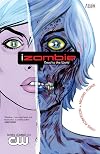
Interesting zombie book. The main character, Gwen, is a zombie who must eat a person's brain every week in order to maintain her human appearance and mind. Unfortunately for her she also gets the memories of the brain's owner. She hangs around with a ghost girl from the sixties and a guy who turns into a were-terrier every month. The were-terrier is strangely cute. Pretty intriguing concept. Partway through the book a nice semi-egyptian explanation is given for the presence of different types of supernatural beings that are running around. Kind of refreshing to see the presence of these beings explained when most books just want you to take them for granted. So far this seems like an entertaining series, and I'll be picking up the second volume when I get the chance.
A great expansion of classical myths. It's always fun to see modern authors calling on the classics for inspiration. This book would probably be just fine to read without having read The Aeneid previously, but I'd definitely recommend trying to read it first. There's just an extra level of recognition and reference that's enjoyable that comes from having read Virgil's epic poem. I loved Lavinia's self-awareness that she was a fictional character. It just reminded me of that feeling when you're writing a story and your characters seem to take on a life of their own. I saw this mirrored in Virgil's dying spirit seeing his creations truly come to life and become more than just ink on paper. It added an extra level to the book beyond the simple story of Lavinia, which definitely made it that much more enjoyable. I loved the amount of care and research that seems to have gone into this book, as detailed in the afterword, and the fact that it's based on a myth gives it some definite wiggle room as far as being historically accurate is concerned. The characters were well done, though I have to admit that I never really felt a strong connection to any of them. There were a few moments where I thought motivations or reactions to events were a bit odd or out of nowhere, but for the most part I found myself sympathizing with the characters and understanding their predicaments.
So, in short, an enjoyable take on a classic story. I'd definitely recommend it to those who enjoy such show more things, though I'd also recommend reading Virgil's Aeneid first just because I think it will make the book that much more enjoyable. show less
So, in short, an enjoyable take on a classic story. I'd definitely recommend it to those who enjoy such show more things, though I'd also recommend reading Virgil's Aeneid first just because I think it will make the book that much more enjoyable. show less
A story giving flesh to the historical character of Anna of Byzantium. Yes, it's historical fiction and liberties were taken with the characters, but overall I found it fairly interesting. The Byzantine empire isn't something I'm terribly familiar with, but this book definitely piqued my interest in it. I also enjoyed the references made to classical myths my Anna's teacher. Always fun to see classics at work. I enjoy reading books like this based on lesser known historical characters. We get caught up on the same few "big" characters of the past that so many other interesting people get overlooked. I'm happy to see fiction like this in the young adult section, letting children know about these lesser known figures like Anna.
That being said, I really disliked Anna. She's the main character and I suppose as such you're supposed to empathize with her and see things from her perspective, but I had trouble as seeing her as anything more than a spoiled brat who was trying to play a game that she didn't realize the rules of. Maybe I just got off on the wrong foot with her in the beginning chapters, after all, my first impression was of her whining about how horrible her life was and how everyone was against her and couldn't understand her. She's a spoiled princess. Instead I really enjoyed the character of her brother John. Sure he did some pretty bratty things, but somehow I doubt that Anna would have hesitated to do those same things if she had been in position to do so. show more Despite his dyslexia, John truly learns to play the game of politics and not only wins his way to the throne but also outmaneuvers the ruthless grandmother. He did what Anna tried to do but better, and in the end he proves to be a good person. True, Anna did redeem herself somewhat by the time the narration returns to her in the convent, but I still feel that on some level she was still the spoiled princess. show less
That being said, I really disliked Anna. She's the main character and I suppose as such you're supposed to empathize with her and see things from her perspective, but I had trouble as seeing her as anything more than a spoiled brat who was trying to play a game that she didn't realize the rules of. Maybe I just got off on the wrong foot with her in the beginning chapters, after all, my first impression was of her whining about how horrible her life was and how everyone was against her and couldn't understand her. She's a spoiled princess. Instead I really enjoyed the character of her brother John. Sure he did some pretty bratty things, but somehow I doubt that Anna would have hesitated to do those same things if she had been in position to do so. show more Despite his dyslexia, John truly learns to play the game of politics and not only wins his way to the throne but also outmaneuvers the ruthless grandmother. He did what Anna tried to do but better, and in the end he proves to be a good person. True, Anna did redeem herself somewhat by the time the narration returns to her in the convent, but I still feel that on some level she was still the spoiled princess. show less
I loved this book. The characters, the world, the description. To begin with, I'm a sucker for stories set in fantasy settings. Something about the urban hodgepodge being translated into a melting pot of not just different cultures, but even different races and forms of life intrigues me. I guess I'm tired of the fantasy that gives each race its own territory. The dark tone of the story was wonderful, and the description conveyed the mood and the grit of the city well. All the cast of people and creatures were wonderfully imagined and entertaining. I loved the influence from lesser known myths present in some of the species like the khepri and the vodyanoi. I especially love how this is one of those stories where things aren't necessarily black and white, bad things get done by good people and not everything turns out sunshine and roses in the end. In the end I definitely walked away from this book satisfied and wanting more of the world of Bas-Lag. Definitely one of my top recommendations.

An interesting collection of short stories in a wide variety of genres. The usual short story collections I pick up focus solely on one genre, which is nice but kind of monotonous at times. The variety of genres really helped to make this book enjoyable, keeping each story interesting and new. At the same time though, it did feel like it had slightly less cohesion in it's theme, but I felt this didn't really detract too much Like most collections, it was a mixed bag of satisfaction. Overall the stories were great though, with only a few that were mediocre. Definitely enjoyable for reading one or two stories at a time out of.
 This review was written for LibraryThing Early Reviewers.
Well, I'll start out by saying that I loved this book. If you want a good mystery, I've come to the conclusion that it's hard to go wrong with a good Christie book. Hey, even Doctor Who admires her. I've watched Agatha Christie stories on the BBC forever and after having read two of her other novels, And Then There Were None and Murder on the Orient Express, I decided to pick this up because of it's setting in Egypt. I'm quite the fangirl of Ancient Egypt, so all the talk of it alone made the book quite fun.
But as this is not just a scenic tour of Egypt but a mystery novel, so let me move on to the mystery. The previous two books by Christie that I read left me baffled throughout as to who the murderer was and who everyone actually was. I had no clue until the truth was finally revealed. Now, I really loved this story and all its little details, but it didn't have as much mystery for me due to the fact that I had figured out from the very beginning before the cast even made it to Egypt who was going to be the main victim and who the murderer(s) would be. The only person I didn't have figured out before the reveal was the thief, and even then it was more a matter of forgetting about that bit of the plot entirely. Perhaps it was lucky guessing or good intuition on my part, but the 'whodunnit' part of the mystery was just a little bit too obvious to me. It was still fun to watch it play out though. It was enjoyable in its own way because of it, I got a great deal of show more entertainment watching Poirot and Race struggle to reveal what I had already figured out. Even though I knew who had done what for the most part, I will admit that I had not entirely figured out all of the how before Poirot made his grand reveal. show less
But as this is not just a scenic tour of Egypt but a mystery novel, so let me move on to the mystery. The previous two books by Christie that I read left me baffled throughout as to who the murderer was and who everyone actually was. I had no clue until the truth was finally revealed. Now, I really loved this story and all its little details, but it didn't have as much mystery for me due to the fact that I had figured out from the very beginning before the cast even made it to Egypt who was going to be the main victim and who the murderer(s) would be. The only person I didn't have figured out before the reveal was the thief, and even then it was more a matter of forgetting about that bit of the plot entirely. Perhaps it was lucky guessing or good intuition on my part, but the 'whodunnit' part of the mystery was just a little bit too obvious to me. It was still fun to watch it play out though. It was enjoyable in its own way because of it, I got a great deal of show more entertainment watching Poirot and Race struggle to reveal what I had already figured out. Even though I knew who had done what for the most part, I will admit that I had not entirely figured out all of the how before Poirot made his grand reveal. show less
Geometry GRE Preparation Guide, 1st Edition (Manhattan GRE Preparation Guide: Geometry) by Manhattan GRE
As a student currently studying for the GRE, I found this book to be helpful. It's been a while since I've taken a math course, especially one that has much to do with geometry, and have forgotten much of what I once knew. This book was a great refresher for all those things that I'd learned and forgotten, with just enough information for me to recall what I needed without feeling like I was taking my whole course over again. The organization was simple and plain enough that I didn't get bogged down in it. It's definitely helpful for anyone looking to brush up on their GRE geometry.
This review was written for LibraryThing Early Reviewers.
This had some potentially interesting local legends in it, but the writing turned what could have been spooky stories into bland little blurbs. Most of the legends felt rather hokey, perhaps because they lacked that dramatic embellishment that I've come to expect from horror stores. There were a few minor factual errors on the history of the sites that locals might catch, but most of them don't really detract from the haunting legends, just the historical accuracy. My qualms with the writing aside, it's an interesting guide to local haunting legends. I live in Cincinnati and it was entertaining to see the legends concerning places that I pass by on a regular basis talked about here. The handbook covers a nice variety of sites, so mostly anyone from the area should be able to recognize several of these spots. Overall, an interesting book for locals.
This review was written for LibraryThing Early Reviewers.
Started out fairly interesting, but got less so towards the second half. Some ideas and characters I wished would have gotten more time and development didn't, and other things that I didn't really care for got too much time. Overall it's a fun read, but nothing particularly stand out. There are other much better works out there using some of the main ideas in this book.
Interesting in concept, but it felt a little too broad for me. While it gave a good general outline and was fairly easy to grasp, I strongly wished for more explanation and details on several points. I felt that most of the chapters and ideas could easily have been expanded into their own books. So nice overall with interesting ideas, just not as much detail as I would have liked to have seen.
Philip K. Dick: Four Novels of The 1960s / The Man in the High Castle / The Three Stigmata of Palmer Eldrich / Do Androids Dream of Electric Sheep? / Ubik (Library of America No. 173) by Philip K. Dick
The Man in the High Castle - Alternate World War II story in which the allies lose and the US is divided between Japan and Germany. (3/5)
The Three Stigmata of Palmer Eldritch - Title character returns from journey possibly altered and bearing a new 'translation' drug. (4/5)
Do Androids Dream of Electric Sheep? - Rogue nexus androids on Earth are hunted and 'retired'. What does it mean to be human? (4/5)
Ubik - What is reality? Half-lifers experience regression and struggle for their existence. Everything is not as it seems. (5/5)
Overall, a great collection. Contains two of my favorite PKD stories, Ubik and Androids. The man in the High Castle is kind of the odd man out in this collection, and not my favorite, but still an enjoyable read. The endnotes are fairly informative and useful, and the timeline is a nice edition. The quality of the book itself is wonderful, great binding and great paper. I'm glad to see The Library of America put out this collection and give PKD some well deserved recognition.
The Three Stigmata of Palmer Eldritch - Title character returns from journey possibly altered and bearing a new 'translation' drug. (4/5)
Do Androids Dream of Electric Sheep? - Rogue nexus androids on Earth are hunted and 'retired'. What does it mean to be human? (4/5)
Ubik - What is reality? Half-lifers experience regression and struggle for their existence. Everything is not as it seems. (5/5)
Overall, a great collection. Contains two of my favorite PKD stories, Ubik and Androids. The man in the High Castle is kind of the odd man out in this collection, and not my favorite, but still an enjoyable read. The endnotes are fairly informative and useful, and the timeline is a nice edition. The quality of the book itself is wonderful, great binding and great paper. I'm glad to see The Library of America put out this collection and give PKD some well deserved recognition.
First off, I must confess, I love this book. It's one of those books that I read in seemingly no time and was left wanting more. It's a collection of stories and mock letters, accounts, histories, etc all focusing around some aspect of the fictional city of Ambergris. While there were a few sections that were only just alright, the majority were uniquely interesting and together they combined to make a wonderful slice out of the city of Ambergris for the reader to view that brought the place to life. My favorites would have to be the first two sections, "Draidin, in Love" and "The Hoegbotton Guide to the Early History of Ambergris", along with the material concerning Patient X. Despite one or two stories that were less interesting to me, when the book is looked back on as a whole, everything came together to create an amazing story of Ambergris.

A cute 4koma style comic following a group of friends in high school and their day to day interactions. The cast expands from the first volume to bring in more of the peripheral friends. It's easy to see bits of and pieces of myself and people I know in the characters, which makes it that much more enjoyable. In particular I can relate to the strips focusing around Konata and her cellphone. My one big complaint would have to be the translation. There were minor errors littered throughout, and a few translations that I found to be very jarring.

I picked this up after being assured by my friends, who recommended it to me, that it was much better than the Twilight series. It was, I'll give them points for that. I'm still not sure if that means I like it though. It was entertaining enough that I'm giving the rest of the series a try, but how far I'll make it is still up in the air, the plot will have to seriously pick up for me to make it very far. The mystery, while not super elaborate was enjoyable, but past that it was just kind of blah. I'm not a fan of romance, and the Sookie/Bill sex just seemed thrown in as plotless fanservice, which is nice if you like that kind of stuff. I don't care for it. Overall a fluffy read for fans of vampire romance.