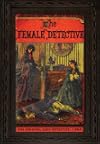
While not the first female detective in fiction (that honor goes to Ruth Trail, in Edward Ellis’s “Ruth the Betrayer,” in 1862), Forrester’s “female detective,” Miss G, was the model for many that followed. As a woman, she disguises herself easily as a maid, or a dressmaker, or as a charity worker. Most detective stories of the time were still a form of melodrama, but Miss G was different: She operated through deduction and science, even at one point giving evidence on ballistics. She can sound remarkably blasé about her job: “Strangling, beating, poisoning (in a minor degree)—these are the modes of murder adopted in England.” It’s the “in a minor degree” that makes her real. Her professionalism, her ability to observe and draw deductions, and, most importantly, her outsider status, in her case her gender, make her the unacknowledged prototype for many of later, more famous, and male, fictional detective.
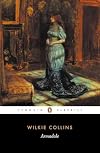
Tracing how real-life Victorian murders were reimagined for entertainment purposes—detective fiction, theater, even puppet shows—gave me the enjoyable task of reading hundreds of novels, some classics, some good, some terrible. I had always skipped “Armadale.” It is the story of two cousins, both named Allan Armadale and both in love with the evil Miss Gwilt. She marries the poor Allan, planning to murder the rich one so that, as the legal Mrs. Allan Armadale, she can inherit his money. The book is much better than this summary makes it sound, once you get past the trauma of all the Allan Armadales running about. Collins used the 1857 case of Madeleine Smith, who was tried for poisoning her lover in Glasgow, as a jumping-off point. Today, however, it is Collins’s fiendishly clever plotting that keeps us turning the pages, as does his then-novel combination of crime and domesticity. Today the “body in the library” is shorthand for murders in domestic settings, but Collins was among the first (and best) at making the familiar seem strange, the suburban sinister.
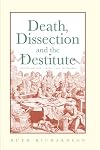
In 1817, Mary Shelley first thought of the story that would become “Frankenstein,” in which the eponymous doctor uses corpses to reanimate a dead man. And even as she wrote this classic, resurrection men across Britain were stealing dead bodies to sell to medical schools, which were legally permitted to use only the bodies of executed murderers for the study of anatomy. There weren’t that many murderers, and demand outstripped supply. The Anatomy Act of 1832 was intended to suppress the trade that resulted by legalizing the anatomization of the body of anyone who had died without being able to afford funeral expenses, but in so doing, it criminalized the poor merely for being poor. Ruth Richardson’s pioneering study of the Act, those who created it, and those who fought it, ranges from the “cholera riots” that broke out as the first great epidemic swept across the country to the political upheavals that produced the Reform Act, which some historians consider to be the start of modern democracy in Britain. Connecting all this disparate information creates a book that, in analyzing how a society treated its dead, shows us how it treated its living.
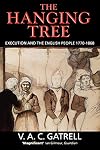
In this learned and deeply impassioned work, Gatrell surveys the development of executions in England from the days of the “bloody code” in the late 18th and early 19th centuries—when people were executed for petty theft—through the legal reforms that made murder essentially the only crime punishable by death and finally to the abolition of execution as a public spectacle. He begins by considering what happens to the body during an execution. Even when things went “well,” many a person executed died in prolonged convulsions, the hangman pulling on the dying person’s legs to cause a final asphyxiation. If the drop was misjudged, the victim might be decapitated. If we are going to study this mode of punishment, Gatrell suggests, its realities had better be made clear. This book’s subjects, he reminds us, ‘once lived as we do’ . Using a variety of sources—not just trial records but ballads, broadsides, diaries and letters—Gatrell re-creates the lives and experiences of those who died, those who sentenced them to death, those who watched them die and those who mourned them. This is a work driven by outrage, a narrative alive with fury but one, also, of impeccable scholarship.
On Murder Considered As One of the Fine Arts: Being an Address Made to a Gentleman's Club Concerning its Aesthetic Appreciation. by Thomas De Quincey
“Pleasant it is, no doubt, to drink tea with your sweetheart, but most disagreeable to find her bubbling in the tea-urn.” So wrote the essayist Thomas de Quincey in 1827, and, really, it is hard to argue with him. Even more pleasant, he went on, was to read about someone else’s sweetheart bubbling in the tea-urn. The world adores murder in the abstract. Without it, we’d have no Hamlet. No Tony Soprano. De Quincey created the model for the gentleman-murderer. It was de Quincey, as well, who understood that violent crime plus art equaled a puzzle, a problem, a solution—a how, a who and a why: the core of all crime fiction. To this formula he added charm and humor. As the narrator of “On Murder” warns: “If once a man indulges himself in murder, very soon he comes to think little of robbing; and from robbing he comes next to drinking and Sabbath-breaking, and from that to incivility and procrastination.”