I tried with this book, but disliked it thoroughly. The writing style is pretentious, and tries to obscure the lack of depth within the novel with unwieldy phrasing, overly convoluted sentences, and abrupt changes in narration. I did not find it challenging, I found it silly. Would not recommend, and I would not have chosen it to review had I known.
Edited to Add: I was given an advance copy for an honest review, and am sad to have to write something negative.
Edited to Add: I was given an advance copy for an honest review, and am sad to have to write something negative.
 This review was written for LibraryThing Early Reviewers.
Another solid book from Julie Anne Peters. Dramatic and tender, with a realistic portrayal of the difficulties of being a young person. One very notable thing is that she is comfortable with technology and incorporates it seamlessly into the narrative, reflecting the reality of her young readers. The cover art is a bit odd and sets it up to be a more intense book, which is really isn't. Cute, easy to read, the kind of book that teenagers will feel "gets" them and young adults will read and remember those times in their lives.
This review was written for LibraryThing Early Reviewers.
Kim's novel is wonderful, fully exploring the intricacies of life for the elite of North Korea and the Evangelical Christian missionaries who make it their life's work to "crack" North Korea. Through her writing you feel the same sense of being out of place in time that the author describes feeling in her travels, reading through several chapters to find out only a week or two has passed. While disorienting, it lends credence to the author's perception of her time there.
The book is filled with juicy bits about life for the North Korean students, describing their understanding of the internet, outdated vocabularies, and inability to write a job application. Kim intersperses these tidbits with more information about her experiences teaching her interactions with the missionaries, her personal history as a South Korean and American, and political happenings in North Korea to create a very complex, vivid and concerning narrative of one of the world's most isolated countries.
The book is filled with juicy bits about life for the North Korean students, describing their understanding of the internet, outdated vocabularies, and inability to write a job application. Kim intersperses these tidbits with more information about her experiences teaching her interactions with the missionaries, her personal history as a South Korean and American, and political happenings in North Korea to create a very complex, vivid and concerning narrative of one of the world's most isolated countries.
This review was written for LibraryThing Early Reviewers.
This book read very smoothly and gave large glimpses into the complicated relationships that many young women of different backgrounds face with regards to love as reflected in their feelings about their bodies and of course, appetites. Opal and Ruth are extraordinarily well done characters in which Moses weaves a narrative that makes you wonder more about their mothers, families and childhoods. Ruth's mother, in particular, is the kind of character that is given a depth conveyed by just a sentence or two- we immediately feel her enormity in Ruth's life and stomach. Opal's transformation from one notion of femininity to another is well described and littered with characters that enhance her story's development. Her brief foray into a "forbidden" love is expected but with a twist that makes it seem that all of Opal's work towards becoming the kind of woman she wants to be may be for naught.
The other two characters, Setsu and Franchesca, were not well developed, particularly Setsu. Franchesca is given a revolutionary attitude in regards to food and body that does not seem to match the author's pace in her descriptions and writing regarding her transformation. You can be left wondering how Franchesca went from her childhood self to her young adult self and the narrative gives no strands to link them.
Setsu in particular is poorly developed and the characters in her mini-world, namely her parents, are grossly overlooked. We could try to draw some symbolism from their lack of show more attention towards Setsu and the lack of attention the author gives them, but its a strained and incomplete symbolism. Setsu's ending is disappointing and colored the last several chapters of the book for me as I waited for her to have something real and final, which she was never given. While reading the book, it is clearly stated that Ruth and Opal are white, and it seems the Franchesca is as well. It is a shame that the one character with ethnic diversity is so shortchanged. At one point there is an excellent opening in the story for an elaboration on Setsu's adoption and food, and it is completely passed over, which may cause readers particularly attentive to this type of criticism to frown and wonder.
Four stars for an excellent idea, good execution, and excellent development of two main and several side characters. One star gone for overlooking Setsu and the poor pace of Franchesca's development.
This book was given to me by the publisher in exchange for an honest review. show less
The other two characters, Setsu and Franchesca, were not well developed, particularly Setsu. Franchesca is given a revolutionary attitude in regards to food and body that does not seem to match the author's pace in her descriptions and writing regarding her transformation. You can be left wondering how Franchesca went from her childhood self to her young adult self and the narrative gives no strands to link them.
Setsu in particular is poorly developed and the characters in her mini-world, namely her parents, are grossly overlooked. We could try to draw some symbolism from their lack of show more attention towards Setsu and the lack of attention the author gives them, but its a strained and incomplete symbolism. Setsu's ending is disappointing and colored the last several chapters of the book for me as I waited for her to have something real and final, which she was never given. While reading the book, it is clearly stated that Ruth and Opal are white, and it seems the Franchesca is as well. It is a shame that the one character with ethnic diversity is so shortchanged. At one point there is an excellent opening in the story for an elaboration on Setsu's adoption and food, and it is completely passed over, which may cause readers particularly attentive to this type of criticism to frown and wonder.
Four stars for an excellent idea, good execution, and excellent development of two main and several side characters. One star gone for overlooking Setsu and the poor pace of Franchesca's development.
This book was given to me by the publisher in exchange for an honest review. show less
This review was written for LibraryThing Early Reviewers.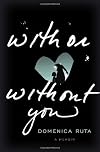
With or Without you is a wonderful and insightful book. Domenica manages to convey the contrasting influences of her childhood gracefully and with a lot of sympathy for everyone involved- from her mother, to her rough extended family, to the prep school friends she never actually knew, everyone is treated with the same blurry brush that makes them all both the victims and the aggressors in Domenica's tale of her life.
My only criticism is that the writing occasionally tends towards melodramatic, but it's a fault that can be overlooked as the entire narrative tends towards the high end of dramatic, and understandably so.
My only criticism is that the writing occasionally tends towards melodramatic, but it's a fault that can be overlooked as the entire narrative tends towards the high end of dramatic, and understandably so.
This review was written for LibraryThing Early Reviewers.