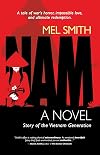
With the fiftieth anniversary of the Tet Offensive in 2018, it is not surprising the Vietnam War is again at the forefront of people’s minds, though curiosities were raised with the release of the Pulitzer Prize-winning book The Sympathizer and the 10-part PBS miniseries The Vietnam War. Each offers a relatively fresh perspective: the former from the pen of a Vietnamese-American academic (Viet Thanh Nguyen) writing about a fictional double agent embedded in the States after the Fall of Saigon; the latter from a near-spotless editing booth wherein the producer (Ken Burns) includes first-hand testimony of 80-odd participants and footage from roughly 130 sources in his 1080-minute-long documentary. While the same cannot be said for Mel Smith’s NAM: The Story of a Generation – A Novel, it would be amiss for interested readers to overlook his book.
I say this in large part because of the author’s ability to evoke the out-of-control panic around the American Embassy in Saigon. Chaos had descended in April 1975, with an uncontrollable sea of people flooding through and over the gates of the compound. Many assisted U.S. efforts to keep the leader(s) of the South Vietnamese government above water and Smith wonderfully captures the “dead-man-walking”, almost-paralyzing fear Southerners felt as their Northern brethren encroached. Yet it was not only those below the DMZ who felt anguish as the wave of Viet Cong deluged the city for Smith’s love story resembles show more Shakespeare’s tragedy Romeo and Juliet, with Le Van Dat and Nu Chi featuring as star-crossed lovers inhabiting country-like versions of the feuding Montague and Capulet families. This storyline, one of two, goes back and forth between five decades and is a page-turning affair.
The American theme, which opens and closes in the late Nineties, is less engrossing though. Situated largely in America, it is not surprising that large segments of dialogue occur at a baseball match and centre around golf, but this will unsurprisingly prove off-putting for many non-American readers. Poignant and poetic turn of phrase (‘I had always thought’, says Mark, the main protagonist whose serves on a River Patrol Boat, ‘homecoming would be an enjoyable return to sanity and sanctuary’; ‘There were so many traces in the air it looked like a plague of fireflies’) underscores the brutality – many would say futility – of the scarring conflict, but not enough to escape charges of banality. Discussion of PTSD reads like non-fiction given the author’s (naval) experience in Vietnam, however, and acts as a remedy for questionable period speech and a clichéd character.
NAM is an admirable debut, to be sure, and Smith deserves praise for giving a kind, considered voice to Vietnamese either side of the 17th parallel. Notwithstanding its obvious attraction to fans of The Sympathizer, NAM remains second best to Tatjana Soli’s The Lotus Eaters, wherein there is deeper characterisation, and a long way behind Karl Marlantes’ debut work, Matterhorn: A Novel of the Vietnam War, which should be readers’ first choice for knee-deep, hair-raising exploits in the canopy-thick jungles of Vietnam. show less
I say this in large part because of the author’s ability to evoke the out-of-control panic around the American Embassy in Saigon. Chaos had descended in April 1975, with an uncontrollable sea of people flooding through and over the gates of the compound. Many assisted U.S. efforts to keep the leader(s) of the South Vietnamese government above water and Smith wonderfully captures the “dead-man-walking”, almost-paralyzing fear Southerners felt as their Northern brethren encroached. Yet it was not only those below the DMZ who felt anguish as the wave of Viet Cong deluged the city for Smith’s love story resembles show more Shakespeare’s tragedy Romeo and Juliet, with Le Van Dat and Nu Chi featuring as star-crossed lovers inhabiting country-like versions of the feuding Montague and Capulet families. This storyline, one of two, goes back and forth between five decades and is a page-turning affair.
The American theme, which opens and closes in the late Nineties, is less engrossing though. Situated largely in America, it is not surprising that large segments of dialogue occur at a baseball match and centre around golf, but this will unsurprisingly prove off-putting for many non-American readers. Poignant and poetic turn of phrase (‘I had always thought’, says Mark, the main protagonist whose serves on a River Patrol Boat, ‘homecoming would be an enjoyable return to sanity and sanctuary’; ‘There were so many traces in the air it looked like a plague of fireflies’) underscores the brutality – many would say futility – of the scarring conflict, but not enough to escape charges of banality. Discussion of PTSD reads like non-fiction given the author’s (naval) experience in Vietnam, however, and acts as a remedy for questionable period speech and a clichéd character.
NAM is an admirable debut, to be sure, and Smith deserves praise for giving a kind, considered voice to Vietnamese either side of the 17th parallel. Notwithstanding its obvious attraction to fans of The Sympathizer, NAM remains second best to Tatjana Soli’s The Lotus Eaters, wherein there is deeper characterisation, and a long way behind Karl Marlantes’ debut work, Matterhorn: A Novel of the Vietnam War, which should be readers’ first choice for knee-deep, hair-raising exploits in the canopy-thick jungles of Vietnam. show less
 This review was written for LibraryThing Early Reviewers.