
This book will make anyone who reads it reevaluate their own collection to discover what the "important" books are and why they matter.
Unorganized, unfocused, and littered with typos. The Melville/Hawthorne parallels were a stretch.
This book was good--storyline, artistry, concept--but it lacked the depth of other graphic memoirs, e.g. [b:Persepolis|9522|Persepolis, Volume 1 (Persepolis, #1)|Marjane Satrapi|https://d.gr-assets.com/books/1375777630s/9522.jpg|25686510]. The book was over just as I was beginning to become interested in the characters!
I was surprisingly impressed with how much I liked this book after I finished reading it. The author managed to make difficult subjects readable without creating bias in the reader. I found myself rooting for Weetzie and her family despite their unconventionalities. I was particularly surprised at the inclusion of a magical realism element. While this new twist was a bit jolting at first, I thought the author, like the family she created, managed to seamlessly incorporate it into the story. Having been exposed to young adult fiction for quite some time, I hadn’t read many LGBTQI titles that so poignantly expressed the difficulties of growing up young and queer while maintaining a sense of optimism. I am anxious to read the other books in this series!

A well-written book about the psychological effects of WWI warfare in Great Britain. A great novel for group discussion, even for those who are infrequent (or non-existent) readers of historical fiction.
Horrible writing and totally predictable. A promising storyline concept with a disappointing follow through.

Actually, 2.5 stars for this one. I didn't love it, I didn't hate it--it really needed way more heart and soul to get it up to the caliber of [b:Legend|9275658|Legend (Legend, #1)|Marie Lu|https://d.gr-assets.com/books/1397663963s/9275658.jpg|14157512]. I'll most likely read the sequel from the library, but i won't be buying the series for my personal collection.
I really enjoyed reading this book, especially the detail Chevalier put into describing Vermeer’s artistic process. How his use of many colors to project white, for instance, is incredible and made me think more critically and appreciatively about art production. I have read reviews of this book, most of them outstanding, but a few who feel as though it was written simply, with shallow insight into characters and their emotions. I disagree. I feel that in order to stay true to the people of the time, especially Griet, a maid from a poor family, Chevalier had to write her perspective with less elaborate vocabulary than those of the Vermeer family. This is a book I would definitely read again and would recommend to both adults and teens.
Heartbreaking and beautiful. Authentically captures the voice of so many African American communities plagued by police brutality--their frustration, fear, anger, and sorrow--through the eyes of one sixteen year old girl.
Like his other books, "Confessions" was intriguing and imaginative, but much too long. I felt as though the story could have been told in a more efficient manner, without what I thought consisted of needless backstory and details that seemed to have nothing to do with the ultimate plot line. The story only started to gain momentum with less than 100 pages to go! With that said, I thought setting the story in Renaissance Holland worked well and added a new dimension to the classic Cinderella fairy tale we're all familiar with. I also enjoyed hearing it from the underdog, aka the "ugly" stepsister.
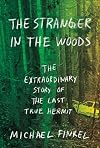
A grown-up version of [b: My Side of the Mountain|41667|My Side of the Mountain (Mountain, #1)|Jean Craighead George|https://images.gr-assets.com/books/1388204221s/41667.jpg|2682098]. Also digs into cognitive science and philosophy--the differences between and effects of being alone and loneliness.
I thought this book, in addition to being hilarious, was a wonderfully written and well thought out novel about coming out and sexuality. It was not overly analytical and probing, but addressed real teen issues with candid humor—an element that is frequently missing from books of this genre. Unlike many LGBTQI fiction books for teens, this novel was not purely sexual in nature but investigated the psychological and emotional aspects of what it means to be young and gay. I also liked how the novel was set in the Midwest—an area of the country that has been known to show dissatisfaction for certain “lifestyle choices.” It called attention to the fact that gay and lesbian teens exist everywhere, even Minnesota. However, my biggest worry with this book is that it will become known as the stereotypical ‘gay experience” of adolescent boys—the ultra feminist female best friend, the square dancing, but mostly the idea that a school sports teams and coaches are outspokenly “anti-gay.”
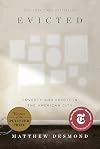
An incredible book and a must-read. Will challenge everything you think you know about poor families and poverty.
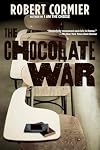
I particularly enjoyed Robert Cormier’s writing style. He was descriptive without being excessive and divulged a good amount about his characters without taking away from the focus of the story—the chocolate sale. Despite all of these great qualities, I thought the story ended quite abruptly (possibly to accommodate the sequel?) and didn’t leave me with a very good taste in my mouth (the boxing match was incredibly brutal). From reading interviews with the author, I understand that his motives with his writing revolve around a “telling it like it is” mentality (for this I commend him) and therefore explain his reason for ending the book in this matter, however, I felt a bit cheated. Having read the novel as quickly as I did, and enjoying getting to know the characters, I really was hoping to see justice done and/or lessons learned at the culmination of the story. While I like stories to end with a twist, either good or bad, I felt that this story simply ended. I wanted to know more.

Ok, I'm the outlier here. This book was, in a word: boring. I can appreciate that the author was trying to get plot traction with the mysterious Beldam characters and their conflict with the villagers, but it never seemed to get anywhere, which made it a particularly frustrating read. Really disappointed in this one, especially after so many great reviews.

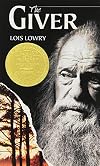
Great for readers who love utopian/dystopian fiction. Also read "Gathering Blue" and "Messenger" (in that order!) after "The Giver" to see all three novels come full circle.
Although I have read this book many, many times, I still find that I am amazed at how talented Lois Lowry is with her ability to construct such a deeply complex society out of simple prose and literary construction. This book was the first novel I read that was considered “dystopian” fiction, and because of it, I have come to love the genre more than any other. When I first read it as a seventh grader, I was excited at the prospect of a novel evoking so many strong feelings and opinions in me in ways no other book had ever done. Other dystopian novels for young adults, like The House of the Scorpion by Nancy Farmer, and The Silenced by James DeVita are amazing novels in and of themselves, but cannot hold the special place on my bookshelf and in my heart that The Giver has. It is one of my absolute favorites!
March 1, 2007
Although I have read this book many, many times, I still find that I am amazed at how talented Lois Lowry is with her ability to construct such a deeply complex society out of simple prose and literary construction. This book was the first novel I read that was considered “dystopian” fiction, and because of it, I have come to love the genre more than any other. When I first read it as a seventh grader, I was excited at the prospect of a novel evoking so many strong feelings and opinions in me in ways no other book had ever done. Other dystopian novels for young adults, like The House of the Scorpion by Nancy Farmer, and The Silenced by James DeVita are amazing novels in and of themselves, but cannot hold the special place on my bookshelf and in my heart that The Giver has. It is one of my absolute favorites!
March 1, 2007
Proceed with caution on this one. While it is extremely well written and has some good messages, the author is thought to be a former member of the KKK and former speech writer for pro-segregationist, Gov. George Wallace of Alabama.
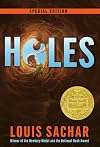
At first, I was a little apprehensive about reading this book, despite the fact that it has won so many prestigious literary awards, including the coveted Newbery. One of the biggest factors, I think, was the book’s cover. They always say you shouldn’t judge a book in this manner, but I found it difficult to get over the outrageous purple and orange combination of the book’s packaging. For me, it was a huge turnoff. However, the inside story completely captured my attention. It wasn’t long before I discovered the amazing stories behind a simple hole in the ground and the curse on the boy with a funny last name. Holes is one of the more captivating young adult/juvenile books I’ve read primarily because of its simple prose and straightforward, honest characters. Louis Sachar does an amazing job weaving lush Green Lake history into the parched earth of Camp Green Lake detention center, bringing each character, no matter when they lived, full circle.

A social experiment gone wrong. In a classroom, pair with books like [b:The Chocolate War|17162|The Chocolate War (Chocolate War, #1)|Robert Cormier|http://d202m5krfqbpi5.cloudfront.net/books/1333120554s/17162.jpg|1122617] or [b:Lord of the Flies|7624|Lord of the Flies|William Golding|http://d202m5krfqbpi5.cloudfront.net/books/1327869409s/7624.jpg|2766512].
Very interesting and funny, but had TONS of typos. These notwithstanding, maybe a 3 or 3.5 star read.


I really enjoyed Monster both as a novel and as a potential screenplay. It incorporated all the elements that make a crime story worth reading—suspense, question of innocence, an intriguing but conflicted main character, among many others. Even though the novel was an extremely quick read, I thought Walter Dean Myers did an excellent job packing many complicated issues into an easily readable format, particularly issues of racial profiling and self-preservation. The protagonist, Steve Harmon, was believable as a defendant despite the fact that his “movie” invokes dream-like and fantastic qualities: distanced camera angles, muted dialogue within descriptive scenes, and flashbacks—qualities that most likely contribute to the character’s detached relationship from reality. What I especially liked was how Myers used Steve’s journal entries to bring a human quality to the story, uniting the disjointedness of his trial experience. Steve’s concerns and fears flow freely in this venue, unlike the harsh restrictiveness he experiences in jail and in the courtroom. The only concern I had with Monster was a minor one. Steve’s trial only lasts a week, which for me is quite unbelievable. It would have been more realistic for Myers to insert more breaks into the novel, as he does at the end…”Five months later” etc.

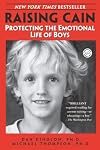
“What do boys need that they’re not getting?” In a compelling success, Dan Kindlon and Michael Thompson effectively tackle the toughest issues facing adolescent boys today: identity, self-expression, and “emotional intelligence.” In their book, the two psychologists candidly discuss the ways in which society has systematically suppressed the emotional needs of boys and compressed masculinity into stereotypical ideals, impossible for any boy to meet. By using specific case studies from their combined 35 years experience in the field of child psychology, the authors succeed in describing the emotional pitfalls of boyhood from birth through the college years. Their refreshingly frank analysis of adolescent boys is key in understanding the emotional as well as the educational needs of this important group. In openly discussing issues, such as depression, suicide, substance abuse, and sexuality, Kindlon and Thompson reveal many boys’ underlying yearning to be accepted by their parents and peers, while struggling to maintain an emotionally engaged persona in an emotionally barren masculine world. Although a bit generalizing in its analysis of father/son relationships and sparse in its coverage of homosexuality, the book offers valuable insight into the world of boys and guides their loved ones to understand the reasoning behind some of their perplexing behaviors. As relevant for educators as it is for parents, Raising Cain is essential reading for anyone who cares show more about the emotional and educational successes of adolescent boys. show less