Getting Back Our Stolen Bootstraps: The Third Paul Makinen Novel (Shingle Creek Sagas) by David R. Yale
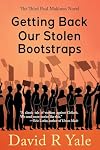
David R. Yale’s novel, Getting Back Our Stolen Bootstraps, has everything—murder, class warfare, struggle for justice, romance, and sex, including one of the most sensuous love scenes you’ll ever read.
With a cast of characters headed by 19-year-old Paul Mckinen, who is remarkably wise with leadership qualities beyond his age, Yale takes us into a Minnesota community called Shingle Creek during one winter month in 1972 where working-class people are struggling to improve their socioeconomic condition by taking on the age-old challenge often hurled at minorities and women to be more self-reliant: “Pull yourself up by your bootstraps.” Although dating back to the 19th century when it had a different meaning, this expression has come to be a metaphor for achieving success through your own individual efforts without external help. A totally impossible feat, as we all need the help of others in some form. So “bootstraps.” But what if the “bootstraps”—a living wage, safe, respectful workplace, equitable job opportunities, access to education and health insurance— have, in effect, been stolen and are controlled by corporate entities with union-busting tactics and laws designed to keep employees in a kind of serfdom to the corporate machine? Among these tactics is labeling workers’ struggle as communist, a political tactic still used by some politicians today. Above all, corporate bosses want to prevent their employees from organizing into unions and show more demanding rights. Thus the basic tension between blue collar workers and “fat cat” bosses, drives this masterfully crafted novel through a full-scale labor organizing campaign, a general strike, and fight for workers’ rights that includes violence, kidnapping, and lawsuits.
Yale writes with an authoritative command of the details of union organizing involving young people, middle-aged people, old people, lawyers, law enforcement, and media. With realistic dialogue and characterization, the author conveys workers’ voices and concerns, bringing the reader into these people’s lives and their lives into ours. The major characters as well as many minor ones display admirable cunning and basic human decency and compassion as they work together to achieve their goals.
With page-turning ferocity, Yale makes the workers’ struggles against corporate tyranny and criminality part of the reader’s experience on a visceral level. You feel for these people as if they were your friends and neighbors. As tensions build, the book’s pace quickens, increasing anticipation as to how it will all turn out for the workers, the community, and the two main characters’ love for each other. Given the current political tensions between today’s working classes and oligarchs, Yale’s book is especially timely. This is the third of Yale’s novels featuring Paul Makinen but it stands alone. show less
With a cast of characters headed by 19-year-old Paul Mckinen, who is remarkably wise with leadership qualities beyond his age, Yale takes us into a Minnesota community called Shingle Creek during one winter month in 1972 where working-class people are struggling to improve their socioeconomic condition by taking on the age-old challenge often hurled at minorities and women to be more self-reliant: “Pull yourself up by your bootstraps.” Although dating back to the 19th century when it had a different meaning, this expression has come to be a metaphor for achieving success through your own individual efforts without external help. A totally impossible feat, as we all need the help of others in some form. So “bootstraps.” But what if the “bootstraps”—a living wage, safe, respectful workplace, equitable job opportunities, access to education and health insurance— have, in effect, been stolen and are controlled by corporate entities with union-busting tactics and laws designed to keep employees in a kind of serfdom to the corporate machine? Among these tactics is labeling workers’ struggle as communist, a political tactic still used by some politicians today. Above all, corporate bosses want to prevent their employees from organizing into unions and show more demanding rights. Thus the basic tension between blue collar workers and “fat cat” bosses, drives this masterfully crafted novel through a full-scale labor organizing campaign, a general strike, and fight for workers’ rights that includes violence, kidnapping, and lawsuits.
Yale writes with an authoritative command of the details of union organizing involving young people, middle-aged people, old people, lawyers, law enforcement, and media. With realistic dialogue and characterization, the author conveys workers’ voices and concerns, bringing the reader into these people’s lives and their lives into ours. The major characters as well as many minor ones display admirable cunning and basic human decency and compassion as they work together to achieve their goals.
With page-turning ferocity, Yale makes the workers’ struggles against corporate tyranny and criminality part of the reader’s experience on a visceral level. You feel for these people as if they were your friends and neighbors. As tensions build, the book’s pace quickens, increasing anticipation as to how it will all turn out for the workers, the community, and the two main characters’ love for each other. Given the current political tensions between today’s working classes and oligarchs, Yale’s book is especially timely. This is the third of Yale’s novels featuring Paul Makinen but it stands alone. show less